

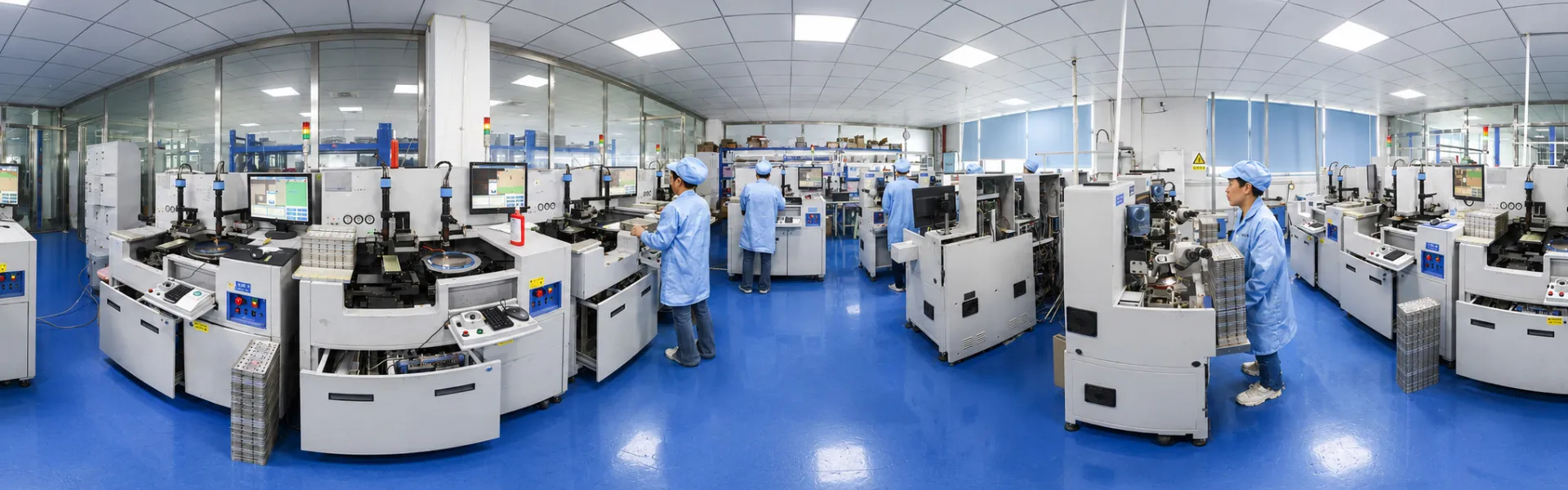
Automated chip packaging
Dec 12, 2025
Leave a message

Chip bonding is the most sensitive step in RFID inlay production. If the parameters at the bonding station drift even slightly, the pass rate at RF testing will reflect it immediately.
When the wafer arrives, the chips are still on blue tape. The equipment has an ejector pin pushing from below while a vacuum nozzle picks from above, taking chips off one by one. The ejector pin diameter is a bit smaller than the chip, around a fraction of a millimeter, and needs to push right at the center of the chip. If it pushes off-center, the chip tilts up and the nozzle can't grab it. Blue tape itself has different adhesion grades. Longer UV curing means weaker adhesion which makes picking easier, but chips can shift during transport. Every time we switch to a new batch of blue tape, we have to get a technician to verify the ejector height and ejection speed. Too fast and the chip flies off, too slow and it affects the cycle time.
Adhesive dispensing happens before bonding. ACA stands for Anisotropic Conductive Adhesive. It's an epoxy resin base with conductive particles inside. The conductive particles are usually plastic balls plated with nickel then gold, around 3 to 5 microns in diameter, dispersed in the adhesive. Before curing the particles are scattered. During compression they get squeezed flat between the chip bumps and antenna pads, creating conductivity. Areas not compressed still have dispersed particles and remain non-conductive. This stuff is expensive, several thousand yuan per kilogram, and imported brands like Hitachi and Sony cost even more. Dispensing volume must be controlled precisely. We use needle dispensing, depositing a fraction of a milligram each time. Too little and contact resistance goes up reducing read range, too much and it overflows connecting adjacent traces causing shorts. We had a new machine operator at our factory who turned up the dispensing air pressure, a whole batch went out and customers complained about shorts everywhere, cost us a lot in compensation. Some factories use stencil printing for the adhesive, faster but you have to change stencils when switching products, not economical for small batches with many SKUs.


After pressing down, heat cures the adhesive. Our equipment has a heating block in the bond head, and the platform below can also heat. Usually we set the top to around 170 degrees and the bottom to 150 or 160 degrees, so heat flows from both sides toward the middle for more even curing. Hold for 10 to 20 seconds depending on the adhesive type. ACA curing is essentially a crosslinking reaction of epoxy resin. If temperature or time isn't enough and crosslinking is incomplete, it will fail when doing 85 degree 85% humidity aging tests later. But if temperature is too high the PET substrate can't handle it either, it wrinkles and deforms. Pressure matters too. Too little and the conductive particles don't get squashed flat enough, contact area is insufficient and resistance is high. Too much and the plating on the particle surface cracks making contact worse, or the adhesive gets squeezed out and particle distribution becomes uneven. These three parameters are all interrelated. Change one and you have to adjust the others. The equipment stores dozens of parameter recipes for different chip and adhesive combinations, just load them when switching products.

After one chip is cured the web advances and the next antenna comes in to continue. Fast equipment can bond two or three chips per second. Mühlbauer imports are even faster, but our old equipment at the factory only does about one per second. Upgrading a line costs several million and the boss won't approve it. The rewind side also has tension control. Can't squeeze the chips out, but can't be too loose or the roll winds up messy.
For testing we do it inline. Right after bonding it passes through an RF reader. Units that don't read get inkjet marked, then rejected during slitting. Testing includes whether the chip responds, whether EPC can be read and written normally, and whether sensitivity is sufficient. Some factories do offline testing, finishing the whole roll first then running it through a test machine, requires more labor but less equipment investment. You need to hit above 99% pass rate to have profit margin. Below that you can't even cover labor and materials, not to mention customer complaints and rework costs.
Send Inquiry