


Different RFID Frequency Has Different Work Principle
Apr 16, 2026
Leave a message
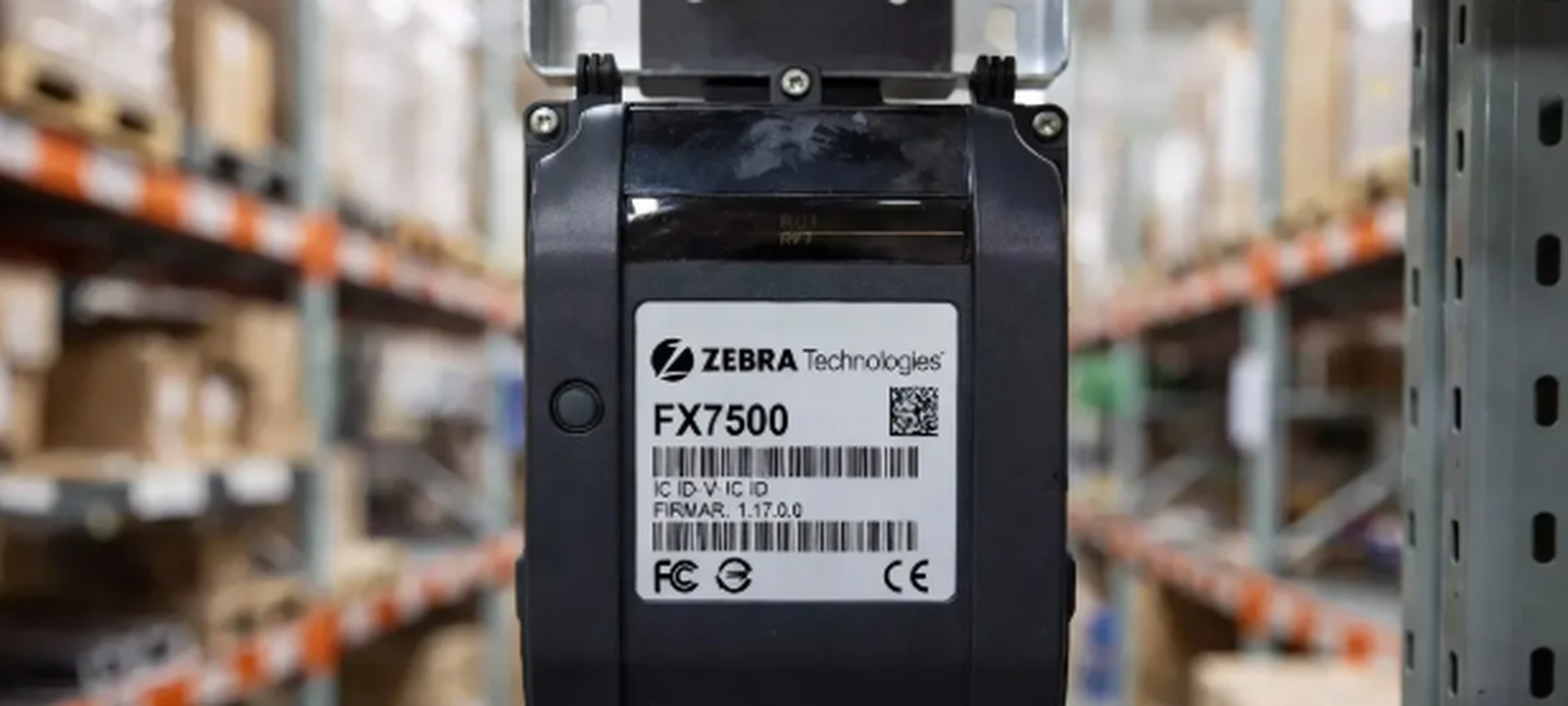
A German 3PL operator running 2.8 million parcels annually bought twelve Zebra FX7500 readers from a US distributor. Hardware cost: €31,000. When the system went live in their Munich facility, they discovered the readers shipped with FCC firmware-902-928 MHz-which is illegal to operate in the EU's 865-868 MHz band. Replacement readers with ETSI-compliant firmware, plus three months of project delay while the original units sat in customs limbo: another €16,000. Total loss from not checking RFID frequency regulations before signing the PO: €47,000.
This is the kind of failure that doesn't show up in spec sheets. Frequency selection mistakes account for a disproportionate share of RFID project failures, and most stem from treating frequency as a checkbox rather than understanding how radio physics actually behaves in specific environments.
How Inductive Coupling and Backscatter Create Different System Behaviors
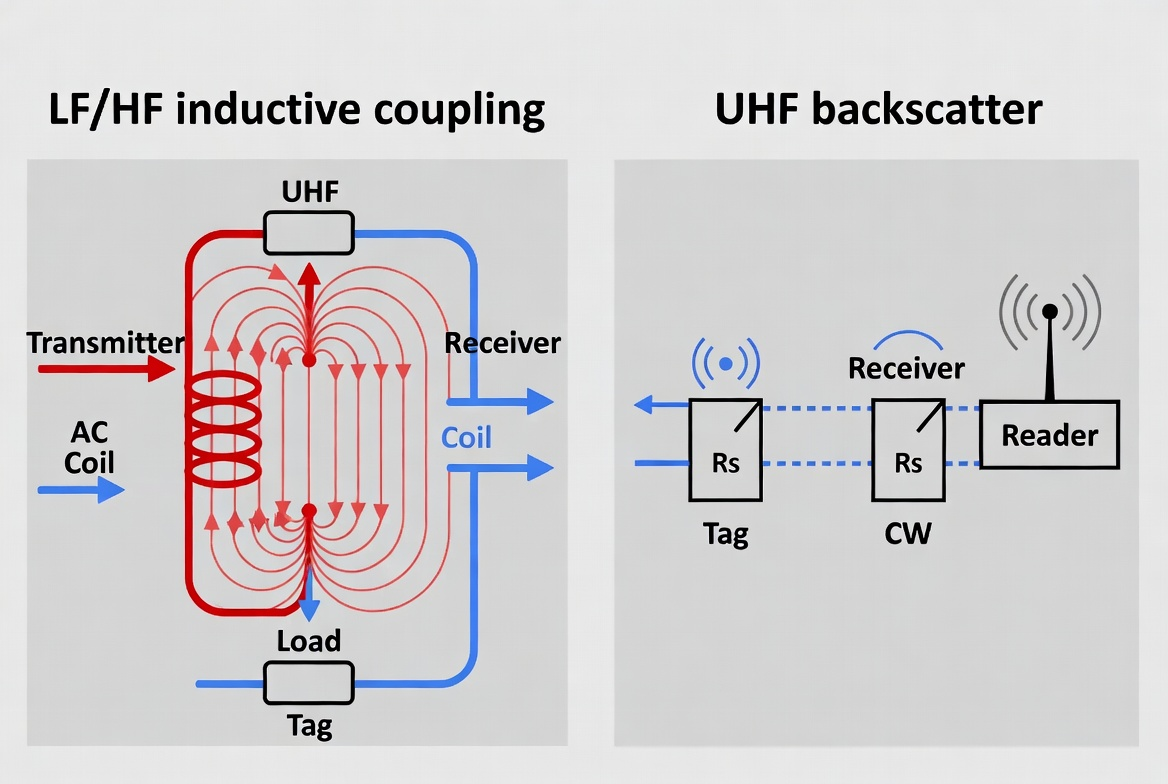
LF systems at 125-134 kHz and HF systems at 13.56 MHz transfer power through magnetic field induction. The reader's coil generates a field that directly induces current in the tag's antenna coil. This near-field coupling follows inverse-cube attenuation-signal strength drops as 1/d³-which is why these systems max out around one meter of read range regardless of power increases.
UHF at 860-960 MHz operates on backscatter. The reader broadcasts electromagnetic waves; the tag harvests energy and reflects a modulated signal back. Far-field propagation follows 1/d² attenuation, enabling passive read ranges of 10-15 meters with compliant reader output power.
When we spec UHF systems for warehouse environments, the physics advantage disappears fast in metal-heavy settings. We ran a controlled comparison in an automotive parts distribution center last year: same Impinj R700 reader, same antenna positioning, 30 dBm output. On plastic totes, standard Avery Dennison AD-229 inlays read consistently at 8.2 meters. On aluminum-alloy pallets, those same inlays dropped to 1.4 meters. Switching to Confidex Ironside on-metal tags recovered range to 4.1 meters-but at 4x the per-tag cost.
For projects where more than 30% of tagged assets are metal or contain significant liquid volume, the on-metal tag premium needs to be in the initial cost model. Discovering this after deployment means either accepting degraded performance or retagging everything.
Metal, Liquid, and the Multipath Problem in Real Facilities
Metal creates eddy currents that shift the tag antenna's resonant frequency away from the reader's operating band. This detuning effect makes a standard UHF inlay that reads perfectly on cardboard become invisible on a steel shelf. On-metal tags with spacing layers and modified antenna geometry solve this, but expect to pay $0.80-2.50 per tag versus $0.08-0.15 for standard inlays (2024 distributor pricing, 10K+ quantity).
Liquid interference follows a different mechanism. We measured this directly during a beverage logistics pilot: a single 500ml PET bottle positioned 10cm from the tag, reader at 2 meters distance, reduced effective read rate from 98% to 34% using standard dipole inlays at 915 MHz. LF systems operating at 134 kHz showed no measurable degradation in the same test setup-which is why animal implant chips use that band.
Multipath is the UHF-specific problem that rarely appears in vendor documentation. Electromagnetic waves bounce off metal racks, concrete floors, and equipment, arriving at the reader via multiple paths. When these paths interfere destructively, you get null zones where tags simply don't read.
We documented this during a cold storage installation outside Rotterdam: seven distinct null zones across a 400m² floor area, each 15-20cm wide based on grid scanning with a Zebra MC3390R handheld at 50cm resolution. Moving a pallet six inches brought tags back into communication. The fix required switching from linear-polarized to circular-polarized antennas, which reduced each antenna's effective coverage by roughly 30% and forced us to add two additional portal readers. Additional hardware and installation: €3,200. The lesson: if your facility has significant metal racking, budget for an RF site survey before finalizing reader placement. For facilities considering UHF RFID deployment on metal-heavy environments, this survey cost is minor compared to post-deployment troubleshooting.

Global Frequency Allocation and the Compliance Trap
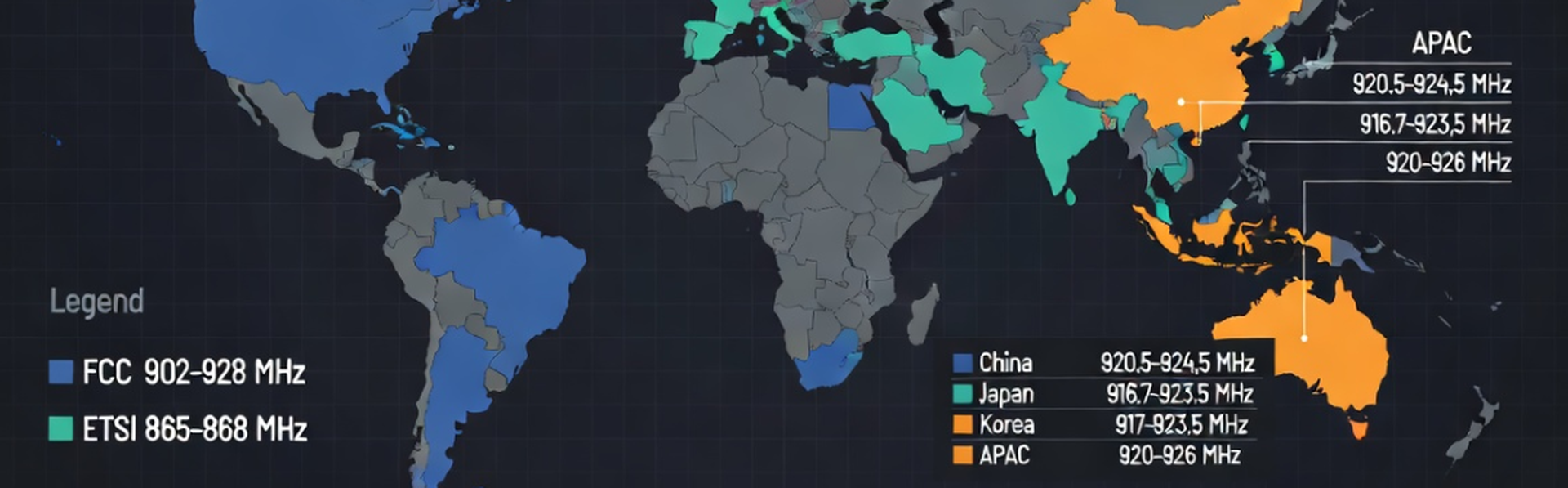
UHF spectrum allocation varies enough between regions that equipment purchased for one market may be illegal in another:
- North America: 902-928 MHz, up to 4W EIRP
- Europe: 865-868 MHz, 2W ERP maximum per ISO/IEC 18000-63
- Japan: 920 MHz band, standardized 2012
- China: 920-925 MHz
Tags themselves are generally region-agnostic-EPC Gen2 protocol hops across the full 860-960 MHz range. The compliance trap is in reader procurement. A Zebra FX9600 purchased with US firmware cannot legally operate in the EU without reflashing, and some reader models don't support field reconfiguration at all.
One of our clients, a consumer electronics manufacturer with DCs in Texas and Poland, learned this when their Poland facility received 8 readers that couldn't be reconfigured. The 15% they saved buying from a single US supplier cost them 200% in replacement hardware and a delayed go-live. For multi-region rollouts, specify regional firmware variants in the PO or work with distributors who stock EU/US/APAC versions separately.
HF at 13.56 MHz and LF at 125-134 kHz are globally harmonized with consistent power limits. For supply chain projects crossing three or more regulatory regions, this uniformity can outweigh the shorter read range, especially when the alternative is managing multiple reader SKUs.
Frequency Selection for Specific Deployment Scenarios
Here's the decision logic we actually use with clients:
The cost crossover calculation depends heavily on reader density. For a typical single-zone deployment (one fixed reader covering 20-30m² read zone, four antennas), HF system total cost equals or beats UHF below approximately 5,000 tags. Above 50,000 tags, UHF wins on total cost because tag price dominates. The 5K-50K range requires modeling with actual reader count and tag volume-a facility needing 12 read points will hit UHF cost advantage much sooner than one needing two.
Making the Procurement Decision
The question isn't which RFID frequency band is universally better. It's which electromagnetic coupling mechanism matches the specific constraints of the deployment environment, the regulatory jurisdictions involved, and the total project budget including infrastructure.
For straightforward applications-access control, payment, defined-path inventory-the choice is usually obvious within five minutes of reviewing site conditions. For complex deployments involving mixed materials, cross-border operations, or unusual read range requirements, the selection process benefits from an RF site survey and cost modeling before committing to hardware purchases.
FAQ
Q: What determines RFID read range-frequency or power?
A: Both, but frequency sets the ceiling. Near-field LF/HF systems are limited to about one meter regardless of power; UHF far-field extends with power up to regulatory limits. The real constraint in most deployments is environment, not either factor in isolation.
Q: Can UHF tags work on metal surfaces?
A: Standard inlays fail due to antenna detuning. On-metal tags work at 10-30x the cost per unit. Whether that premium makes sense depends on metal asset percentage-above 30%, it's usually unavoidable.
Q: Why do some countries require different UHF frequencies?
A: Historical spectrum allocation predates commercial RFID. The practical impact falls on reader procurement, not tags. Check firmware compatibility before signing POs for multi-region deployments.
Send Inquiry