


NFC Clothing: The Magical Use Of Tags Built Into Garments
May 08, 2026
Leave a message

From Hang Tag to Smart Tag: How NFC Gets Into Garments
NFC clothing integrates Near Field Communication chips directly into garments, hidden behind care labels, pressed into woven patches, or sewn as disc buttons into inner seams. When a consumer taps their smartphone within a few centimeters of the tag, the chip transmits stored data: authentication credentials, care instructions, brand content, or a link to a full digital product record. Unlike UHF RFID that powers bulk inventory scanning at warehouse distances, NFC operates at 13.56 MHz with an intentionally short read range, making each interaction deliberate and personal.
The distinction matters more than most first-time buyers realize. If your team already works with RFID in logistics or retail contexts, the shift to consumer-facing NFC garment tags introduces a different set of variables: washability, scan UX across phone models, and the digital experience that loads after the tap all become make-or-break factors. This article covers chip selection logic, wash-durability data from production testing, and the implementation mistakes that turn a $3-per-garment investment into a write-off.
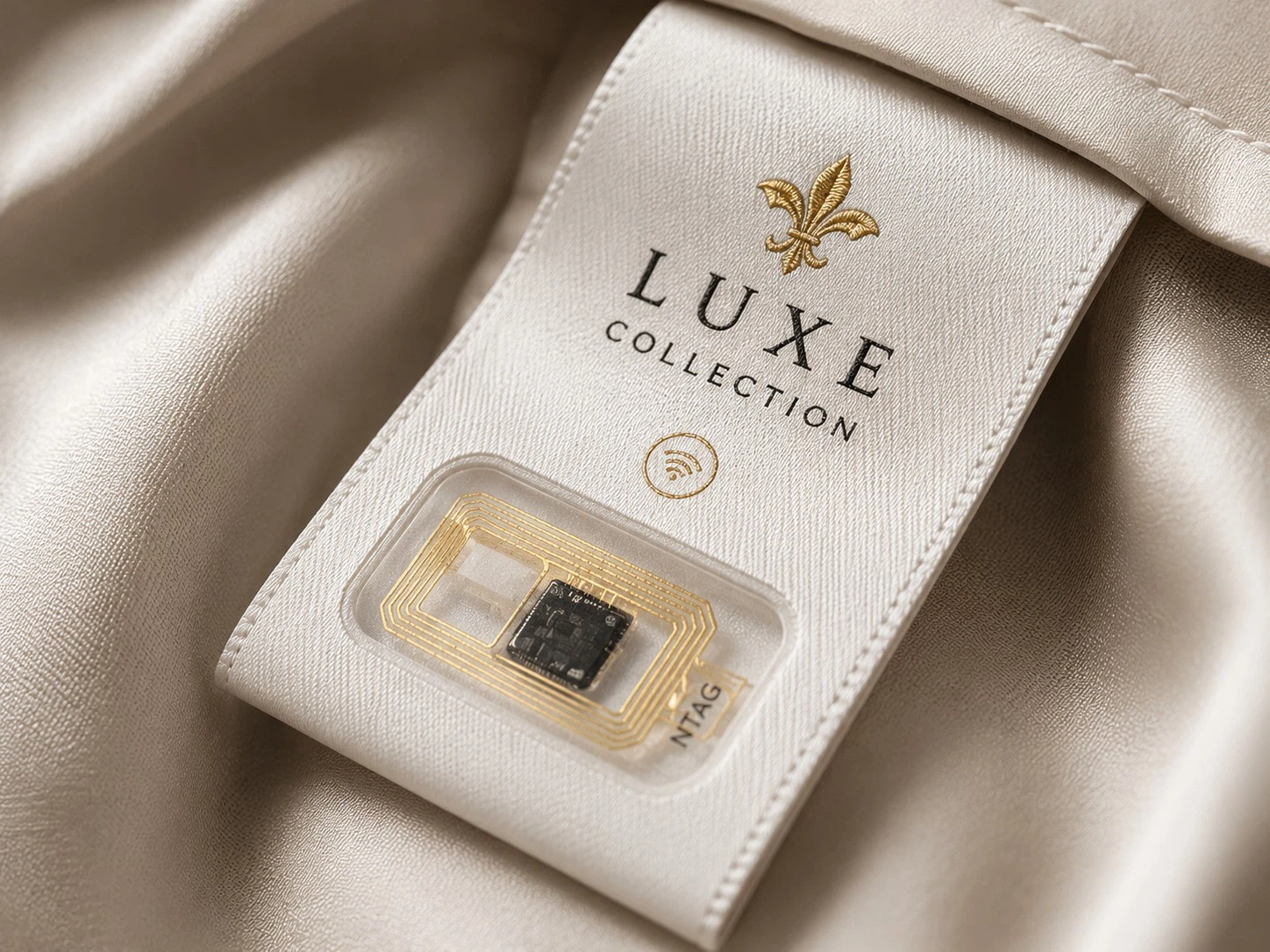
For apparel teams comparing NFC clothing tags with washable UHF textile labels, the first question should not be "which chip is more advanced?" but "who needs to read the garment, and at what distance?" NFC is ideal when one shopper taps one item with a phone to view authentication, care instructions, brand content, or a digital product record. UHF RFID is better when a laundry operator, warehouse team, or workwear supplier needs to identify dozens or hundreds of garments quickly without touching each label one by one.
This is why many clothing projects eventually split into two layers: a consumer-facing NFC apparel experience for storytelling or product verification, and a production-facing UHF garment tag for bulk reading, wash-cycle counting, sorting, and asset management. If the main goal is smartphone engagement, NFC should lead the project. If the main goal is workwear tracking, uniform rental, warehouse receiving, or industrial laundry control, a sew-in UHF textile label is usually the more practical hardware choice.
Where NFC Tags in the Fashion Industry Create Real Business Value
The fashion industry loses over $50 billion annually to counterfeit goods (AlpVision), with footwear, apparel, and leather products accounting for 51% of fake imports seized in the EU (Corsearch). NFC clothing anti-counterfeiting measures address this head-on. A customer scans the garment and receives instant verification linked to a secure cloud database, no app required.
Nike embedded NFC chips into NBA Connected Jerseys starting in 2017, unlocking real-time scores, player highlights, and limited-edition merchandise through a tap at the hem, pricing the Swingman version at $110 and the Authentic at $200 (NXP Semiconductors). What made this work wasn't the chip - it was the content pipeline behind it. Nike continuously tested whether the exclusive offers were compelling enough to drive repeat scans, treating the jersey as an ongoing engagement channel rather than a one-time gimmick.
Search interest around terms such as Berify NFC apparel platform, Berify NFC clothing authentication platform, and similar NFC apparel chips platform queries shows that many buyers are no longer looking for a loose tag alone. They are looking for a complete authentication workflow: a secure chip, serialized encoding, a cloud backend, a scan result page, and a way to manage product data after the garment leaves the factory.
That platform-first mindset is correct for luxury fashion, limited drops, collectible streetwear, and branded merchandise where one-to-one product verification matters. However, it should not be confused with RFID inventory infrastructure. A Berify-style NFC apparel authentication platform answers the question "is this item genuine when a user taps it?" A UHF textile RFID system answers a different question: "which garments are present in this bin, tunnel, laundry bag, stockroom, or return batch?" Both can exist in the same apparel operation, but they solve different business problems.

Bulgari took a different route in 2021 by equipping its full leather goods line with NFC, but designed a dual-layer experience: consumers see product origin and craftsmanship details, while store staff access entirely separate data: supply chain records, stock levels, authentication logs, all from the same tag (Glossy). The business problem Bulgari solved wasn't just counterfeiting; it was the fact that store associates previously had no way to verify a returned item's authenticity at the point of intake.
Industrial uniform and workwear management is another application gaining traction. A Korean consortium recently committed over $11 million to develop NFC-enabled smart uniforms for 600,000 hospitality and corporate garments (Market Reports World, 2024). The value proposition isn't location tracking - it's wash-cycle tracking data in managed uniform programs. For managed uniform programs, knowing that a chef's jacket has completed 150 of its rated 200 washes determines replacement timing far more accurately than calendar-based schedules.
In workwear NFC discussions, buyers often use "NFC" as a general shorthand for smart clothing identification, but industrial uniform projects usually need something different from phone tapping. Hotels, hospitals, factories, rental laundries, and fire-resistant workwear suppliers often require batch reading at receiving points, sewing lines, washing tunnels, and packing stations. In those cases, a slim UHF RFID clothing tag sewn behind the care label or into a seam can support faster counting than NFC because the operator does not need to touch each garment with a smartphone.
For this type of project, the tag format matters as much as the chip. A soft UHF textile label can be designed for direct sewing, heat-resistant placement, repeated bending, and laundry exposure, while still carrying a unique EPC number for backend matching. This makes it suitable for bulk uniform tracking, linen sorting, garment rental, and apparel warehouse operations where the business value comes from speed and visibility rather than consumer interaction.
Secondhand and circular fashion presents a fourth use case. When an NFC tag carries a tamper-proof ownership record that survives the garment's full lifecycle, resale platforms can verify authenticity without the physical inspection step that most luxury consignment services currently require.
And then there's the application that's shifting NFC from "nice to have" to "compliance requirement" for any brand exporting to Europe.
The EU Digital Product Passport Changes the Calculus Entirely
The EU's Ecodesign for Sustainable Products Regulation (ESPR), which entered into force in July 2024, mandates that most products sold in the EU carry a Digital Product Passport, a structured digital record covering materials, manufacturing, environmental impact, and recyclability (Intertek). The textile-specific delegated act is expected around 2027, with mandatory enforcement no earlier than 2028.
Every DPP requires a physical "data carrier" attached to the product. QR codes, RFID, and NFC all qualify under the regulation. But there's a practical distinction most compliance summaries skip entirely. QR codes typically live on removable hang tags or paper labels, which fails the requirement that the carrier remain with the garment through its full lifecycle, from production to secondhand resale to end-of-life recycling. NFC tags pressed into care labels or bonded behind woven patches survive the entire journey, which is precisely what the regulation envisions.
For brands selling into EU markets, the NFC clothing compliance preparation window is now. The most defensible first step doesn't require waiting for the delegated act to finalize. Start assigning unique serial identifiers to every SKU today. The underlying architecture of pointing a unique physical ID to a cloud record will not change regardless of the final delegated act. What the regulation will still define is which data fields are mandatory and in what format, but your serialization infrastructure is the same either way.
Can UHF RFID Be Used Together With NFC for Apparel Digital Product Passports?
Yes. A Digital Product Passport does not force every brand to use only one data carrier. NFC, QR codes, and RFID can all point to a digital record, but their best use cases are different. NFC is easier for consumers because a phone tap can open a product page immediately. UHF RFID is stronger for operational environments where garments need to be counted in bulk before the product reaches the customer or after it returns through resale, rental, repair, or recycling channels.
For brands planning a long-term apparel data architecture, a practical setup is to use one cloud product record and connect it to different physical identifiers. The consumer may interact with an NFC clothing tag on a premium item, while the warehouse or laundry team reads a UHF textile label linked to the same garment ID. This approach avoids treating DPP as a marketing page only and turns it into a lifecycle system covering production, logistics, ownership, maintenance, and end-of-life handling.
NTAG213 vs. NTAG424: The Chip Decision Most Brands Get Wrong
| Dimension | NTAG213 | NTAG424 DNA |
|---|---|---|
| Usable Memory | 144 bytes | 256 bytes |
| Data Retention | 10 years | 50 years |
| Anti-Cloning | None - static data, copyable | Yes - dynamic encrypted code per scan |
| Typical Cost at Scale | ~$0.10–$0.15 depending on order volume and form factor | ~$0.25–$0.40 depending on order volume and form factor |
| Typical Use | Marketing URLs, loyalty, care info | Authentication, anti-counterfeiting, DPP |
The table gives you the specs. But the actual selection logic depends on variables the table can't capture: your garment's price point, your counterfeiting exposure, and how long you need the data to persist.
A common misunderstanding in NFC apparel chips backend platform planning is assuming that the chip alone creates security. It does not. For authentication, the chip, encoding method, key management, URL structure, backend verification logic, and scan response page all have to work together. Without that backend layer, even a garment with a visible "smart tag" message may only provide a basic link, not reliable anti-counterfeiting.
For apparel brands that do not need consumer-facing authentication, the backend requirement is different. A UHF garment tracking system usually focuses on EPC-to-SKU mapping, wash-count history, location events, return status, and exception handling. That is why an NFC fashion project and a UHF workwear tracking project should not use the same technical brief, even if both are described internally as "smart clothing tags."
Here's our clearest industry stance: if your brief says "NFC-powered anti-counterfeiting" but your spec sheet says NTAG213, you have a marketing story, not a security solution. The NTAG213 outputs the same URL on every scan. Anyone with a $30 NFC writer replicates it in seconds. The NTAG424 generates a unique cryptographic code each time it's tapped, making cloned tags immediately detectable by the backend.
That said, not every garment needs NTAG424. The decision splits cleanly across three scenarios. For fast-fashion brands embedding styling tips and care video links, NTAG213 at roughly ten cents per unit is the rational choice; no one counterfeits a $25 t-shirt's tap experience. For luxury goods where NFC anti-counterfeiting directly protects margin, the NTAG424's cryptographic verification pays for itself on the first intercepted fake. And for DPP compliance where data integrity across decades of garment life matters, choose the NTAG424; its 50-year retention alone settles the argument.
Five Deployment Mistakes We Keep Seeing
Chip-Mismatch
"Using a standard chip for security-critical applications like anti-counterfeiting."
Universal Strategy
"Applying the same inexpensive flexible label across evening wear and daily-wash workwear without durability testing."
Empty Experiences
"Neglecting the digital experience behind the tap, linking to only a homepage rather than engaging content."
Metallic Interference
"metallic thread in woven brand labels interfering with NFC signal propagation due to lack of separation."
Local Data Storage
"Treating the tag as a local data store rather than a cloud pointer, limiting content updates and analytics."
The first NFC clothing deployment error is the chip-mismatch problem described above, using a standard chip for security-critical applications. The second is applying a universal tag strategy across an entire product line. In our own wash-cycle testing on garment-spec flexible tags, standard labels showed significant read-rate degradation after 20 industrial cycles at 60°C, while PPS disc tags rated for industrial workwear laundry maintained consistent performance past 180 washes at the same temperature. Brands that deploy the same inexpensive label across evening wear and daily-wash workwear discover the failure rate through customer complaints, not through pre-production testing.
Third - the one mistake that turns a $3 per-garment NFC integration into a sunk cost - neglecting the digital experience behind the tap. Fashion media has documented multiple cases where brands linked tags to nothing more than their homepage, creating an interaction that actively disappoints rather than engages. The physical tag is the trigger. The value lives entirely in what loads on the customer's screen afterward.
Fourth, metallic thread in woven brand labels interferes with NFC signal propagation. This is a basic RF engineering constraint that gets overlooked when the label design team and the tag integration team work in silos. If your brand label uses metallic yarns, the tag placement must account for adequate separation. Otherwise read distance collapses to near zero.
Fifth, treating the tag as a local data store rather than a cloud pointer. Even the largest NFC chips hold less text than a single paragraph. The robust approach uses the tag as a unique identifier pointing to a cloud-based record, enabling content updates, scan analytics, and lifecycle data accumulation without ever re-touching the physical garment. Implementing this architecture correctly, however, requires selecting a backend that supports dynamic URL resolution. The specific platform choice depends on your existing tech stack and whether you need multi-region hosting for DPP compliance.
The content strategy should also match the garment category. For NFC home jeans or casual denim, the tap experience may focus on fit guidance, repair instructions, resale registration, or styling content. For NFC-enabled dresses, limited fashion capsules, and premium apparel drops, the same tap can open authenticity status, collection stories, event access, or owner-only rewards. Spanish-speaking markets may even search for terms such as NFC ropa, but the underlying expectation is the same: the label should make the garment easier to trust, use, maintain, or resell.
By contrast, a UHF label hidden inside workwear or rental apparel is usually not designed for the consumer to scan. Its value appears in the background: faster check-in, fewer lost garments, better wash-cycle records, and cleaner reconciliation between physical stock and the management system. Mixing these two user journeys is one reason smart apparel pilots fail; the buyer expects NFC-style engagement while the operation actually needs RFID-style throughput.
From Prototype to Production: A Realistic Path
At Syntek, we've supported NFC garment integration projects across three continents since 2006, from luxury handbag authentication runs to 200,000-piece workwear programs for industrial laundry operators. One pattern holds across all of them: the bottleneck is almost never the tag hardware.
A typical NFC clothing implementation follows five phases: defining the use case and selecting the appropriate chip family, designing the post-scan digital experience, ordering sample tags for physical testing on your actual fabrics and wash conditions, running a limited production pilot, then scaling to full production with a manufacturing partner whose chip bonding and encoding happens in-line, not as a separate outsourced step.

When the project brief points toward bulk garment identification rather than phone-based interaction, the production path changes. A UHF textile RFID label should be sampled on the real fabric, sewn or bonded in the intended position, then tested through bending, washing, drying, ironing exposure, and reader-gate scenarios before mass production. The goal is not only to confirm that the tag can still be read, but also to confirm that its placement does not irritate the wearer, deform the garment, or reduce read performance when many items are stacked together.
For apparel factories, uniform suppliers, and laundry operators, Syntek can support custom UHF clothing tag projects based on size, encoding format, printing requirement, sewing position, and expected wash environment. This is different from supplying a complete consumer NFC authentication platform, but it is often the more useful route for workwear, linen, rental garments, and industrial textile management where the return on investment comes from operational accuracy.
"In workwear programs using industrial-grade PPS disc tags, we've confirmed above 95% read rates after 180 wash cycles at 60°C, the temperature threshold where most garment-spec flexible tags begin failing."
If you're scoping NFC tag options for a garment project, start with your use case and fabric composition, not a volume quote. Which of the five deployment variables above is most likely to trip up your project? That's the question worth answering before anything ships. Explore our NFC and RFID product range to find the right starting point, or reach out to our applications team for a sample kit matched to your textile and use case.
FAQ
Q: Can NFC clothing tags survive machine washing?
A: Garment-specification NFC tags are engineered for domestic wash and dry cycles, with industrial-grade variants rated for 200+ washes at sustained read performance above 98%.
Q: Is NFC or QR better for clothing labels?
A: NFC tags bonded into fabric stay with the garment permanently, while QR codes on hang tags or printed labels degrade or are removed. That gap is decisive for lifecycle applications like Digital Product Passports and resale authentication.
Q: Do consumers need to download an app to scan NFC clothing tags?
A: No. All modern iPhones and Android smartphones read NFC natively; the scan opens a URL directly in the default browser without any app installation.
Q: Are NFC clothing tags and UHF RFID clothing tags the same thing?
A: No. NFC clothing tags are designed for close-range smartphone interaction, such as product authentication, care instructions, brand content, or Digital Product Passport access. UHF RFID clothing tags are designed for longer-range bulk reading in warehouses, laundries, rental programs, and workwear management. NFC is better for one-to-one consumer engagement; UHF is better for fast operational identification.
Q: When should an apparel brand choose UHF instead of NFC?
A: Choose UHF when the main task is counting, sorting, tracking, or managing many garments at once. A UHF textile label is usually more suitable for uniforms, hotel linen, hospital garments, industrial laundry, apparel warehouses, and rental clothing. Choose NFC when the main task is letting a customer tap one garment with a smartphone for authentication or digital content.
Q: Is a Berify-style NFC apparel authentication platform the same as an RFID garment tracking system?
A: No. A Berify-style NFC apparel authentication platform focuses on consumer verification through a smartphone tap, usually using a secure chip and backend scan logic. An RFID garment tracking system focuses on operational visibility, such as reading many UHF textile labels at once during receiving, washing, packing, inventory checks, or returns. Some apparel brands may use both, but they should be planned as separate layers.
Send Inquiry