


Custom RFID Cards for Hotels: A Total Cost of Ownership Playbook for Chains and Resorts
Jun 12, 2026
Leave a message

The Per-Card Price Is the Smallest Number That Matters
A single 200-room property cycles through roughly 12,000 plastic access cards in a year, and across the global industry that adds up to something on the order of 1,300 tons of embedded plastic going to landfill annually (USPTO). Worldwide, hotel key card output is measured in the billions of units a year. When you buy custom RFID cards for a portfolio of twenty or fifty properties on a rolling five-year refresh, that per-card quote becomes the least important figure in the whole calculation.
That is the part most cost guides get backwards. They open with a price-per-card table and stop there. But the quote on a purchase order and the money that actually leaves your accounts over five years are two different numbers, and the gap between them is where procurement budgets quietly bleed. Below is the model we use when a chain asks us to help them rebuild that math from the card up.
What Actually Drives the Five-Year Card Bill
The real cost of a custom RFID card program has five moving parts, and only the first one shows up on the invoice. There is the unit price. There is the replacement rate, which is set by how long a card physically survives in a guest's pocket. There is compatibility rework, the cost of cards that arrive and don't talk to a property's locks. There is the distributor markup layered on top of factory cost. And there is the disposal and compliance cost, which used to be zero and increasingly is not.
Independent cost guides put the "hidden" portion of a hotel access program (software licensing, training, retrofitting, replacements) at somewhere between 10 and 20 percent of the annual security budget on top of the visible hardware spend. For a 150-room property, that hidden tier runs to something like $5,000–$10,000 a year in recurring software licensing and staff training alone.
That is money committed before a single card is reordered. For the RFID card itself, the hidden-to-visible ratio is even more lopsided, because the unit price is so small that a single point of replacement-rate or a single batch of incompatible stock swamps any saving you negotiated on the quote.
A buyer who optimizes only the per-card price is optimizing the one variable that barely matters. Which of the five actually dominates your bill is not universal, either; it swings on how many lock generations and acquired properties sit inside your group, which is exactly where the real decision starts.

Chip Choice Is a Five-Year Decision, Not a Spec-Sheet Line
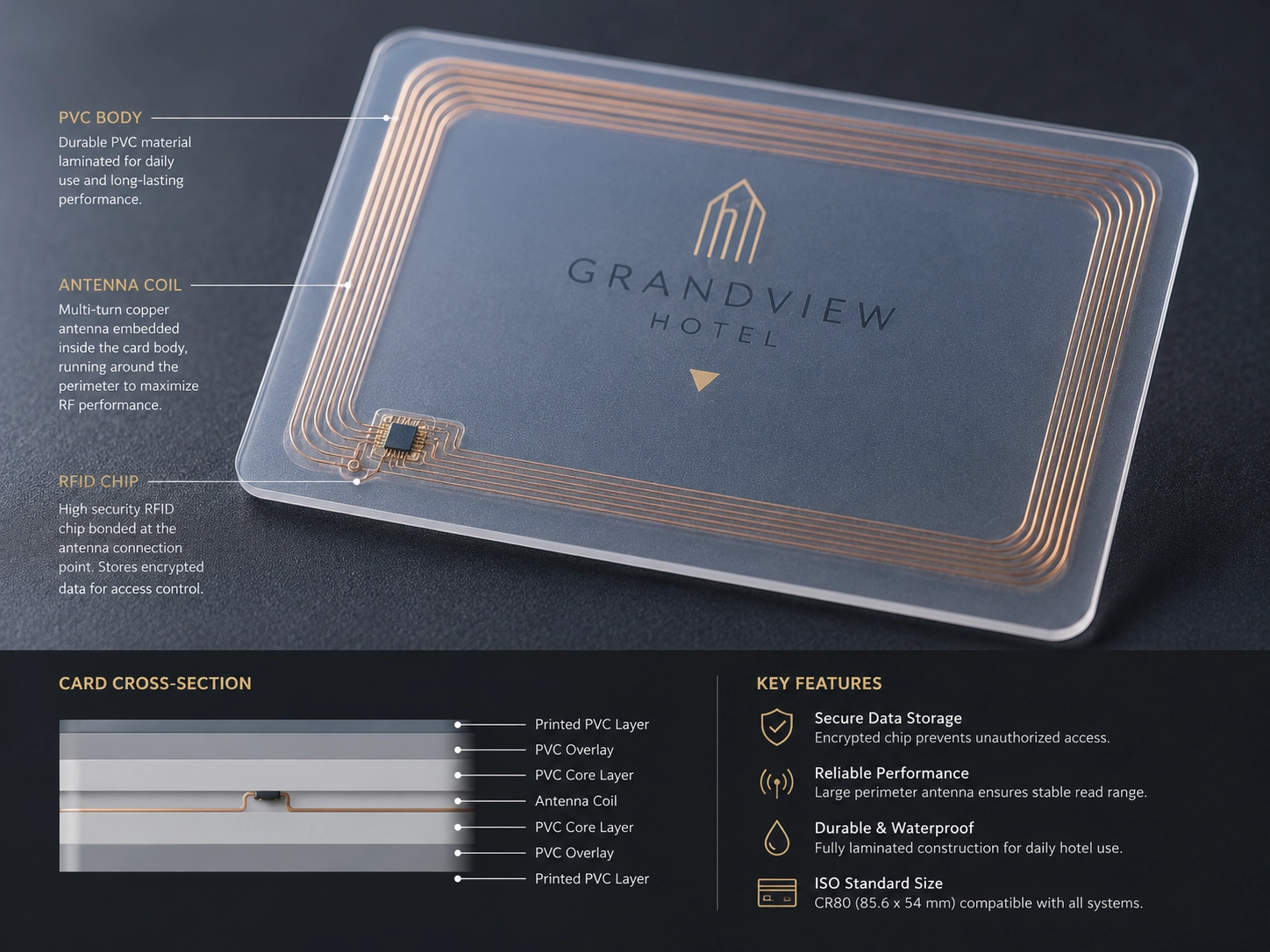
The single largest lever on a custom RFID key card program is the chip, and it is usually treated as an afterthought. The three families that cover almost all hospitality work are MIFARE Classic 1K, MIFARE Ultralight C, and MIFARE DESFire. They are not interchangeable, and the cheapest of them is frequently the most expensive decision you can make.
MIFARE Classic and its low-cost compatibles are the budget default. They are also the family with the longest history of being cloned with commodity hardware, and the problem is no longer academic. In 2024, security researchers disclosed a hardware backdoor in a widely used "MIFARE compatible" variant, the kind of low-cost chip that ends up in cheap hotel stock.
The flaw lets a card be copied in minutes with nothing more than brief physical proximity (SecurityWeek). That is the uncomfortable thing a manufacturer should say out loud: if you spec the cheapest chip to shave a few cents, you may be buying a security liability that costs far more than you saved the first time a guest-room incident turns into a liability claim.
DESFire sits at the other end. With AES-128 mutual authentication and high-grade certification, it resists the card-only cloning attacks that hollowed out the Classic family, at a higher but still modest per-unit cost. Ultralight C is the practical middle for many limited-use, disposable-stay scenarios. The point for a buyer is not "always buy the most secure chip." It is that the chip decision locks in your security exposure, your card lifespan, and your unit price simultaneously, for the full life of the deployment, which is exactly why it belongs in the procurement conversation and not on an engineer's bench at the end. For a structured way to map a chip family to an access-control use case, our breakdown of card types and security tiers in access control walks through the trade-offs property by property.
The Compatibility Trap That Scraps Bulk Orders
Here is the variable that wrecks more bulk orders than price ever does: the chip inside a hotel card is bound to the lock brand it has to open, and a custom RFID hotel key card that is perfect for one property can be landfill at the property next door. The binding is tight and brand-specific.
| Lock platform | Typical card technology | Security posture |
|---|---|---|
| ASSA ABLOY Vingcard | DESFire EV1/EV2/EV3 (newer lines moving to Ultralight AES) | High, encrypted |
| Dormakaba Saflok | MIFARE Ultralight C | Moderate–high |
| Onity (legacy) | MIFARE Classic EV1 | Moderate |
| SALTO XS4 | DESFire EV3 | High, encrypted |
The trap is volume. A buyer rolling out a single SKU across a group assumes one card opens every door, then discovers that a tray of cards built for one platform is explicitly incompatible with another. Branded chain stock will often state, in black and white, that it will not work with Vingcard, Salto, or magstripe systems. The locks themselves are a moving target too: Vingcard's newer lines have shifted toward a more secure MIFARE Ultralight AES credential with replay protection (Hotel Online), which means stock you over-ordered for an older generation can be stranded before it is ever issued.
The matrix above looks tidy on paper. It stops looking tidy the moment you audit a real twenty-property portfolio and find three lock generations, two acquisitions running someone else's hardware, and a wing that was retrofitted out of cycle. That audit, not the quote, is the thing that determines whether your bulk RFID card order is an asset or a write-off. Before a single SKU goes to production, the safe move is to match hotel key cards to each property's exact lock spec and confirm it on real hardware first. The audit is always cheaper than the write-off.
Why Durability, Not the Datasheet, Sets Your Replacement Rate
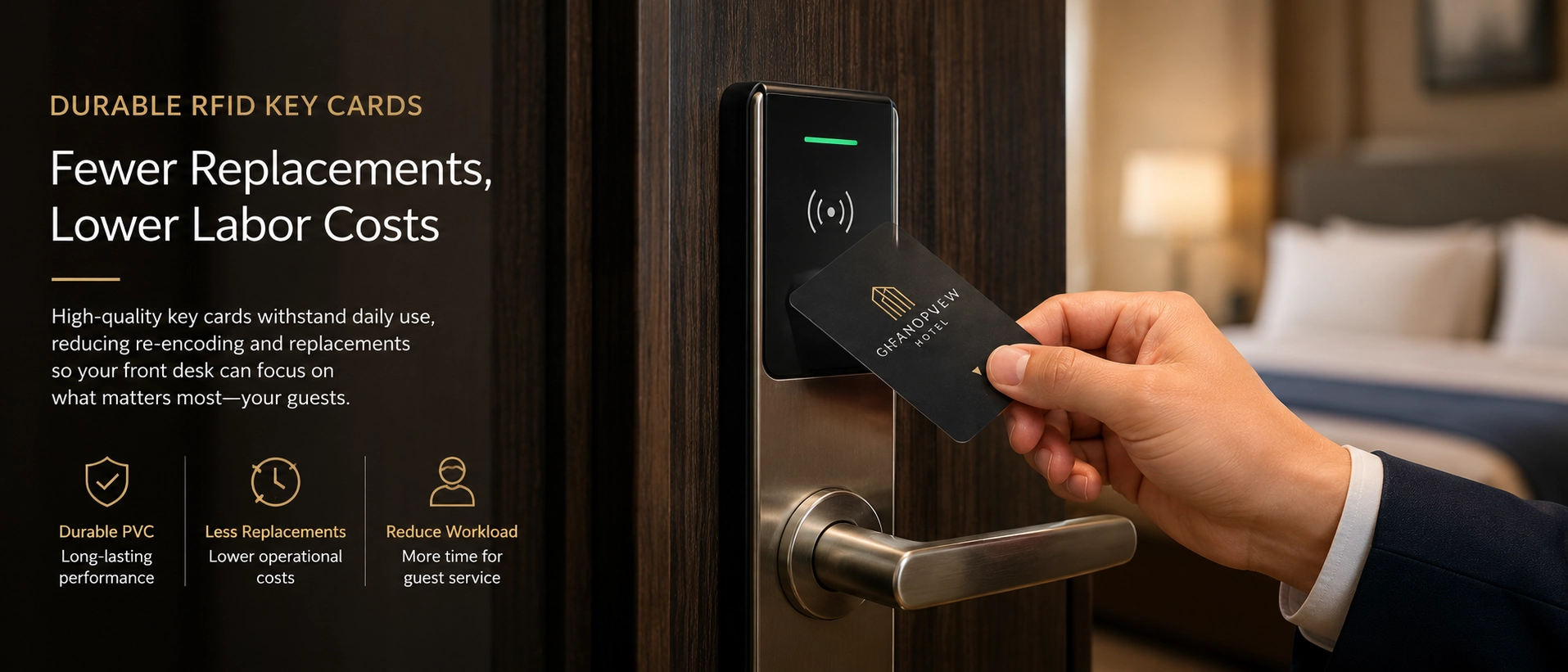
Replacement rate is the quiet multiplier on every other number, and it is governed by physics, not marketing copy. A MIFARE chip is rated for roughly 100,000 read/write cycles (per NXP's published MIFARE specifications); at a realistic 10 to 20 taps per day, that translates to about two to three years of continuous service before the chip itself is the limit. In practice the RFID card body fails first, and that is where material choice earns or loses money.
This is where the magstripe-versus-RFID comparison stops being a feature debate and becomes a budget one, and it is where the honest version of the math matters most. Take a 150-room property keeping roughly 400 cards in active rotation, and put magnetic-stripe stock head to head with custom RFID cards. Magnetic-stripe stock at around $0.15 a card looks unbeatable on the quote, and at that scale the raw card-material difference is genuinely modest: even at a 30–50 percent annual attrition rate (consistent with industry installer data on card field-failure rates), the reprint cost of a few hundred magstripe cards is a small line.
The crossover does not live in the card price. It lives at the front desk. Magstripe cards demagnetize against phones and wallets, and every card that dies mid-stay is a 10-to-15-minute resolution at the desk: a re-encode, a walk to the room, sometimes a comped delay. Run that across a 400-card rotation failing at 40 percent a year and you are buying dozens of guest-service incidents annually that the card itself caused. Durable RFID hotel key cards run higher per unit but attrite in the 10–15 percent range and survive three to seven years, so the reorder cadence stretches out and the desk-time bleed mostly stops. The higher unit price is a labor-and-reliability saving, not a card saving, and the busier the property runs, the faster that crossover arrives.
Substrate is the lever inside that math, and it is the one judgment a procurement manager should make on purpose. For select-service and limited-service properties, grade-A laminated PVC is the right spec: its survival advantage over thin economy stock outweighs the small unit premium, and the brand cue does not need to be premium. For luxury and resort flags, a wood-core or premium card earns its higher cost back twice: once through extended cycle life, and once through a brand signal the guest physically holds. Spending up on the card body is justified by the room rate it sits next to, not by the card in isolation.
That discipline travels across every hotel consumable that gets reissued. In linen programs the same failure-rate modeling, rated cycles divided by real daily use, decides whether an RFID laundry tag buy is a two-year or a five-year commitment, and the cards on your front desk obey the identical arithmetic.
Sustainability Is a Cost Lever, Not Just an ESG Checkbox
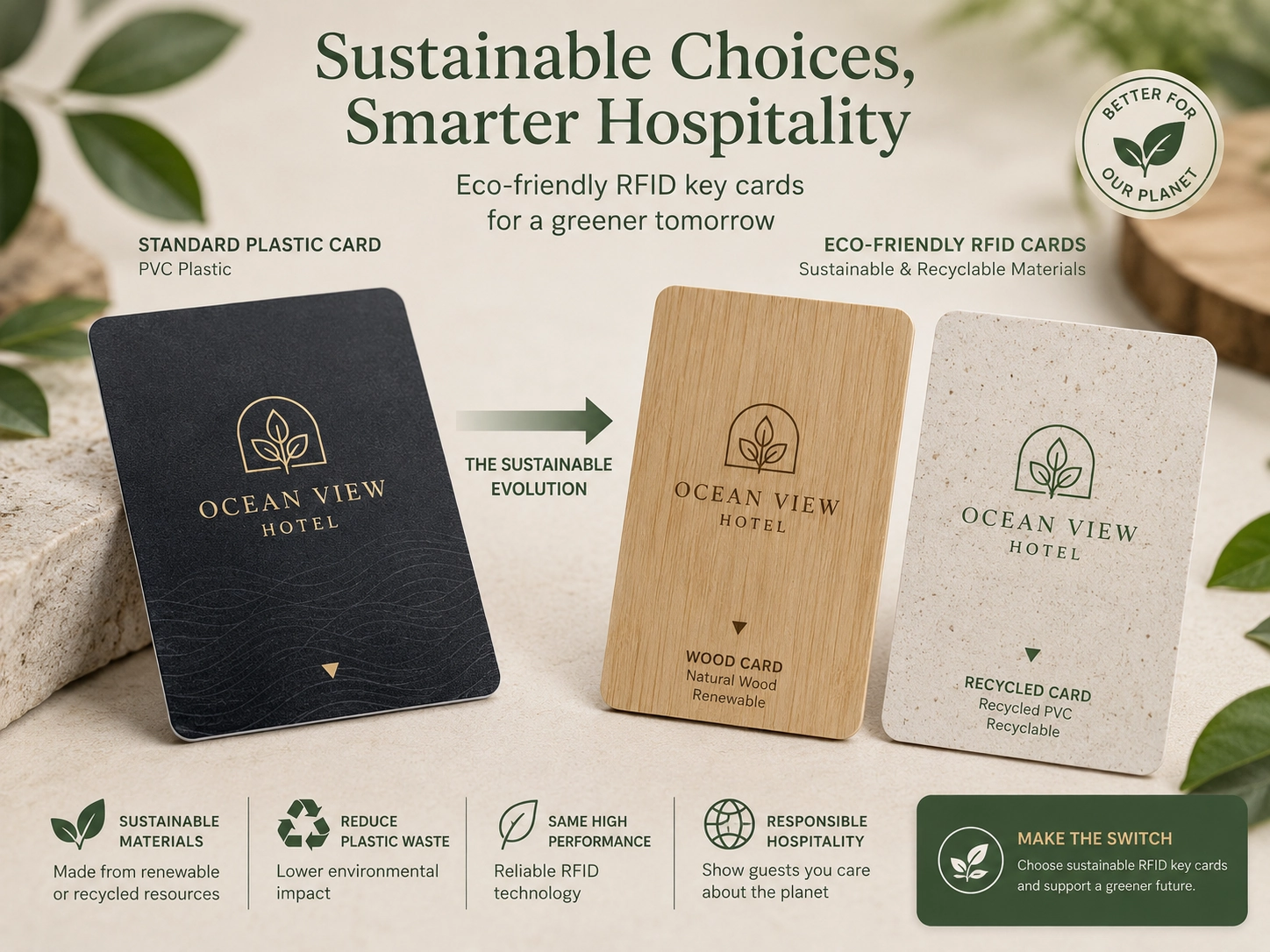
For a long time the environmental angle was a brand story. Regulation has turned it into a line item. For hotel groups now scoping eco-friendly RFID hotel key cards as a procurement line rather than a marketing flourish, the disposal side of the ledger is where the new cost has appeared.
Standard PVC hotel RFID cards are a composite of plastic, antenna, inks, and chip, which makes them effectively unrecyclable through municipal streams and turns disposal into a real, growing cost, particularly under tightening EU corporate sustainability reporting rules that increasingly ask hotel groups to account for exactly this kind of waste.
The good news for procurement is that the lowest-friction option is also close to the cheapest to adopt. Recycled PVC made from 50 to 100 percent reclaimed material meets the same ISO 7810 CR80 standard as virgin stock, prints identically, and performs identically on the reader, so an eco-friendly custom RFID card can be a near drop-in swap. The caveat a buyer needs in writing: rPVC typically carries a 5–15 percent unit premium over virgin stock (a typical range across rPVC stock meeting ISO 7810), and an "eco" label on its own proves nothing. ISO 14021 self-declarations are common and frequently unaudited, so ask the manufacturer for a stated post-consumer content figure you can hold them to, not a green logo.
The deeper trap to flag for any buyer is that a lot of "eco" cards are a paper shell wrapped around a plastic core, which delivers the marketing claim and none of the recyclability. The procurement-grade question is not "does it look green," it is "what is the core substrate and can it actually be recycled or composted." Treat an unverified sustainability claim the way you would treat an unverified compatibility claim: as a risk, not a feature.
Where the Markup Hides: Factory-Direct vs Distributor
"Every layer between the production line and your front desk adds a margin, and on a low-unit-cost, high-volume item like a key card, those layers compound fast."
Volume is the largest single discount lever. Bulk orders past the thousand-unit mark routinely unlock 15 to 40 percent off the single-unit price (a discount band consistent across published industry cost benchmarks), and a chain consolidating spend across sister properties has far more of that leverage than any single hotel buying alone. The question is who captures it. When you source bulk custom RFID cards through a distributor, the volume break exists, but a share of it is absorbed before the price reaches you. Put a number on it: a DESFire EV3 card a distributor lists at roughly $2.00–$3.00 commonly lands under $1.00 ex-factory at 5,000 units direct. The gap between those two figures is not service value; it is inventory carrying cost and reseller margin.
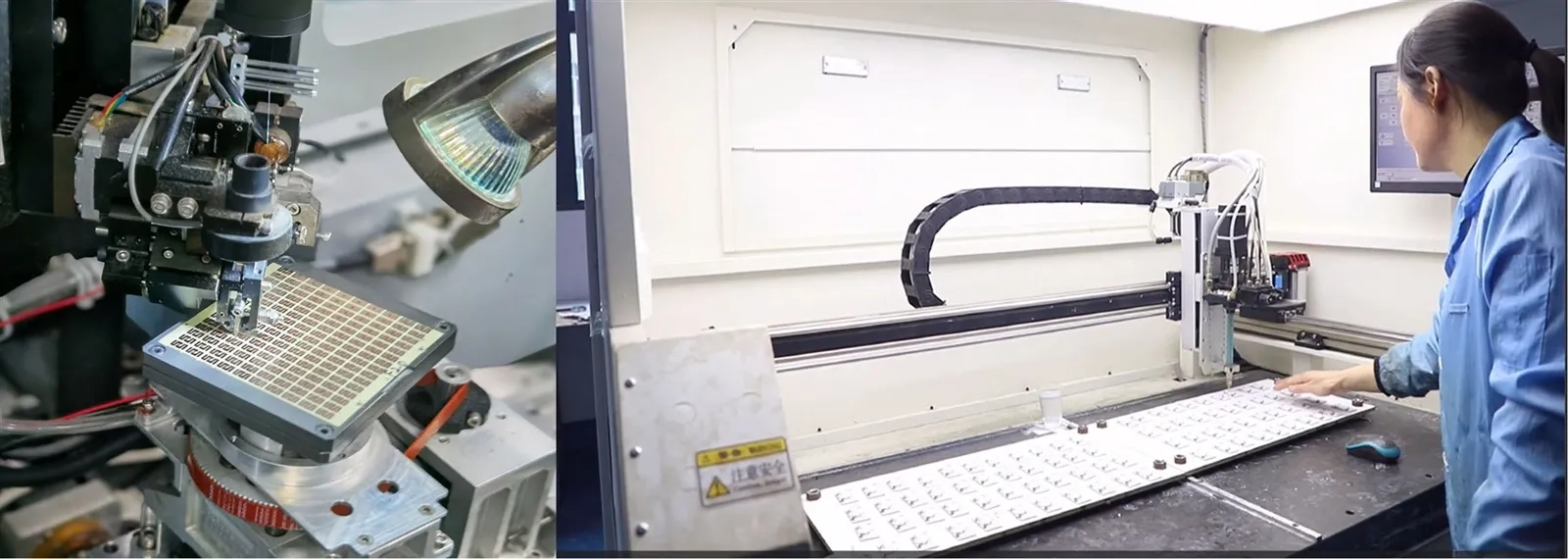
Buying custom RFID cards direct from the factory collapses those layers, and it does something a reseller structurally cannot: it lets the people who bond the chip, wind the antenna, and laminate the card (on ISO 9001-certified, CE-compliant lines) answer your compatibility and lifespan questions before the order runs, not after it ships. Lead time tightens too when there is no intermediary inventory step. The catch a reseller will not advertise is that the markup you are paying often buys you nothing you could not get closer to the source, with better technical access on top.
A Portfolio Sourcing Checklist for Multi-Property Groups
Pulling the levers above together, a multi-property sourcing decision for custom RFID cards comes down to a short, ordered set of judgments, each one worth more to the five-year bill than the unit price you will spend the most time negotiating:
Audit lock generations before you spec a single card.
Group properties by lock platform and generation first; the compatibility matrix, not the catalog, defines your SKUs.
Set a single chip baseline wherever the locks allow it.
A consolidated DESFire or Ultralight baseline simplifies reordering and raises your volume leverage, provided every grouped property's hardware supports it.
Write the replacement rate into the contract, not just the price.
Specify substrate grade and an expected card lifespan; a slightly higher unit price with a documented failure rate beats a cheaper card that reorders twice as often.
Add a recycled-content and core-material clause.
Require the actual substrate to be named and verifiable rather than implied by an eco label; the exact wording that holds a supplier to a stated post-consumer figure is worth getting from the manufacturer directly before you sign.
Sample at production scale before the bulk run.
Test real cards against the real locks at one property per platform; which specific failure modes to check for on that sample run is the part your manufacturer should walk you through, because a stranded bulk order costs far more than a sample tray.
Run those five in order and the per-card price ends up being the last and easiest thing you decide.
FAQ
Q: How much do custom RFID hotel key cards cost in bulk?
A: At volumes past a thousand units the per-card price is competitive across reputable suppliers, but the sourcing channel moves it more than the print run does: a DESFire EV3 card that sells through distribution at roughly $2–$3 commonly lands under $1 ex-factory at 5,000 units. Chip choice and substrate then move the real five-year cost far more than that starting number does.
Q: Which is cheaper over five years, magstripe or RFID hotel key cards?
A: Magstripe is cheaper up front but fails at a much higher annual rate, so over a five-year horizon RFID stock usually delivers the lower total cost of ownership.
Q: Are all hotel key cards compatible with every lock brand?
A: No. The chip is bound to the lock platform, so a card built for Vingcard, Saflok, Onity, or SALTO will often not work on the others, which makes a lock audit the first step in any bulk order.
Q: How long do RFID hotel key cards last before replacement?
A: Around two to three years of daily use is the chip's rated limit, but card material and handling usually set the real replacement rate first.
Why Hotels Source Custom RFID Cards From Syntek
We have manufactured RFID cards since 2006, in-house from chip bonding and antenna winding through lamination and printing, under ISO 9001 and CE certification, which is why we can answer a compatibility or lifespan question before your order runs rather than after it ships. That same chip-to-card control has delivered multi-million-unit annual card programs for system integrators and national projects across Europe and Central Asia, the kind of volume that proves a line can hold tolerance and frequency consistency across an entire portfolio.
It also means we can run a multi-property rollout without minimum-order lock-in: if a portfolio spans eight lock platforms, we run eight SKUs in parallel rather than in sequence. If you are scoping a multi-property program, the most useful next step is a free sample run against your own locks before any bulk commitment. Start with our custom hotel and access card range and send us your lock specs.
Send Inquiry