

RFID Laundry Tags for Linen Management: A Procurement & Selection Guide
May 21, 2026
Leave a message

The Hidden Cost of Poor Linen Management
A mid-size hotel replaces roughly a quarter of its linen inventory every year, not because the sheets wear out, but because they vanish. Towels walk off with guests, flat sheets get misrouted between properties, and duvet covers disappear somewhere between the loading dock and the laundry truck. Industry surveys put the annual linen loss rate at 20–30% of total stock (HID Global). For a 300-room hotel carrying $200K in textile assets, that translates to $40,000–$60,000 in replacement costs alone - every single year.
Hospitals face the same arithmetic with higher stakes. Surgical gowns, isolation drapes, and patient linens must be tracked not just for cost control but for infection compliance. When a facility cannot prove that a specific garment was laundered, sterilized, and returned within the correct cycle window, the problem stops being a budget line and becomes a regulatory exposure. For any hospital evaluating an rfid laundry solution for linen compliance, the cost of inaction is measured in audit findings, not just replacement invoices.

How Textile RFID Laundry Tags Actually Work
The operating principle is straightforward. A small RFID inlay (antenna plus microchip) is enclosed inside a textile patch or sealed pouch and attached to each linen item by sewing or heat-sealing. When tagged items pass through or near a UHF reader (mounted inside a laundry tunnel, on a conveyor belt, or at a doorway), the reader energizes the tag wirelessly and captures its unique ID. No line-of-sight needed, no individual scanning. A single tunnel reader running at conveyor speed can register an entire cart of 200 mixed items in under four seconds - the equivalent of what a barcode team would spend 15–20 minutes doing by hand.
An rfid laundry management system reconciles each scan against expected inventory in real time, automatically updating stock levels, flagging overdue items, and logging each textile's cumulative wash count for lifecycle forecasting. The middleware pushes this data into whatever ERP, PMS, or laundry platform the facility runs - Opera, SAP, Kannegiesser - so operations staff work from a single source of truth instead of spreadsheets.

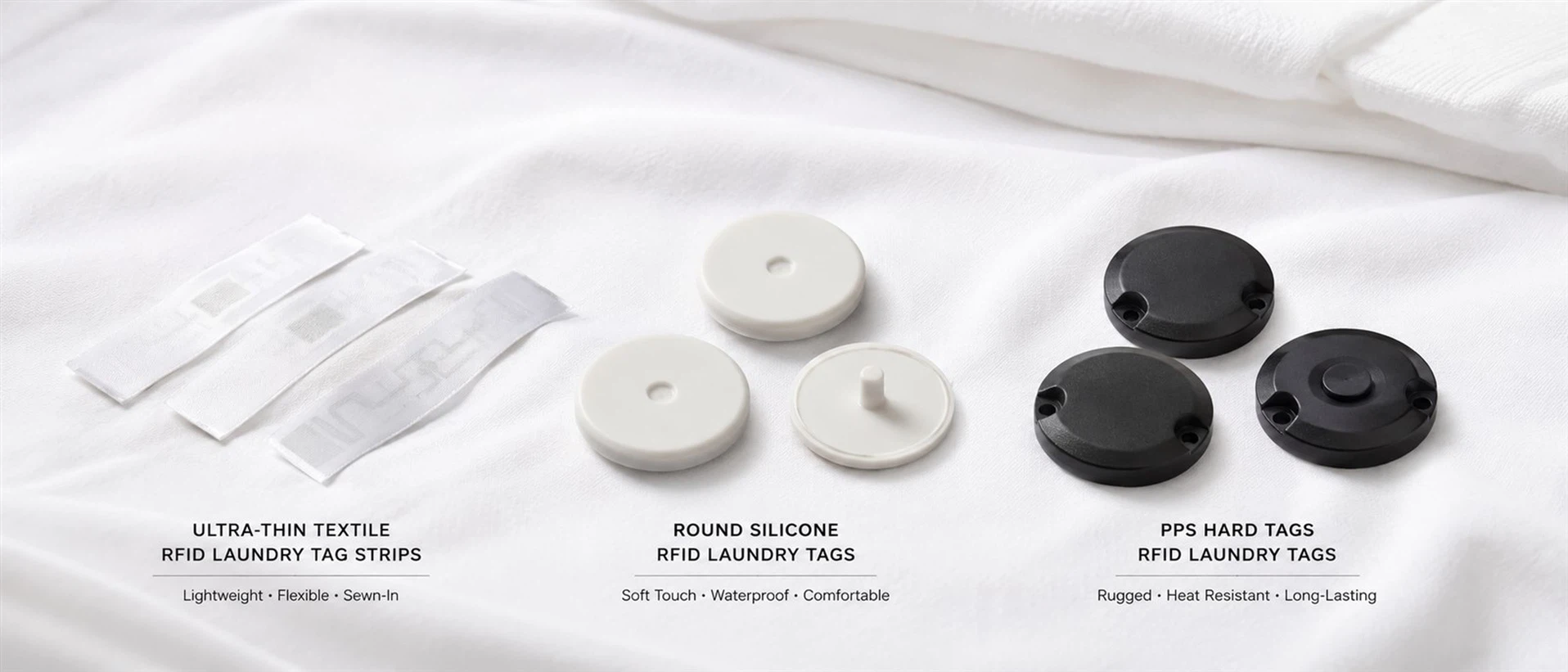
Textile Fabric Tags vs. Silicone vs. PPS: Which RFID Laundry Tag Type Fits Your Operation
This is where most buying guides stay vague. Vendors tend to showcase whichever tag type they manufacture, without acknowledging that no single form factor works across all textile categories. Here is a direct comparison of the three dominant rfid laundry tag types used in commercial linen operations:
| Dimension | Textile Fabric Tag | Silicone Encapsulated Tag | PPS / Hard-Shell Tag |
|---|---|---|---|
| Typical size | 70 × 15 × 1.4 mm | 24 × 15 × 3.5 mm (button) or 70 × 15 × 3 mm (strip) | 20–36 mm diameter, 3–5 mm thick |
| Flexibility | Bends with fabric; virtually imperceptible when sewn in | Semi-flexible; noticeable in thin textiles | Rigid; creates a hard spot |
| Rated wash cycles | 200+ (industrial conditions) | 200–300 | 200+ |
| Max temperature tolerance | Up to 200 °C (pressing/calendering) | Up to 180 °C | Up to 230 °C |
| Best-fit textile types | Flat linen (sheets, pillowcases, tablecloths), uniforms, patient gowns | Towels, thick-weave items, workwear | Mats, heavy-duty workwear, items requiring metal-mount |
| Attachment method | Sew-in or heat-seal | Sew-in (pouch/pocket) | Sew-in or rivet |
| Unit cost range | $0.80–$2.00 | $1.50–$3.00 | $2.00–$4.50 |
The read-rate performance gap between these three form factors widens significantly under real tunnel-washer conditions - lab spec sheets alone don't capture this. We publish actual wash-survival curves from our production testing on request; contact our team if you want the data for your specific washing parameters before committing to a tag type.
"In our production testing, antenna trace delamination under repeated high-G spin-extraction - not temperature - is the single most common failure mode in budget textile rfid laundry tags. The epoxy bonding between antenna and substrate starts to micro-crack around cycle 80–100 under 60-bar extraction, long before the chip itself degrades."
Where textile fabric tags win - and where they don't. For high-volume flat-linen programs (hotels, hospitals, table-linen rental), textile tags are the default for a reason: they're thin enough to pass through calendar ironers without snagging, soft enough that guests and patients never feel them, and cost-effective at scale. But the standard "200+ wash cycles" claim deserves scrutiny. That number is tested under controlled lab conditions, typically a 75 °C wash, moderate spin, line dry. In a real tunnel washer running at 60-bar extraction pressure followed by 180 °C tumble drying, antenna fatigue accumulates faster. In our production testing, antenna trace delamination under repeated high-G spin-extraction - not temperature - is the single most common failure mode in budget textile rfid laundry tags. The epoxy bonding between antenna and substrate starts to micro-crack around cycle 80–100 under 60-bar extraction, long before the chip itself degrades. Well-made tags with reinforced lamination processes survive 200+ cycles under those same conditions. The gap between a $0.80 tag and a $1.50 tag is often the difference between a project that pays for itself and one that requires a costly mid-life re-tagging.
Silicone tags earn their place on towels and thick terry-cloth items where the tag needs to survive more mechanical stress during wringing and tumbling. PPS hard tags belong on industrial mats, heavy coveralls, or anywhere the tag might contact metal fixtures. Their rigid shell shields the antenna from detuning.
Key Specifications That Drive Procurement Decisions
Several technical parameters beyond form factor separate a successful rfid laundry system deployment from an expensive pilot that never scales.
Frequency
UHF (860–960 MHz, governed by ISO 18000-6C / EPC Gen2) is the industry standard for commercial laundry. It delivers read ranges of 5 meters or more and supports the bulk scanning speeds that make RFID operationally viable. HF/NFC at 13.56 MHz has a niche. Some luxury hotels are experimenting with dual-frequency tags that let guests tap a towel with their phone to see a hygiene certificate, but standalone HF is too short-range for laundry logistics.
Chip selection
NXP UCODE 7 and UCODE 8 dominate the textile-tag segment for washable rfid tags in commercial laundry applications. Impinj Monza R6 and M750 are common in silicone and PPS formats. For standard flat-linen textile tags running through a post-dryer read tunnel, UCODE 7 provides sufficient sensitivity. If your tunnel reader must handle mixed loads that include items still damp from extraction, a common reality in high-throughput operations, specify UCODE 8 or Impinj M750. The additional 3–4 dB sensitivity margin compensates for water-induced signal attenuation and is worth the $0.15–0.20 per-tag premium at this scale.
OEKO-TEX certification
This is emerging as a quiet gatekeeping criterion. HID Global's LinTRAK tags carry OEKO-TEX STANDARD 100 certification, proving the tag materials are skin-safe (HID Global). Hospital procurement offices and high-end hotel groups are beginning to require this certification as a line item in RFQs. But here is a variable most suppliers won't bring up first: the majority of small-to-mid-size tag manufacturers do not yet hold this certification, which narrows the qualified supplier pool far more than many buyers realize when they draft their specifications.
Cost-per-use, not cost-per-tag
A textile tag priced at $1.50 and rated for 200 washes works out to $0.0075 per use. A cheaper tag at $0.80 that fails at 130 cycles costs $0.0062 per use, but triggers a re-tagging labor cycle that adds $0.50–$1.00 per item in handling. This math only holds if the tag actually survives its rated cycle count. The failure cases we break down below show how quickly the economics reverse when tags fall short.
Real-World ROI: What the Numbers Look Like After Deployment
Industry benchmarks suggest rfid laundry tracking for hotel and hospital linen can reduce textile losses by 15–25% and cut manual labor costs by 30–40% (CPC Group). Those ranges are credible, but the spread is wide because results depend heavily on implementation quality. The following two deployments have verifiable third-party data and illustrate what drives the difference:
Hospital Israelita Albert Einstein (São Paulo)
This 750-bed hospital tagged 158,000 textile items (sheets, towels, pillowcases, patient gowns) and reported $300,000 in annual savings (RFIDCard.com). The savings broke down across two main buckets: reduced replacement purchasing (the hospital could prove which items were in circulation vs. genuinely lost, instead of re-ordering on assumption) and optimized wash-cycle scheduling (lifecycle data showed which items still had useful life left, preventing premature retirement). This is the deployment where rfid linen tracking in hospital settings shows its fastest compliance payoff. The same data that drives cost savings also satisfies infection-control audit requirements.
Royal Jersey Laundry (London)
Serving multiple five-star hotels, this commercial rfid laundry tracking deployment used UHF tags with a real-time platform to monitor soiled-linen intake, clean-linen dispatch, per-client inventory levels, and garment aging data. The value was less about loss prevention and more about service-level visibility: the laundry could prove to hotel clients exactly how many items were processed each day and flag linens approaching end-of-life before quality degraded (RFID Journal).
Most facilities recoup their full rfid laundry investment within 12–18 months. That timeline assumes a clean implementation. The actual conditions under which these numbers hold are more specific than the benchmarks suggest, and the next section covers what goes wrong when process design doesn't match the technology.
Five Implementation Mistakes That Kill RFID Laundry Projects
Roughly one in four rfid laundry implementation projects underperforms expectations, and the root cause is almost never the technology itself. It's process design.
1. Scanning wet textiles
UHF radio waves at 860–960 MHz are absorbed by water. If your read point is positioned between the washer and the dryer, you will see miss rates spike - sometimes above 30%. The fix is simple (scan after drying, not before), but it requires rethinking the physical workflow, and many integrators default to the most "convenient" reader placement without testing under wet conditions first (Lowry Solutions).
2. Inconsistent tag placement
When tags are sewn into different positions on the same garment type, corner hem on one batch, center seam on the next, read performance varies unpredictably across items. One industry analysis found that 25% of underperforming rfid laundry system installations traced back to inconsistent or poorly documented tag placement protocols (AssetPulse). We've seen this at a hotel chain client where three different sewing contractors attached tags in three different positions on identical pillowcases. The operations team spent two weeks troubleshooting "reader issues" before anyone checked the tag locations. Standardize the placement location per SKU, document it with photos, and audit incoming tagged inventory before it enters circulation.
3. Skipping the pilot phase
A 2–4 week pilot with 500–1,000 tagged items costs little and reveals almost everything that will go wrong at scale: reader blind spots, software integration gaps, staff resistance, tag survival under your specific wash chemistry. A hospital client came to us after deploying 40,000 tags across three buildings without a pilot. Within 60 days, they discovered that their particular alkaline detergent concentrate was accelerating antenna corrosion on the tag model they'd chosen. A $12,000 pilot would have caught it; instead, the full re-tagging cost exceeded $35,000.
4. Choosing a tag based on price alone
This is the most expensive mistake in the category, not because of the tag cost itself, but because of the re-tagging labor that follows. A mid-size hospital that has to re-tag 20,000 items at $0.75 per item in handling labor has just spent $15,000 fixing a procurement decision, enough to have bought the better tag for the entire original order. We've had clients arrive at this exact realization after six months with a budget tag that started failing 50 washes early. The staff loses confidence in the data, reverts to manual counts, and the entire system investment sits idle.
5. Neglecting reader maintenance
Fixed RFID readers are installed and forgotten. We've seen this most often in tunnel installations where readers are mounted above conveyor lines. Belt vibration gradually shifts the antenna orientation, and by month eight the coverage cone has drifted enough to create a predictable blind spot on items passing through one side of the aperture. One quarterly check with a calibration target catches it in minutes; without that check, operations staff assume the tags are failing when the real problem is a reader that nobody has touched since commissioning day.
From Pilot to Full Deployment: A Practical Roadmap
Start with a needs assessment that does three things: quantifies your current loss rate, maps the labor hours spent on manual counting per shift, and identifies the specific textile categories causing the most pain. This scoping step determines tag type, read-point architecture, and rfid laundry management system integration requirements before any hardware is ordered.
Next, request samples from your shortlisted suppliers, and test them under your actual wash conditions, not the supplier's lab conditions. Run tagged items through your tunnel washers, your dryers, your ironers, at your standard chemical concentrations and temperatures. Track read rates over 30–50 cycles. Any supplier unwilling to provide free evaluation samples is telling you something about their confidence in the product.
Once a tag and reader configuration are validated in pilot, integrate with your existing systems. Most modern rfid laundry tracking platforms offer API connectors or middleware for common PMS platforms (Opera, Mitel), ERP systems (SAP, Oracle), and laundry-specific platforms (Kannegiesser, JENSEN). Budget 2–4 weeks for integration and staff training before full rollout.
After go-live, schedule a 90-day review to audit read accuracy, tag survival rates, and actual versus projected labor savings. This checkpoint catches drift early, before small problems compound into the kind of systemic issues that cause operations teams to abandon the system.
Before signing with any supplier, make sure you can answer these five questions about them - and that their answers are specific, not vague:
- What is your tag's tested survival rate (not rated, but tested) under tunnel-washer conditions at 60+ bar extraction pressure?
- Can you provide OEKO-TEX STANDARD 100 certification or equivalent skin-safety documentation for the tag materials?
- What is your MOQ for custom tag dimensions, and can you deliver evaluation samples within 2 weeks?
- Do you manufacture the inlay in-house or source it from a third-party converter, and what is your batch-to-batch read-sensitivity variance?
- What post-deployment support do you offer if tag failure rates exceed the agreed threshold within the first 12 months? A credible manufacturer should commit to replacement support if documented failure exceeds 5% before cycle 100. Any vague "case-by-case" answer at this stage is a red flag.
What a credible answer to each of these questions looks like, and the red flags that indicate a trading company rather than a manufacturer, is something we walk through in every sample consultation.
Why the Tag Manufacturer Matters More Than You Think
An RFID laundry tag is not a commodity. The antenna geometry, bonding method between inlay and textile substrate, and encapsulation process all affect how the tag performs after 100, 150, or 200 wash cycles. Two tags using the same NXP UCODE 7 chip can deliver dramatically different field results depending on manufacturing consistency. The actual conditions that separate a reliable tag from a failing one involve antenna lamination pressure, adhesive cure profiles, and quality-control tolerances that never appear on a product datasheet.
This is where working with a dedicated rfid laundry tag manufacturer - rather than a trading company or general-purpose tag reseller - changes the risk profile of a deployment. A manufacturer with in-house antenna design, lamination, and testing capability can customize tag dimensions, adjust antenna tuning for specific textile densities, and maintain batch-to-batch consistency across large orders. When your deployment involves 50,000 or 500,000 tags, that consistency is the difference between a system that works at scale and one that degrades unpredictably.
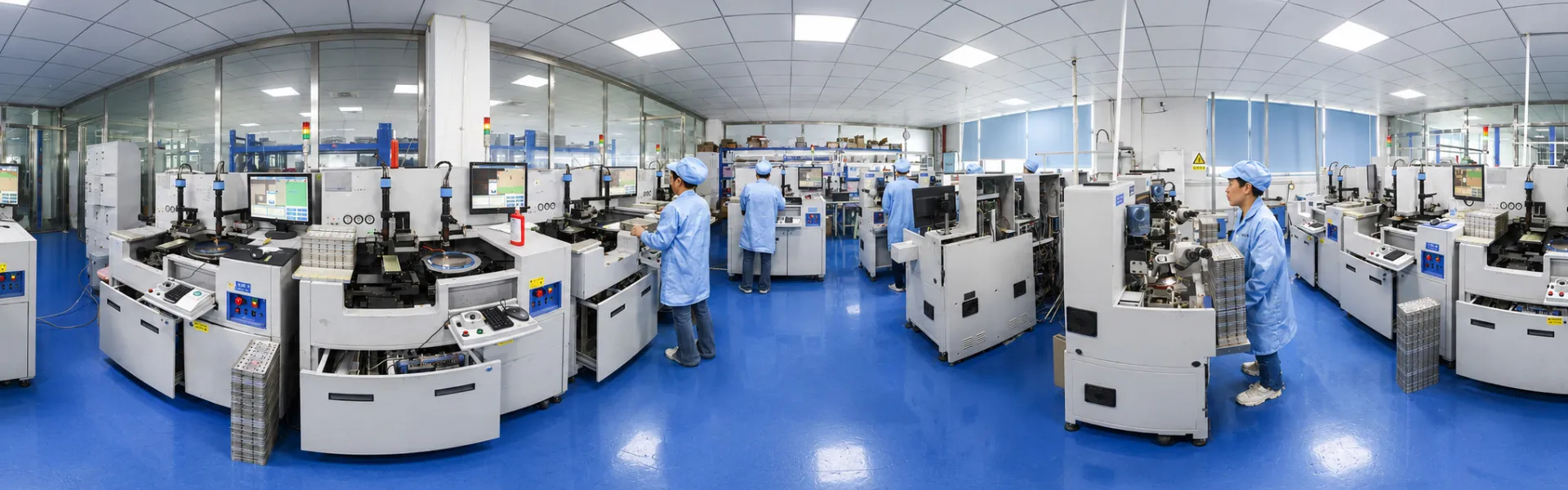
Syntek has operated in the RFID manufacturing space since 2006, with five production lines and over 200 employees in Hunan, China. Annual export volume exceeds $3 million across Europe, the Americas, Russia, South Asia, and the Middle East. For teams evaluating textile RFID tags for laundry programs, we provide free samples for wash-cycle testing - because a tag should prove itself in your facility before you commit to a purchase order. Delamination onset varies with your wash chemistry and extraction configuration; our engineering team models expected survival curves before you finalize a tag spec.
For a broader view of how RFID technology integrates across the garment and textile management chain, our application guide on RFID in clothing management covers warehouse, retail, and lifecycle tracking use cases beyond the laundry-specific scope of this article.
Frequently Asked Questions
Q: How many wash cycles can a textile fabric RFID laundry tag survive?
A: Industrial-grade textile tags are rated for 200+ cycles under standard conditions (75 °C wash, moderate spin, 180 °C dry). Actual lifespan varies with wash chemistry, extraction pressure, and mechanical stress. Always validate with a pilot under your specific conditions.
Q: What does an RFID laundry tag actually cost per use?
A: At a unit price of $1.50 and a 200-cycle lifespan, the per-use cost is under $0.01. Most facilities achieve full ROI within 12–18 months through combined linen-loss reduction and labor savings.
Q: UHF or HF - which frequency for laundry?
A: UHF (860–960 MHz) is the commercial laundry standard. It supports bulk reads of hundreds of items per minute at 5+ meter range. HF/NFC is a supplementary option for consumer-facing features like hygiene verification, not a replacement for logistics-grade tracking.
Q: Can RFID laundry tags be customized?
A: Yes, tag dimensions, chip model, antenna design, and attachment method (sew-in or heat-seal) can all be specified to match your textile types and washing environment. Request samples before committing to production quantities.
Q: What causes RFID laundry projects to fail?
A: The five most common causes are wrong tag selection for the environment, inconsistent tag placement, scanning wet items, skipping pilot testing, and neglecting reader maintenance. None are technology failures. All are process failures.
Still have questions about rfid laundry tag specifications or deployment planning? Contact our team for a free consultation and sample kit.
Send Inquiry