

Application of RFID technology in clothing management
Sep 19, 2024
Leave a message
RFID technology is generally used in the following eight areas of clothing management:
1. RFID clothing anti-counterfeiting
Labels are the basis for the entire RFID clothing smart store application. Before use, electronic tags need to be encoded and bound to clothing. After the electronic tags and clothing information are bound, they can be used with a labeling machine. RFID tags can be attached in the following ways: implanted in clothing, made into nameplates or labels, and added with anti-theft tags. Giving each piece of clothing an ID number that is difficult to forge can effectively avoid counterfeiting and solve the problem of clothing anti-counterfeiting.
2. RFID smart shelves
Using ultra-high frequency RFID automatic identification technology, numbering each type of each type of goods, automatically scanning and identifying goods information, tracking the status and location of goods, and docking with the background database, it can achieve accurate positioning of goods, intelligent storage and retrieval, automatic inventory, real-time monitoring, etc.
3. RFID clothing inventory
Using RFID reading equipment to achieve rapid inventory and efficient handover of inventory goods, greatly improving work efficiency and inventory speed to grasp the accuracy of inventory data. When managing a store, the tags read by the reader can be automatically analyzed to understand the actual number of clothing of a certain type, color, or model, thereby ensuring inventory balance, timely replenishment, avoiding the phenomenon of out-of-stock or out-of-size clothing in clothing stores, and ensuring the normal needs of customers.
4. RFID quick search
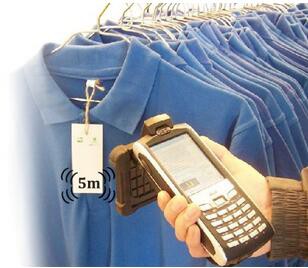
Using RFID handheld devices in RFID clothing smart stores, you can quickly and easily find designated clothing by locking the information of designated clothing.
5. RFID self-service cashier
Produce sales lists, greatly save checkout time, give customers a good shopping experience, and enhance brand image. Through fixed UHF RFID readers or RFID handheld cashier devices, the system can quickly collect information on the goods selected by customers and generate sales lists, greatly saving checkout time, and sales staff can spend more valuable time focusing on customer service.
6. RFID anti-theft and loss prevention
When unpaid goods leave the store, the RFID access control device of the RFID clothing smart store will detect the behavior in time and trigger an alarm to avoid losses for the company.
7. RFID smart fitting room
The RFID reading device cooperates with the background system to easily count the number of times the clothes are tried and the purchase rate. Data analysis facilitates merchants to adjust strategies and plans.
8. RFID quick search
Using RFID handheld devices in RFID clothing smart stores, you can easily and quickly find the specified clothes by locking the specified clothing information. When looking for goods, use the RFID handheld terminal to lock the specified clothing information and press the beep size prompt within a certain distance to quickly confirm the location of the clothes you are looking for. Some major clothing brands have applied RFID to the entire supply chain: Uniqlo: Uniqlo introduced RFID to help consumer experience and reduce 90% of manpower. Uniqlo has opened a digital store driven by RFID technology, including RFID fitting mirrors, RFID shopping carts, RFID self-checkout, etc., to help upgrade the consumer experience in all aspects. It has also introduced an automated system in the warehouse where machines are responsible for clothing quality control, sorting, etc., automatically reading the RFID tags on the clothes, reducing 90% of the manpower in the warehouse.
Decathlon is one of the earliest companies to introduce RFID technology and is also the most representative brand in terms of application. It is understood that Decathlon began to introduce RFID technology in 2013. After years of development, Decathlon has now integrated RFID technology into various links such as warehousing logistics, retail and omni-channel sales. Cotton Era: Cotton Era uses RFID to achieve item-level management of textile products, and achieves full-process management from factories, warehouses to stores, greatly improving the overall efficiency of logistics and data accuracy, increasing sales revenue, and achieving complete transparency of supply chain data, providing timely, accurate and clean data sources for data collection and big data analysis in the second and third stages, and providing key support for Cotton Era to achieve digital transformation.
At present, the main function of clothing RFID tags is to optimize the entire supply chain system, facilitate production management, and occupy the market at a faster rate.
Send Inquiry