

How To Choose Stainless Steel Business Cards For Bulk Orders
Sep 21, 2026
Leave a message

Stainless steel business cards do not have to be positioned as luxury products to be useful. For many business, membership, promotional and branded-card projects, the practical questions are simpler: how thick should the card be, which surface is easiest to live with, which production process fits the artwork, and what must be approved before a larger order is released?
This guide focuses on ordinary custom metal cards for B2B purchasing. It covers the decisions that change cost, handling, appearance and production repeatability. It does not assume that a heavier card or a more reflective finish is automatically better.

Start With How the Cards Will Actually Be Used
Before choosing a finish, decide what the cards need to do after they leave the factory. A card handed out one at a time at meetings has a different requirement from a card packed into event kits, distributed by a sales team, mailed with samples, or used as a reusable membership credential.
| Use case | What matters most | What to avoid |
|---|---|---|
| Everyday business card | Readable contact details, comfortable handling, practical finish, manageable weight | Adding thickness or decorative processes that do not help the user |
| Event or promotional handout | Consistent artwork, efficient packing, easy distribution, repeatable production | Complex constructions that make a large quantity unnecessarily difficult to handle |
| Membership or numbered card | Durable marking, variable data, correct sequence, clear record-to-card mapping | Approving only a visual mockup without checking the personalized sample |
| Gift or presentation card | Surface appearance, packaging, edge quality and presentation | Assuming the most polished finish is automatically the most practical |
The useful starting question is therefore not "Which card looks most expensive?" It is "What does the recipient need to read, carry, scan or keep, and how many cards must the buyer manage?"
Choose Thickness for Handling, Not for Prestige
Metal-card suppliers commonly offer more than one thickness. The trade-off is straightforward: as thickness increases, the card generally becomes more rigid and substantial, but a stack also becomes heavier and occupies more space. That matters when a team carries many cards, when cards are packed in sets, or when shipping cost and packaging volume matter.
Rather than copying a thickness from another supplier's product page, ask the manufacturer which thickness is standard for the chosen material and process. Then request a physical sample if hand feel, wallet fit or rigidity matters to the project.
| Selection priority | Practical direction |
|---|---|
| Large quantity and frequent distribution | Start with the supplier's lighter standard construction and confirm that it remains sufficiently rigid. |
| General business use | Use the supplier's normal production thickness unless there is a clear reason to change it. |
| Presentation or reusable card | Consider a heavier construction only after checking carry weight, edge comfort and packaging. |
| Custom shape or large cut-through area | Confirm structural strength on a finished sample because the artwork can affect rigidity as much as nominal thickness. |
Thickness should be frozen in the approved specification. A reorder made from the same artwork but a different gauge of metal is not automatically the same product.
Brushed, Matte, Mirror or Natural: Pick the Finish by Handling Conditions
Current metal-card suppliers commonly list natural, brushed, matte and mirror-style surfaces. The choice changes more than appearance: it changes reflectivity, fingerprint visibility and the contrast of engraving or printing.
Brushed finish
A brushed surface has a directional grain and is a practical starting point for everyday handling. Compared with a highly reflective mirror finish, light fingerprints and handling marks are often less visually dominant. It also gives logos and engraved areas a clear metallic background without making the entire card highly reflective.
Matte finish
Matte surfaces reduce glare and can make printed or engraved information easier to view under changing light. They are useful when legibility and a restrained appearance matter more than shine.
Mirror or polished finish
A mirror surface creates the strongest reflection and can make a simple design visually striking. The trade-off is maintenance: fingerprints, smudges and fine handling marks are easier to notice. If the card will be handled frequently, approve the finish from a real sample rather than a rendered image.
Natural metal finish
A natural finish keeps the material visually simple and can reduce the number of decorative decisions in the project. It is a good option when the artwork itself should do most of the work.
There is no universally "best" finish. For a mainstream bulk project, the most useful choice is the one that keeps the artwork readable and still looks acceptable after normal handling.
Match the Artwork to the Production Process
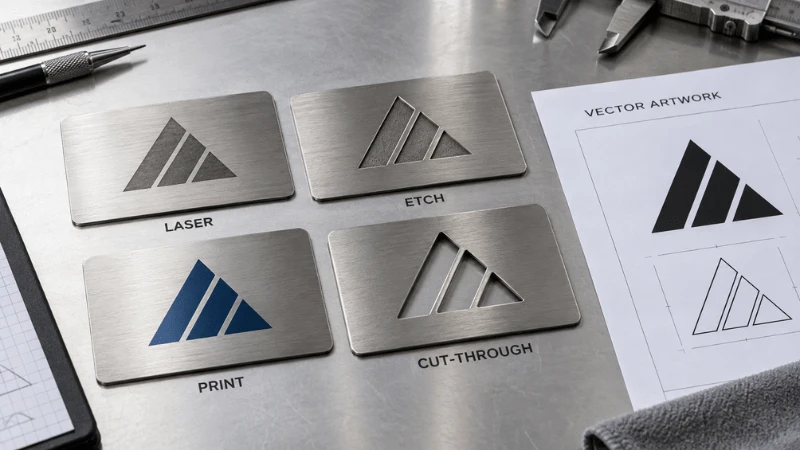
Laser engraving, chemical etching, screen printing, color printing and cut-through designs do not reproduce artwork in the same way. A file that looks perfect on a monitor can still be difficult to manufacture if it contains extremely fine lines, small bridges, delicate text or gradients that depend on a printing method the order does not use.
| Process | Best suited to | What to confirm before approval |
|---|---|---|
| Laser engraving or laser marking | Logos, names, serials, simple line art and durable variable information | Minimum text size, line weight, contrast on the chosen finish and whether engraving is surface marking or deeper removal |
| Chemical etching | Recessed patterns, logos and larger decorative areas | Minimum line width, depth expectation, edge definition and how filled color will be applied if required |
| Screen or spot-color printing | Solid brand colors and simple graphic elements | Color reference, coverage, registration and adhesion on the selected surface |
| Full-color printing | Artwork that requires multiple colors or photographic-style graphics | Actual printable area, surface preparation, color proof and how abrasion will be evaluated |
| Cut-through design | Open shapes, logos and decorative negative space | Minimum bridge width, structural strength, edge treatment and whether small internal pieces remain mechanically stable |
Ask the factory for its process-specific artwork limits instead of relying on a generic design rule. Those limits depend on the material, thickness, equipment and finishing process used for the order.
Design for the Finished Metal Card, Not for Paper
Paper business-card artwork often contains small type, fine rules, soft gradients and edge-to-edge details. Metal rewards a different approach. Strong shapes, adequate spacing and deliberate contrast are easier to reproduce consistently.
Before sending production artwork, prepare a clean vector file for logos, line work and cut paths whenever the production method requires it. Keep text editable during design, then provide the font or convert final text to outlines according to the supplier's file requirements. Separate variable fields such as names, serial numbers and QR codes from fixed artwork.
For die-cut or cut-through cards, clearly distinguish the printed or engraved artwork from the actual cut path. A visually attractive opening can weaken the card if thin bridges or sharp points are introduced without considering the metal thickness and final edge treatment.
The safest workflow is to ask one question for every decorative feature: is this printed, engraved, etched, filled, cut through or left as bare metal? If the answer is unclear, the artwork is not yet a production specification.
Treat QR Codes and Variable Data as Production Data
A QR code can turn an ordinary metal card into a useful bridge to a profile, menu, website, portfolio or campaign page without adding electronics. But a QR code is not only a graphic element. It must remain scannable after the actual finish, printing or engraving process is applied.
Do not approve a QR code only from a PDF. Test the code on the finished production-equivalent sample using representative phones and normal lighting. Reflective surfaces, low contrast, excessive reduction or poor engraving can make a code harder to scan even when the digital artwork looks correct.
If every card carries a different QR code, serial number, member ID or employee name, define the data mapping before production. The supplier should know which row in the data file belongs to which visible card. A good-looking batch can still be unusable if the variable information is duplicated, shifted or matched to the wrong card.
| Variable-data field | What the buyer should define |
|---|---|
| Name or role | Source file, spelling rules, capitalization and maximum text length |
| Serial number | Start/end range, fixed prefix or suffix, leading zeros and duplicate rule |
| QR code | Destination source, static or unique code, mapping rule and sample scan requirement |
| Membership or internal ID | Exact format and relationship to any printed name or database record |
Build an RFQ That Removes Guesswork
A useful request for quotation should let a manufacturer understand the product without filling in important gaps by assumption. "Custom stainless steel card, black, logo engraved" is a starting description, not a complete purchasing specification.
Include the following fields:
- intended use: business card, promotion, membership, gift or another defined task;
- order quantity and expected reorder quantity if known;
- card dimensions or the supplier's standard format;
- required thickness or a request for the supplier's standard option;
- metal type and any grade requirement that matters to the project;
- surface finish: natural, brushed, matte, mirror/polished or another agreed finish;
- fixed artwork and production process for each element;
- cut-through areas or custom shape drawing;
- single-sided or double-sided production;
- QR code, serial number, name or other variable-data requirement;
- packaging and sequence requirements;
- sample approval requirements before the full order;
- what must remain unchanged on future reorders.
For current product-level sourcing, the Syntek metal business card page remains the commercial owner. For cross-category custom production questions involving material, printing, numbering, QR codes or packaging, the OEM/ODM manufacturing page is the broader commercial route.
Approve a Real Sample Before the Bulk Run
A digital proof is useful for checking spelling, layout and basic artwork position. It cannot show the real reflectivity, hand feel, edge quality, engraving depth, print adhesion or QR readability of the finished metal card.
The production-equivalent sample should be checked as a physical object. The approval record does not have to be complicated, but it should be specific enough that the supplier can reproduce the same result later.
| Approval item | Question to answer |
|---|---|
| Material and thickness | Does the finished card match the agreed construction and handling expectation? |
| Dimensions and shape | Does the card fit the intended holder, packaging or distribution method? |
| Edges and cut-outs | Are edges comfortable and are cut-through areas mechanically acceptable? |
| Surface finish | Does the real reflectivity, grain and handling appearance match the approved expectation? |
| Artwork | Are logo, text, line detail and front/back orientation correct? |
| Printed or filled color | Does the production sample match the approved color reference closely enough for the project? |
| QR code | Does the physical code scan reliably to the correct destination? |
| Variable data | Do names, numbers and codes match the source data and sequence? |
| Packaging | Are the count, order, grouping and individual protection suitable for delivery? |
Keep one approved physical sample and the matching artwork revision. A future order should be compared with that controlled reference rather than with a product photo or a memory of the first shipment.

Freeze the Reorder Specification
The first order becomes more valuable when it creates a repeatable specification. Record the details that should not change without approval: metal, thickness, surface finish, artwork revision, engraving or etching process, print colors, cut paths, variable-data format and packaging.
If a later reorder changes material, thickness, surface coating, production process or cut-through geometry, treat the change as something that may require a new physical sample. Small visual changes can alter contrast, feel, QR readability or structural stiffness.
This is especially important when several departments or distributors order the same card. A shared specification prevents "same design" from turning into several slightly different products over time.
If You Add NFC, It Becomes a Different Engineering Problem
An ordinary metal business card can carry a printed or engraved QR code without changing the card's electromagnetic behavior. NFC is different. Metal close to an NFC antenna can create eddy currents, reduce antenna inductance and change the tuning of the system. NXP's antenna-design guidance describes this metal-environment effect and the use of ferrite as one possible way to manage it. See NXP AN13219.
That means an NFC feature should not be added to a finished metal-card design as an afterthought. The antenna location, isolation method, tap side and finished card construction need to be designed and tested together.
If the project requires phone-readable NFC, use a separate smart-card specification and validation path. Syntek's NFC card testing checklist covers finished-card NFC acceptance in more detail.
A Practical Default for Mainstream Orders
For a normal B2B metal-card project, start simple: use the supplier's standard stainless-steel format, select a finish that remains readable after normal handling, choose one or two production processes that suit the artwork, keep cut-through details structurally sensible, and define any QR or variable data before the first sample is made.
Then approve the real sample, not only the rendering. Freeze the approved construction and artwork revision for reorders.
The best metal business card is not automatically the thickest, shiniest or most complicated one. It is the card that can be produced consistently, carried comfortably, read easily and reordered without reopening every design decision.
Send Inquiry