


How To Test Faraday Key Fob Pouches Before A Bulk Order
Oct 15, 2026
Leave a message

A Faraday pouch can be a useful way to reduce radio communication with a stored car key. But a supplier's claim that a pouch "blocks RFID" does not tell a bulk buyer whether it works with the intended vehicle, how it must be closed, or whether the next production lot will behave like the approved sample. Faraday key fob pouch testing should start with the actual key and vehicle, confirm an unshielded control, test the fully closed pouch, and record the conditions before any order is approved.
This guide addresses sample and incoming-batch verification for car-key signal blocking pouches. It is not a catalog of pouch prices or a guarantee against vehicle theft. Buyers looking for available constructions and customization options can review Syntek's RFID signal-blocking product category and signal-blocking bag product page. Actual blocking performance must be demonstrated for the supplied sample and target use.
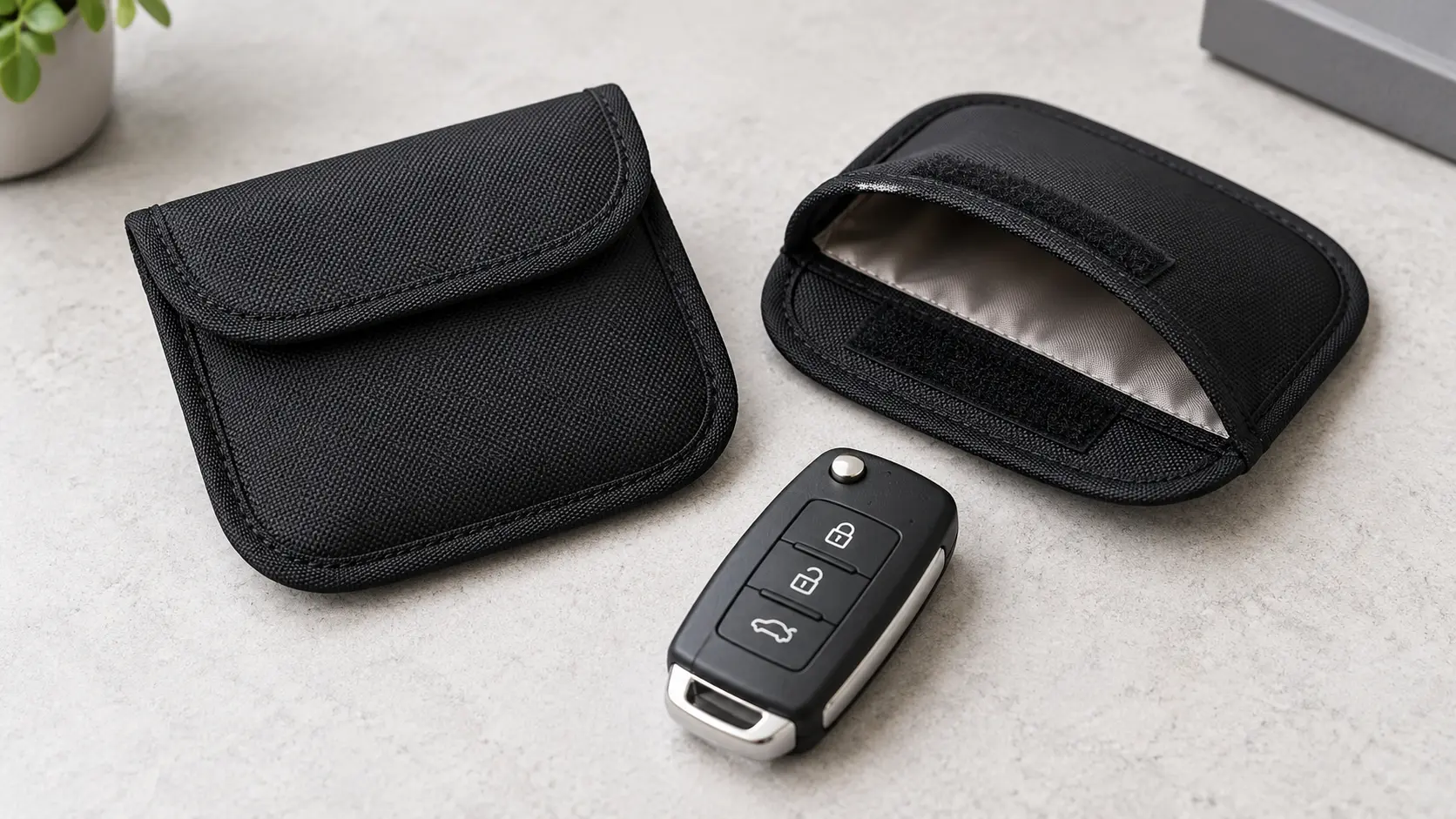
The key test is simple-but the conclusion must be narrow
Guidance from Warwickshire Police and Thatcham Research recommends testing a Faraday pouch with the vehicle instead of simply assuming that it works. The first useful question is whether the normal keyless-entry behavior that works outside the pouch stops when the key is correctly enclosed.
That is a functional test on one vehicle and key system. It is not a laboratory measurement of shielding attenuation across all bands. Vehicle designs vary; passive entry, remote-button operation and other key functions may use different signaling paths or behave differently. Record the precise behavior tested rather than generalizing a single result to every car.
Confirm which feature the customer actually wants to protect
Before sampling, ask whether the intended use is storage of a keyless-entry fob, temporary isolation of a device, or shielding a contactless card. These are not interchangeable applications. A small pouch for a car key should not be sold as a universal phone, Wi-Fi, GPS, NFC, LF, HF and UHF blocker without evidence for those individual functions and frequency ranges.
| Requested use | Representative verification | What that test cannot prove |
|---|---|---|
| Vehicle passive-entry key storage | Normal unlock behavior outside the pouch versus correctly closed pouch near the same vehicle | Protection for every vehicle model or every radio frequency |
| Remote lock/unlock-button isolation | Where safe, compare remote-button response with key unshielded and fully enclosed | That all passive-entry or start functions use the same path |
| Contactless card storage | Specified card and reader, with pouch open and securely closed | Coverage of other card frequencies or car-key systems |
| Phone wireless isolation | Separate tests for each relevant service and device | Universal isolation of every wireless interface |
Car-key pouch buyers should prioritize the first row if that is the advertised use. A phone failing to ring inside a pouch is not a substitute for a car-key test, and a car-key pass is not proof of cellular or GPS attenuation.
Sample approval protocol: use an outside control and a closed-pouch trial
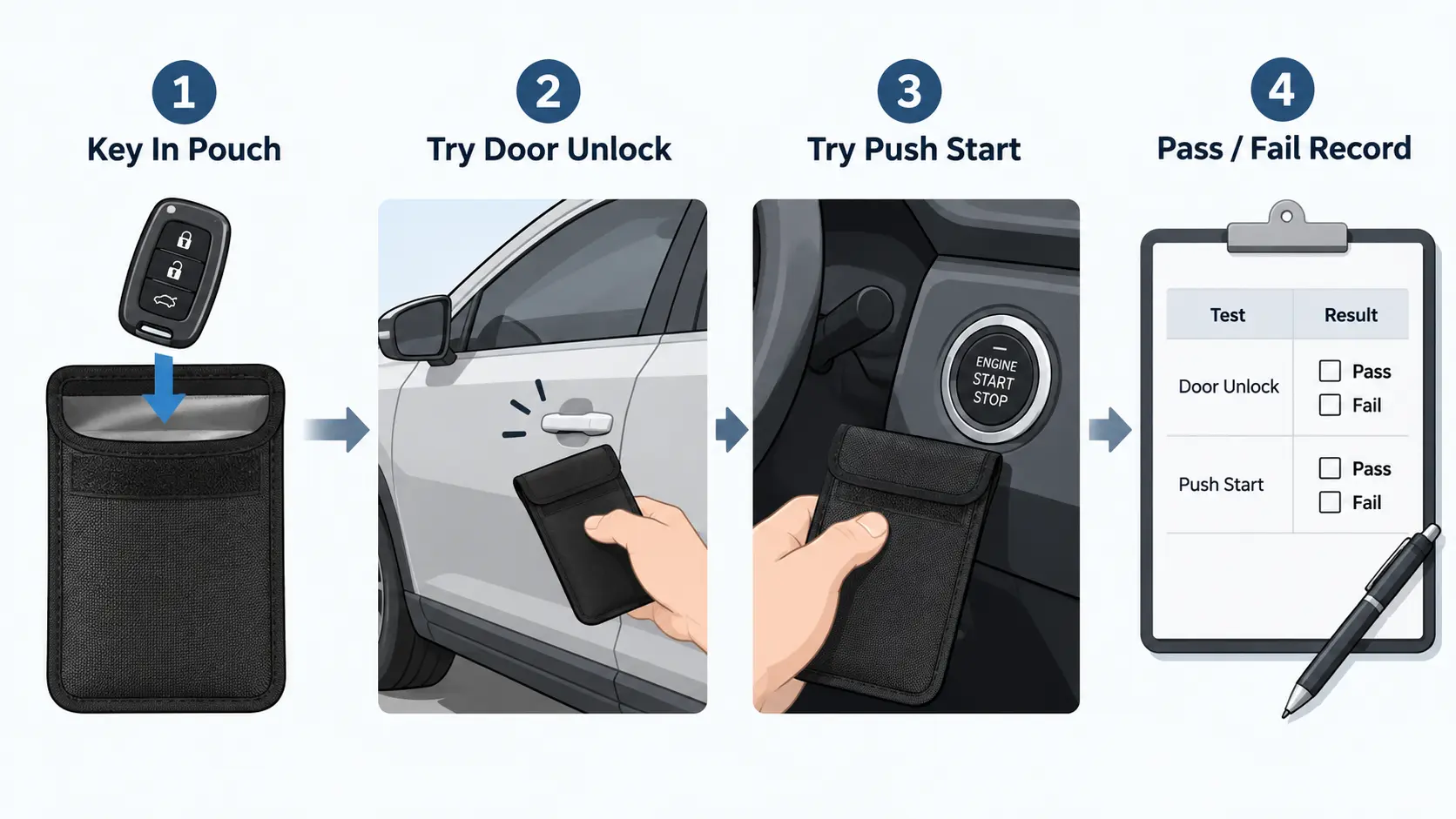
- Identify the test pair. Record vehicle make, model/year where known, key variant, available keyless features and any owner-manual guidance. The method must suit the vehicle and should be performed by an authorized user in a safe stationary setting.
- Check normal operation. With the key outside the pouch, verify that the intended entry function works under the selected test conditions. Without a working baseline, a later non-response cannot be credited to the pouch.
- Inspect the pouch. Check lining continuity where visible, seams, opening design, correct internal pocket where applicable, and signs of damage or wear. Avoid puncturing or peeling the functional shielding layer.
- Close it as instructed. Place the key fully inside the specified shielding compartment and use the intended flap or closure, leaving no exposed key or trapped material in the seal.
- Repeat the same function. With the key enclosed, attempt the intended passive-entry action from the agreed test position. Record whether the vehicle responds. Follow manufacturer instructions; do not perform unsafe or unattended start tests.
- Reopen and confirm recovery. Take the key out and check that the function resumes. This reduces the chance of misreading a temporary vehicle or key condition as a shielding result.
- Repeat on relevant samples. Test more than one pouch, and include the vehicle/key combinations actually included in the buyer's requirement. Keep results associated with sample IDs.
Write results as "No passive-entry response observed with this vehicle, key, test position and correctly closed sample", not "100% signal protection". If a baseline fails, mark the trial inconclusive and resolve the baseline first.
Closure design can defeat otherwise promising shielding fabric
A conductive textile layer is only part of an enclosure. Openings, seams and the way users fold or fasten a pouch can influence leakage and real-world behavior. NIST's work on small-enclosure shielding illustrates why aperture shape and enclosure geometry can matter to shielding performance. It does not certify any specific consumer pouch.
For a purchasing comparison, inspect the function of the complete pouch: Does the key fit without stretching the flap? Is the shielding pocket clearly distinguishable from an ordinary storage compartment? Is the closure repeatable after a user opens and closes it several times? Does a printed logo, added hook or changed material stack alter the opening or shield? These questions often determine whether users can reproduce the laboratory-looking demonstration in everyday handling.
What bulk buyers should ask for in an RFQ
A pouch RFQ should separate appearance customization from verified function. There is no need to buy a luxury accessory to solve a practical isolation task, but a low unit price is useful only after the intended vehicle test and physical fit are satisfied.
| RFQ field | Specify or ask to verify |
|---|---|
| Intended device and use | Keyless fob model/vehicle group and feature to be blocked |
| Finished construction | Outer fabric, inner conductive layer, stitching, closure and number of compartments |
| Size and fit | Finished internal usable dimensions for the real key and any protective case |
| Functional evidence | Vehicle/key used, open control, closed trial, sample revision, observed outcome and test date |
| Customization | Color, label, logo printing, packaging; identify changes that affect shield or closure |
| Batch consistency | Approved retained sample and agreed comparison method for incoming orders |
| Service-life expectations | Closure and lining inspection after realistic use; agreed retest rule, not an invented guaranteed lifespan |
| Commercial details | Quote, MOQ, packaging and lead time confirmed by supplier for this exact order |
Do not substitute a vague "anti-radiation" statement for a documented functional requirement. If the product must meet a numeric shielding effectiveness target in decibels, the buyer and a capable laboratory need an agreed measurement method and frequency range. The IEEE 299.1 standard addresses specified categories of shielding enclosures; its stated size and test scope should not be casually treated as a certification of a small consumer key pouch.
Incoming-lot acceptance is more than opening the first carton
Once a sample is approved, maintain it as the comparison reference. On repeat orders, choose samples across cartons and production positions according to a sampling plan agreed before shipment. Check external appearance, usable dimensions, lining condition, seam and closure quality, and the same defined vehicle/key function used for initial approval. Record lot and sample identifiers.
Where a failure appears, isolate the affected stock until the cause is understood. Repeating a test on the same pouch can help diagnose handling mistakes, but it does not erase a genuine failure or justify changing acceptance criteria after results are known. Escalate changes to shielding fabric, lamination, closure geometry or key fit for requalification. Cosmetic artwork changes may also need review if they alter construction.
Three decisions that prevent a weak test from becoming a false guarantee
- Pass for intended use: the specified key and vehicle behave normally without the pouch, do not produce the defined function with the correctly closed test sample, and recover when the key is removed. Record the exact conditions.
- Inconclusive: the unshielded control fails, the vehicle's feature is ambiguous, the closing method is uncertain, or the trial cannot be repeated. Fix the test before accepting or rejecting a lot.
- Fail or hold: a correctly closed sample still permits the disallowed function under the approved test, or a critical lining/closure defect is found. Hold for investigation under the agreed specification.
Even a passing pouch is an additional precaution, not complete protection against vehicle theft or other attack routes. The AA recommends regular retesting as effectiveness can change with wear. For retailers and distributors, include simple closure and periodic-test instructions with the finished product so end users understand the conditions under which it was checked.
Buyer takeaway: approve the pouch + closure + target key/vehicle + repeatable test as one controlled configuration. Use the signal-blocking product range only after that configuration is clear, and confirm any customization against the retained approved sample.
Send Inquiry