

RFID Fabric Wristbands: A 2026 Sourcing Guide for Events, Cashless Venues and Resorts
Jul 10, 2026
Leave a message

One of our longest-running accounts is a Portuguese event-solutions company that reorders woven RFID bands from us by the million each year, layered with QR codes and UV-fluorescent security. What holds that account together has little to do with the weave or the print. It is that every batch lands encoded to their platform, reads cleanly on the first attempt, and ships on the date they planned around, with no re-spec and no surprises at the gate. That is the real job of a fabric RFID wristband, and it is the job most buyers are sourcing for when they type this term into Google. The people searching rarely want something to wear; they want a component that has to work inside a live system, built to a specific chip spec, artwork and deadline. Demand keeps climbing: Fortune Business Insights tracks the global RFID market on a path from roughly USD 17 billion in 2025 toward the mid-USD-40-billion range by the mid-2030s, near 12% a year, and a growing share of that volume now sits on the wrist rather than in a pocket.
Material and chip decide the project before the event opens
The wristband is almost always the cheapest line item in a deployment, and it is also the first dependency in the chain. If it does not read on the first tap at a busy gate, nothing downstream moves: no top-ups, no bar sales, no access zones. That is why buyers who have run one live event stop treating a custom RFID fabric wristband as a print job and start treating it as a system component. In our own QC we treat first-read yield as a release gate rather than a nice-to-have, because it is the one failure a buyer notices before anything else does.
The payoff for getting it right is measurable. Removing cash and replacing tills with taps commonly lifts per-head spend by 20–30%, and marquee events such as Coachella and Tomorrowland now run the wristband as the single point of interaction across the whole site. RFID fabric wristbands for events and festivals earn that role only when the material and the silicon inside them are matched to the real conditions. Get either wrong and the spending lift disappears into refund queues.
Fabric, silicone, Tyvek, PVC: matching the band to the job
The useful version of the "fabric vs silicone RFID wristband" question is not which material is better; it is which failure you are trying to avoid. A three-hour club night, a rain-soaked five-day festival, a full-season water-park pass and a corporate access badge are four different problems wearing the same word.
| Material | Best-fit wear | Durability / water | Branding surface | Relative unit cost | Reuse model |
|---|---|---|---|---|---|
| Tyvek / paper | Single day, one entry | Low; tears when wet | Flat print only | Baseline (lowest) | Single-use |
| PVC / vinyl | 1–3 days, budget events | Good; waterproof | Full-colour print | ~5–10× baseline | Single-use, some reuse |
| Silicone | Repeated daily wear, reusable systems | High; fully washable | Debossed or printed | ~10–30× baseline | Reusable |
| Woven fabric | Multi-day festivals, VIP, keepsakes | High; holds up in rain and sweat | Dye-sublimation or true woven logo, Pantone match | ~20–50× baseline, below leather VIP | Single-use, non-transfer |
Read the cost column as ratios rather than sticker prices: a woven band sits several times above a Tyvek strip but well under a leather VIP piece. Where a woven RFID wristband earns its place is exactly where cheaper materials give out, surviving four nights of rain, sweat and crowds without the tag delaminating, and doubling as a souvenir keepsake that keeps a logo on wrists long after load-out. The reverse judgment matters just as much, and most suppliers will not volunteer it. If your event runs two days or less and budget leads, do not default to woven; the roughly 3–5× premium over Tyvek or vinyl buys durability you will never use up. Set the woven threshold at three-plus days outdoors, real water exposure, or a genuine branding-and-keepsake requirement. Below that line a cheaper material does the same job for less. The full range across each family is easier to weigh against a single RFID wristband category overview than in the abstract.
Chip and encoding: the part that has to match your platform
Here is the variable most quotes leave off until it is too late to change. The band is a carrier; the money and the access rights live on the chip, and that chip has to speak the same language as the platform you have already committed to. A high-frequency NFC woven wristband usually runs one of a small family of ICs: NTAG213/215/216 for open NFC, MIFARE Classic 1K or Ultralight C for closed-loop cashless, or a UHF inlay when you need to read across a lane rather than at a tap. HF/NFC read range on a fabric band typically lands around 60 mm depending on the reader, a value that is deliberate rather than a limitation, because you want a clean single tap at the till and not stray reads from the next person in line.
Encoding is where projects quietly break. Cashless and access platforms each favour their own chip families and key structures, so a physically perfect band encoded to the wrong scheme is scrap. Confirm the platform first, then order the silicon to match. Never the reverse. Anti-counterfeiting rides on the same chip, not on the fabric: a cloned band cannot reproduce a cryptographic signature, so tamper resistance depends on encrypted ICs such as NTAG 424 DNA with SUN authentication or Ultralight C with 3DES, verified server-side. A single-use clasp stops a used band being passed over the fence, and the tag stays readable even after the band is cut, but neither replaces cryptographic validation. If a factory cannot discuss encoding compatibility with your specific cashless or access system on the first call, that is the tell. In our own sampling we do not accept a parameter sheet as proof of compatibility. We ask the buyer to encode a sample to their own platform and read it on their own hardware before the bulk run starts, because a chip that passes on our reader can still fail on yours if the key layout differs.

The multi-day failures worth studying before you buy
The most useful procurement education comes from deployments that broke. Download Festival's 2015 cashless rollout stumbled badly: the operator played down the scope, yet attendees hit long queues and some found pre-loaded balances had vanished, with no cash fallback to bridge the gap (Gigwise). The pattern repeats. France's Hadra Festival dropped cashless after WiFi-dependent transactions failed and crowds pushed back on being tracked, and unclaimed top-up refunds, which have averaged around 16% of balances at some UK events and quietly built into tens of thousands of pounds, are now pitched to organisers as a feature rather than a bug (Resident Advisor). The through-line: read range matters far less than offline resilience. A waterproof fabric RFID wristband is only as dependable as the closed-loop system behind it, and the events that stay online through a network drop are the ones that engineered redundancy before the gates opened.
Turned into a pre-order spec, those failures give procurement four acceptance criteria worth writing into any multi-day festival contract:
- First-read yield - ask for the line's first-tap pass rate off production, not a lab reading on a single sample.
- Offline authorisation - confirm the encoding supports offline transactions so a network drop does not freeze the gates.
- Transfer and tamper resistance - specify a single-use clasp plus an encrypted chip wherever a passed-on band means lost revenue.
- Water and multi-day endurance - for anything past a single day outdoors, require rain, sweat and immersion behaviour in writing.
The on-site habits that keep a multi-day deployment running sit alongside the hardware choice; our field notes on using RFID festival wristbands on site cover the operational side a spec sheet will not.
How to vet a fabric wristband factory before the PO
This is the part competitors' guides skip, and it is where the decision is actually won. Evaluating a woven RFID wristband manufacturer is not about who quotes lowest; it is about who controls the variables that decide whether your order ships correct and on time. Five checks separate a real factory from a trading desk reselling someone else's line: whether chip bonding and QC happen in-house or get subcontracted; the real MOQ and lead time for your configuration rather than a brochure figure; who owns the tooling once you have paid for it; whether every unit is tested before shipment or only sampled; and whether the plant can handle global freight and export documentation without a middleman.
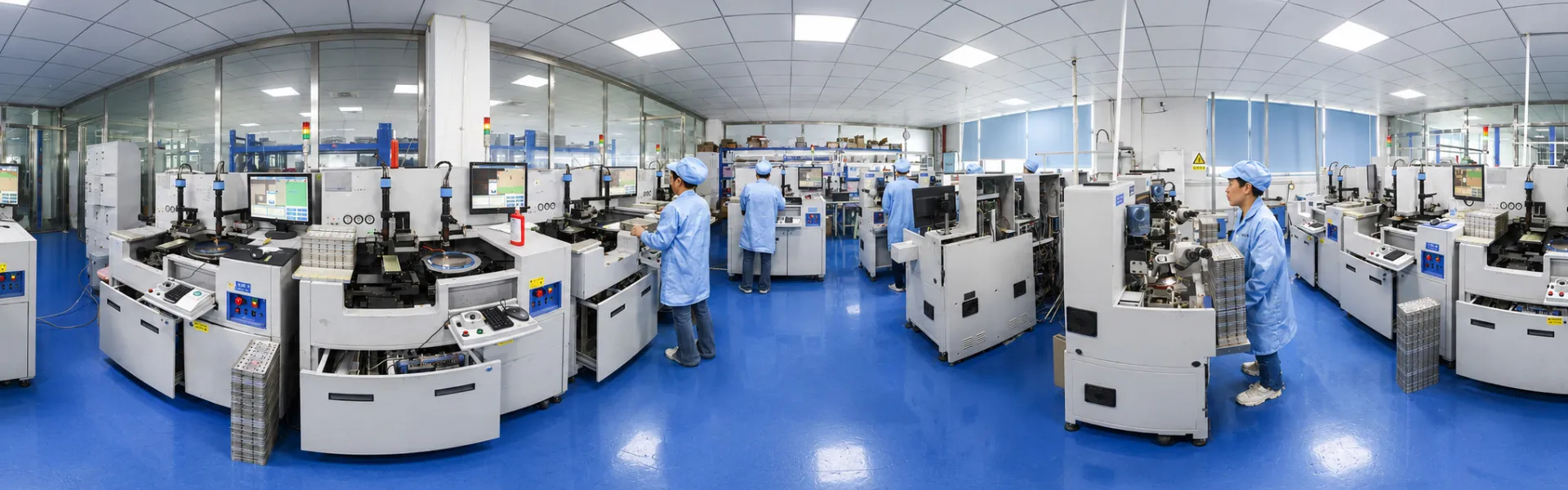
Measured against that list, buying a custom RFID fabric wristband OEM in China direct from the plant is the straightforward path. Syntek has built RFID products since 2006 and shipped to overseas buyers since 2012, out of a 3,600 m² plant running five production lines and roughly 200 staff, with annual exports above USD 3 million across Europe, the Americas, Russia and the Middle East. The full chain, from weaving and chip bonding to printing, winding and encoding, sits under one roof rather than scattered across subcontractors, which is what lets us hold winding to about ±0.1 mm, tooling tolerance near ±0.02 mm and colour to ΔE under 1. Those are figures our clients re-check against approved samples at incoming inspection, not numbers we ask anyone to take on trust, and they sit behind the plant's quality-management and product-compliance certification, which we share on request for buyer due diligence. Every unit is tested before it leaves rather than spot-checked, and a signed-off sample comes before any bulk run, so a first-tap failure surfaces on the proof instead of at your gate. Free pre-production sampling exists for exactly that reason: catching an encoding mismatch on a sample is cheaper for everyone than catching it in a shipping container. For buyers building to their own brand and chip spec, our factory-direct OEM/ODM programme is the entry point.
What volume production actually looks like

Capability claims mean little without throughput behind them. Sourcing custom RFID fabric wristbands in bulk is a different discipline from making a hundred good samples: it is making a million identical ones, each encoded correctly. The Portuguese provider referenced above moves north of a million wristbands a year through us alongside custom cards, with QR and UV-fluorescent security layers added inline. A separate cashless and amusement-park platform builder in Israel takes on the order of two million encoded RFID cards a year on the same production discipline, set out in our RFID card export case. The volume figure matters less than what it proves: the same line that holds tolerance on a proof holds it across seven-figure runs, which is the only definition of quality worth anything once your event is on the calendar. That is also where a bulk NFC woven wristband order lives or dies.
FAQ
Q: What's the difference between fabric and silicone RFID wristbands?
A: Fabric (woven or cloth) bands suit multi-day festivals and premium branding; silicone suits reusable, repeated daily wear. Wear duration, water exposure and reuse decide the choice.
Q: Which chips can be encoded in a fabric RFID wristband?
A: HF/NFC and UHF options, commonly NTAG213/215/216, MIFARE Classic 1K or Ultralight C, and UHF inlays, encoded to match your existing cashless or access platform.
Q: What's the typical MOQ and lead time for custom orders?
A: Both depend on chip type, band construction and finishing. As a rough guide, woven RFID orders commonly start in the low hundreds to a few thousand units, with production typically running two to four weeks after a sample is signed off; everything runs factory-direct with in-house chip bonding and 100% QC before shipment. Ask for a quote against your exact spec for firm figures.
Q: Are fabric RFID wristbands waterproof and tamper-proof?
A: Yes, suited to water parks and multi-day outdoor use; single-use clasps prevent transfer, and the tag stays readable even after the band is cut.
Q: Can you print our logo and match Pantone colours?
A: Yes, woven or dye-sublimation branding plus a custom-printed tag face; supply vector (.ai) artwork and Pantone references for the closest match.
Talk specs before you commit
If you are scoping an event, resort or cashless venue, the fastest way to de-risk it is to put a real sample in your hand encoded to your platform. Request a proof and pricing through our woven RFID fabric wristband program, and as a factory-direct RFID cloth wristband supplier we will sample before bulk, test 100% before shipment, and handle global freight. Reach us by email or WhatsApp to move from spec to sample.
Send Inquiry