

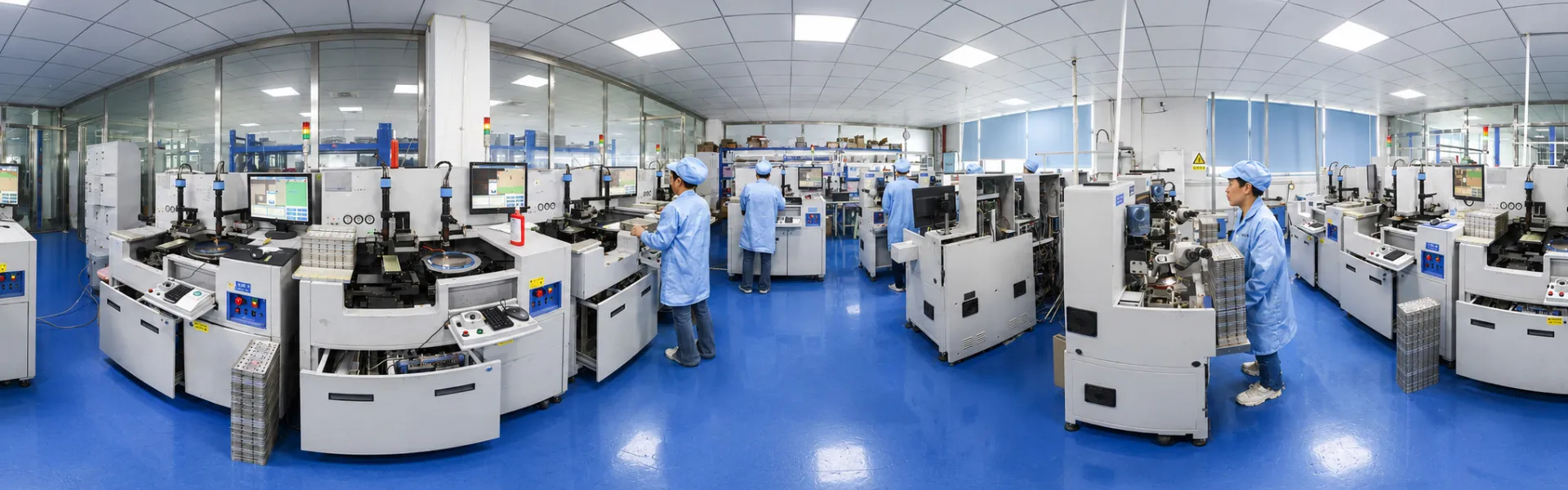
Copper Wire Winding Line
Dec 17, 2025
Leave a message
Copper Wire Winding Line
Talk to anyone running an RFID ear tag factory long enough, and the conversation always lands on the same headache: read failures. Not the reader. Not the chip. The coil.
Somewhere between the spool and the finished transponder, something went wrong. And nine times out of ten, it happened during winding.

Here's what the spec sheet won't tell you. A 134.2kHz FDX-B transponder needs its antenna tuned within a tight window-miss it by a few microhenries, and you've got a tag that reads at 3cm instead of 12cm. Or doesn't read at all. The coil inside a 2.12×12mm glass tube transponder runs about 800 turns of 0.05mm enameled copper wire. That's thinner than human hair. Wind it too tight, the insulation cracks. Too loose, the inductance drifts. Either way, the resonant frequency shifts off 134.2kHz, and your customer's scanner won't pick it up in the field.
We burned through a lot of reject tags before we figured out that tension control wasn't a set-it-and-forget-it affair. The spool diameter changes as wire pays out. Morning humidity in Hubei isn't the same as afternoon humidity. Temperature swings affect how the polyurethane insulation behaves-above 28°C, it softens slightly, and your tension readings lie to you. Had one batch last summer where Q factor dropped by 15% across 2000 units before anyone caught it. Took two weeks to isolate the cause: the AC unit near the winding line had failed over a weekend.
Most operations run tension between 18-25 grams for 0.05mm wire. Go below 15g and the layers won't sit tight-the coil acts like it has fewer effective turns than it actually does. Push past 30g and you're stretching the copper, increasing resistance, killing your Q. And here's where it gets annoying: you can't just set 20g and walk away. A 250mm spool doesn't pay out the same as a 100mm spool at the same brake setting. The good lines have closed-loop tension with feedback from a dancer arm. The budget lines don't, and that's where the variation creeps in.
The bonding step catches a lot of people off guard too. After winding, the coil has to be secured-usually thermal compression bonding, sometimes adhesive. Mess up the cure and the connection between coil and chip fails six months down the line, right when the tag is implanted in some cow in Mongolia and your customer is asking why their herd management system shows gaps.

Syntek's ear tag line runs about 50,000 sets a month and holds under 1% field failure-that number took years to achieve. Part of it was switching to TPU housings they produce in-house. Part of it was getting the bonding window dialed in: 4-6 seconds at the right temperature, no more, no less. Deviate outside that and either the joint is cold (weak adhesion) or the insulation degrades (shorts later).
ISO 11784/11785 FDX-B compliance isn't just paperwork. The standard exists because a missed tag at a border checkpoint means an animal can't be traced. Can't be sold. Sometimes gets destroyed. Real consequences. The factory in Jingzhou has been shipping to ranches in Botswana, Mongolia, Senegal-places where replacement isn't an overnight FedEx package. When a transponder fails there, someone loses money, maybe loses an animal. That context shapes how seriously you take the winding process.
Buyer's Guide
For anyone sourcing coils or complete transponders: ask about their tension control system. Ask if they calibrate daily or weekly. Ask what happens during a humidity spike. The factories that answer those questions without hesitation are the ones that have actually solved them. The ones that don't answer are still figuring it out on your order.

Glass tube transponders for injection-the 2.12×12mm and smaller 1.4×8mm sizes-are particularly unforgiving because there's no room for a sloppy coil. The wire has to wind within a few millimeters of space around a ferrite core, leave room for the chip bonding, and survive encapsulation in bioglass at elevated temperatures. Thermal expansion mismatches between copper, ferrite, and glass create stress if the coil geometry isn't right. Cracks in the glass happen. Then moisture gets in and kills the chip.
The keyfob side of the business is more forgiving-access control products don't face the same environmental abuse as livestock tags-but the fundamentals stay the same. Get the winding right, or troubleshoot forever.
One thing that surprised us: wire quality variation between suppliers matters more than we expected. Two spools labeled "0.05mm PU insulated copper" from different vendors measured the same on a micrometer but behaved completely differently on the line. One ran clean. The other had micro-fractures in the insulation that didn't show up until post-winding continuity checks. Twenty hours of production time lost because incoming inspection didn't include a bend-and-check on the first few meters of each spool. Now it does.
The automation helps. Modern winding machines store hundreds of parameter sets-turns, tension profile, traverse speed-and can switch between product types in minutes. Syntek runs ear tags, NFC cards, and glass transponders on adjacent lines with different winding specs for each. But automation doesn't fix bad inputs. Garbage wire in, garbage coil out, no matter how precisely the machine runs.
Worth mentioning: the 134.2kHz frequency itself is chosen because it penetrates water and tissue better than higher frequencies. That's why LF dominates livestock ID. But it also means the antenna coil does more of the heavy lifting in energy harvesting-there's no big backscatter boost like you'd get at 900MHz. A marginal coil that might squeak by at HF will completely fail at LF. No room for "good enough."
If you're evaluating an RFID ear tag supplier or looking for coil production partners for glass tube transponders, the winding process is where quality is won or lost. Chip reliability is largely commoditized at this point-the major IC vendors all produce stable silicon. The differentiation is in the antenna. Always has been.
Send Inquiry