

Custom NFC Business Cards: OEM Solutions from Syntek RFID Factory
Aug 03, 2026
Leave a message

The Batch That Works on the Desk and Fails in the Room
A print reseller approved eight samples of custom NFC business cards in spring, then released an order for five thousand cards for an end client's sales conference. Nine days after delivery came the email that everyone in this trade eventually receives: about half the cards were dead.
They were not dead. Every card in the retention sample read perfectly on our QC bench. What had actually happened was that the client's field team carried iPhones while the office staff carried Android handsets, and the tags had been encoded the way most people encode a digital name card, as a vCard record. Android picked it up. iOS did nothing whatsoever. No error, no prompt, no vibration. Nothing.
That single decision destroyed a production run, and it had nothing to do with antenna quality, chip grade or print finish. It was an encoding choice made in ten seconds by someone who had never tested a batch across both mobile platforms.

Demand for this product category is not the problem. The digital business card market is projected to grow from roughly USD 217 million in 2026 to about USD 331 million by 2031, a compound rate near 8.9% (Mordor Intelligence). The hardware side of it is growing faster than the software side. The problem is that almost everything published about NFC business cards is written for a person buying one card, while the failures that matter happen at five thousand.
This article is about ordering a batch. It does not explain how near-field communication works, and it assumes you already know why you want the product. What follows is the set of decisions that determine whether the custom NFC business cards in the shipping carton behave the same way as the sample on your desk.
Four Variables Decide Whether a Production Run Survives Contact With Real Phones
Strip away the marketing and a batch of bulk NFC business cards is governed by four things: the chip, the NDEF encoding format, the substrate, and who writes and locks the data. Everything else, foil stamping, spot UV, Pantone matching, packaging, is cosmetic in the sense that it never causes a card to stop reading.
That statement holds under one condition most suppliers will not volunteer: it assumes the four variables were decided before tooling, not after. Encoding format and chip choice are locked at the moment the inlay is bonded and the data is written. Changing either one after production means re-encoding or re-manufacturing an entire run of NFC business cards, and re-encoding is only possible if the cards were not permanently locked, which for security reasons they usually should be. So the sequence in which you make these four decisions matters as much as the decisions themselves, and the rest of this piece follows that sequence.
There is a fifth variable, and it only applies to two kinds of buyer. If you resell, or if you are rolling cards out across a company rather than a team, whether the URL sits on a domain you control decides whether an order of NFC business cards is an asset or a liability two years from now. That one is covered in its own section further down, because the fix costs nothing at the specification stage and cannot be applied afterwards.
One more thing worth settling early, because it changes the whole quotation: are you buying finished cards or blank stock? Printers and design studios with their own equipment often buy blank NFC business cards in bulk, inlay bonded and surface unprinted, and handle artwork in house, which shortens lead time and keeps colour management under their own roof. Everything below about chips, encoding and locking applies to both routes; only the printing and finishing sections change.
Chip Selection: Why Bigger Is Not Better
There are three NTAG parts in serious circulation for this product, and the memory figures are the only absolute numbers in this section that you need to treat as hard thresholds.
| Chip | User memory | Realistically holds | Where it belongs |
|---|---|---|---|
| NTAG213 | 144 bytes | A URL, comfortably | High-volume giveaway cards, event handouts, anything URL-only |
| NTAG215 | 504 bytes | A URL plus a full contact record | The default for most custom NFC business cards |
| NTAG216 | 888 bytes | Large payloads | Rare; specify only when a documented payload requires it |

Specifying NTAG216 on NFC business cards is a mistake dressed up as an upgrade, and it is worth being blunt about that rather than presenting three equal options. It carries a price premium, availability is thinner than NTAG213 or NTAG215, and there are consistent field reports of reliability problems when encoding and reading large data sets on it, while NTAG215 shows no equivalent pattern (Seritag). Buyers ask for it because 888 sounds better than 504. Nobody has ever needed 888 bytes on a name card.
The genuine trap sits at the other end. NTAG213's 144 bytes are ample for a link but will not hold a complete contact record with company, title, two phone numbers and an address. Order NTAG213 cards intending to write full contact data and you get truncated fields or write failures, discovered after the run is printed. If you are comparing chip families before committing to NFC business cards wholesale orders, our engineering breakdown of NTAG213, NTAG215 and NTAG216 selection criteria goes through the memory maps and the lock-bit behaviour of each part. The lock-bit detail in particular is what decides whether a chip choice stays reversible later.
Three deployment scenarios, three different answers. A conference giveaway where every card carries the same landing page runs fine on NTAG213 and saves real money at volume. A corporate rollout where each card carries a unique employee profile URL should be NTAG215, because you want headroom for a contact record if the client changes their mind at revision three. A white label programme where you hold stock and encode per order should also be NTAG215, since you cannot predict what your own customers will ask you to write.
The vCard Mistake That Kills Whole Batches
This is the section that pays for reading the rest.
Background tag reading on iPhone, the behaviour where the phone reacts to a card without any app open, only triggers on an NDEF message whose first record is a URI record. A MIME-type vCard record produces no notification at all (Apple Developer). There is no failure message to diagnose, which is exactly why the fault survives sampling and reaches the customer: the person testing your samples was probably on Android.
The workaround circulating in the industry is to write two records, vCard first for Android convenience and URL second for iOS. It half works, and it fails in a way that is invisible during proofing. iOS reads the first URI record it finds. If a production operator writes the records in the wrong order on a job re-run, the entire batch of NFC business cards goes silent on iPhone while remaining perfectly functional on every Android device in the QC area. Record order is a production parameter and needs to be written into the job sheet, not left to whoever is running the encoder that shift.
There is a second layer that generates support tickets even when the encoding is correct. iPhone background reading is suppressed when the device has not been unlocked since power-on, when the camera is active, when Apple Pay or the Wallet is open, and in airplane mode. Picture the actual moment of use: a trade show aisle, the recipient holding their phone up taking a photo of the booth, someone hands them a card, the tap does nothing. The card is fine. The camera was open. Brief the end client on this before the cards ship, because otherwise it comes back to you as a defect claim.
The safe specification for pre-programmed NFC business cards is a single URI record pointing at a profile page that itself offers the contact download. It behaves identically on both platforms, it survives being re-shared as a link, and it is the only configuration we will write without a signed waiver. Our walkthrough of programming NDEF data across NTAG and MIFARE chip types covers the record structures and the write sequence in detail.
Material: PVC, Wood, Metal and What Metal Costs You
Substrate is where the buyer's aesthetic ambition meets physics, and on NFC business cards physics does not negotiate.
| Substrate | Read performance | Cost position | Lead time impact | Best fit |
|---|---|---|---|---|
| PVC / PETG | Baseline | Lowest | Shortest | Volume runs, giveaways, white label stock |
| Wood / bamboo | Close to baseline | Mid | Moderate; laser engraving adds a pass | Brand-led runs wanting texture without RF risk |
| Metal | Reduced, single-face only | Highest, and highly variable | Longest | Executive-tier runs where perceived value outranks tap reliability |

Wood is the substrate most buyers overlook. It carries much of the premium signal metal does in the hand, takes laser engraving well, and sits close enough to the PVC baseline in read performance that we rarely see complaints from the field. Our wooden RFID card range covers the bamboo and birch stock we hold for these runs, and when a client wants texture rather than weight, wooden NFC business cards solve the brief without the shielding problem below.
Metal is the one that needs explaining honestly. A metal card sitting in a 13.56 MHz field generates eddy currents, and the opposing field those currents produce absorbs energy and detunes the antenna away from its resonant point (NXP). Untreated, metal NFC business cards barely function. In one published mitigation study, adding a ferrite layer to an antenna mounted on metal brought read range back from effectively zero to around 30 mm, and impedance retuning then took it to roughly 61 mm (Leankon). That is a working card, but still measurably short of a plastic-substrate baseline, and normally readable from one face only.

Our own sampling procedure exists because of that gap. Every metal build we quote goes out as a functional sample rather than a visual one, tested against both iPhone and Android handsets on the bench before we release the run, and we tell the customer where on the card an NFC business card of that construction actually taps. Buyers who skip that step are approving an appearance, not a performance.
The variable nobody mentions in a quotation is the shielding design itself. Ferrite is heavy and expensive relative to the rest of the bill of materials, and suppliers economise on it in different ways: some flood-coat a full layer, some route it only along the antenna trace, some simply omit it and hope the customer never tests the card against a phone case with a magnet in it. When quotes for metal NFC business cards wholesale runs are separated by a factor of two or three, you are usually looking at the shielding strategy rather than the metal. Ask what is between the inlay and the plate, and ask for a functional sample.
Our own position: if the client's priority is that every recipient's tap works first time on every handset, we will recommend against metal and say so in writing. If the priority is the weight of the card in the recipient's hand at an executive dinner, metal is worth its trade-offs and we will build it properly.
What we cannot do from a quotation alone is tell you which shielding construction your specific design needs, because it depends on plate thickness, cut-outs and where the artwork forces the antenna to sit. That answer comes back with a functional NFC business card in your hand, not with a price list.
Verifying the Chip You Actually Received
Substituting a "compatible" chip for a specified NXP part is the most profitable fraud in this industry, because the substitute usually works well enough on ordinary NFC business cards that nobody checks, until an application depending on a specific lock-bit or password behaviour breaks two years later.
There is a check you can run at goods-in. NXP writes an ECDSA signature over each chip's 7-byte UID during manufacture and stores it in a protected memory area; a reader issues a READ_SIG command, and the returned signature is verified against NXP's published public key. It cannot be forged outside NXP's own hardware security modules, which makes it the one piece of incoming inspection a buyer of custom NFC business cards can perform independently of the supplier's word. The same UID-level thinking is what separates a legitimately encoded card from a copied one, a distinction we go through in more depth in our note on how cloned RFID stickers actually work.
The honest limit of that check matters as much as the check itself. An originality signature proves the silicon is genuine. It does not prove the finished card is: a genuine chip can be harvested and placed into a product built from anything, and some highly configurable chips permit UID and signature manipulation. So treat the signature as necessary but not sufficient, and pair it with a supplier who will state the exact part number on the commercial invoice. We do, and we will send you the signature verification output from the retention sample of your run if you ask for it.
Pre-Programming and Locking Before the Cards Leave the Line
Most first-time buyers assume they will receive blank cards and write them after arrival. For fifty cards that is fine. For five thousand NFC business cards it is somebody's month.
Encoding on the line means the data is written as part of the production sequence, from a customer-supplied list, one unique URL per card, with the card position in the sheet tied to the record. Sample reads are pulled at a fixed proportion through the run rather than only at the end, because encoder drift shows up mid-batch, not at the start. Cards are then locked, so the NDEF content cannot be overwritten by anyone with a phone and a free tag-writing app. Skip that step and your client's entire sales team carries cards a stranger at a conference can rewrite.
Any competent factory can recite that process, which is why it is worth asking what you actually receive alongside the cards instead. On a run of custom NFC business cards in bulk we hand back the encoding list reconciled against card positions, the read results from the sampled cards, and the signature verification output mentioned above, which is what lets you audit a batch rather than trust it. Suppliers who cannot produce those three documents are not necessarily doing anything wrong, but you have no way of knowing.
Two practical notes from running these jobs. First, supply the URL list as a flat file with an explicit card-identifier column, because spreadsheets with merged cells and formatting generate more re-runs than any technical fault. Second, decide before production whether you want permanent locking or password-protected write access; permanent is safer, password-protected is what you want if the client is likely to redirect URLs at the card level rather than at the server. Most buyers of white label NFC business cards choose permanent locking plus a redirect layer, which gets you both. Our OEM and ODM programme covers per-unit encoding, serialisation and locking as a standard part of the job rather than a surcharge line.
Who Owns the URL Decides Whether a Batch Has a Shelf Life
An NFC business card stores one thing: a URL. Everything the recipient sees lives at the other end of that link, on a server nobody in the transaction owns unless somebody deliberately arranged it.
That is the structural weakness in a large share of NFC business cards deployed today. If the URL points at a third-party platform's domain, the cards remain useful exactly as long as that platform keeps the subscription active and stays in business. When the subscription lapses, five thousand printed cards become five thousand dead links simultaneously, and there is no remedy short of reprinting.
For a corporate rollout the fix is straightforward and should be decided at the specification stage, not after: write URLs on your own domain, and point them at whatever profile platform you use through a redirect you control. Platform changes then cost a configuration change instead of a reprint. Resellers get a commercial asset out of the same structure: you retain the relationship with the destination, which means the reorder conversation for the next run of NFC business cards is yours rather than the platform's.
Three specifications change more often than any others between our first quotation and the final order, and this is one of them. The second is material: a client who opened with metal for the whole team frequently lands on metal for the executive tier and PVC or wood for everyone else, once the read-distance trade-off is on the table. The third is quantity structure, splitting one large order into a first production batch and a scheduled repeat, so the artwork and the URL scheme get validated in the field before the bulk of the money is committed. All three are buyer-initiated, and all three make the final order of NFC business cards for teams work better than the one originally specified.
Specs, MOQ and Lead Time: What an Order of NFC Business Cards Looks Like
| Parameter | Standard |
|---|---|
| Format | ISO 7810 CR80, 85.6 × 54 mm, 0.76 mm thickness |
| Operating frequency | 13.56 MHz, ISO/IEC 14443A |
| Chip options | NTAG213 / NTAG215 / NTAG216, MIFARE families on request |
| Printing | UV digital and offset, 300 dpi and above, Pantone matching |
| Finishing | Matte, gloss, frosted, spot UV, foil, laser engraving on wood and metal |
| Encoding | Per-unit URL writing, serialisation, permanent or password-protected locking |
Minimum order quantity (MOQ) is not a single figure for NFC business cards wholesale enquiries, and any supplier who quotes one before seeing your artwork is quoting a different product than the one you are asking about. Printed PVC carries the lowest minimum, because setup is short and tooling is shared. Wood, metal and specialty finishes sit at a multiple of that floor, since each adds process steps: engraving passes, shielding assembly, longer curing, all of them uneconomic below a certain run length. Per-unit encoding raises the floor slightly on small runs and becomes cost-neutral above a few thousand units.
Printing in house changes the arithmetic again. Blank NFC business cards skip the artwork approval loop entirely, which usually means both a lower minimum and a shorter schedule than a fully finished run of the same size. Whether your design can actually take that route is the part worth asking about before you plan around it, because anti-counterfeit features, non-CR80 dimensions and edge-to-edge finishes all pull the job back onto the printed line.
Timing follows the same logic. Sampling for standard PVC is a matter of days; metal with a shielding evaluation takes appreciably longer, because the functional test is the point of the sample. Production of NFC business cards sits in the region of one to three weeks for straightforward runs, extending with finishing complexity and encoding volume. If you are working backwards from an event date, count backwards from the event to the sample approval, not to the production start, since sample approval is where schedules are actually lost.
Why Buyers Place Repeat Orders With Syntek
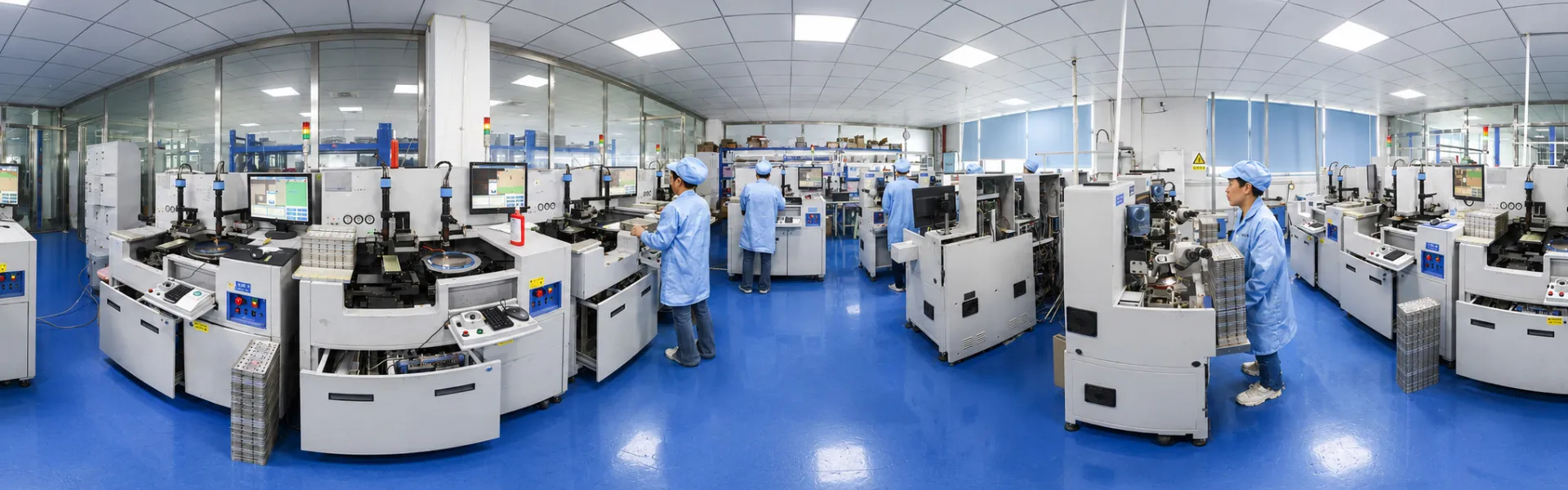
We have manufactured RFID and NFC products in China since 2006, operate as a certified national high-tech enterprise, and run five production lines across roughly 3,600 m² with more than 200 staff. Chip bonding, antenna winding, screen and UV digital printing, encoding and QC all happen in-house, which is the reason we can answer a question about record order or shielding without calling a subcontractor. We hold ISO 9001, CE and ICAR certification, and have exported continuously since 2012, with annual export volume above USD 3 million into Europe, the Americas, Russia, South Asia and the Middle East. Being an NFC business card manufacturer in China with the encoding step inside the same building as the press is what makes per-unit programming a line item rather than an outsourced risk.
The more useful thing to tell you is what we will not do. We will not quote a metal card as reading equivalently to PVC. We will not ship a batch encoded as vCard without a written acknowledgement of the iOS behaviour. We will not promise control over a profile page hosted on a platform we do not operate. Suppliers who agree to all three are agreeing to a claim rather than a specification.
If you are evaluating a first run of custom NFC business cards, request free samples with your own chip and substrate specification and test them across both mobile platforms before you commit. You can also review the full product configuration on our NFC smart business card page, then send artwork and quantity through the free sample request form.
FAQ
Why do my NFC business cards work on Android but not on iPhone?
Because the tags were almost certainly encoded as vCard (MIME) records. iPhone background tag reading only triggers on a URI record, so a vCard tag produces no popup and no error at all.
Which NTAG chip should I specify for a bulk order of NFC business cards?
NTAG215 is the safe default. NTAG213 holds a URL but not a full contact record, and NTAG216 carries a price premium plus reported reliability issues with large data writes.
Do metal NFC business cards read as well as PVC ones?
No. Metal detunes the antenna at 13.56 MHz; ferrite shielding and impedance tuning restore usable range, but read distance stays below a plastic baseline and the card normally reads from one face only.
How can I verify the chips in my order are genuine?
NXP NTAG21x chips carry an ECDSA originality signature over the chip UID that can be read with a READ_SIG command and verified against NXP's public key. It proves the silicon, not the finished product.
What is the minimum order quantity for custom NFC business cards?
It depends on material and finishing rather than on a single company-wide figure. Printed PVC runs at the lowest minimum; wood, metal and special finishes require more because of tooling and shielding steps.
For pricing against your specification, chip choice and encoding list, contact our sales engineering team with your artwork and target quantity.
Send Inquiry