


PVC Cards With Or Without RFID: How To Choose For Membership, ID, And Access
Nov 05, 2026
Leave a message

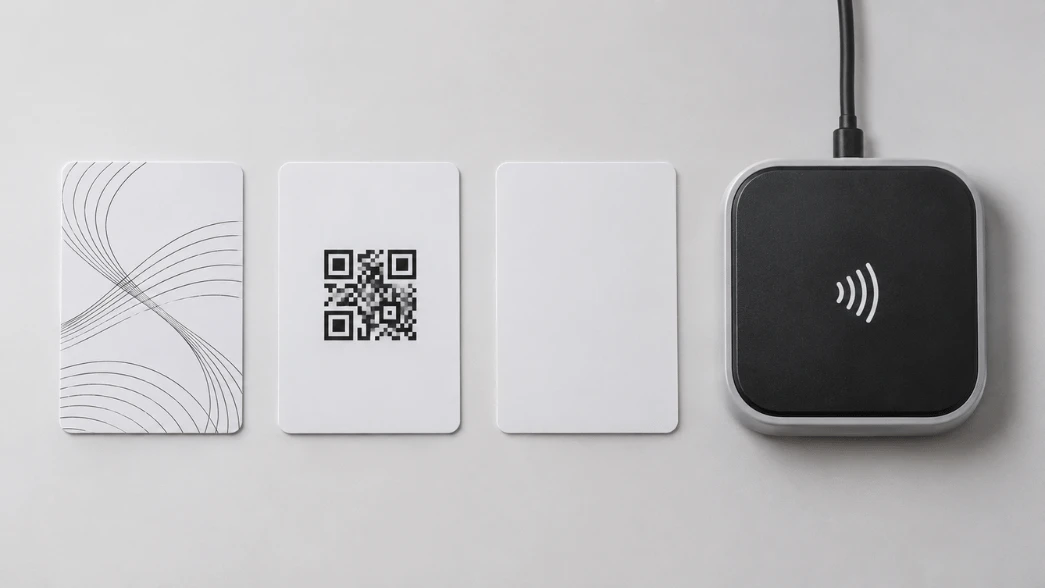
A printed PVC card and an RFID-enabled PVC card may look almost identical on a desk. The difference is not the plastic. It is what the card must do at the point of use. If a membership assistant only needs to see a name or scan a barcode, an embedded chip may add cost and integration work without improving the task. If a gate or building reader must recognize a contactless credential, surface printing alone cannot fulfill the requirement.
This guide helps an operations or procurement team decide whether electronics belong in the card at all, before negotiating artwork, blank versus pre-printed stock or a particular RFID chip. It covers membership, staff ID, simple access and phone-tap engagement as distinct workflows. It does not select a specific Syntek chip or certify a card against your installed readers; those decisions depend on the system and a production-equivalent sample.
Start with the transaction, not the material
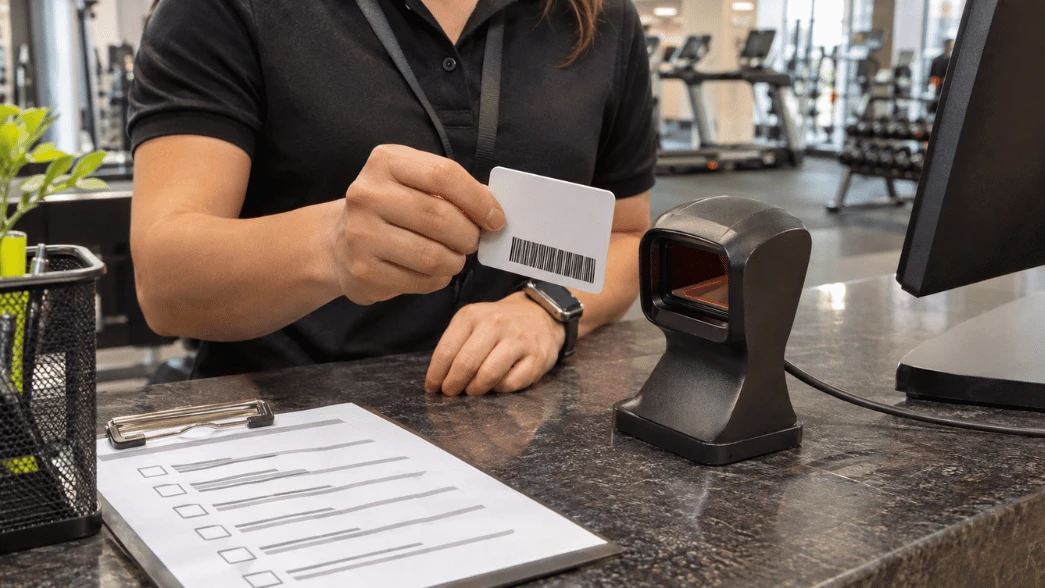
Picture three very ordinary interactions. At a gym counter, a receptionist visually confirms a member's name and enters the account number. At a membership desk, a scanner reads a printed barcode and retrieves the person's record. At a controlled door, an electronic reader receives a card credential and asks an access-control system whether to open. All three cards might have a glossy white PVC surface, but only the third interaction necessarily calls for a compatible electronic credential at the door. A fourth interaction-a visitor tapping a phone on a card to open a webpage-may benefit from NFC, but it uses a different app and compatibility model from door access.
The right first question is: what event must the card cause, and what device will read it? Write the event in a sentence: "Find the member record at the counter," "identify the employee visually," "permit entry at an existing gate," or "open a public webpage on a compatible phone." That answer is more informative than a supplier catalog label such as "PVC card," "smart card" or "MIFARE card."
A card body can carry printed text, a photo, a barcode, a QR code, a magnetic stripe, contact pads or an embedded RFID/NFC chip. These are different mechanisms that may be combined. The plastic substrate does not determine the security, the reader protocol or whether the card participates in an authenticated transaction. In mixed systems, a visible code can remain as a fallback even when the finished card includes an RFID credential.
Five card architectures that buyers should not confuse
| Card architecture | What the user does | Necessary infrastructure | What must be proven |
|---|---|---|---|
| Printed PVC with text/photo only | Shows the card to a person | Visual inspection process | Information and print are accurate; human workflow is adequate |
| Printed PVC with barcode or QR | Presents a printed code to a camera/scanner | Reader or compatible phone plus software | Code maps to the correct active record and cannot be misused as an authentication secret |
| PVC with magnetic stripe | Swipes or inserts at a compatible reader | Magnetic-stripe reader and defined track data | Track format, reader support and complete system action |
| PVC with RFID/contactless IC | Presents card near a designated reader | Compatible reader, controller/software and data/credential provisioning | Frequency, protocol, credential, authorization and final transaction |
| PVC with NFC web interaction | Taps using a supported phone/device | Compatible NFC device and controlled URL/content endpoint | Correct payload, supported phone behavior and destination ownership |
The matrix is a design choice, not a performance ranking. A barcode is often sufficient for attended service. RFID can reduce an explicit presentation step in some workflows, but "tap instead of scan" is not automatically faster or more secure in the actual business process. A badge with a chip does not authorize a person by itself; the surrounding reader, controller and application decide what happens.
The NFC Forum's technology overview provides the official 13.56 MHz basis for NFC. For physical identification-card construction, ISO/IEC 7810 addresses card characteristics and dimensions, not application compatibility or access permission.
Membership cards: when a printed code is enough
Membership programs are frequently the easiest place to overbuy card technology. If staff always check in members at a staffed counter and the point-of-sale or membership system already accepts a barcode, a printed PVC card with an account identifier may do the job. Its success depends on readable printing, the scanner and the database lookup-not on the presence of an RFID inlay.
First confirm how the account is established and protected. A scannable member number may be useful for retrieval while the software performs the actual eligibility check. It should not automatically be treated as a secret or strong proof of identity; a photo of a barcode can often reproduce the visible code. When the business requires more confidence, add an appropriate staff check, identity step or server-side control rather than assuming the barcode is authentication.
Then examine how cards are replaced. A printed account number may be reissued after the old record is marked inactive or linked to a successor, depending on the system. If the program's lifecycle includes household memberships, temporary passes or lost cards, document how reissue works before choosing the physical technology. A sophisticated chip cannot correct a poor database process.
Where the program wants an unattended check-in gate or fast physical presentation without line-of-sight scanning, a compatible RFID credential may be justified. That requires a reader at the entry point, credential enrollment, database reconciliation and an exception path for lost or unreadable cards. Evaluate the entire cost of that change, not just the price difference between plain and chipped PVC.
Staff ID: visible identification and electronic access are two jobs
An employee photo badge may serve only as visible identification. In that case, the needed outputs are photo accuracy, name/department information, a legible design and a controlled issue/return process. Adding a contactless chip does not make a person more identifiable to a security guard who relies on the photo; it adds an electronic credential function for a separate reader-based workflow.
Many organizations use a dual-purpose physical card: one surface for human inspection and one embedded credential for door access or attendance. That combination can reduce the number of items a person carries, but the two jobs should be independently approved. A correctly printed photograph does not prove the electronic credential works, and a successful door-reader beep does not prove the printed employee identity is correct.
If building access already exists, start with the live reader and controller documentation. Identify the accepted frequency, protocol, chip or credential family, UID or protected application behavior, facility code and bit format if applicable, enrollment process and required authentication model. Ask who owns the keys or provisioning data. Without those facts, "13.56 MHz PVC RFID card" is an incomplete replacement specification.
The related Syntek printable PVC card compatibility guide takes over once the business has decided to use an embedded credential; it explains the downstream reader, chip and printer selection. This article deliberately stops one decision earlier.
Door access is a system transaction, not a card feature
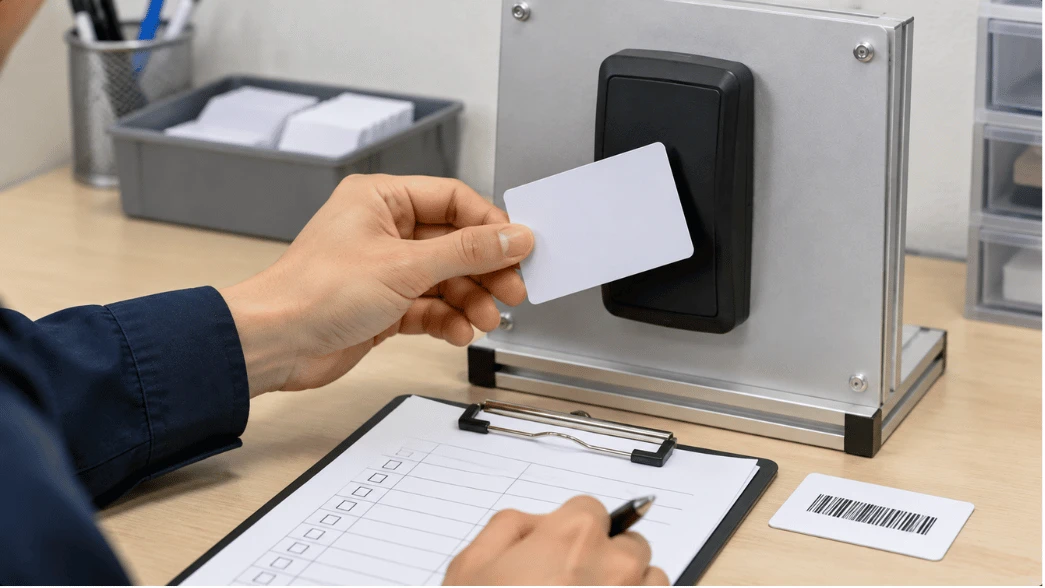
A door reader may detect a card while the controller rejects the credential. That is why electronic access requires a test of the full chain: card technology, reader behavior, credential payload, controller, backend authorization and the physical lock or gate action. Two cards using the same frequency are not necessarily interchangeable. Nor does a card labeled "smart" imply a secure system if the reader makes its decision only from a public identifier.
Separate a new access project from a replacement order for a legacy site. For a replacement order, the operational requirement is normally to reproduce the accepted behavior without unexpectedly changing facility codes, identifiers or user enrollment. For a new system, the organization can specify stronger authentication and credential lifecycle requirements from the beginning. Both choices may use a PVC body; they differ in system constraints.
Avoid confusing a phone-readable NFC promotional tag with an installed access badge. Some smartphones can read web-oriented NFC tags but cannot emulate the exact credential used by a proprietary door system. Demonstrating that a phone opens an NDEF URL proves a web interaction, not compatibility with a lock or turnstile. The application and installed equipment control the distinction.
Physical form matters too. A slot punch, unusually thick overlay or damaged embedded antenna can change whether a finished card works. Approve the final artwork and any hole/slot position against the intended card construction, then test the production-equivalent sample at the actual reader. "Same material" does not guarantee the same antenna or chip performance.
NFC membership engagement is not the same as secure access
A member might tap an NFC-enabled PVC card to open a club's webpage, loyalty registration page or campaign content. That is an interaction use case. It may not require the same chip family, credential provisioning or controller integration as secure access. For a simple web action, the project should define the URL, page ownership, write/lock policy, phone compatibility test and post-launch content maintenance.
If the business already uses a printed QR code to open the same webpage, compare the value of adding a tap path. Some visitors prefer tapping and others prefer scanning. If both are offered, use a controlled destination and confirm that neither printed code nor NFC record points to an unmanaged third-party endpoint. A URL that works during proofing can still become a problem later if a domain expires or the landing page is retired.
NFC does not inherently prove the physical card is authentic. Copyable static URLs and ordinary public NFC data should not be marketed as cryptographic anti-counterfeiting. A system that needs authentication must specify the actual cryptographic mechanism, application and backend verification. The same principle applies to access credentials: "has a chip" is not a security specification.
The best use case for NFC is one where the touch interaction makes the intended journey simpler and the supporting digital service is already managed. Otherwise, printing the URL or QR may be sufficient. Buying an embedded chip to compensate for an unclear digital journey simply moves the ambiguity inside the card.
Calculate system cost before comparing card prices
A plain PVC card order is often evaluated by printed unit price and finishing requirements. An RFID-enabled card adds other cost centers: reader procurement or replacement, software configuration, card encoding, enrollment labor, exception handling, spare equipment, sample validation and ongoing support. If the application already has compatible readers, these costs may be relatively contained. If the site must install a new electronic access system, the project is no longer a simple card purchasing decision.
Build a comparison model using locally quoted, verified inputs instead of generic "RFID is cheaper in the long run" claims. For each option, include the card/printing cost, hardware and software changes, issuance effort, replacement workflow, training and disposal. Add the economic effect of realistic failure modes: scanners unable to read a poor print, card readers that cannot use the credential, and administrative work needed to resolve mismatched account records.
A valuable exercise is to price one complete user action rather than one blank card. For example, ask what resources are needed for a member to check in correctly or an employee to enter through an authorized door. Track the full workflow only if the application has an agreed measurable target. No universal savings percentage is meaningful without a defined baseline.
The cost question by deployment state
| Starting point | Likely first evaluation | Hidden implementation work |
|---|---|---|
| Existing staffed desk and barcode scanner | Printed PVC with barcode | Data mapping, scanner readability, reissue and privacy controls |
| Existing compatible door readers | RFID PVC credentials matching the approved installed profile | Enrollment, data format, key/application controls, reader/backend validation |
| New unattended entry system | System architecture before card purchase | Readers, controller, door hardware, software, security policy and support |
| Campaign/web interaction without a reader estate | Printed QR, NFC, or both | Phone behavior, URL governance, marketing content and support |
Use the last column to plan real purchasing work. Do not buy thousands of electronically enabled cards before someone can demonstrate the required end-to-end event.
Define a card specification without mixing technology layers
A useful request for quotation starts by distinguishing the physical body, the visible or machine-readable surface, and the electronic credential, if any. Use three sections with separate sign-off owners so that print designers do not implicitly choose reader technology and IT teams do not specify artwork requirements by accident.
Physical body: intended card format, size, thickness, material and finish; printer or production method if cards will be personalized later; holes or slots; handling and environmental conditions. If citing ISO/IEC 7810, specify the card type and verified applicable edition instead of using the standard name as a general quality seal.
Printed content: front/back artwork; name or photo fields; numbering; barcode symbology or QR data; brand/legal approval; proof method; record for variable-printing corrections. For a barcode, specify what software entity the scanned data references; an attractive code does not guarantee correct account mapping.
Electronics, if needed: frequency, air interface/protocol, chip family, credential/application data, key management and personalization owner, reader and controller models, enrollment steps and acceptable end-to-end test outcome. Include the firmware or software environment where it materially changes compatibility. A vendor should not guess these fields from the word "RFID."
Order and acceptance: current quantities and expected replenishment, sample approval gate, packaging, intended market, acceptance plan and handling of exceptions. The Syntek RFID card category owns product inquiry and available card configurations. The OEM/ODM information page is the appropriate path for confirming current print/encoding options and commercial terms.
Run a small decision trial before ordering a full batch
A fair trial must compare the result that matters. If choosing between barcode and RFID for membership entry, test each candidate through the real service operation. A barcode trial should use finished print under the scanner and lighting conditions at the counter; it should confirm the correct member appears in the application. An RFID trial should use the approved chip and reader, then verify that the software retrieves the intended credential record and applies the right eligibility rule.
If the two designs serve different tasks, do not force them into a false speed contest. A visible employee badge and a door credential provide different outputs, so evaluate each separately. Where a single card must perform both functions, the candidate passes only when both independent outcomes are demonstrated.
Record the sample's material, printing method, artwork revision, any electronic components, reader/scanner model, expected account or credential value, observed application result and test operator. Use controlled test accounts rather than publishing personal member records. If a sample fails, classify the failure: poor printed-code quality, card geometry, unsupported reader protocol, wrong data mapping, denied authorization or a backend outage. The remedy depends on the layer.
The buyer should predefine sampling and approval thresholds based on actual risk. A high-security access deployment and a simple promotional membership card do not require the same acceptance criteria. Avoid inferring "100% compatible" from one successful desk demonstration; a pilot shows how one defined configuration behaves.
Plan reissue, loss and future migration before you print
Card technology selection is a lifecycle decision. People lose cards, change jobs and leave membership programs. Artwork gets revised. Front-desk equipment is replaced. A program that can issue its first thousand cards but cannot revoke or replace a lost credential will struggle later.
For printed membership numbers, document whether the identifier is reusable and how the system prevents an old barcode from activating an inactive account. For RFID access, define enrollment, suspension, revocation, replacement and credential migration. Track who may assign or reset an identifier and how those actions are audited. Physical cards should not be treated as the authoritative record of active permission; the backend controls eligibility.
If an organization anticipates migration from barcode check-in to an unattended gate, it can preserve the membership account model while changing the presentation technology, provided its software can map new credentials to existing accounts. That does not mean the barcode and RFID identifier should be identical or publicly convertible. Use a deliberate mapping controlled by the application. This can limit administrative disruption without over-specifying a chip today.
Similarly, a building moving from legacy proximity badges to authenticated smart credentials should identify the reader upgrade and key-management plan rather than assuming a card with two technologies resolves every migration issue. Multi-technology credentials can sometimes bridge a transition, but approval requires real tests against both installed reader populations and an explicit retirement condition for the legacy side.
A purchase decision you can defend
Choose plain printed PVC when visual identification or an existing scanner workflow already completes the task, and there is no justified need for an additional electronic reader-based event. Choose PVC with barcode/QR when a visible code and managed software lookup meet the service and fraud-control requirements. Choose RFID-enabled PVC when a compatible contactless credential is required by an actual reader and application-and the system owner can specify how it is enrolled, authenticated and revoked. Choose NFC-enabled PVC for web interaction only when the tap journey is useful and the online destination is maintained.
The final deliverable is not "PVC or RFID" as a slogan. It is a short architectural decision record: the user action, device, backend outcome, physical format, identification method, sample test and lifecycle owner. That gives procurement a reproducible specification, IT an integration boundary and the supplier a clear product inquiry.
For questions about blank RFID stock versus pre-printed encoded stock after you have chosen RFID, use Syntek's blank versus pre-printed RFID cards guide. That next-stage decision belongs to a separate existing page and should not be confused with whether the project needs an electronic chip in the first place.
Send Inquiry