

Custom NFC Stickers Uses: OEM Solutions & Factory Guide
Aug 11, 2026
Leave a message

Why B2B Adoption Outpaces Consumer Use
The commercial application of nfc stickers uses has moved past experimental marketing gimmicks and settled into three high-volume industrial lanes: authentication, contactless engagement, and asset traceability. Fact.MR pegs the NFC packaging segment at a 12.6% historical CAGR (2019–2023), and Grand View Research puts the broader smart packaging market on a 6.2% CAGR track through 2030 - modest numbers on the surface, but the B2B share is where the volume actually lives. Consumer NFC use is capped by phone habit; industrial use is driven by purchase orders that repeat quarterly.
For procurement teams evaluating an OEM factory, the difference between a 10-year deployment and a full-scale re-tagging disaster almost never comes down to the chip family. It comes down to substrate compatibility, encoding workflow, and whether the factory pretested against the actual reader model you plan to deploy. This guide is structured around the three buying decisions that determine that outcome.
Top Commercial Uses of NFC Stickers
1. Smart Packaging and Anti-Counterfeiting
Premium spirits, cosmetics, and pharma brands are the anchor demand here. The standard build is a fragile-face NTAG213 or NTAG424 DNA inlay laminated under the closure seal: when the seal is broken, the antenna traces tear, and the tag becomes permanently unreadable. That physical destruction - not the cryptography alone - is what most brand-protection audits actually score against. If your program relies on a tap for consumer engagement after first open, you need a two-tag layout (one destructive, one persistent), not a single "clever" tag trying to do both.
2. Contactless Engagement and Digital Business Cards
When executing nfc tag uses in marketing, the single biggest cost driver is encoding policy, not chip cost. For public smart posters, tap-to-Wi-Fi cards, or restaurant menu tags, the tags must be permanently locked at the factory. In our order book, roughly 9 out of 10 public-deployment tags ship with irreversibly locked NDEF - password-protected memory is only used when the client explicitly needs remote URL rotation for a rotating marketing campaign. Defaulting to password-protection "just in case" is one of the most common over-specifications we see in incoming RFQs.
For personal vCards, NTAG215's 504 bytes fit a full contact record with photo URL, LinkedIn, and 2–3 phone numbers. A plain URL to a hosted digital business card, on the other hand, needs only NTAG213.
3. Asset Tracking and Field Maintenance
This is where material choice starts silently killing deployments. A paper-face NTAG213 sticker applied to an outdoor utility meter typically delaminates within a single rainy season - the adhesive migrates, water wicks under the face, and within 6–9 months you're either re-tagging 100% of the fleet or accepting a corrupted asset ledger. For any outdoor or wash-cycle environment, the correct build is a PET or PC face with epoxy encapsulation, and the chip should be selected based on read distance under conductive interference (see the anti-metal section below), not on memory size.
How to Choose the Right NFC Chip
Most technical support tickets on programmable nfc stickers oem projects trace back to one of two mistakes: overpaying for memory that will never be used, or under-specifying against the actual reader environment. NXP's official datasheet numbers are the correct starting point:
| Chip | User memory | Data retention | Write endurance | Best-fit use |
|---|---|---|---|---|
| NTAG213 | 144 bytes | 10 years | 100,000 cycles | Plain URLs, UIDs, high-volume marketing |
| NTAG215 | 504 bytes | 10 years | 100,000 cycles | Full vCards, Amiibo-class content |
| NTAG216 | 888 bytes | 10 years | 100,000 cycles | Offline maintenance logs, rich medical data |
Practical rule from our order book: for the majority of B2B nfc stickers uses, NTAG213 is correct and NTAG216 is over-spec. Jumping to 216 typically adds 25–40% to unit cost with no functional gain if the deployment is URL-based.
Before finalizing the chip, three concrete questions decide whether the antenna geometry will actually work in your environment:
- What is the exact reader model? A Zebra MC3300xR handheld and an iPhone 15's NFC modem tolerate very different antenna Q-factors. We tune inlays differently for handheld vs. smartphone-only deployments.
- What is the required minimum read distance under load? "4 cm on a benchtop" and "4 cm through a stretched-wrap pallet" are different specs. State the worst-case scenario, not the ideal.
- Is the mounting substrate conductive or lossy? Metal, carbon-fiber composites, and water-heavy contents (liquids, gel packs) all detune HF antennas. If yes to any of these, skip the standard inlay and go straight to the anti-metal build described next.
If any of these three answers is "not sure," request a sample pack tuned for two adjacent chip options and test both against your reader before locking the BOM.
Overcoming Physical Limits in Industrial NFC Stickers Uses
Standard NFC tags do not work on metal. The metal surface absorbs the 13.56 MHz field and detunes the antenna into silence - no read, no partial read, just zero. This is not a "sometimes" problem; it is a deterministic physics problem, and it is the single most common failure mode in incoming warranty claims from clients who bought bulk tags off a marketplace.
The industry-standard solution is an anti-metal ferrite isolation layer laminated between the antenna and the adhesive. Public reference points: ShopNFC's adhesive ferrite ships at ~0.4mm thickness; Avery Dennison's Bullseye On-Metal inlay adds less than 0.5mm of total build over its non-metal equivalent. Our internal test batches - measured across ~200 sample runs over the past decade for North American and European industrial clients - show that a 0.3mm ferrite layer is sufficient for curved metal pipes and small-radius fittings, while flat metal assets (server racks, HVAC panels, tool cabinets) tune more reliably at 0.5mm. Effective read range between a standard tag and a properly tuned anti-metal tag on the same steel surface, measured with a standard Zebra MC3300xR handheld at ambient temperature, typically differs by 3–5× - often the difference between "unreadable" and "readable at 3 cm."

Instead of guessing which build survives your specific deployment, the reliable next step is short: send us a photo of the substrate and the target read distance, and our engineering team will spec the exact ferrite thickness and adhesive class from our anti-metal RFID product line. Substrate photos alone eliminate ~70% of the back-and-forth in a typical RFQ cycle.
What Factory-Direct OEM Actually Changes for Your Project
When sourcing custom nfc stickers for business, going direct-to-factory typically reduces landed cost by 18–22% versus a trading-house repackaging the same inlays, based on our 2022–2024 quote comparisons across ~40 North American and European B2B accounts. On projects requiring custom die-cut shapes plus bulk pre-encoding, the delta widens past 30% because the intermediary usually adds a per-touch service fee on both the tooling and the encoding runs. But cost is not the primary reason procurement teams switch to direct factory sourcing - control is.
ISO-Certified Quality Control

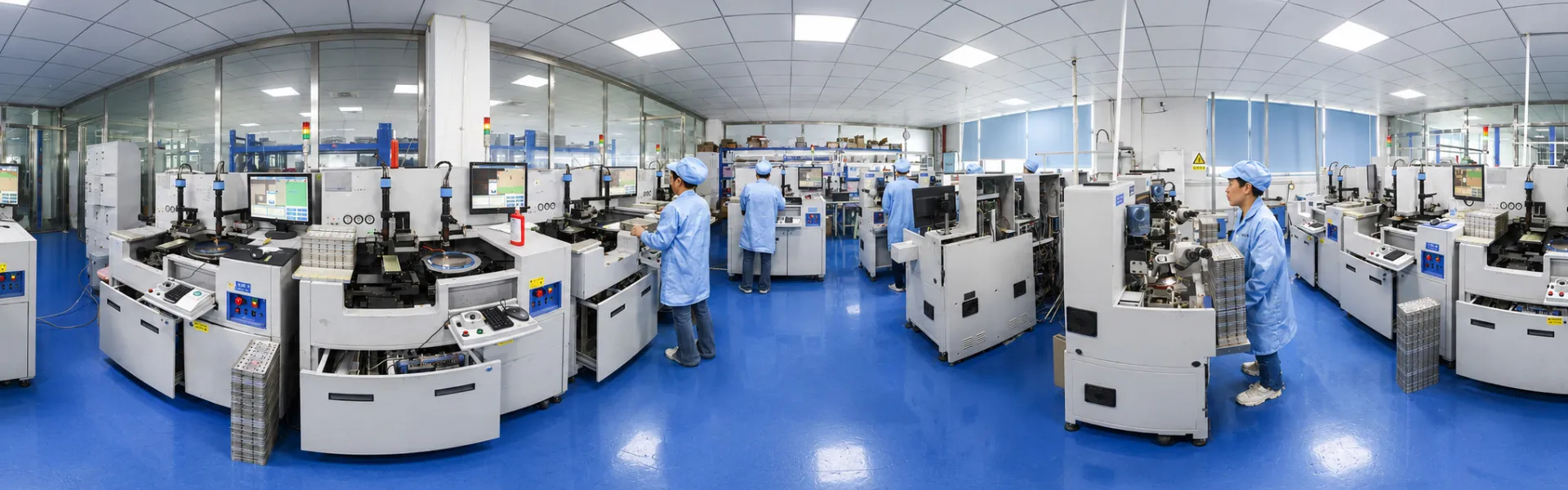
We operate under ISO 9001, CE, and RoHS certifications. Every tag goes through 100% inline functional testing - UID read + NDEF integrity check - before it is wound into a reel. Sample-only QC (the industry norm at the trading-house tier) will typically miss antenna hairline cracks that only manifest after adhesive lamination, which is exactly where field failures originate.
Lead Times and Production Capacity
Concrete numbers for planning purposes: standard bulk orders (stock inlay, no custom encoding) ship in 7–10 working days. Custom die-cut shapes or bulk pre-encoding orders typically require 14–18 working days - the extra time is tooling fabrication plus encoding line setup, not production speed. Sample lead time is 3–5 working days. Daily production capacity exceeds 100,000 pieces per line, and MOQ starts at 500 pieces for standard designs (1,000 pieces once custom printing or die-cutting is added).
Bulk Pre-Encoding and Locking
Manually encoding 50,000 tags via a smartphone app is a hidden 200+ hour labor cost - one of the most common reasons a "cheap" bulk order ends up more expensive than a factory-encoded one. Our OEM service handles inline pre-encoding, per-tag consecutive UID or QR printing, and irreversible locking before reels ship. For campaigns requiring per-tag unique URLs (redemption codes, serialized authentication), we accept a CSV of target payloads and return a manifest matching printed serials to encoded UIDs.
Ready to test these solutions on your actual substrate? Request a sample pack - we ship customized test kits worldwide within 3–5 working days.
FAQ
Q1: What are the most common commercial nfc stickers uses?
A1: The three highest-volume commercial uses are anti-counterfeiting smart packaging (spirits, cosmetics, pharma), tap-to-connect marketing surfaces (digital business cards, smart posters, menu tags), and industrial asset tracking (utility meters, tool cabinets, server racks).
Q2: Which NFC chip should I choose for my business needs?
A2: For plain URLs or UIDs, NTAG213 (144 bytes) is the correct and lowest-cost choice. For full vCards or Amiibo-class content, NTAG215 (504 bytes). NTAG216 (888 bytes) is only justified for offline data storage - for most B2B URL-based deployments, it is over-specification.
Q3: Can NFC stickers be used on metal surfaces?
A3: Standard NFC stickers will not read on metal - the surface detunes the antenna. Anti-metal NFC stickers with a 0.3–0.5mm ferrite isolation layer are required. Syntek supplies both curved-surface (0.3mm) and flat-surface (0.5mm) anti-metal builds.
Q4: Does Syntek RFID factory offer bulk encoding services?
A4: Yes. We provide inline pre-encoding, per-tag consecutive UID/QR printing, and irreversible NDEF locking before reels ship - accepting client-supplied CSV payloads for serialized campaigns.
Send Inquiry