


How Far Can RFID Tags Be Read?
Dec 08, 2025
Leave a message
How far an RFID tag can be read depends on three things: the frequency band it operates in, whether the tag carries its own battery, and the conditions between the tag and the reader. A low-frequency tag implanted in a pet reads at under 10 centimeters. A passive UHF label stuck on a warehouse pallet reads at 5 to 12 meters with a fixed reader. An active tag bolted to a shipping container can respond from over 100 meters away. Those numbers shift significantly once you introduce metal surfaces, liquids, tag orientation, or antenna design into the equation.
The table below provides a quick reference for the most common RFID frequency bands and their typical read distances under standard operating conditions.
| Frequency Band | Typical Range (Passive) | Common Applications |
|---|---|---|
| LF (125–134 kHz) | < 10 cm | Animal ID, access control keyfobs |
| HF (13.56 MHz) | Up to 1 m | Payment cards, library management, NFC |
| UHF (860–960 MHz) | 3–12 m (fixed reader); 1–5 m (handheld) | Retail inventory, logistics, warehouse |
| Microwave (2.45 GHz) | Up to 30 m | Toll collection (ETC), vehicle tracking |
| Active (433 MHz / 2.45 GHz) | 30–150 m+ | Container yards, fleet management, RTLS |
Each of these ranges assumes reasonably clear conditions. Real-world numbers depend on factors covered in the sections that follow.
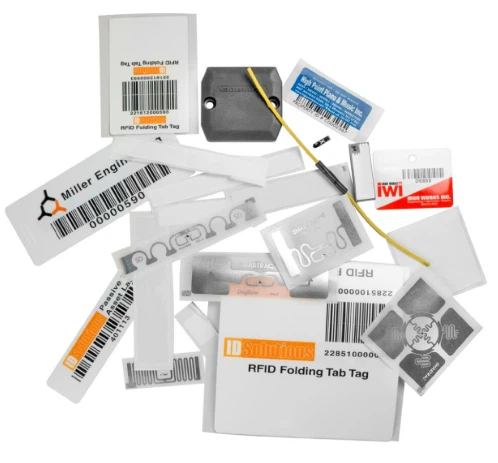
Passive UHF accounts for the majority of RFID deployments in retail, logistics, and manufacturing. These tags draw power entirely from the reader's electromagnetic field, which means the reader's transmit power and antenna gain directly cap the achievable distance.
A fixed UHF reader connected to a high-gain panel antenna (8–9 dBi) in an open warehouse aisle typically achieves 8 to 12 meters on standard-size inlays. Handheld UHF readers, constrained by smaller antennas and battery power, reach roughly 2 to 5 meters under similar conditions. That 2–3x gap between fixed and handheld setups is one of the first things to account for when planning read points in a facility.
Tag size plays a measurable role. A full-size UHF inlay measuring 90 × 20 mm captures more energy from the reader's signal than a compact 30 × 10 mm label designed for individual retail items. Under the same reader configuration, the larger inlay can add 3 to 5 meters of effective distance. Manufacturers often publish read-range specifications based on their largest inlay paired with a high-power reader-numbers that rarely match what a mid-size label achieves on an actual product.
The IC chip inside the tag matters as well. Newer-generation ICs from suppliers like Impinj (Monza R6) and NXP (UCODE 9) feature read sensitivities below -22 dBm, enabling longer communication at lower power levels. An older chip with -17 dBm sensitivity requires noticeably more energy to wake up, which shortens the usable range by several meters even when the reader and antenna stay the same.
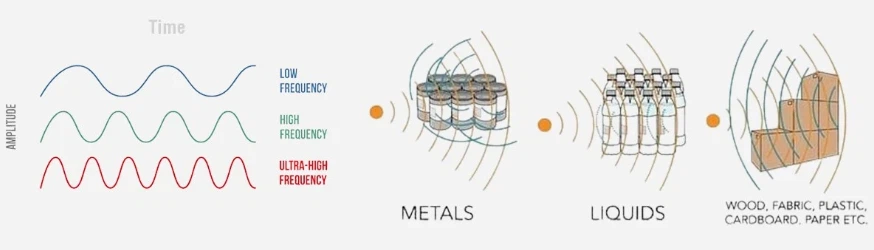
Put the same tag on a metal shelf and the range drops. Put it on a bottle of water and it drops further. Metal and liquid are the two most common materials that degrade passive UHF reading distance. Metal reflects radio waves, creating interference patterns that can cancel the signal at the tag's antenna. A standard UHF label placed flat against a steel shelf may lose 80–90% of its free-air range, dropping from 8 meters to less than half a meter.
On-metal RFID tags solve this by incorporating a spacer layer-often ceramic or foam-that separates the antenna from the metallic surface. These specialized tags can recover 3 to 8 meters of range on steel or aluminum assets, depending on the spacer thickness and antenna design. If your application involves tagging IT equipment racks, tool cribs, or industrial machinery, standard paper-face labels will not deliver usable distance.
Liquid absorbs UHF energy rather than reflecting it. A tag attached to a bottle of water or a case of beverages sees its range shrink to roughly 1 to 3 meters. Pharmaceutical and food-and-beverage operations often work around this by positioning the tag on the outer edge of the container where the liquid column doesn't sit directly behind the antenna.
Other environmental factors compound these effects. Dense shelving creates multipath reflections. Nearby Wi-Fi access points and Bluetooth devices operating in adjacent frequency bands can raise the noise floor. Even the humidity level in a cold-storage facility or a laundry processing plant shifts tag performance enough to require on-site testing before committing to a system layout.

The reader antenna is half the range equation. Two key antenna properties-gain and polarization-determine how far the signal travels and how tolerant the system is of tag orientation.
Antenna gain, measured in dBi, describes how tightly the antenna focuses its energy. A low-gain near-field antenna (2–3 dBi) is designed for read distances under 30 centimeters, suitable for desktop encoding stations or point-of-sale scanners. A mid-gain panel antenna (6 dBi) covers a read zone of roughly 3 to 5 meters and fits most portal or conveyor-belt installations. High-gain directional antennas (9–12 dBi) push passive UHF read distances beyond 10 meters but narrow the beam width, meaning tags outside the antenna's cone receive little energy.
Polarization affects how the antenna's electric field aligns with the tag's antenna. A linear-polarized antenna concentrates all its energy in one plane, maximizing range when the tag is oriented to match. Rotate that tag 90 degrees and the signal drops dramatically. Circular-polarized antennas distribute energy across both planes, making them far more forgiving when tags are oriented randomly-common in retail, laundry processing, or any conveyor where items tumble. The trade-off is a 3 dB power penalty, which translates to roughly 30% less maximum range compared to a perfectly aligned linear setup.
For applications where tagged items pass through a portal in unpredictable orientations, circular polarization is almost always the safer choice despite the modest range sacrifice. Where tags are consistently aligned-such as palletized goods with labels always facing outward-linear polarization delivers the longest possible read distance for passive UHF systems.
Low-frequency RFID at 125 kHz or 134.2 kHz relies on near-field inductive coupling, which physically limits the communication distance to around 10 centimeters for standard-size tags. Oversized LF coils used in livestock gate readers can stretch that to 50–80 centimeters, but those are specialty configurations. The benefit of LF is its resilience: because the wavelength is long relative to most objects, metal and water cause far less interference than they do at UHF. That is why LF remains the standard for animal microchip implants and harsh-environment access keyfobs.
High-frequency RFID at 13.56 MHz also uses inductive coupling and typically reads at distances under one meter. NFC, which is a subset of HF, intentionally restricts communication to approximately 4 centimeters for security reasons-tapping a payment card or phone requires deliberate physical proximity. Library management systems and laundry tag readers using HF can achieve 30 to 70 centimeters with larger reader coils, but pushing HF passive tags beyond a meter requires specialized tunnel readers or unusually large tag antennas.
The short-range nature of LF and HF is not a limitation for their intended use cases-it is the design intent. When a tag stores payment credentials or personal identification data, restricting the readable distance is a security feature, not a shortcoming.
Active RFID tags carry their own battery and transmit a signal at regular intervals, independent of the reader's energy. This self-powered broadcast is what pushes read distances to 30 meters, 80 meters, or over 150 meters in open-area deployments. Container yard management, vehicle fleet tracking, and real-time location systems (RTLS) in hospitals all rely on active tags because passive range simply cannot cover the required area.
The cost structure is different. An active tag runs anywhere from $5 to $50 or more, compared to $0.05–$0.30 for a passive UHF inlay. The battery adds weight, adds thickness, and has a finite life-typically 3 to 7 years depending on the broadcast interval. Systems that beacon every second drain faster than those pinging every 30 seconds.
Achieving the maximum possible read distance from an existing RFID system comes down to optimizing each link in the signal chain, not just swapping in a more powerful reader.
Start with antenna placement. Mounting a fixed reader antenna at the wrong height or angle relative to the tag path is the single most common reason for underperforming read zones. Conduct a site survey with sample tags attached to actual products-not taped to cardboard in a conference room. Move the antenna in small increments and log read rates at each position before bolting anything to a wall.
Minimize cable loss between the reader and antenna. Every meter of coaxial cable attenuates the signal. Low-loss cable (LMR-400 or equivalent) preserves more power over longer runs compared to standard RG-58. For runs exceeding 6 meters, the cable choice alone can make a 1–2 meter difference in effective tag reading distance.
Match antenna polarization to your tag orientation. If tags consistently face the antenna in the same alignment, switch to linear polarization and aim for the extra range. If orientations vary, stay with circular but consider adding a second antenna at a perpendicular angle to cover blind spots.
Upgrade the tag IC, not just the tag size. A newer-generation chip with better receive sensitivity can extend readable distance without changing any infrastructure. This is often the most cost-effective range improvement for large-scale deployments where thousands of tags are in circulation.
Finally, manage the RF environment. Relocate Wi-Fi access points away from reader antennas. Shield metal surfaces near the read zone with RF-absorbing material where feasible. In dense inventory environments, stagger reader activation times to reduce inter-reader interference-a technique called dense reader mode, supported by the EPC Gen2v2 protocol.
Battery-assisted passive (BAP) tags occupy the middle ground. They contain a small battery that powers the IC chip, but they still rely on the reader's signal to initiate communication rather than broadcasting on their own. This hybrid approach extends passive UHF range from the typical 5–10 meters to roughly 15–30 meters while keeping the tag thinner and less expensive than a full active unit. BAP tags suit applications like cold-chain monitoring of pharmaceutical shipments, where the cargo needs to be read at dock-door distances but the tag also needs to log temperature data autonomously between scans.
The boundary between dedicated RFID hardware and consumer devices is shifting. Qualcomm announced plans to embed UHF RFID reader capability into mobile chipsets, and several enterprise phone manufacturers have already shipped handsets with built-in readers. The RAIN Alliance has launched a smartphone interoperability project aimed at standardizing how phones interact with passive UHF tags.
Phone-based UHF reading, however, faces hard physical constraints. A smartphone cannot accommodate the antenna sizes that fixed or dedicated handheld readers use, and regulatory limits on handheld transmit power apply equally. Industry estimates put the practical read distance of a phone-integrated UHF reader at around 1 to 1.2 meters-useful for tapping a product tag to pull up information, but nowhere near the distances needed for inventory scanning at scale.
For tag manufacturers and system integrators, this trend opens a new category of consumer-facing interactions layered on top of existing supply-chain RFID infrastructure, without replacing dedicated readers for operational tasks.
The phone question is about passive UHF. A phone can't fit the big antennas that warehouse readers use. Regulations limit how much power a handheld can broadcast. Thomas Brunner at Kathrein Solutions estimated phone-based readers would reach 120 centimeters at best. That's closer to tapping a payment card than scanning inventory from across a store.
The privacy question depends partly on range. A tag that reads at two centimeters is hard to scan secretly. A tag that reads at 10 meters is easier. A phone that reads at a meter is somewhere in between. Whether that matters depends on what information the tag contains and who wants it.
Send Inquiry