


How RFID Tags and Readers Communicate?
Dec 08, 2025
Leave a message

RFID tags communicate with readers by exchanging radio-frequency energy, and the exact method depends on the operating frequency. UHF tags at 860–960 MHz reply by backscatter-reflecting a modulated version of the reader's own signal. HF tags at 13.56 MHz and LF tags at 125–134 kHz use inductive coupling and load modulation at much shorter range. Passive tags carry no battery; they harvest power from the reader's field to run their chip.
The Gen2 communication sequence, step by step
For UHF, the air interface is defined by the GS1 EPC Gen2 air interface (also ratified as ISO/IEC 18000-63). An inventory round follows a fixed order:
- Power-up. The reader emits a continuous-wave signal. Any passive tag in range rectifies that energy and boots its IC in microseconds.
- Query. The reader sends a command using PIE (Pulse-Interval Encoding). It tells every tag to pick a random slot in a frame whose size the reader sets with the Q parameter.
- RN16. A tag that draws slot zero backscatters a 16-bit random number by toggling its antenna impedance between a matched (absorbing) and mismatched (reflecting) state.
- ACK. The reader echoes that same RN16. The tag verifies the match.
- EPC. Only then does the tag backscatter its Electronic Product Code-typically 96 bits of item-level data.
The full Query-to-EPC exchange takes roughly 5–25 ms per tag, depending on link data rate and encoding. Reading other memory banks requires additional Read commands after the handshake.
Backscatter vs. load modulation: the method changes by frequency
UHF is a far-field, radiative link: the tag reflects the reader's wave. HF and LF are near-field, magnetic links: the tag loads and unloads its coil so the reader sees a change on its own antenna. Two different physics, two different range ceilings.
| Band | Frequency | Coupling / method | Typical read range | Core standards |
|---|---|---|---|---|
| LF | 125–134 kHz | Inductive / load modulation | Up to ~10 cm | ISO 11784/11785, ISO 18000-2 |
| HF | 13.56 MHz | Inductive / load modulation | <10 cm (ISO 14443) to ~1 m (ISO 15693) | ISO 14443, ISO 15693, ISO 18000-3 |
| UHF | 860–960 MHz | Far-field backscatter | 3–10 m typical, up to ~15 m ideal | GS1 EPC Gen2 / ISO/IEC 18000-63 |
If you need centimeter-precision proximity (badges, payment), HF wins. If you need to read a moving pallet from across a dock door, only UHF reaches-but at the cost of metal and liquid sensitivity. For 13.56 MHz hardware decisions, review the difference between RFID and NFC first.
Passive, active, and semi-passive: how the power source changes the link
| Tag type | Power source | Communication | Range | Relative cost | Typical use |
|---|---|---|---|---|---|
| Passive | Harvested from reader field | Backscatter / load modulation | cm to ~10 m | Single-digit cents | Retail, logistics, access |
| Semi-passive (BAP) | Battery powers chip; comms still backscatter | Backscatter | Longer / more reliable than passive | Dollars | Cold chain, sensor tags |
| Active | Onboard battery; transmits own signal | Active RF transmission | 100 m+ | ~$10–50+ | RTLS, container tracking |
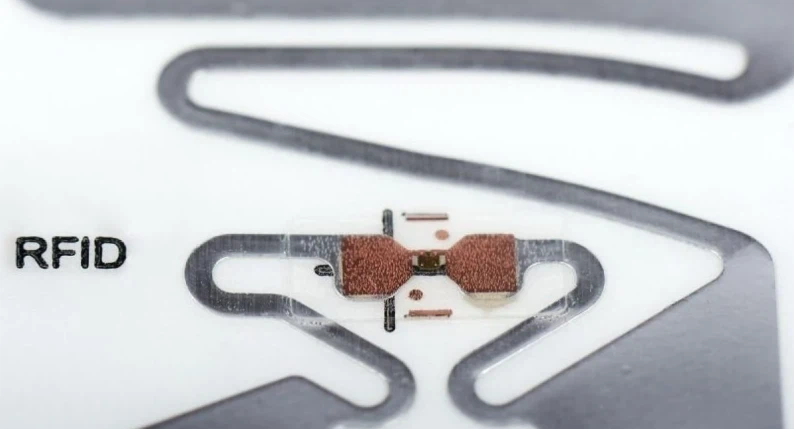
The reason a passive tag stays battery-free is that it never originates a carrier-it only modulates the reflection of one. A semi-passive tag spends its battery on logic and sensors, so the full received energy can feed the backscatter link, extending range without a transmitter. At scale, the tag side is usually a UHF RFID label inlay applied by the billion, while the reader side of every backscatter link is the interrogator-see our UHF RFID readers for fixed and handheld options.
Choosing the communication method for your application
Work through four questions in order; each one narrows the band before cost enters:
- Required read distance? Under ~10 cm → LF/HF. A few meters → UHF. Tens of meters with live tracking → active.
- Item material? Metal or high-liquid content degrades UHF first. If the tagged item is metallic, plan for anti-metal RFID tags or step down to HF/LF where near-field coupling is more forgiving.
- Tag volume and unit cost? High-volume, disposable tagging favors passive UHF inlays at single-digit cents. Low-volume, high-value asset tracking can absorb active tag cost.
- Who builds the reader? Buying finished interrogators is fastest; embedding interrogation into your own device starts from RFID reader modules.
- Coupling method, not marketing, sets the upper bound on how far RFID tags can be read in any given band.
Regional frequency and compliance
UHF is the one band where "communicate with a reader" depends on where you deploy. The allocation and power rules differ by region, and a tag tuned for one center frequency loses a few dB when used in another-significant when you are already at the edge of the link budget.
| Region | UHF band | Max power | Notes |
|---|---|---|---|
| US (FCC 47 CFR Part 15) | 902–928 MHz | 4 W EIRP | Frequency hopping required |
| Europe (ETSI) | 865.6–867.6 MHz | 2 W ERP | Listen-before-talk in some sub-bands |
| China | 920–925 MHz | Per local rule | - |
| Japan | 916–921 MHz | Per local rule | Listen-before-talk |
Note that EIRP and ERP are different power-measurement references, so raw wattage figures are not directly comparable across regions. Specify the deployment region before ordering, and ask the manufacturer for the read-range spec for that band rather than a global headline number.

Troubleshooting tag-reader communication
When tags will not read, the cause is almost always one of five things. Work the list in order:
Power link first. If the tag never powers up, it cannot backscatter, so the reader sees nothing. If it reads at 30 cm but not at 3 m, the problem is link budget, not a dead tag.
Polarization mismatch. A linear reader antenna loses ~3 dB at 45° tag orientation and can drop the link entirely at 90°. Circularly polarized antennas fix this, trading roughly 3 dB of peak gain.
Environment. Other readers, Wi-Fi, or 900 MHz equipment raise the noise floor. A spectrum sweep before install prevents surprises.
Metal and liquid. Steel racking causes multipath cancellation. Use on-metal designs (foam spacer or ferrite layer) that create a controlled ground plane-typically three to five times the cost of a standard inlay.
Reader configuration. An undersized Q causes excessive collisions; an oversized Q wastes empty slots. Anti-collision uses slotted ALOHA, and EPC Gen2 is commonly cited as supporting up to ~1000 tags per second under ideal conditions-rarely seen in a real warehouse.
Tag failure is also a real, budgetable line item: a small percentage of inlays arrive dead-on-arrival or fail early as chips crack or adhesive lifts. High-volume programs model this in; smaller users get surprised.

What data actually gets transmitted
A Gen2 tag organizes memory into four banks: EPC memory (Bank 01, the ~96-bit item identifier sent during inventory), reserved passwords (Bank 00), the factory-fixed TID (Bank 10), and optional user memory (Bank 11). In a standard round only the EPC is returned after the ACK handshake. Writing takes longer than reading, because each write is individually acknowledged and the tag needs more harvested power to drive its non-volatile memory cells.
FAQ
Q: How Does A Passive RFID Tag Send Data Without A Battery?
A: It reflects, rather than transmits. The reader emits a continuous wave; the passive tag harvests a fraction of that energy to power its chip, then encodes data by switching its antenna between two impedance states. The reader detects the tiny changes in the reflected signal. This is backscatter for UHF and load modulation for HF/LF-no onboard transmitter or battery is involved.
Q: How Far Can An RFID Tag Be Read?
A: It depends on the band. LF reaches about 10 cm and HF up to roughly 1 m, both near-field. Passive UHF typically reads 3–10 m and up to ~15 m in ideal open air, while active tags reach 100 m or more. Real-world range is shorter than spec because metal, liquids, antenna orientation, and interference all reduce the link budget.
Q: What Is The Difference Between Backscatter And Load Modulation?
A: Both let battery-free tags reply, but the physics differ. Backscatter (UHF, far-field) reflects the reader's radiated wave by changing antenna impedance. Load modulation (HF/LF, near-field) varies the load on a coil so the reader sees a change on its own coil through magnetic coupling. Backscatter enables meter-level range; load modulation is limited to short, close-proximity reads.
Q: Why Do My RFID Tags Fail To Read Near Metal?
A: Metal reflects and detunes UHF signals, and steel surroundings create multipath cancellation where reflected copies arrive out of phase. Liquids absorb UHF energy. The fix is an on-metal tag with a foam spacer or ferrite layer that forms a controlled ground plane, or moving down to HF/LF where near-field coupling tolerates these materials better. Expect on-metal tags to cost several times a standard inlay.
Q: What Frequency Do RFID Tags And Readers Use?
A: Three main bands. LF at 125–134 kHz and HF at 13.56 MHz use near-field coupling for short-range access, payment, and animal ID. UHF at 860–960 MHz uses far-field backscatter for meter-range logistics and retail. Tag and reader must share the same band to communicate, and UHF allocations vary by region (902–928 MHz in the US, 865.6–867.6 MHz in Europe).
Send Inquiry