

What Is the Difference Between RFID and NFC?
Dec 09, 2025
Leave a message

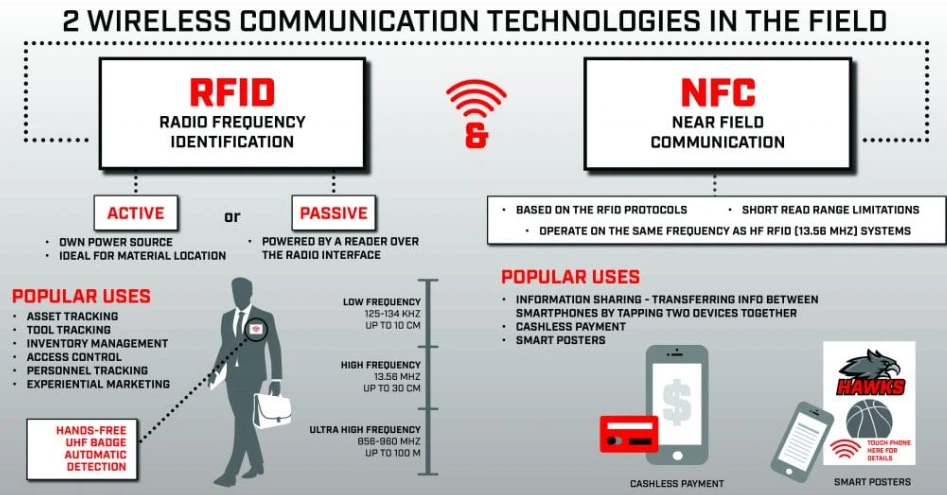
RFID vs NFC is not a choice between "old" and "new" technology. It is a workflow decision. Use RFID when tagged items must be identified automatically at a distance, often in batches. Use NFC when a person, phone, card, or terminal should make a deliberate close-range tap, usually within a few centimeters.
RFID Vs NFC: The Buyer-Level Answer
The practical difference is simple: RFID is usually selected for automatic identification, while NFC is selected for intentional interaction. A warehouse gate, laundry tunnel, retail shelf, or production line needs RFID because the system must detect many tags without touching each item. A phone-readable package, access card, inspection point, or smart poster needs NFC because the user is expected to tap one item at a time.
| Decision Point | Choose RFID When... | Choose NFC When... | What To Confirm Before Ordering |
|---|---|---|---|
| Read behavior | Items should be captured automatically as they pass a reader zone. | A user should intentionally tap a tag, card, wristband, or terminal. | Define whether the workflow is hands-free or tap-based. |
| Typical range | Near contact to several meters, depending on LF, HF, UHF, antenna, reader power, and environment. | Usually a very close tap; NFC Forum describes NFC as 13.56 MHz short-range communication. | State the required read distance in centimeters or meters, not just the chip name. |
| Frequency family | May use LF 125 kHz / 134.2 kHz, HF 13.56 MHz, UHF 860–960 MHz, or active RFID bands. | Uses 13.56 MHz and is commonly associated with ISO/IEC 14443 and NFC Forum specifications. | Match tag frequency, reader protocol, region, and existing system. |
| Reader device | Fixed reader, handheld reader, desktop encoder, antenna portal, or embedded module. | Smartphone, NFC terminal, access reader, or NFC writer. | Confirm whether the reader is already installed or must be sourced with the tags. |
| Batch reading | Suitable when many items must be read quickly, especially with UHF / RAIN RFID. | Usually one close interaction at a time. | Estimate tags per second, item density, and movement speed. |
| Phone compatibility | Not guaranteed. UHF and LF RFID tags normally need dedicated readers. | Usually the correct choice when ordinary smartphones must read the tag. | Ask whether the tag must be readable by iPhone or Android NFC. |
| Common applications | Warehouse inventory, logistics, apparel, laundry, tools, production tracking, vehicle access, asset management. | Payments, access credentials, smart packaging, product authentication, marketing, inspection check-ins, membership. | Choose by use case first, then by chip and label construction. |
The Core Difference: Automatic Capture Or Intentional Tap
If the system must identify objects without a person stopping to scan each one, RFID is normally the better starting point. A UHF RFID gate can detect cartons, garments, tools, or tagged assets as they move through a read zone. For this type of workflow, UHF RFID tag stickers for automated inventory reads are more relevant than phone-readable NFC labels.
If the action should happen only after a deliberate human gesture, NFC is usually the better choice. A customer tapping packaging, a hotel guest presenting a wristband, or a technician checking in at a machine all benefit from the short-range tap. In those cases, custom 13.56 MHz NFC tags for phone interaction give a clearer user experience than long-range RFID.
Frequency And Range: Do Not Buy By The Word "RFID" Alone
RFID is a broad family. NFC is one short-range branch of that family. Two tags may look almost identical as adhesive labels, but one may be a UHF EPC label for warehouse scanning while the other is an NFC label for a phone tap. The chip, antenna, reader, and memory model can all be different.
| Technology | Typical Frequency | Typical Buyer Use | Selection Warning |
|---|---|---|---|
| LF RFID | 125 kHz or 134.2 kHz | Animal identification, legacy access control, harsh environments. | Usually not phone-readable; confirm reader compatibility first. |
| HF RFID | 13.56 MHz | Smart cards, libraries, tickets, access credentials, some industrial labels. | HF does not automatically mean NFC-compatible; confirm protocol and memory type. |
| NFC | 13.56 MHz | Phone tap labels, smart packaging, authentication pages, membership, inspection records. | Best for deliberate close-range interaction, not long-range batch inventory. |
| UHF / RAIN RFID | 860–960 MHz, depending on region | Warehouse, logistics, retail apparel, asset tracking, gate reading, supply chain visibility. | Needs UHF reader and antenna design; ordinary phones cannot read standard UHF labels. |
For a deeper frequency review before chip selection, compare the RFID operating frequency guidelines for LF HF and UHF projects. This is useful when a project includes legacy access cards, UHF inventory, and NFC phone interaction at the same time.
Where RAIN RFID Fits In The RFID Vs NFC Decision
RAIN RFID refers to passive UHF RFID systems based on ISO/IEC 18000-63 and GS1 UHF Gen2. In practical sourcing terms, RAIN RFID is the family to consider when the project needs long-range item identification, fast stock counting, and many-tag reading across warehouses, retail stores, logistics points, or industrial assets.
If cartons, garments, pallets, tools, or returnable containers must be detected at a doorway or conveyor, NFC will usually create unnecessary manual labor. A worker would have to tap every item. For gate-style deployments, evaluate long-range UHF RFID readers for gate scanning together with sample tags before finalizing the label size and antenna design.
When RFID Is The Better Choice
RFID is better when speed, distance, or batch reading matters more than user interaction. It reduces manual scanning when the system can create a reliable read zone. The exact RFID type still depends on the item, surface, environment, reader distance, and data requirement.
- Warehouse inventory: UHF RFID can count many tagged items without line-of-sight scanning.
- Retail apparel: UHF labels support item-level stock visibility and faster cycle counts.
- Laundry and textile circulation: RFID laundry tags can be counted through sorting, washing, dispatch, and return workflows.
- Industrial asset tracking: RFID can record movement at gates, shelves, benches, and process checkpoints.
- Vehicle or long-range access: UHF systems can support hands-free reads where short tap access is not enough.
When NFC Is The Better Choice
NFC is better when the project needs a controlled close-range action. The short range is not only a limitation; it is the reason the interaction feels intentional. A user taps a tag because they want to open a URL, verify a product, unlock access, register a warranty, check in at a point, or trigger an app action.
- Smart packaging: NFC labels can open product pages, manuals, warranty forms, or anti-counterfeiting pages from a phone.
- Access credentials: NFC cards, keyfobs, or wristbands fit controlled tap-to-enter workflows.
- Inspection and maintenance: NFC tags can prove that a technician was physically present at the asset.
- Marketing and membership: NFC can connect offline products, posters, or badges to digital actions.
- Pre-encoded labels: NFC memory can hold URL, ID, or application data when prepared before deployment.
When tags need to be encoded, tested, or rewritten in batches before shipment, NFC reader and writer devices for tag encoding can make the workflow more repeatable than relying only on individual phones.
Can A Smartphone Read RFID Tags?
A smartphone with NFC can read many NFC tags and some compatible 13.56 MHz HF tags, but it cannot read standard UHF RAIN RFID labels used for long-range inventory. UHF RFID uses a different frequency band and requires a dedicated UHF reader and antenna. This is one of the most common sourcing mistakes.
| Tag Type | Can A Typical NFC Phone Read It? | What To Use Instead |
|---|---|---|
| NTAG / NFC sticker | Usually yes, depending on phone, encoding, and tag placement. | Use phone or NFC reader/writer. |
| HF 13.56 MHz non-NFC card | Sometimes, but not guaranteed. | Confirm protocol, chip type, and phone support. |
| LF 125 kHz access tag | No in normal smartphone use. | Use compatible LF reader. |
| UHF EPC / RAIN RFID label | No in normal smartphone use. | Use UHF handheld, desktop, tunnel, or fixed reader. |
Common Purchasing Mistakes To Avoid
Most RFID vs NFC mistakes happen before the sample stage. The buyer chooses by product name, appearance, or chip popularity instead of workflow, frequency, reader, and installation environment.
- Assuming every RFID tag works with phones: only NFC-compatible tags are realistic for ordinary smartphone interaction.
- Using NFC for bulk inventory: tapping hundreds or thousands of items creates labor cost and bottlenecks.
- Ignoring metal or liquid: metal surfaces, liquids, stacking density, and reader angle can change read performance.
- Buying tags before confirming the reader: frequency, protocol, memory, and antenna design must match the installed hardware.
- Skipping sample testing: test tags on the real item, at the real distance, with the real reader before mass production.
Can RFID And NFC Work Together?
Yes. In many industrial and brand projects, RFID and NFC solve different parts of the same process. UHF RFID can track items through production, warehouse, and logistics. NFC can stay on the consumer-facing package or service point for phone taps, authentication, warranty registration, or maintenance records.
A hybrid design is useful when one workflow needs automatic visibility and another needs human confirmation. For example, UHF RFID can confirm that a box entered the warehouse, while NFC on the product packaging lets the end customer verify authenticity. For standards context across these technologies, see the related article on RFID and NFC standards and application background.
Standards And Compatibility To Check
Standards do not replace sample testing, but they prevent many avoidable sourcing errors. NFC projects should confirm NFC Forum compatibility and the relevant 13.56 MHz protocol. UHF / RAIN RFID projects should confirm EPC memory, regional frequency, ISO/IEC 18000-63, and GS1 UHF Gen2 requirements where applicable.
- NFC Forum: use the NFC Forum NFC Technology reference for NFC operating principles and short-range interaction.
- RAIN Alliance: use the RAIN Alliance standards page when specifying passive UHF / RAIN RFID systems.
- GS1: use the GS1 EPC UHF Gen2 Air Interface Protocol when the supply chain requires EPC Gen2 alignment.
RFQ Checklist: What To Send Before Asking For A Quote
Before requesting a quote, define the workflow in operational terms. A supplier can recommend a better RFID or NFC product when the use case, read distance, reader, surface, environment, and encoding requirement are clear.
| RFQ Item | What To Provide | Why It Matters |
|---|---|---|
| Application | Inventory, access, packaging, anti-counterfeiting, inspection, laundry, asset tracking, or event use. | The same tag shape may need a different chip or antenna for different workflows. |
| Required read distance | Tap, 5 cm, 10 cm, 1 m, 3 m, 5 m, or another target range. | Range determines whether NFC, HF RFID, LF RFID, or UHF RFID is realistic. |
| Reader type | Phone, access reader, NFC writer, UHF handheld, fixed reader, tunnel reader, or existing reader model. | Reader compatibility is often more important than the tag name. |
| Tag surface | Plastic, cardboard, glass, textile, metal, liquid container, curved handle, or other surface. | Surface material affects antenna tuning and adhesive choice. |
| Data requirement | URL, UID only, EPC, user memory, encrypted data, serial number, QR/barcode match, or custom encoding. | Memory and encoding needs affect chip choice and production process. |
| Physical format | Sticker, card, keyfob, wristband, laundry tag, hard tag, anti-metal label, or custom shape. | The carrier determines durability, installation, printability, and user experience. |
| Testing plan | Sample quantity, real item photos, reader position, expected movement speed, and pass/fail criteria. | A small pilot prevents large production orders with the wrong frequency or antenna. |
FAQ: RFID Vs NFC Selection Questions
Q: Is NFC A Type Of RFID?
A: Yes. NFC is a specialized short-range branch of high-frequency RFID operating at 13.56 MHz. The important sourcing point is that not every RFID tag is NFC-compatible. UHF inventory labels, LF access tags, and some HF RFID cards may all be RFID, but they do not automatically work like NFC phone-tap tags.
Q: Which Is Better, RFID Or NFC?
A: Neither is universally better. RFID is better for automatic identification, longer read distance, and batch reading. NFC is better for close-range, intentional actions such as phone taps, access presentation, authentication, and inspection check-ins. Choose by workflow first, then confirm frequency, reader, memory, and tag construction.
Q: Can I Use NFC For Inventory Tracking?
A: NFC can track individual items when a person taps each tag, but it is usually inefficient for high-volume inventory. For warehouse shelves, cartons, garments, laundry, or assets moving through a gate, UHF / RAIN RFID is normally a better fit because it supports faster, non-line-of-sight reading with dedicated readers.
Q: Can A Phone Read UHF RFID Tags?
A: A normal smartphone with NFC cannot read standard UHF RFID tags. UHF labels operate in the 860–960 MHz range and need a UHF RFID reader and antenna. Phones are useful for NFC tags and some compatible HF 13.56 MHz interactions, not for standard long-range UHF inventory labels.
Q: Is RFID Or NFC More Secure?
A: Security depends on the chip, protocol, data model, reader control, and application design. NFC has a natural advantage for intentional user actions because the range is very short. Long-range RFID can also be secure, but it needs careful reader placement, access permissions, encoding control, and privacy planning.
Q: Can One Product Use Both RFID And NFC?
A: Yes. Some projects use dual-frequency tags or two separate tags on the same product. A common design is UHF RFID for supply chain visibility and NFC for customer engagement, service records, warranty registration, or product authentication. This works best when each frequency has a clearly defined role.
Implementation note: if the SaaS editor removes script tags, move the JSON-LD block to the site's custom code area.
Send Inquiry