


How To Retrofit RFID Waste Bin Tags: Mounting, Lift-Cycle Testing And Tag Replacement
Oct 12, 2026
Leave a message

Retrofitting RFID onto an existing waste-bin fleet is a mechanical and operational integration task. A screw-mounted transponder may fit securely on a container and read on a workbench, yet fail when the bin is lifted by a collection truck. The opposite problem is possible too: a truck reader may detect a nearby bin that was never collected.
Before ordering tags for a waste collection rollout, confirm the container design, the lifting equipment, the required RFID interface, the location of the reader and the meaning of a successful collection event. This guide provides a field-oriented retrofit and acceptance method for waste contractors, municipal operations, container suppliers and RFID system integrators.
Define What the Retrofit Must Prove
Start with the event the waste operator needs to record. The simplest target is bin identification at a defined point in the route. More demanding projects want to distinguish an attempted lift from a completed lift, associate a bin with a route or customer, or link collection events with measured weight.
RFID provides an identifier when a compatible reader detects a tag. The tag alone does not measure fullness, prove emptying, determine weight or provide GPS coordinates. Those tasks require additional sensors, vehicle systems and business rules. A truck-mounted read may support a collection record only when the chosen workflow establishes that the bin was actually handled.
| Operational question | What must be validated | What a bare RFID read cannot establish |
|---|---|---|
| Which bin approached the lifter? | Reader captured the identifier inside the intended lift zone | Whether the bin was lifted |
| Was a collection completed? | RFID identity combined with defined lift-cycle or operator evidence | That waste actually left the container |
| Which customer or location owns the bin? | Identifier correctly mapped to the authoritative bin register | That the current location equals the registered address |
| How much waste was collected? | Approved weighing process and linked measurement record | Any weight or volume measurement |
| Was a tag replaced? | Old and new electronic identifiers reconciled to the same bin record | Continuity of asset history by itself |
For a general introduction to the application, Syntek already has a waste-bin RFID use-case overview. This page deals specifically with retrofitting, installation validation and maintenance.
Survey the Containers and Lifting Equipment Before Choosing a Mount
Existing bins rarely form one perfectly uniform population. A municipality may operate two-wheel plastic carts, four-wheel containers, bins with different rim designs, older replacement lids and metal commercial containers. The collection fleet may use comb lifters, trunnion mechanisms, side loaders or manually handled bins.
Record the combination of container model, lifting mechanism and reader location for every group in the pilot. A mounting position that is protected on one cart may sit inside the impact or abrasion path on another.
For European installations, EN 14803 addresses waste-container identification and quantity-determination systems, including safety, interfaces, performance and data integrity. Its scope includes systems handling EN 840-series containers. Project-specific mounting and compliance decisions still require the applicable standard, the container and lifting-equipment documentation, and an approved installation design.
Use a simple survey record:
| Survey item | Question to answer on site |
|---|---|
| Bin model and material | What plastic, metal or mixed construction is actually in service? |
| Existing transponder nest | Is a designed RFID recess available, and what are its dimensions? |
| Approved mounting region | Which locations are clear of moving, gripping and wear surfaces? |
| Bin condition | Are there cracks, repairs, warped rims or previous fixing holes? |
| Lifter style | Comb, trunnion, side loading or another handling arrangement? |
| Reader and antenna | Where is the sensing field expected during a lift? |
| Existing label or identifier | What printed number or barcode already identifies the bin? |
| Service environment | What cleaning, impact, weather and contamination are realistic? |
Decide Between a Nest-Fit Transponder and a Screw-Mounted Tag
These options are not interchangeable merely because they are both called RFID waste-bin tags.
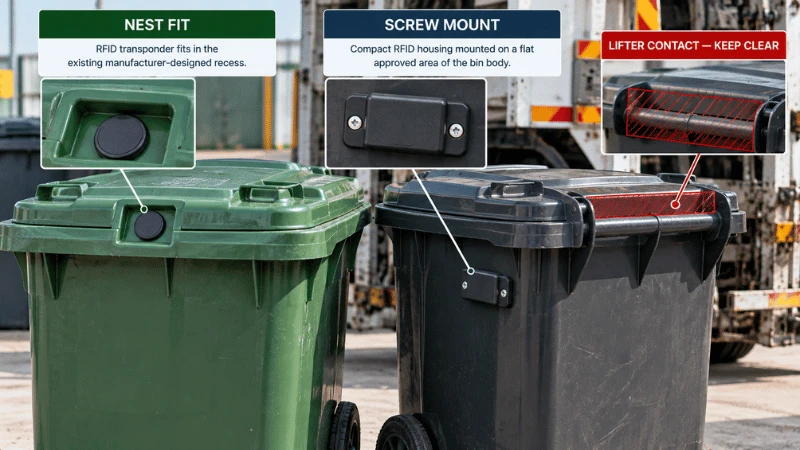
Using an existing bin nest
Some containers have a purpose-designed location for a transponder. If the approved tag fits that location and the collection reader is designed to interrogate it, a nest-fit installation can avoid new holes. Confirm the recess geometry, retention method, insertion direction and reader alignment; a visually similar cavity is not proof of interchangeability.
Adding a screw-mounted housing
A screw-mounted tag may be appropriate when an existing fleet lacks a compatible nest or a project-specific mounting arrangement calls for a surface-fixed unit. The installation needs an approved fixing surface, correct fasteners, clearance around the lifter and protection from scraping or deliberate removal.
Drilling into a cart is a design decision, not a default instruction. Unauthorized holes or fasteners can weaken the container, create cracks, expose a tag to damage or interfere with safe operation. Follow the bin maker's instructions and the approved retrofit drawing. Do not place the tag on a lifting contact area solely because it gives the strongest bench read.
If a container already has a functioning approved RFID mount, replacing it with a screwed-on tag should have an identified benefit and a validated mechanical reason.
Lock the RFID Technology to the Actual Reader
Waste-bin projects may use low-frequency RFID or UHF RFID, depending on the installed collection system. Product catalogs often list multiple chips or bands under the broad heading "RFID bin tag." These options are not radio-compatible alternatives.
According to GS1's explanation of RFID frequency bands, LF, HF and UHF systems have different operating bands and associated protocols. For example, ISO/IEC 14443 is associated with HF contactless smart-card technology, whereas passive UHF EPC/RAIN implementations use the Gen2 family and ISO/IEC 18000-63. The same headline frequency or the same application name does not prove that a particular truck reader can read a particular tag.
Before sampling, ask for the installed system's:
- frequency band and regional operating configuration;
- air-interface protocol, supported tag types and any encoding constraints;
- reader model, firmware and antenna configuration;
- expected tag identifier format and data interpretation;
- physical sensing position relative to the lifter;
- method for confirming a lift event, if required.
A mismatch can be invisible until commissioning: the housing fits the cart, but the reader cannot inventory the tag or its identifier cannot be mapped correctly by the application.
Choose the Mounting Position for the Lift, Not the Bench
The best position is the one that combines safe attachment, predictable radio coupling and survivability through real collection operations. It is not necessarily the place where a handheld reader shows the longest distance during an isolated test.
On a prototype bin, compare only manufacturer-approved candidate locations. Document a clear photo, position relative to the bin rim, tag orientation, fastener type and the lifting equipment used. Then run the bin through the actual reader field while the lifter follows its normal motion.
Pay particular attention to:
- Moving contact surfaces: comb teeth, lifting arms, trunnion pockets, wheels and handling points must remain unobstructed.
- Orientation: the tag may rotate substantially as the bin is lifted, emptied and returned.
- Metal proximity: a tag that behaves normally on a plastic cart may require a different design when mounted against metal.
- Contamination: dirty bins and wet surfaces should be included in tests, rather than using only cleaned samples.
- Public exposure: a visible tag may be more vulnerable to deliberate removal or impact.
- Servicing: replacement staff must be able to inspect and access the tag safely.
For passive RFID, GS1 notes that a useful read zone depends on reader power, antenna pattern and tag orientation. A maximum-distance claim is a poor acceptance criterion for a truck lift whose geometry changes throughout the cycle.
Prepare a Repeatable Installation Work Instruction
A pilot does not scale if every installer chooses a different angle or screw. Once the sample position is approved, write an installation instruction that can be audited in the field.
- Verify the bin identity, model and approved mounting location against the work order.
- Inspect the proposed area for damage, cracks or interference with the lifter.
- Confirm the correct tag construction, reader compatibility and identifier assignment.
- Install with the approved fastener, orientation and method specified by the container/tag design; use the specified tightening practice rather than inventing a universal torque.
- Inspect mechanical retention and verify that no sharp edge, protrusion or moving obstruction has been created.
- Read the installed tag with the intended verification device and compare the returned value with the installation record.
- Capture the final position and result; quarantine any unreadable or incorrectly associated installation.
If any step requires modifications to lifting equipment or a safety-critical part of the container, stop for the relevant engineering approval. A tag installation must not compromise safe waste handling.
Create a Bin-to-Tag Register Before Route Testing
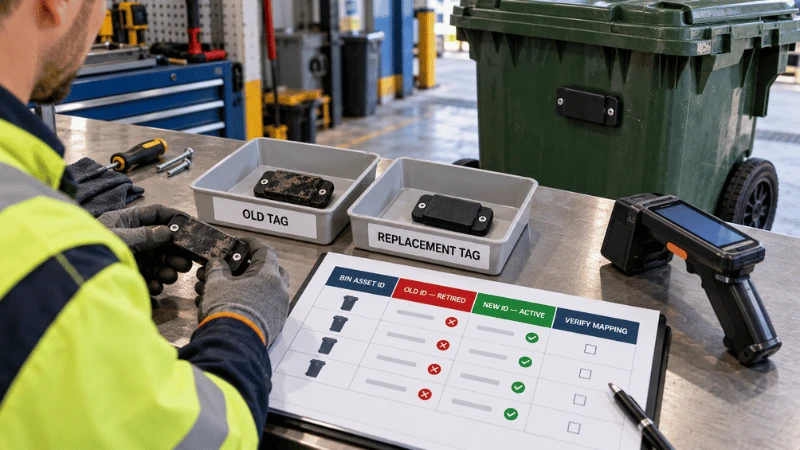
Waste collection systems need to distinguish the long-lived bin asset from its replaceable tag. A practical register contains the bin's stable business identifier, its printed marking, the active RFID identifier, its assigned location or account, the container model and the installation history.
| Field | Reason |
|---|---|
| Bin asset ID | Persistent record that survives tag changes |
| Printed bin or barcode number | Fallback for field inspection and dispute resolution |
| Active RFID identifier | Value that the selected collection reader returns |
| Container model / material | Explains the approved installation method and test group |
| Service point / customer account | Operational relationship; updated independently of the tag |
| Mounting location / image | Supports repeat installation and failure investigation |
| Installation and verification status | Shows whether the bin entered service after acceptance |
| Old RFID identifier / replacement reason | Preserves continuity when the physical tag is changed |
Do not assume that the printed serial, RFID chip identity and municipal asset number are the same string. Decide what each field means, then check the mapping before automatic collection records are enabled.
Test an Actual Lift Cycle, Including Adjacent Bins
The highest-value acceptance test is a sequence that exercises the normal collection action and the most plausible false positives. A passing bench read is only a preliminary check.
One-bin lift sequence
Record the RFID observations across approach, engagement, lifting, tipping and return. Compare timestamps with any available lift signal or truck event. Where the business process requires a completed-collection event, establish which combination of signals creates it. The tag alone cannot supply that judgment.
Neighbor and non-collection sequence
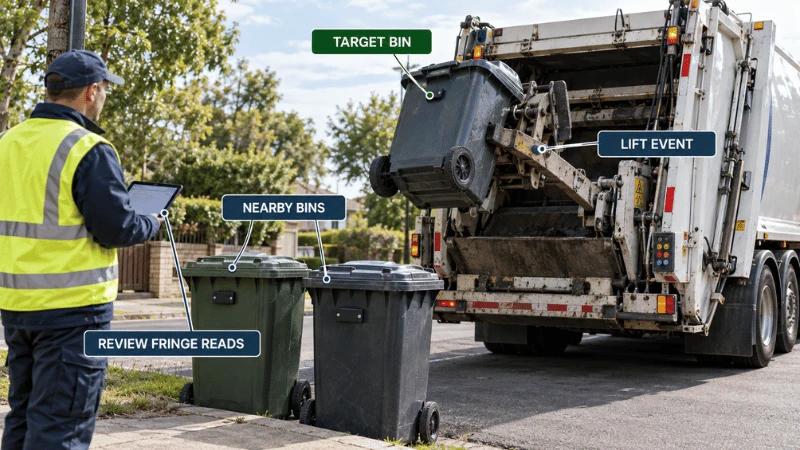
Position other tagged bins as they normally appear at a roadside pickup. Move the target bin through the lift while the neighbors remain stationary. Confirm that the business system does not count stationary bins as collected merely because a radio read occurred. Repeat with a truck passing bins without lifting them if that scenario is relevant.
Mixed-bin sequence
Use the container models, tag positions and operating states that the real route will encounter. Include dirty or wet bins, different fill conditions, normal vehicle motion and the assigned operator procedure. Repeat after any change to antennas, reader power, mounting method or software filtering.
For UHF systems, a wide RF field can be useful for inventory but problematic for distinguishing one lift from the next. The objective here is a defined lift-zone result, not the maximum number of tags detected.
Separate Identification From Billing and Quantity Records
A bin tag identifies a container; it does not independently establish a payable quantity of waste. Even when the operator has a pay-as-you-throw program, the invoiceable event depends on the agreed measurement and business process.
The separation can be made explicit:
RFID tag → reader observation → bin identity → validated collection or lift event → optional measured quantity → operational or billing record
Any weight measurement should come from the relevant weighing equipment and be linked to the correct event. An emptying confirmation should follow the system's approved lift/operation logic. A GPS coordinate, where used, comes from a location subsystem rather than the passive tag.
This distinction also prevents repeated RFID observations during one lift from turning into multiple collection or billing entries.
Use an Acceptance Matrix Instead of a Universal Read-Rate Claim
| Test group | Field test | Decision to record |
|---|---|---|
| Mechanical fit | Check approved position, fasteners, clearance and normal lifting motion | No unsafe interference or mounting damage |
| Technology match | Read with the deployed truck/handheld equipment and decode the identifier | Compatible interface and correct identifier format |
| Normal lift | Run representative bins through a full operational lift | Correct bin associated with the intended event |
| Neighbor control | Keep other tagged bins near the truck during collection | Uncollected bins are not assigned false collection events |
| Route variability | Repeat on representative vehicle, bin and operator combinations | Results remain within the project's agreed limits |
| Environmental condition | Verify performance after realistic dirt, moisture and handling exposure | No unexplained failure under defined conditions |
| Data reconciliation | Compare captured ID, bin register, lift event and software record | No mismatched or duplicate bin assignments |
| Offline behavior | Exercise the relevant communication-failure process | Events recover or are flagged without silent loss or duplication |
| Replacement | Retire one tag and install an approved replacement | Same bin record retained; old identifier disabled |
Agree on the numerical thresholds, evidence format and sign-off responsibility before testing. The required limits should reflect the route, the truck hardware, the relevant specification and the consequences of a false or missed event. No single generic vendor read-distance or pass-rate figure can validate every installation.
Replace Damaged Tags Without Creating New Bins in the Database
Bin tags can be broken, removed or rendered unreadable in service. A reliable replacement procedure must protect the asset record and any historical collection data associated with it.
- Identify the physical bin from its approved visible marking or the authoritative asset record.
- Confirm why the original RFID tag is being replaced and capture its identifier if still readable.
- Flag the old identifier as retired or inactive according to the system's controls.
- Assign a replacement identifier and verify that it is not already allocated to another bin.
- Install the approved tag using the same mechanical checks as a new retrofit.
- Read the replacement with the intended equipment and validate the bin-to-tag mapping.
- Confirm that the historical bin asset record and service association were preserved.
- Record the installer, reason, date and final verification status.
If an apparently missing bin still has an active tag in the database, do not recycle its identifier merely because the asset was not seen during the last collection. Resolve the asset status first.
Specify the Retrofit in the RFQ, Not Only the Chip Name
Once the workflow and pilot conditions are known, a tag supplier can quote against a useful technical brief rather than a vague request for an "RFID screw waste-bin tag."
| RFQ item | What the buyer should supply or request |
|---|---|
| Container population | Models, bin materials and availability of a transponder nest |
| Handling geometry | Comb, trunnion or other lifter, plus reader and antenna locations |
| Approved mount | Position drawing, available clearance and fixing constraints |
| Tag technology | Confirmed frequency, air interface, chip/identifier and supported encoding |
| Housing | Dimensions, mounting-hole arrangement, material and fixing details |
| Environment | Weather, washdown, chemicals, mechanical shock and service temperature conditions |
| Asset identification | Required printed number and RFID-to-bin register mapping |
| Verification | Bench and installed readback, lift-cycle pilot and false-read checks |
| Change control | What IC, antenna, housing or assembly changes require reapproval |
| Reorder consistency | Approved reference sample and shipment acceptance process |
The commercial next step is the Syntek RFID bin-tag product page. It can support discussion of a suitable physical tag option; the final specification and claims should be confirmed against the approved SKU documentation and actual truck/bin environment. For readers and other system hardware, see the Syntek RFID reader category.
Release the Retrofit Only After the Whole Workflow Passes
The result of a pilot should be a controlled installation and acceptance package: approved container groups, mounting instructions, reader configuration, identifier map, normal and exception tests, replacement procedure and the named person who signs off each change.
A useful deployment order is:
container survey → system/interface check → approved mounting design → installation pilot → full lift-cycle test → neighbor-bin false-read test → data reconciliation → replacement drill → signed acceptance → staged rollout
The practical goal is not merely to attach an RFID tag that a reader can see. It is to keep the tag attached safely, identify the correct bin at the intended lift point and maintain a trustworthy bin record when hardware is repaired or replaced.
Send Inquiry