


RFID Key Fob Issuance And Return: A Multi-Site Access Control Workflow
Oct 09, 2026
Leave a message

A batch of RFID key fobs can pass a supplier's read test and still become an operational problem on the day it is issued. A facilities team may have the right credentials but no reliable record of which office received them, which employee holds one, which number the controller recognizes, or whether a reported-lost fob was actually disabled.
For multi-site access control, the practical task is to connect physical stock, electronic identity, a named holder, an approved access profile and a recorded lifecycle status. The system must keep those relationships accurate when a fob is issued, transferred, returned, lost or replaced. This is an operating procedure for office, campus and contractor access teams-not a comparison of fob chips or a supplier buying guide.
One Fob, Five Different Records
Start by separating the items that staff often combine in a single spreadsheet column called "card number."
| Record | What it describes | Owner or source | Risk when confused |
|---|---|---|---|
| Physical fob reference | The item received, packed, printed and handed over | Supplier and stock custodian | Wrong item is issued or cannot be found |
| Electronic credential identifier | The value the relevant reader/controller processes, which may differ from the raw chip UID | Approved encoding and reader configuration | A working RF response is not recognized by the access system |
| Person or contractor record | The human currently responsible for the fob | HR, contractor sponsor or identity owner | An unassigned or former user's credential stays active |
| Access authorization | Doors, sites, schedules and expiry attached to the credential or identity | Site owner and access administrator | The fob works at the wrong site or time |
| Lifecycle record | Stocked, reserved, issued, suspended, lost, returned or retired | Credential-operations register | Physical possession and software status diverge |
The number printed on a fob may be a convenient inventory reference, not its actual reader-side credential value. A facility code, card number, hexadecimal representation or proprietary encoding may be involved depending on the installed platform. Syntek's explanation of how access-control key fobs work owns that technical compatibility question; the workflow here assumes a compatible credential has already been approved.

Separate Factory Handover From Site Enrollment
There are two handoffs. First the buyer accepts a physical delivery against an approved supplier specification. Then an authorized administrator enrolls or activates the credential for a real holder in the access-control system. Completing one does not prove the other.
A supplier handover file can reasonably contain batch reference, item sequence, printed number, approved electronic identifier or format, pack/site destination and quality disposition. The supplier generally does not need a full employee roster or permission history. The organization can map the delivered credential to the holder later, inside its own controlled access system.
For a multi-site rollout, nominate one owner of the numbering/identity namespace. Two locations ordering separately should not accidentally create credential collisions or receive overlapping ranges if those ranges must be unique in the shared system. The access-system vendor or integrator must define the actual uniqueness boundary.
Receive a Shipment as Controlled Stock
Receiving should produce a documented answer to four questions: what was delivered, what electronic identifiers are present, which site is responsible for the stock, and which units are unavailable for issue.
For each delivery or sub-batch, check:
- Quantity and group: cartons, bags and site allocations match the packing record.
- Reference integrity: visible numbers or labels correspond to the approved mapping file where provided.
- Electronic response: representative or specified units can be identified using the actual accepted reader/encoding workflow.
- Uniqueness: a data-level comparison finds no duplicates in a namespace that requires unique active credentials.
- Exceptions: damaged, unreadable, duplicated or unrecognized units are quarantined instead of added to available stock.
Sampling levels and acceptance thresholds belong in the buyer's agreed specification; neither a generic percentage nor a reader beep is sufficient proof for every project.
Give Each Site a Stock Custodian and a Reconciliation Boundary
One central team may purchase all the fobs while individual offices issue them. That arrangement needs explicit custody records rather than a single total inventory count.
A simple stock model distinguishes:
- Central unallocated stock: usable units not yet assigned to a site.
- Site available stock: usable units physically held by a named custodian.
- Reserved stock: units set aside for an approved request but not handed over.
- Issued stock: physical credentials handed to holders and tracked in the access system.
- Quarantine or retired stock: damaged, ambiguous, recovered-lost or otherwise non-issuable units.
Transfers between offices should be recorded as two linked events: release from the sending location and receipt by the destination. A shipment in transit should not appear as available at both locations.
Issue a Fob Only After Identity and Access Have Been Approved
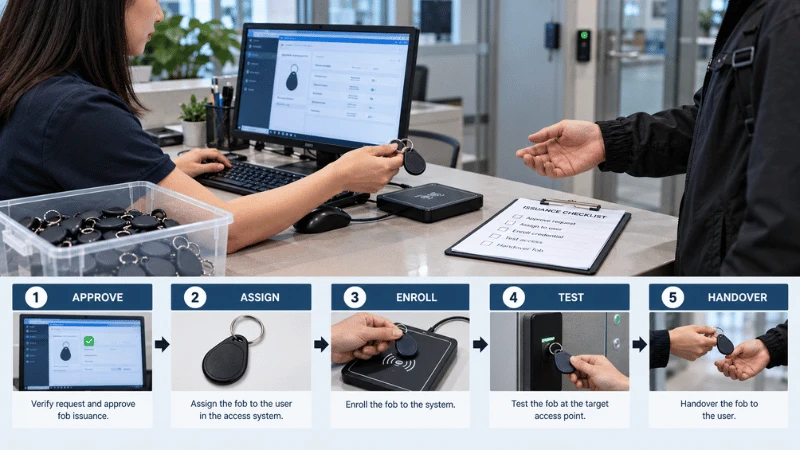
The goal of issuance is to prove that a specific physical credential was given to the correct person and enabled with the correct permissions. The normal order is:
- Confirm the holder's identity and an authorized request or sponsor.
- Choose an available, non-quarantined fob from the correct site inventory.
- Read or verify the electronic credential identifier using the approved reader/tool.
- Associate that credential with the holder in the access-control system.
- Apply the approved site, door group, schedule and expiration rules; avoid copying broad permissions from a previous holder.
- Test permitted access and, where feasible, a representative denied-access condition.
- Record the physical handover, issuing operator, holder acknowledgement and effective status.
When software enrollment is centralized, the site administrator may not have privileges to create permissions. In that case the workflow should require an authorization confirmation before physically releasing the fob.
Use a Site-Specific Access Profile, Not an Implicit Global Permission
A multi-site credential may be recognized by readers at several locations without being authorized to open every door. Recognition and authorization remain separate decisions.
Define profiles such as Site A employee, Site B contractor, maintenance after-hours or temporary visitor, but treat these as examples rather than universal settings. Each profile needs an approval owner, permitted doors, schedule, expiry condition and review rule. Contractors may require a sponsor and time limit; permanent staff may follow departmental approval.
NIST SP 800-53 PE-2 calls for maintaining authorized-access lists, issuing credentials, reviewing access and removing people when access is no longer required. This is a useful control framework, not a claim that every small office must implement a particular NIST certification program.
Know What to Record for Every Handover
A useful credential-operations log is event based. It should tell an auditor what changed, who approved it, who performed it, which fob was affected and whether the change was verified.
| Event | Required evidence | Result to verify |
|---|---|---|
| Issue | Holder, physical/electronic reference, approver, issuer, time, access profile | Correct holder and approved doors |
| Site transfer | Sender/receiver, shipping or custody record, intended destination | One current stock custodian |
| Access change | New approval, old/new profile, operator, effective time | Old rights removed and new rights applied |
| Lost / stolen | Reporter, time reported, affected credential, response owner | Old credential disabled in all relevant systems |
| Replacement | Old reference, new reference, authorization, test result | Only intended replacement is active |
| Return | Who returned it, receiving operator, condition, access status | Access disabled before the fob returns to stock |
| Retirement | Reason, disposal or quarantine disposition, approval | Credential no longer active or issuable |
Do not place unnecessary sensitive identity details in a supplier spreadsheet or print them on the shell. Access logs and personal data should follow the organization's privacy, retention and access-control policies.
A Reported-Lost Fob Triggers Two Actions
When a holder reports a missing fob, the first priority is to disable its authority-not to wait for a replacement shipment. The second is to update physical stock and incident records.
A practical lost-fob process is to verify the report, identify the exact credential, suspend or revoke it through the access-control platform, confirm the change propagated to the affected sites, document the incident and then issue a new credential under a separate reference. HID's credential support guidance likewise directs operators to deactivate a missing credential and assign a replacement.
Some access installations cache permissions in readers or controllers, operate offline, or synchronize across servers. In such cases a central "disabled" status may not immediately prove denial at every door. The integrator must define propagation behavior and the verification method. Where the system permits, test the revoked credential at a representative controlled entry point; otherwise inspect the supported controller status or logs.
Returned Is Not the Same as Disabled
An employee can place a fob on a reception desk while the access-control database still treats it as active. The reverse can also happen: a revoked fob remains physically missing.
Keep these two dimensions separate:
| Physical status | Electronic status | Correct operational interpretation |
|---|---|---|
| Returned | Active | Unsafe to reissue; remove rights and verify |
| Missing | Disabled | Access response complete, but physical incident remains open |
| Available at site | Unenrolled / inactive | Potentially issuable after inspection and approved enrollment |
| Quarantined | Disabled | Not available for reassignment without explicit review |
Never assume that deleting a person's record automatically changes every controller or reader's current access state. Verify against the behavior of the actual platform.

Decide Whether Returned Fobs Can Be Reissued
Reusing intact fobs can make sense for controlled, low-friction operations, but it is a system-policy decision. A read-only legacy LF fob may contain an immutable identifier; the operator can change its access-system assignment without changing the chip, provided the software supports that workflow. In a smart credential system, protected application data, personalization and keys may complicate or prohibit reassignment.
Before reissue, remove the former holder's access, inspect and read the fob, check its status across linked systems, clear or reconfigure application-specific data only when supported and authorized, create the new association, and perform an end-to-end access test. If the old credential is associated with a security incident, the organization's policy may require permanent retirement instead.
Reissue should never be described as "resetting the UID." Many credentials have non-rewritable identifiers; the operational change may happen only in the controller database.
Offboarding Must Close Every Site's Permission
When a user leaves the organization or a contractor's assignment ends, the system owner must remove their authorization even if the fob is not physically recovered. For multi-site facilities, one forgotten site or independent controller is enough to leave an access gap.
Give the offboarding task an accountable owner. Confirm the holder's active credentials, disable all relevant access assignments, reconcile physical returns, record missing items and close the request only when the prescribed checks are complete. Where a person has both a physical fob and a mobile credential, treat them as separate credential records unless the platform documents a unified revocation behavior.
HID's credential-management documentation illustrates why replacement, termination and credential status are explicit lifecycle operations in managed identity systems. The specific functions available to an ordinary LF or HF building-access deployment still depend on its own software.
Reconcile Physical Stock Against Active Credentials
A periodic audit should compare at least three sources: site-held stock, the assignment register and the access-control system's active credential list. The useful output is not simply "400 key fobs on hand"; it is a list of exceptions needing action.
Look for active credentials with no approved holder, a terminated person with surviving access, a fob recorded as returned but still enabled, duplicate active mapping where prohibited, missing site inventory, unused stock accidentally enrolled, and transfers that never received a destination confirmation.
Set review frequency and response deadlines from business risk. High-turnover contractor sites may need more frequent checks than a small office with stable staffing. A blanket monthly or quarterly schedule cannot substitute for an agreed policy.
Pilot the Whole Lifecycle Before Rollout
Use representative credentials, at least two site configurations if the project spans different access systems, and test cases that exercise the transitions instead of only presenting a new fob to a reader.
| Pilot scenario | Acceptance evidence |
|---|---|
| Receive and allocate stock | Batch, printed/electronic IDs, receiving site and quarantine records agree |
| Issue to approved employee | Correct holder can enter an authorized door and is denied at a non-authorized one |
| Temporary contractor expiry | Access stops at the approved expiry in every relevant system |
| Lost fob | Revocation process and propagation are proven by the supported method |
| Replacement | Old credential is inactive; replacement belongs to the correct holder |
| Return and reissue | Former association cleared and reissue meets platform policy |
| Multi-site transfer | Stock custody and site access changes match approvals |
| Offline controller | Documented behavior during delayed synchronization or reconnection |
| Offboarding | All credentials and all required sites show access removed |
Mark failures with an owner and a retest requirement. A supplier's factory inspection can demonstrate tag response and correct data, but cannot substitute for testing the organization's real enrollment and permission workflow.
Ask the Supplier for a Clean Handover, Not an Employee Database
When commissioning bulk RFID key fobs, the buying specification should identify the approved chip/credential technology, reader compatibility reference, expected electronic data format, visible numbering rule, unique-range or mapping requirement, packing/site grouping, sample-approval process and incoming verification needs.
The site operator should separately control employee identity, permissions, issuance approvals, lost-fob response and audit logs. Where a supplier is asked to pre-encode or pre-number, agree precisely which fields it needs and how discrepancies will be handled. Syntek's proximity key fob compatibility guide covers the upstream technical buying decision, while its RFID key fob product category remains the commercial owner for physical credential sourcing.
The Control Point Is the Assignment, Not the Key Ring
Multi-site key fob operations are easier to manage when one chain stays auditable:
approved credential → received stock → site custody → verified holder → authorized access profile → lifecycle event → system confirmation → inventory reconciliation.
A key fob that scans correctly is only the beginning. Issuance is complete when its physical holder and electronic permissions are recorded and verified; return, replacement and offboarding are complete when both the credential's authority and the physical stock record have been reconciled.
Send Inquiry