


RFID And IoT Integration: How Tags, Readers, Edge Logic And Cloud Systems Work Together
Oct 06, 2026
Leave a message

RFID and the Internet of Things are often compared as if a project must choose one or the other. In many industrial systems, that is the wrong architecture question.
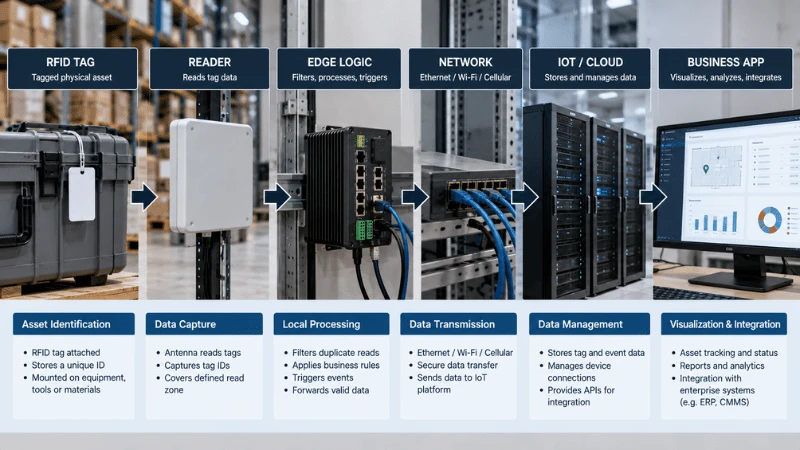
RFID is an automatic identification and data-capture technology. IoT describes connected devices and systems that exchange data through networks. An RFID deployment can therefore become one data-capture layer inside a larger IoT architecture: tags identify physical objects, readers observe them, edge software converts raw reads into useful events, and networked applications share those events with cloud or enterprise systems.
This guide explains that integration boundary for asset, warehouse, manufacturing and retail teams that need to connect RFID hardware with modern connected applications without treating every passive tag as an internet-connected device.
RFID and IoT Solve Different Layers of the Same Physical-to-Digital Problem
NIST defines an IoT device as equipment with at least one transducer for interacting with the physical world and at least one network interface for interacting with the digital world. A passive RFID tag normally does not meet that model by itself: it has no Ethernet, Wi-Fi or cellular network connection and typically communicates only when energized by a compatible reader.
The reader or gateway is often the bridge.
| Layer | Main job | Typical component |
|---|---|---|
| Physical identity | Identify the object | Passive RFID tag, label or credential |
| RF capture | Interrogate tags and collect identifiers | RFID reader and antenna |
| Edge / middleware | Filter duplicates, add context and create events | Reader application, gateway or middleware |
| Network | Move event data between systems | Ethernet, Wi-Fi, cellular or industrial network |
| IoT / cloud platform | Store, route, analyze or combine events | IoT hub, cloud service, message broker or API layer |
| Business application | Apply operational rules | ERP, WMS, MES, asset platform or custom application |
For a component-level view of RFID itself, Syntek's RFID system architecture guide explains tags, antennas, readers, middleware and application software. This page focuses on the integration between that RFID stack and an IoT environment.
A Passive RFID Tag Is Usually Not an IoT Endpoint
One of the most useful design boundaries is to stop calling every tagged object an internet-connected device.
A passive UHF tag may hold an EPC and respond to an interrogator. The tag does not normally open a TCP/IP connection, authenticate to a cloud broker or publish its own messages over Wi-Fi. The reader infrastructure performs the RF transaction and then passes data into networked software.
This distinction affects security, device management and troubleshooting. A tag-read failure is an RF problem until proven otherwise. A cloud API failure is a network/application problem. Combining both under the phrase "IoT issue" makes root-cause analysis harder.
The Reader Turns Physical Observations Into Digital Input
The reader controls communication with the RFID tags in its read zone. Depending on the system, it can inventory EPCs, read other memory, write data, report antenna information and expose device status through an SDK, LLRP, API or vendor interface.
At this stage, the output is still closer to a sensor observation than a business event:
tag EPC X was observed by reader Y on antenna Z at time T
That observation may be repeated many times while the tag remains in the field. Sending every raw observation directly to a cloud application can create unnecessary network traffic and ambiguous business logic.
Edge Logic Should Clean RFID Data Before the Cloud Uses It
RFID edge software or middleware commonly performs the first layer of event processing.
- remove duplicate reads within a defined time window;
- filter out identifiers that do not belong to the workflow;
- associate a read with a reader, antenna, door, workstation or zone;
- apply direction or trigger logic where the installation supports it;
- buffer observations during network interruptions;
- convert tag identifiers into application identifiers;
- raise exceptions for unknown, duplicate or unexpected tags;
- publish a compact event to the next system.
GS1's system architecture places RFID readers and filtering/collection software on the data-capture path before application-level event data. Its RFID standards family includes interfaces such as LLRP and Application Level Events for this boundary.
The important design principle is that the cloud should receive useful events, not an uncontrolled flood of RF observations.

Use an Event Model to Preserve Meaning Across Systems
Once the RFID layer has identified an object, the next question is what happened to that object.
GS1's EPCIS standard provides a useful model for visibility events by expressing the what, when, where, why and how of products and assets. EPCIS 2.0 also supports sensor data, which makes it relevant when RFID identity is combined with temperature, condition or other IoT observations.
A project does not have to use EPCIS to learn from this structure. At minimum, an RFID-to-IoT event should usually carry enough context to answer:
- which object or objects were involved;
- when the event occurred;
- where the observation belongs;
- what business step occurred;
- which device or process produced the event;
- whether the event is normal or exceptional.
RFID Identification and IoT Sensing Can Share the Same Event
RFID often answers "which object is this?" while sensors answer "what condition is it in?"
A connected cold-chain system, for example, may use an RFID or barcode identifier for the shipment and a networked temperature sensor for environmental measurements. A manufacturing system may identify a tool or workpiece through RFID and combine that identity with machine-state or vibration data from separate sensors.
The architecture should keep the data sources distinct even when the application later joins them.
| Data source | Example output | Business meaning added later |
|---|---|---|
| RFID tag + reader | EPC observed at Station 4 | Workpiece entered inspection |
| Temperature sensor | 8.2°C at time T | Cold-chain condition at event time |
| PLC / machine controller | Cycle complete | Production operation finished |
| IoT application | Combined event | Item X completed process Y under condition Z |

Decide What Must Stay at the Edge
Cloud connectivity is useful for multi-site visibility, analytics and centralized management, but not every RFID decision should wait for a round trip to the cloud.
Keep logic local when the process must continue during network disruption or needs low-latency physical control, such as:
- opening or stopping a conveyor gate;
- triggering a stack light or buzzer;
- rejecting an unexpected tagged item;
- buffering reads during loss of WAN connectivity;
- deduplicating high-volume reads;
- controlling reader power or antenna sequencing.
Send higher-level events to the cloud when the value comes from cross-site visibility, historical analysis, dashboards, remote administration or integration with enterprise applications.
Use the Network Layer for Events, Not to Hide RF Design Problems
A connected reader does not fix a bad read zone.
If tags are missed because they are mounted incorrectly, screened by metal or liquid, poorly oriented, or outside the intended antenna field, faster cloud APIs cannot recover the missing identity. Similarly, a portal that reads neighboring tags will simply send bad observations more efficiently.
The RFID hardware layer must be validated first. Syntek's RFID technology guide provides background on frequency, tags, readers and antennas before the network integration step.
Choose the Integration Interface From the Deployment Scale
| Deployment | Practical integration pattern | What to verify |
|---|---|---|
| Single workstation | Reader SDK or local application directly to business software | Driver support, output format, exception handling |
| One fixed portal | Reader or edge gateway to REST/API or message queue | Filtering, buffering, device health, authentication |
| Many readers at one site | Centralized edge/middleware layer | Reader management, configuration consistency, event routing |
| Many sites | Local edge plus central IoT/cloud platform | Site identity, offline queue, remote updates, event schema |
| Supply-chain ecosystem | Event repository / standardized sharing layer | Identifier governance, partner permissions, interoperable event model |
GS1 notes that IoT architectures depend on identification, automatic data capture and interoperable data sharing. Its IoT standards overview explicitly positions EPC/RFID as one of the technologies linking physical objects to digital information.
Separate RFID Security From IoT Network Security
RFID and IoT add different security surfaces.
The tag-reader layer may involve public identifiers, password-controlled memory, tag authentication or no authentication at all, depending on the technology. The reader/network layer may involve device credentials, API keys, TLS, network segmentation, firmware management and cloud permissions.
A strong cloud security posture does not transform a simple fixed-ID RFID tag into a cryptographically authenticated credential. Likewise, a secure RFID tag does not automatically secure the reader's operating system or network connection.
NIST's IoT guidance defines network-connected device security as its own lifecycle problem. Treat the RFID air interface, reader/edge device and cloud application as separate trust boundaries.
Plan for Offline Operation Before You Need It
Industrial systems should define what happens when the cloud or WAN connection is unavailable.
Questions for the pilot include:
- does the reader continue operating locally;
- which events are buffered and for how long;
- how are duplicate buffered events prevented after reconnection;
- which local decisions can still be made;
- how does the system mark events created while offline;
- what happens if device time drifts;
- how are configuration changes synchronized after recovery.
Cloud connectivity should extend the system, not become an unplanned single point of failure.
Pilot the Full Physical-to-Cloud Transaction
A useful RFID/IoT pilot tests the complete chain:
- tag the representative physical item;
- validate the intended read zone;
- capture the raw identifier;
- apply edge filtering and context;
- create the intended business event;
- send the event across the network;
- confirm the cloud or enterprise platform stores the correct item, location and time;
- trigger the expected downstream action;
- test duplicate reads, unknown tags, network interruption and device restart;
- verify reconciliation after recovery.
A successful tag read is therefore only the first checkpoint.
What to Put in an RFID-to-IoT Integration Specification
| Field | Decision to document |
|---|---|
| Business event | Receiving, movement, inventory, issue/return, production step or another defined event |
| RFID technology | Frequency, protocol, tag type and data identifier |
| Reader / antenna | Hardware, read zone and relevant configuration |
| Edge logic | Filtering, deduplication, trigger and exception rules |
| Device interface | SDK, LLRP, REST, MQTT, vendor API or another approved path |
| Event schema | Identifier, timestamp, location, event type and required context |
| Network | Ethernet, Wi-Fi, cellular or other connection and security controls |
| Offline behavior | Buffering, local decisions and reconciliation |
| Cloud / enterprise target | IoT platform, WMS, ERP, MES, asset system or other application |
| Device management | Configuration, monitoring, firmware and credential ownership |
| Acceptance test | End-to-end normal and failure scenarios |
| Change control | Which tag, reader, firmware, edge or API changes trigger revalidation |
If the project is still selecting RFID hardware, Syntek's RFID reader category is the commercial next step after the read event and integration boundary are defined.
The Integration Rule
The practical sequence is:
physical object → RFID identity → read zone → reader observation → edge filtering → business event → network transport → IoT/cloud platform → enterprise action
RFID and IoT are not competing answers to the same question. RFID can supply reliable physical identity and event observations; IoT infrastructure can connect, combine and distribute those events. The architecture works when each layer has a clear responsibility and the project validates the complete chain instead of assuming that connectivity alone creates useful data.
Send Inquiry