


Bamboo, rPET or Silicone RFID Wristbands for Festivals
Nov 20, 2026
Leave a message

If you are sourcing RFID wristbands for a music festival, choose the closure and return plan before comparing strap materials. Start with a one-time closure for tickets that must stay with the issued wearer. Consider reusable silicone RFID wristbands for crew or other managed groups when you can collect, clean, inspect and reauthorize them for the next event.
At Syntek, we offer silicone and woven RFID wristbands with custom branding and encoding options. Use this guide to compare the strap, closure, RFID module, artwork and operating costs for your festival, then send us the requirements for your shortlisted construction. Your audience and crew may need different configurations to meet the same event's access and waste-reduction plan.
Start With Your Festival's Access and Waste Plan
Before requesting samples from us, confirm three points with your client's operations and access-control teams: whether wristbands must show evidence of removal, who will collect them after use, and which ticketing or cashless platform must accept them. These decisions help you rule out unsuitable configurations before comparing colors or unit prices.
Use the table below to shortlist a configuration for each wearer group. Confirm the acceptance conditions with your event team before requesting a sample.
| Festival user group or operating condition | Configuration to evaluate first | Acceptance condition |
|---|---|---|
| Paid general-admission attendees with non-transferable tickets | Fabric RFID wristband with a one-time closure | Fit-and-removal checks show that the band cannot be removed and refitted normally without visible evidence; agree a replacement procedure |
| VIP attendees whose credentials must remain with the issued wearer | Fabric wristband with a suitable one-time closure and distinct tier identification | Validate physical fit, event permissions and replacement controls with the platform provider |
| Supervised crew and staff with an assigned return process | Reusable silicone RFID wristband | Confirm recovery responsibility, cleaning, inspection and next-event authorization before budgeting repeat use |
| Any group without a verified return process | A single-event purchasing model for whichever construction meets the access brief | Credit no future deployments until stock is returned, passes inspection and is eligible for reissue |
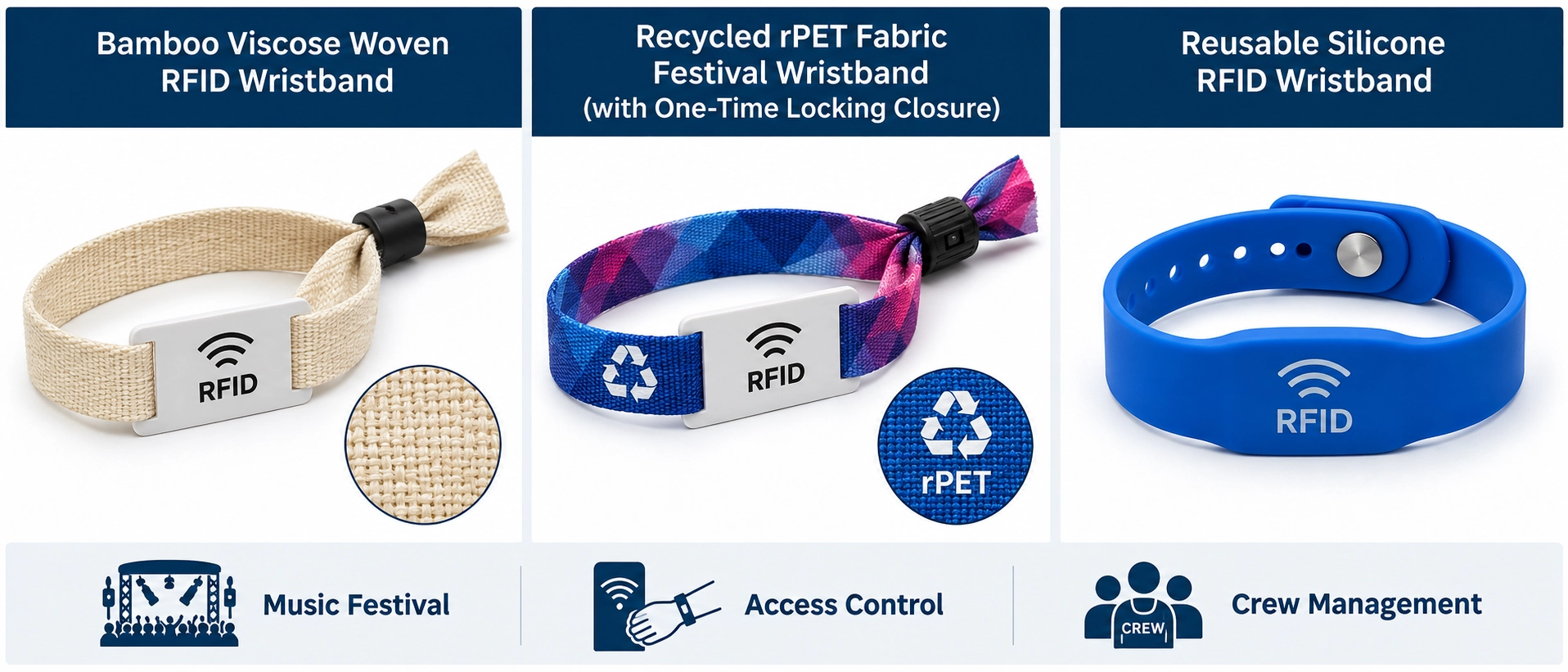
Our wristband range includes woven formats with single-use locks or reusable sliders, alongside reusable silicone formats. Choose the closure around your admission policy and confirm the fit on a sample. The material name alone does not establish how well the finished band resists transfer.
Waste requirements also depend on the event location. San Francisco Recreation and Parks lists recycling, composting and waste-planning provisions for events, with applicability determined through its permit process. This is a specific local example, not evidence of a general ban on disposable wristbands across Europe or North America. Confirm the actual permit and venue requirements before promising a compliant material substitution. (San Francisco Recreation and Parks)
For a festival with a zero-waste objective, ask where each component will go after collection. A take-home souvenir, a returned credential and a discarded band are different outcomes; record them separately.
Compare the Complete Wristband, Not Just the Strap
Use the following matrix when preparing your brief for our team or comparing quotations. Specify the strap, closure, RFID module and decoration together so each proposal covers the same requirements.
| Decision field | Bamboo fiber / bamboo-derived viscose proposal | rPET fabric proposal | Silicone proposal |
|---|---|---|---|
| Strap identity | Confirm actual bamboo fiber, bamboo-derived viscose or a blend | Confirm polyester composition, recycled proportion and the component covered | Confirm silicone specification and the finished construction |
| Closure | Request the proposed lock or slider; do not infer security from the fiber | Request the proposed lock or slider; do not infer security from recycled content | Confirm whether it is a closed loop, adjustable strap or another format |
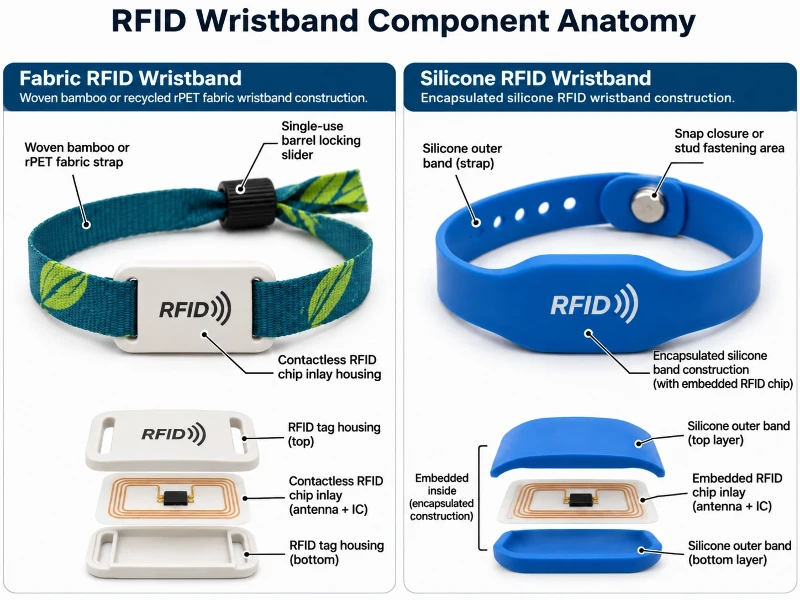
| RFID module | Identify chip, antenna, housing and attachment | Identify chip, antenna, housing and attachment | Identify chip, antenna and encapsulation |
| Branding | Confirm the process offered on the actual fabric and tag surface | Confirm the process offered on the actual fabric and tag surface | Confirm the available screen-printed, embossed, debossed or color-filled logo options |
| Evidence needed | Fiber declaration and complete component list | Recycled-content evidence tied to the quoted product and order | Material traceability and evidence for any stated finished-product performance |
| Reuse or disposal | Validate removal, component separation and the receiving facility | Validate removal, component separation and the receiving facility | Validate recovery, cleaning, inspection, reissue and eventual disposal |
If your brief calls for bamboo-derived fabric or rPET, include the required fiber composition, recycled content and supporting documents in your inquiry to us. Availability of the requested construction, its complete bill of materials (BOM) and the relevant material evidence must be confirmed before quotation.
For a bamboo-derived fabric brief, proceed only when the actual fiber and any blend are documented. For rPET, proceed when recycled content and its certification scope can be substantiated. For silicone, prioritize a managed return and reissue plan, with finished-band cleaning and inspection validated. For non-transferable admission, the closure and fit matter more than whether the strap is bamboo-derived, recycled PET or silicone. Assess any environmental comparison separately using evidence for the complete wristband and its intended use.
Bamboo Fiber and Bamboo-Derived Viscose
Ask what "bamboo" describes. It could refer to the textile fiber, the plant source used to make viscose, a closure or slider, or a separate tag housing. These are different specifications.
The US Federal Trade Commission distinguishes actual bamboo fiber from rayon or viscose made using bamboo as the source material. Its US labeling guidance explains that the latter should be identified as rayon or viscose made from bamboo. Use that distinction when checking supplier descriptions; a bamboo-looking surface does not establish fiber composition. For another destination market, check the applicable local labeling requirements. (FTC)
Include the strap, thread, closure, tag housing, inlay and any coating in your material-document request to us. If your brief specifies a blend, state the required fiber proportions. This gives your client a defined material specification to approve.
Recycled PET Fabric
For rPET, establish whether the recycled-content statement covers the strap alone or another defined part of the product. Do not extend a yarn supplier's document to the lock, housing or electronics without supporting evidence.
Textile Exchange describes RCS and GRS as third-party certification systems for recycled materials and chain of custody. For a quoted wristband, request the applicable certification scope and order-linked evidence. A logo on a quotation is not a substitute for checking what is covered. (Textile Exchange)
The GRS and RCS version updates have a separate implementation timetable from the Materials Matter Standard transition. Check Textile Exchange's official standards updates, then ask the certifier which version, certification scope and transaction evidence apply to the order date and supply chain. Do not treat the different transition dates as interchangeable.
Recycled input and end-of-life processing are separate questions. Ask the intended waste contractor whether it accepts the assembled band or requires components to be separated. For US environmental marketing claims, the FTC's Green Guides summary explains that a compostability claim needs evidence covering all materials in the product and appropriate qualifications about processing conditions and facilities. (FTC)
Browse our woven RFID wristband options to identify the construction you want to discuss. Include your fabric specification and evidence requirements when you contact us; a woven format alone does not establish recycled content.
Reusable Silicone
Evaluate silicone as a finished credential: fit, closure, encapsulation, decoration and reader compatibility all belong in the approval. A band that can be removed and worn again still needs an operational route back into inventory.
Compare our silicone RFID wristband formats and send us your wearer sizes, fit requirements, artwork and approved chip specification. Before approving a repeat-use program, establish the selected model's cleaning and reuse limits through the finished-band validation below.
Balance Tamper Evidence With Reuse
One-Time Closures for Controlled Admission
Where admission must remain tied to the issued wearer, specify the observable requirement: what should happen when someone tries to loosen, remove or transfer the band? Request a sample of the proposed construction from us and agree a fit-and-removal check with your access-control team.
A one-time closure can make reuse more complicated if removal damages the strap or lock. Confirm which components, if any, can be recovered and what must be replaced. Do not budget an entire assembly for another event simply because one part remains intact.
Reusable Formats for Managed User Groups
A removable band may suit a controlled return process, but its removability also creates a transfer question. Define identity checks, replacement authority and return responsibility alongside the physical format. Our guide to event wristband security requirements can help you define the physical and digital controls for that brief.
Digital controls address another part of the problem. Ask the platform provider what anti-passback, account binding or staff checks actually prevent under the proposed workflow. Do not treat any one of them as proof that a removable wristband cannot be handed to another person.
It is reasonable to evaluate different configurations for ticket holders and crew when their access and return procedures differ. Keep the permissions and physical identification clear so that a reusable crew credential cannot be mistaken for general admission.
Approve Sponsor Artwork on Production Samples
Match the Artwork to the Process
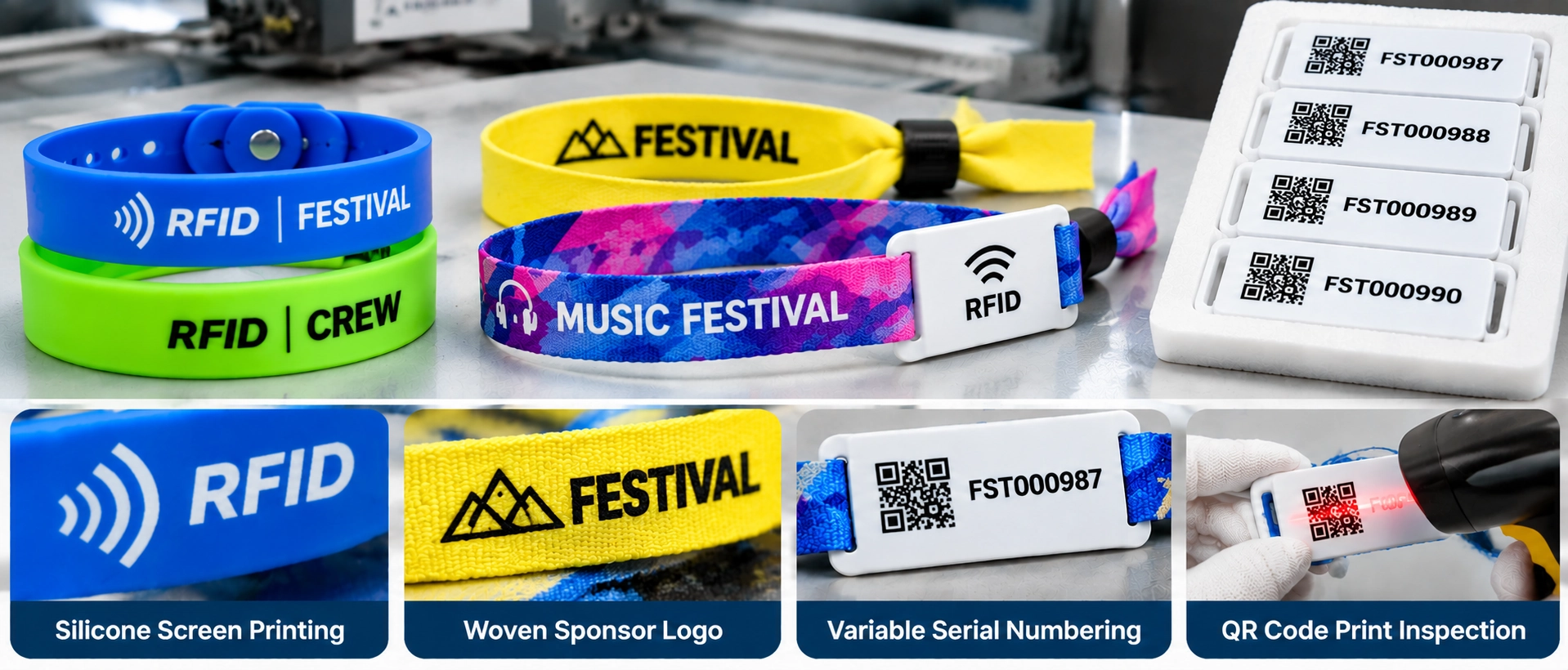
Compare the same sponsor artwork at its intended size on each proposed construction. Specify the logo colors, smallest required text, identification numbers and any QR code, rather than asking which material has the "best print precision."
Our customization options include screen printing, color filling, embossed and debossed logos, woven artwork, numbering and encoding, depending on the product. Use our custom artwork and encoding requirements to prepare your files, then confirm the available process with us for the selected model and material.
Separate the decoration on the strap from printing on the RFID housing. A large readable tag face does not demonstrate that small text will reproduce equally well across a textured strap. Approve an actual-size physical sample made using the proposed production process; a screen mockup is useful for layout but cannot prove the finished surface result.
Check Readability After the Agreed Wear and Cleaning Cycle
Agree the sample checks before ordering. Review sponsor-logo recognition, color acceptance, number legibility and QR scanning under the intended conditions. For a reuse proposal, agree the proposed cleaning procedure with us for the selected band, then repeat the relevant checks after cleaning.
Record the sample identity, process, inspection conditions and acceptance decision. Use those results to approve the construction for your sponsor's artwork and event conditions; results from one material or process do not establish the performance of another.
Compare Cost per Successful Deployment
What a Like-for-Like Quote Must Include
When requesting a bulk quotation from Syntek, provide the quantity by wearer group, approved chip specification, artwork, delivery deadline, destination and required shipping terms. Compare proposals in the same currency and confirm the closure, RFID module, printing, setup or tooling, encoding, data files and packaging included in each. Identify freight, taxes and platform charges separately where applicable.
For this comparison, use the following planning model. It is a budgeting method, not a measured industry result:
Cost per successful deployment = total costs within the agreed purchasing and operating boundary ÷ actual successful deployments within that same boundary.
The numerator includes initial purchase, replacement stock, tooling or setup, decoration changes, logistics, collection, cleaning, inspection, platform reissue, storage and end-of-life handling where applicable. Count each charge once, even if a supplier bundles several items into one price.
Count one successful deployment as one band-event issue: one wristband authorized and issued for use at one event. Several gate scans during that event remain one deployment. Count a later event only after the band is authorized and issued again. Apply the same event coverage and user requirements to every proposal, and report the result in the chosen currency per band-event issue. If no successful deployments occur, this rate cannot be calculated.
What Changes When Bands Are Collected
Model a no-return case and a managed-return case. In the no-return case, do not credit the organizer with future uses of bands taken home by attendees. In the managed-return case, use the quantity that passes inspection and is actually available for reissue, rather than the quantity originally ordered.
| Operating question | Budget treatment |
|---|---|
| Who collects and counts returns? | Include labor, collection points and reconciliation |
| Which bands are damaged, missing or unsuitable? | Remove them from reusable stock and include replacements |
| Can next season use the existing artwork? | Include replacement or rebranding costs if required |
| Can the platform issue the credential again? | Include the confirmed reset, encoding or account-management work |
| Where will approved stock be held? | Include storage, inventory control and dispatch |
Use comparable quotations and your actual operating records before deciding which configuration costs less across multiple events. A lower purchase price does not settle the multi-event budget, and a lower operating cost does not establish a lower carbon footprint. An environmental comparison needs its own lifecycle boundary and evidence.
Validate the Next Event Before Calling a Band Reusable
Inspect, Clean and Recheck the Finished Band
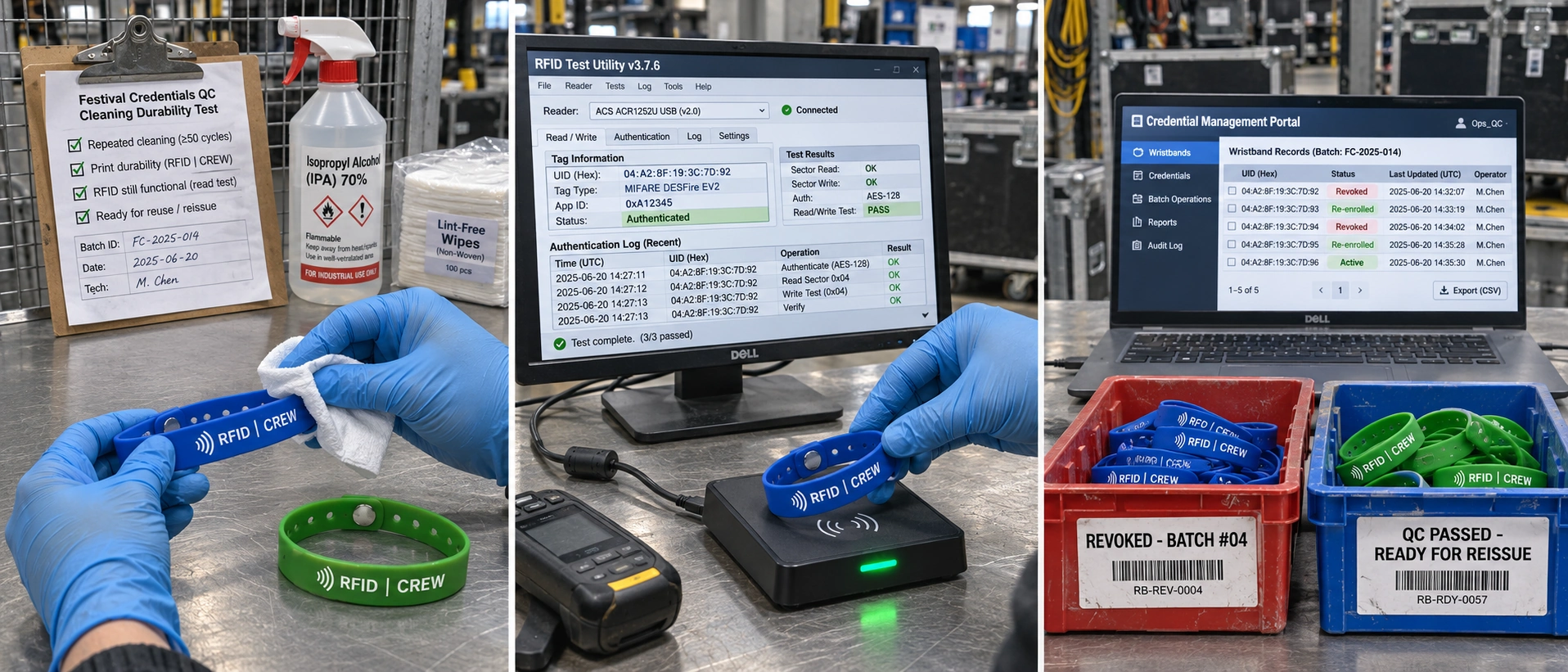
Before approving reusable stock, send us your proposed cleaning procedure for the selected assembly, including the decorated surface and RFID enclosure. Request confirmation of the cleaning agent, temperature, contact time, drying method and inspection criteria, and validate the procedure on the finished band. Do not choose a high-temperature or aggressive cleaning process based only on the strap material.
For a pilot, track the same sample units through wear, return, cleaning and inspection. Check the closure, cracks or separation, appearance, legibility and operation on the intended readers. Define when a band is rejected and record the result. A successful pilot supports only the tested configuration and conditions; it does not establish an unlimited service life.
Revoke and Reissue Credentials on the Platform
Confirm the next-event workflow before committing to reusable stock. Ask the platform provider how old access rights are removed, how a credential is detached from an account, and whether the same physical chip can be enrolled for the next event. Include any constraints on locked data, keys, application configuration and cashless balances.
Reading a UID is a different operation from authenticating a credential. For example, NXP's February 2022 announcement lists the UID, AES authentication and protected data access as separate features of MIFARE Ultralight AES. That example does not establish compatibility with your platform or availability in a particular wristband; it shows why "the reader detects it" is an incomplete acceptance test. (NXP)
Include a negative test: a credential with withdrawn permissions should be denied the access it previously held. Then test an authorized reissue, including the intended reader and any offline operating procedure. Obtain the integrator's approval before treating the physical stock as ready for another season.
Prepare Your Festival Wristband Brief for Syntek
To request a specification review and sample quotation, send us the requirements below for each wearer group. Start with the access policy, platform and material evidence your client needs. For a bamboo-derived or rPET proposal, include the required composition and documentation so availability can be confirmed before you approve the specification.
| RFQ field | Information to provide or request |
|---|---|
| Event and user groups | Festival dates, destination, wearer groups and quantities per group |
| Physical security | Removal evidence, fit requirements, closure type and replacement policy |
| Material brief | Preferred strap material, full component declaration and documents required for public claims |
| Platform | Provider, approved chip specification and encoding requirements; involve the integrator if these are unknown |
| Artwork | Vector files, color references, actual-size text, variable data and approval requirements |
| Reuse plan | Return owner, collection process, proposed cleaning method and intended next-event workflow |
| Commercial basis | Sample scope, quote inclusions, shipping terms and required delivery date |
| Acceptance | Approved reference sample, reader tests, inspection criteria and required data files |
Explore Syntek's RFID wristband options and send us your festival brief to request a specification review, confirmation of available materials and supporting documents, and a sample quotation. Include quantities by wearer group, your platform's approved chip requirements, artwork and delivery deadline. These inputs help us review the requested construction and identify what needs confirmation before sample or bulk approval.
Send Inquiry