


Silicone vs. Woven rPET RFID Wristbands for Waterparks and Resorts
Nov 19, 2026
Leave a message

We wrote this analysis for procurement directors and engineering contractors managing busy, humid tourist venues. We compare medical-grade silicone with GRS-certified recycled polyethylene terephthalate woven materials. Our review covers factory yield rates, water ingress tests, and total lifecycle costs. Our goal is simple. We want to help you select hardware that maintains stable access control for waterparks and multi-day outdoor events.
How RFID bands work in high humidity
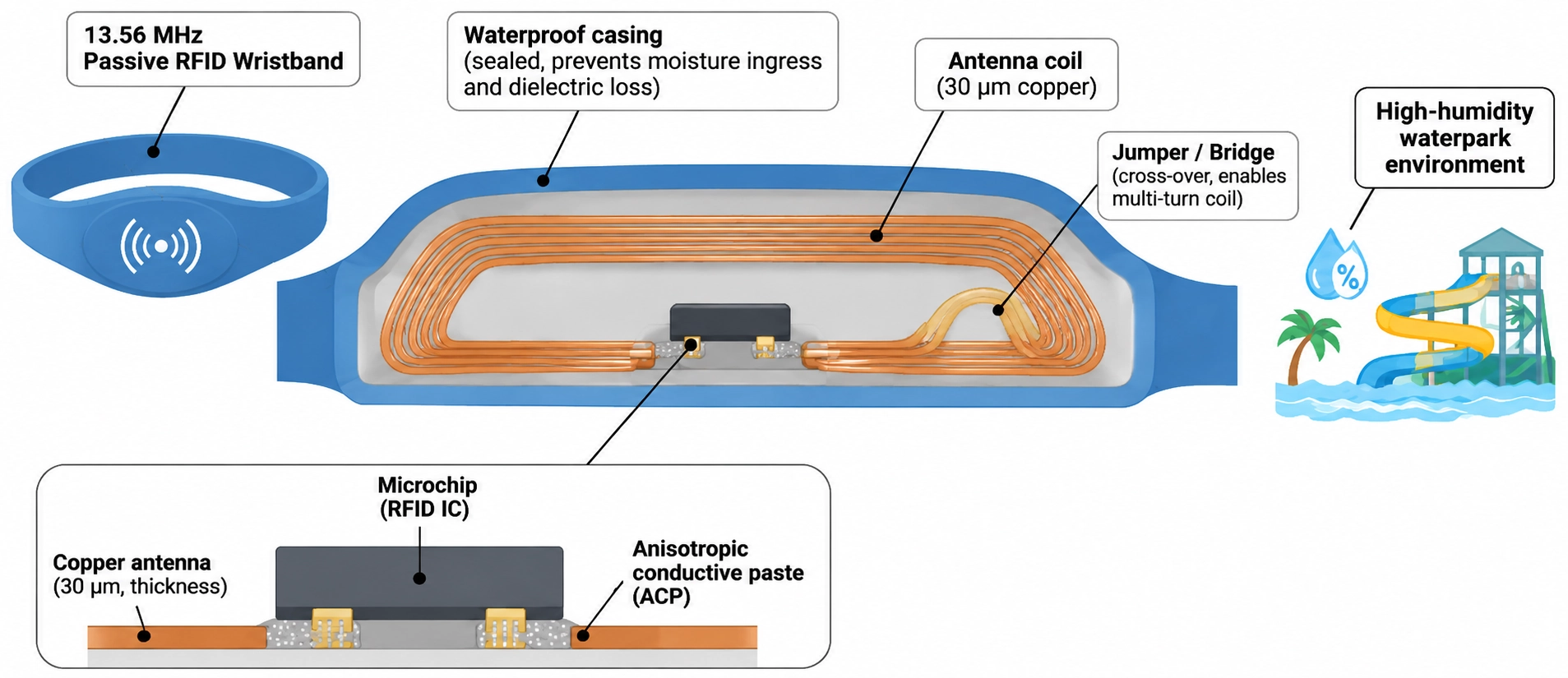
Water weakens wireless signals and sets the design rules for wearable access devices. Liquid absorbs radio energy, especially at high frequencies. Because of this, the physical casing must preserve a precise air gap and moisture seal around the copper antenna. RFID stands for Radio Frequency Identification. This system uses electromagnetic fields to identify and track tags on items automatically. Passive RFID tags carry no internal battery. Instead, they draw all operating power from the reader's radio waves through magnetic induction. In a 13.56MHz setup, the reader antenna creates an alternating magnetic field. When a wristband enters this field, the magnetic flow induces an alternating current inside the band's copper coil. This current flows into a rectifier circuit inside the microchip, which turns the alternating current into direct current to power the processing core.
The tag cannot boost its own return signal. Therefore, this first energy transfer must run with high efficiency. The quality factor, or Q-factor, of the antenna circuit sets this efficiency level. We suggest targeting a Q-factor between 30 and 40 for wearables to balance power delivery with data bandwidth needs. High humidity disrupts this balance through dielectric loss. Water has a relative permittivity near 80 at room temperature, while air sits near 1. If water seeps into the band and touches the inlay, this high value alters the extra capacitance of the antenna circuit. That shift pulls the tag off its tuned frequency. As a result, the read range drops from a normal 3 to 5 centimeters down to zero.
Material selection and sealing methods decide if a device survives regular immersion. Waterparks cannot rely on basic polyvinyl chloride laminated cards. The layers peel apart under continuous exposure to chlorinated water and regular bending. Instead, the wearable must seal the microchip and the etched aluminum or copper antenna inside a single waterproof shield. At the same time, it must stay flexible enough for a wrist. We suggest specifying a minimum antenna thickness of 30 micrometers. This thickness handles the mechanical bending that happens when guests swim or slide. Antenna bonding usually relies on anisotropic conductive paste to attach the bare die to the base film, so this joint needs firm defense against water pressure. If the outer shell flexes too much under water, the microchip can snap off the antenna leads. Software cannot detect or fix this permanent hardware failure.
Medical-Grade Silicone: Engineered for Waterparks and Continuous Immersion
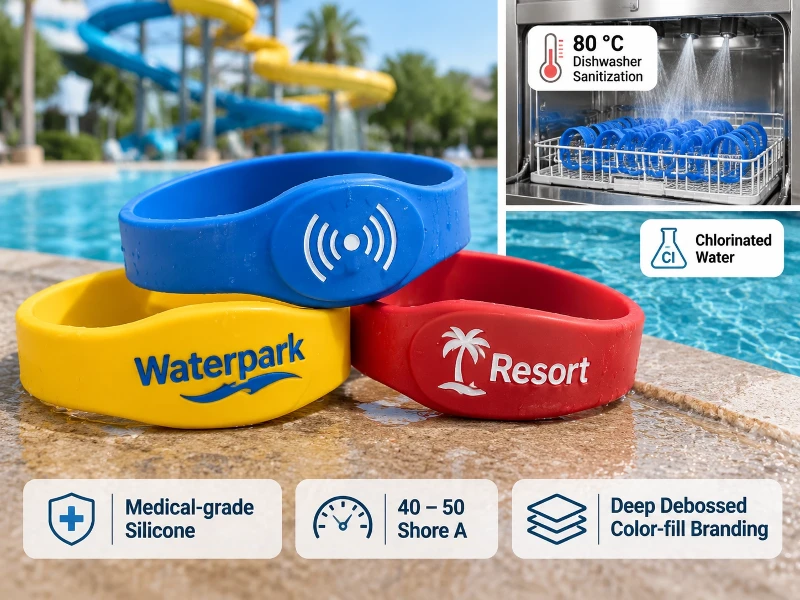
Medical-grade silicone provides the highest operational stability in water because it does not react with chemicals. The material resists pool chlorine, chloramines, cyanuric acid, sunlight, and hot wash cycles. Heat curing cross-links the polymer chains. This creates a solid structure without tiny pores, stopping moisture from creeping toward the internal chip. We suggest choosing a tensile strength of 6 to 8 megapascals. This rating ensures the band can stretch over hands without tearing near the sizing holes.
Most sellers report costs of $1.00–1.75 per unit for premium silicone wearables, though official documentation does not specify a universal price floor across all manufacturing regions. This purchase price buys a device that withstands heavy physical abuse on waterslides and wave pools. For branding, silicone supports deep debossing with color fill. These marks remain readable long after printed ink scrapes off against pool walls. The material retains its strength and stretch even after months of daily outdoor use. Hotels can collect these bands and clean them in commercial dishwashers at 80 degrees Celsius for 15 minutes. Staff can then hand them to new guests, spreading the hardware cost across dozens of visits. We suggest picking a Shore A hardness of 40 to 50 for the silicone. This range shields the chip while remaining soft enough to avoid skin chafing during active movement.
Physical asset loss still affects budget planning regardless of material strength. Most sellers report a 10–15% annual replacement rate due to guests losing the bands or taking them home as souvenirs, though official documentation does not specify exact attrition metrics for the hospitality sector. Buying teams should add this baseline loss into annual budgets rather than planning for zero replacements. The silicone often outlasts the guest's stay. Because of this, managing physical inventory becomes the primary operating cost after the first purchase.
GRS-Certified rPET Woven Wristbands: Eco-Compliance for Multi-Day Events
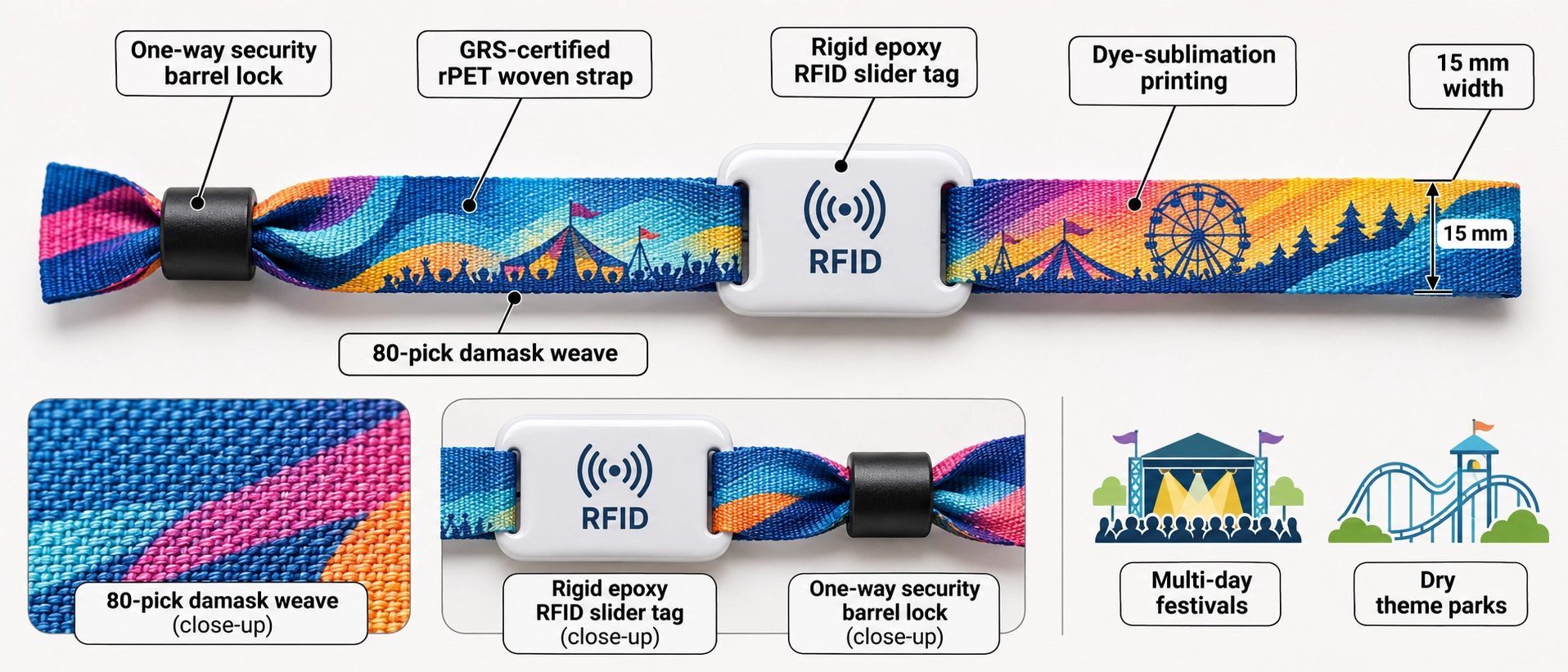
Global Recycled Standard certified woven bands meet strict environmental rules while serving multi-day dry events. The recycled polyester fabric breathes well and feels soft immediately. These traits make it great for music festivals, dry theme parks, and roller rinks where guests wear the band for 48 to 72 hours straight. Air passes through the weave to reach the skin. This airflow prevents skin rashes that sometimes occur under non-porous bands in hot weather. We suggest an 80-pick damask weave for the strap. This tight surface displays logos clearly and stays strong under pull force.
From a green perspective, buying GRS-certified recycled polyethylene terephthalate provides clear supply chain tracking for teams aiming to cut scope 3 carbon emissions. Mills spin the yarn from post-consumer plastic bottles. They also need transaction certificates at every production step to keep their certification valid. For logos, we recommend dye-sublimation printing on rPET. The heat drives ink directly into the plastic fibers so designs do not fade under direct sunlight. We suggest a strap width of 15 millimeters. This size fits standard slider tags without feeling bulky on a wrist.
| Deployment Factor | Specification / Metric | Operational Impact |
|---|---|---|
| Technology Type | Passive Radio Frequency Identification | Transponders function without an internal battery, requiring active reader field excitation to transmit data. |
| Tag Ingress Code | Two numerals | Enclosure resistance ratings define particle and liquid ingress protection to safeguard the embedded IC. |
| Ingress Standard | IEC 60529 | Standardizes physical testing for water resistance and enclosure sealing against pool chemical saturation. |
| Carrier Frequency | 13.56 MHz | Operates at High Frequency (HF) across short-range contactless guest access, ticketing, and cashless architectures. |
| Auxiliary Chip | NTAG213 | Provides standard high-frequency NFC connectivity, suitable for promotional URLs rather than encrypted hotel lock interfaces. |
| Alternative Material | XIUCHENG C01 Silicone | Substitutes fabric bands with non-porous silicone to prevent strap waterlogging in continuous aquatic operations. |
| Security Closure | XIUCHENG C14 Vinyl | Uses a one-time snap closure to provide visible evidence of tampering or physical band transfer. |
| Textile Construction | XIUCHENG C13 Elastic | Replaces rigid woven straps with stretch polyester-nylon blends for extended multi-day and membership wear. |
| Weave Palette | 8 PMS thread colors | Restricts custom yarn branding layouts to eight Pantone Matching System spot colors for textile-integrated designs. |
| Annual Loss Allowance | 10–15% replacement rate | Sets the baseline threshold for budgeting annual credential replenishment across recurring visitor programs. |
| Gate Throughput | 60% reduction in gate congestion | Wristband contactless scans lower entrance queuing delays compared to traditional physical barcoded tickets. |
| Unit Cost Range | $1.00–1.75 per unit | Represents expected procurement expenditure per wristband when specifying premium silicone RFID credentials. |
We must also state the clear limits of this fabric in water. The internal chip sits inside a hard epoxy or polyvinyl chloride shell that blocks water, but the woven strap acts like a sponge. Recycled fibers soak up pool water, sweat, and rain. Once wet, the fabric dries slowly, leaving a cold, soggy strip on the guest's arm. We advise against using woven bands as the main credential for heavy waterpark operations. Trapped moisture rarely harms the sealed chip, but it annoys guests and can spread bacteria if left unwashed. Woven bands work best when water contact happens only occasionally. They use one-way barrel locks with internal plastic teeth to secure the band for a single event before disposal or recycling.
Material Comparison: Silicone vs. rPET Production Yield Rates
Silicone injection molding delivers higher and more predictable factory yields than fabric assembly lines. Tracking production variance helps contractors plan accurate project schedules and order enough spares for large events. Factories produce silicone wristbands using liquid injection molding or compression molding at temperatures between 160 and 200 degrees Celsius. Workers cut steel molds that often hold 64 or 128 cavities per plate to press the bands in bulk. The inlay rests inside the mold cavity while the silicone cures around it as one solid piece. This single-body build stops the internal chip from shifting out of place, keeping the factory yield rate above 98 percent. The plant tests tag resonance after curing, and failure rates remain low.
Building woven wristbands requires several separate assembly steps. Workers weave the recycled polyester, slice the straps with hot knives to stop fraying, and mount a hard slider or sew the chip into a cloth pocket. Workers often use ultrasonic welding to fuse both halves of the hard plastic slider over the fabric and chip. The titanium horn of the welder must line up with the plastic housing. Small shifts during sewing can punch through the copper antenna, while uneven welding pressure can leave the slider partly open. These extra steps cause wider swings in defect rates, sometimes dropping factory yields down to 92 to 95 percent. Buyers ordering high volumes of woven bands should include a 5 percent safety margin for factory defects. They should also add seven to ten days to their delivery schedules compared to silicone.
| Material Type | Target Environment | Moisture Barrier Mechanism | Estimated Production Yield | Environmental Compliance |
|---|---|---|---|---|
| Medical-Grade Silicone | Waterparks, continuous immersion | Monolithic injection molding | 98-99 percent | Reusable, high lifecycle |
| GRS-Certified rPET | Festivals, dry amusement parks | Rigid epoxy slider or PVC pouch | 92-95 percent | Post-consumer recycled plastic |
High-frequency contactless modules require calibration to standard 13.56 MHz reader interrogators to ensure stable read ranges.
Radio Frequency Identification (RFID) deployments utilize passive tags that lack internal battery hardware, relying entirely on reader electromagnetic coupling.
Ingress Protection validation requires testing enclosures against the standard IP code composed of two numerals to certify moisture resistance.
Hardware procurement for premium silicone RFID wristbands typically targets unit budgets of $1.00–1.75 per unit.
Venue lifecycle models should project an annual replacement rate of 10–15% for ongoing loss and physical degradation.
Deployment planning can model up to a 60% reduction in gate congestion when transitioning manual ticketing to contactless gates.
Factory encoding must designate an NTAG213 integrated circuit specifically for simple URL redirection rather than encrypted door locks.
Textile strap fabrication supports integrated jacquard weaving incorporating up to eight PMS thread colors for physical identification.
Moisture Ingress Testing Standards: Ultrasonic Encapsulation for IP68
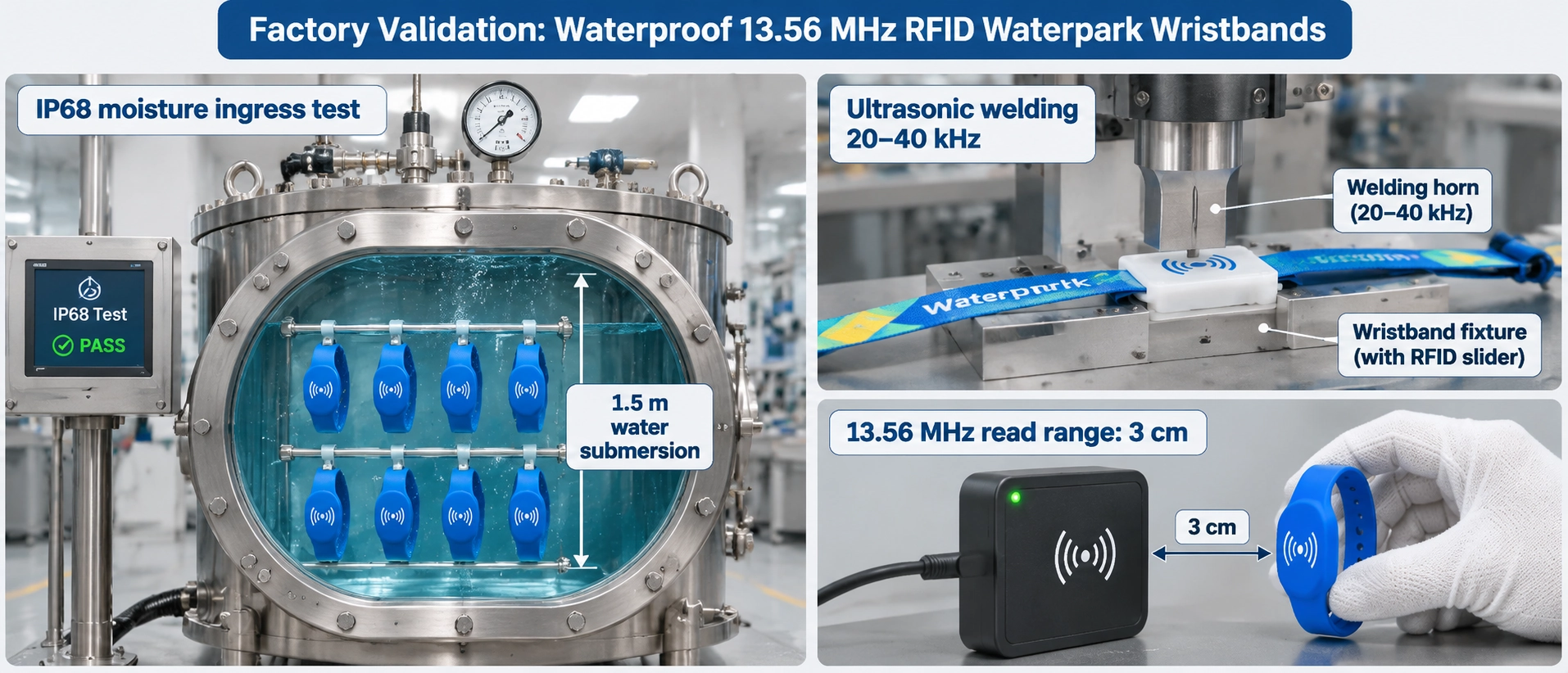
Certifying a wristband for waterpark use requires strict factory tests under the IP68 standard. The IP code uses two numbers. The first number shows defense against solid dirt, while the second shows defense against liquids. An IP68 rating proves the case is dust-tight and safe during long submersion under terms set by the manufacturer. For waterpark use, the baseline test submerges tags under 1.5 meters of water for at least 30 minutes, which creates about 14.7 kilopascals of water pressure on the seals.
To hit this mark, factories use ultrasonic sealing for hard tags on woven bands, or single-step molding for silicone bands. Ultrasonic welding directs sound vibrations at 20 kilohertz or 40 kilohertz into plastic parts clamped under pressure. This friction creates rapid heat that melts and locks the plastic chains together across the joint. The process forms a clean, solid weld without glue. We suggest a weld time of 0.5 to 1.0 seconds to keep heat from frying the microchip inside. A tight ultrasonic weld blocks moisture from entering the chip chamber. Contractors should always demand written IP68 test records from suppliers instead of trusting general waterproof claims.
Factory IP68 Encapsulation Waterproof Testing Procedure
- Submerge the randomly sampled wristbands in a pressurized water tank calibrated to simulate a depth of 1.5 meters.
- Maintain the continuous submersion and pressure for a minimum duration of 30 minutes to test the structural seals against hydrostatic pressure.
- Remove the wristbands and dry the exterior surfaces completely using compressed air to prevent false readings during the electrical test.
- Interrogate each tag with a calibrated reader to verify the read range has not degraded below the specified 3-centimeter threshold.
- Perform a destructive cross-sectional analysis using a fluorescent dye penetrant on a subset of the samples to visually confirm no moisture breached the internal cavity.
Overcoming Chip Compatibility and Frequency Lock-In
Picking the best physical band matters little if the internal chip cannot talk to your access scanners. We often see procurement teams buy durable silicone bands that fail during rollouts because of frequency mismatches or locked software keys. Radio waves pass through targets differently at low frequencies compared to high frequencies. Low-frequency 125kHz signals cut through water and human bodies easily, so they work well for simple gate access at pools. High-frequency 13.56MHz signals, including Near Field Communication tools under the ISO 14443A standard, move more data for cashless payments. However, moisture weakens these signals much faster. We suggest choosing NTAG213 chips with 144 bytes of user memory for basic cashless sales. This capacity stores secure identity tokens without paying extra for empty memory.
Buyers must also watch out for vendor lock-in. Many older access suppliers load secret keys onto their chips, locking memory blocks to their own brand of software. If your turnstiles look for this locked format, generic blank wristbands bought direct from a factory will not scan, even if they run on the correct frequency. Check whether your software uses a closed system or an open standard that reads the standard 7-byte universal unique identifier. If your platform needs data stored in an NFC Data Exchange Format, the factory must write this data before sealing the chip inside the band.
Steps to Avoid System Vendor Lock-In
- Extract the exact integrated circuit model number, operating frequency, and ISO standard from your current credentials, rather than relying on the generic system brand name.
- Request an unencoded sample wristband from the new hardware manufacturer and attempt to format it using your existing administrative encoding station.
- Verify with your software integrator whether the database requires custom cryptographic keys pre-loaded into the memory sectors at the factory, or if the system reads the universal unique identifier directly without encryption.
Operational ROI and Gate Throughput Analysis
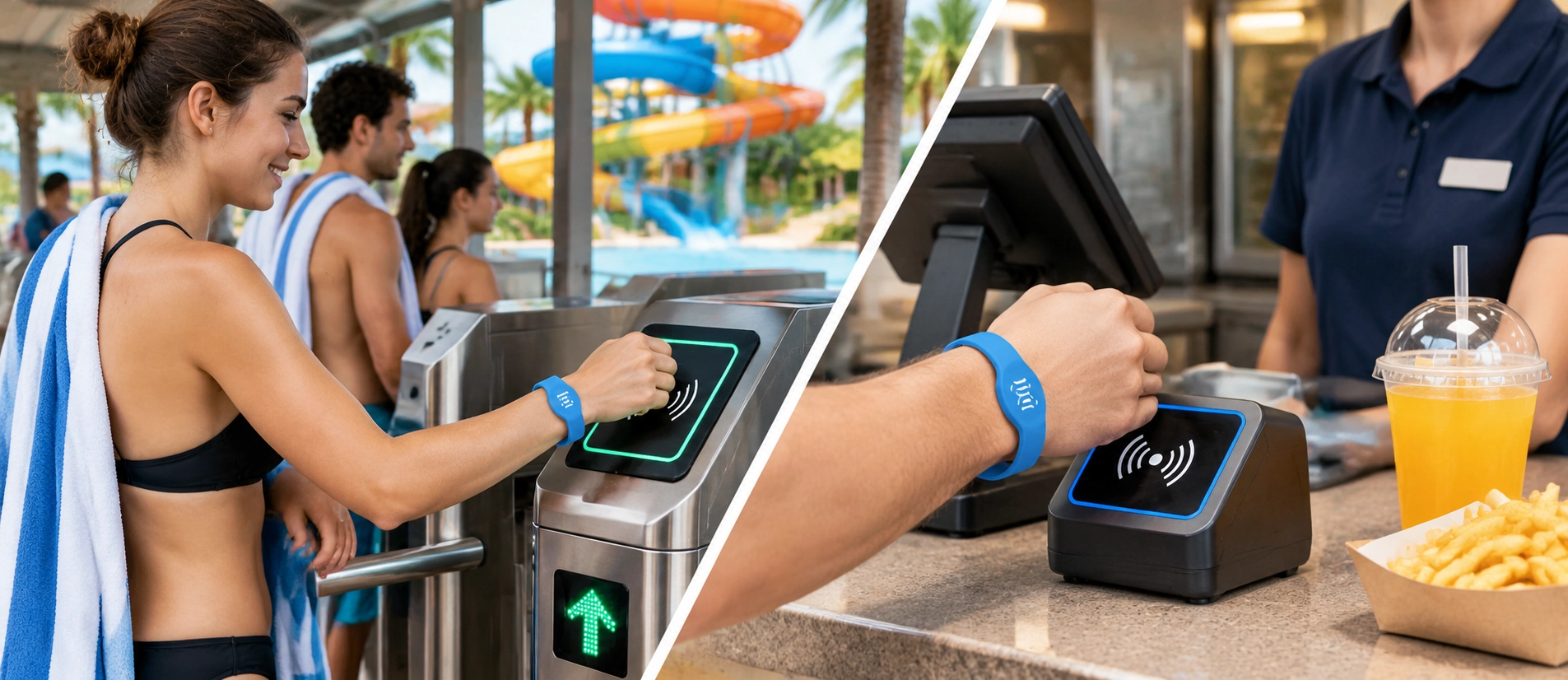
Buying premium sealed wristbands raises your initial equipment spend, but it cuts total operating costs by improving daily park efficiency. Cheap paper barcodes or leaky plastic cards cause hidden delays at entry turnstiles. When pool water ruins a paper ticket or a low-grade card, the guest gets stuck at the gate, calls for help, and waits for staff to override the lock. This small pause causes long lines during busy morning rushes, forcing managers to hire extra gate staff to clear the crowds. Quality silicone or well-sealed rPET hardware prevents these scan errors. The chip reads in milliseconds, keeping guests moving through lines without stopping.
Most sellers report a 60% reduction in gate congestion when transitioning from visual verification to tap-and-go access, though official documentation does not specify the exact throughput metrics for every gate configuration. Consider planning for a steady flow of 30 to 40 people per minute through each lane with fast high-frequency readers. Faster entry gives guests more time to spend money at food stalls and gift shops. Leaving regular wallets in lockers also makes buying items easier. You can plan for a 15 to 20 percent lift in secondary sales after rolling out closed-loop cashless payments on wristbands.
Durable silicone wristbands also lower labor expenses because staff print fewer replacement tickets during the day. In budget reviews, the higher purchase price of a good band spreads out over dozens of guest visits, while a disposable band is a daily loss. Investing in sturdy hardware pays off by clearing entry lines faster, stopping ticket jams inside turnstiles, and smoothing out daily operations.
Frequently asked questions
What if a park's daily capacity is higher than expected? Can we reorder quickly?
Venues facing sudden attendance spikes should coordinate replenishment timelines early because custom manufacturing takes time. While passive RFID tags require no internal batteries, custom wristbands-such as woven C13 elastic models or snap-closure C14 vinyl bands-need fabrication, printing, and chip encoding. To prevent gate shortages, configure an inventory reorder alert in your venue management software when stock hits a 20-day buffer threshold. For emergency shortfalls, order blank, unprinted 13.56 MHz RFID wristbands that support rapid dispatch and immediate on-site system enrollment.
Send Inquiry