

How to Choose Replacement TM Cards for Sauna Locks
Nov 18, 2026
Leave a message

If a sauna locker key starts taking several touches to work, try a known-good key on the same lock before ordering replacements. A key that has to be tilted to read calls for a fit check. Two keys that fail on the installed probe and read on a reference setup point to the reader side. A lock that reads the expected ID and stays closed calls for a controller and enrollment check.
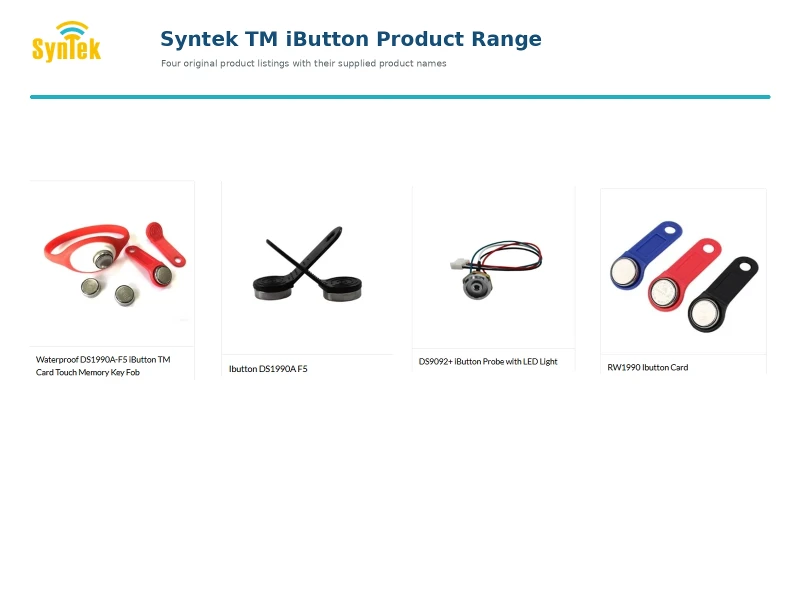
For a locker OEM changing suppliers, these results determine what to request from Syntek. Specify a read-only iButton tag if your controller enrolls and expects permanent identifiers, a rewritable RW1990 fob if your project explicitly requires writable IDs, or a TM1990A-F5 wristband if the credential is issued for wear. If the fault follows the installed probe, review the panel-mount 1-Wire contact probe before committing to new keys. The product comparison below shows which published specifications apply and what to check on your own equipment.
Decide Whether to Sample a Key, a Wristband or a Probe
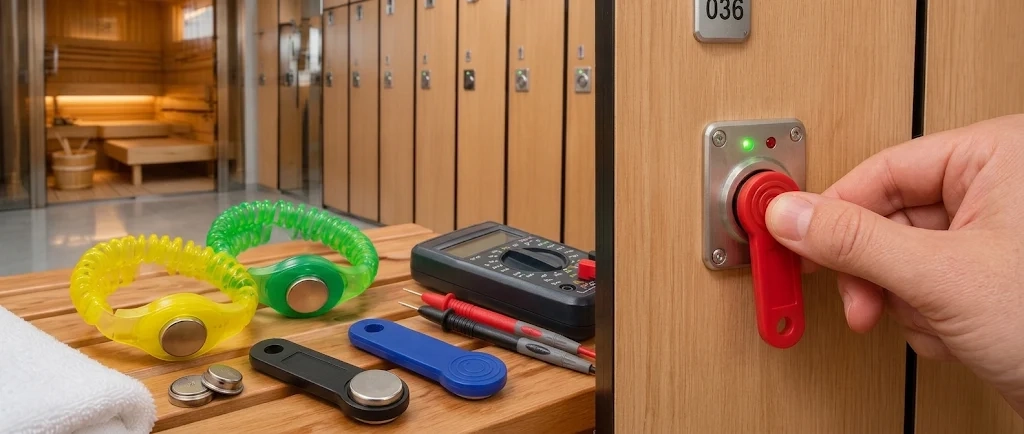
TM cards in this guide are contact-type Touch Memory credentials. The button needs physical contact at the data and ground surfaces of a compatible probe. Keep the touch method and equipment consistent when comparing the returned key with a known-good key. Where diagnostics are available, record the returned ID and the resulting lock action separately. Analog Devices 1-Wire application note · Syntek guide to contact iButtons and RFID credentials
| What you observe | What to do before requesting samples |
|---|---|
| The returned key misses reads on both the installed and reference probes. The known-good key reads on both. | Inspect the returned button's rim, contact faces and fit in its holder. Request a replacement in the required form factor and ID type. |
| Both keys miss reads on the installed probe and read on the reference setup. | Check the installed probe for deposits, wear or poor seating. If the problem persists, have the equipment team check the wiring, connectors, ground and 1-Wire interface under the maker's service procedure. Shortlist a replacement probe if the team confirms the probe is at fault. |
| A loose credential reads, but the same type of button in a worn wristband needs repositioning. | Compare the band on the wrist at its normal adjustment. Check button movement, exposed contact area and clearance around the reader bezel before selecting a wearable sample. |
| The installed system reads the expected ID and denies access, or a guard tour device omits the event. | Verify enrollment, assigned role where applicable, and the expected host response. Confirm the permitted ID type before ordering a different chip. |
If the installed controller only shows a light or beep, record the indication and whether the locker opens. Label any ID measured on a separate setup as a reference read. In your sample request, describe what happened on each setup so the supplier knows whether the priority is button fit, reader replacement or ID behavior.
Compare Syntek TM Cards and Contact Probes Against Your Requirements
Use the published specifications to build a shortlist. For each candidate, put the project requirement, the proposed part and the sample check on the same RFQ line. This helps purchasing quote the right item and gives quality engineering a clear basis for approval.
| What your project requires | Syntek product to review | Published specification relevant to the RFQ | What to verify on a sample |
|---|---|---|---|
| A card-style credential with a permanent ID for a controller that enrolls each key | TM1990A-F5 read-only iButton tag | TM1990A-F5, factory-set ROM registration number, ABS housing with a stainless steel contact | Ask for the finished outline and contact geometry. Confirm grade if your RFQ specifies it. Check first-touch reads, enrollment and the expected lock action on your firmware. |
| A rigid fob with writable IDs, a specified steel can and an available marking option | RW1990 rewritable Dallas key with ABS handle | RW1990, ABS handle, listed 304 stainless steel can, nominal button diameter 16.25 mm and height 5.89 mm, optional laser engraving | Confirm the quoted version and obtain the critical fit tolerances. Request traceable grade evidence when required. Check an authorized test ID, seating and post-exposure mark legibility. |
| A wearable credential with an embedded button and fixed-ID enrollment | TM1990A-F5 iButton wristband | Read-only TM1990A-F5 with a pre-installed button. The specification table lists silicone or TPU | Specify the band material and confirm it for the quoted configuration. Check button retention, contact exposure and reader clearance while the band is worn. |
| A replacement contact probe when the installed probe has been identified as the fault | Panel-mount 1-Wire iButton probe | Panel-mount contact probe with separate data and ground leads | Confirm cutout, panel thickness, behind-panel clearance and controller wiring. Fit the probe to the intended panel and test it with both a known-good key and the proposed credential. |
Choose the ID type before you choose the housing. If your controller expects an approved DS1990A part, include the exact model and permitted substitutions in the RFQ. The Analog Devices DS1990A has a factory-set 64-bit registration number in read-only memory. A TM1990A-F5 listing describes a different offered part. Ask the supplier to identify the exact quoted device and qualify it on your controller before any substitution. If the lock requires cryptographic authentication, verify that capability separately against the device and system documentation. Analog Devices DS1990A datasheet
If you need two approved formats, such as a card-style tag for locker staff and a wristband for guests, request them as separate sample lines. Record the chip, holder material, fit result and permitted uses for each. Browse the Syntek iButton range to identify the formats you want quoted.
Turn the Wet-Area Requirements Into Sample Acceptance Criteria
Confirm the housing material and test the finished assembly
Moisture can linger where the steel button meets its holder. If chlorides are present, the stagnant liquid in the gap can become more corrosive. Inspect the rim, both exposed contact areas and the holder junction. Photograph suspected corrosion and record the read result separately. This gives your supplier two observations to investigate. Australian Stainless Steel Development Association on crevice corrosion
For the Syntek RW1990 fob, use the published 304 can and nominal button dimensions as the starting point for the RFQ. Specify which component needs grade evidence and ask what can be traced to the quoted lot if that evidence is mandatory. For the card-style TM1990A-F5 and the wristband, confirm the exact metal and holder materials for the offered configurations. A housing specification is one part of approval. Include the assembled credential in the fit and exposure checks.
Tell Syntek where the credential is used and where it is stored between uses. Exposure can include sweat at check-in, condensation in the locker area or contact with a cleaning solution during returns. Specify which exposures apply, how the sample is presented to the probe and when it must read. If your team expects the key to work while damp, include that condition in the acceptance record. If your procedure calls for a recovery period, define it before testing.
If your purchase specification requires salt spray, agree on the method, sample configuration, duration and acceptance criteria. ISO 9227 defines salt spray methods and leaves the product-specific conditions and interpretation to the applicable specification. Salt spray results cannot predict long-term corrosion resistance in service. Record the appearance and the functional outcome under your agreed service exposure as well. ISO 9227:2022
Check button retention at the same angle users present the key
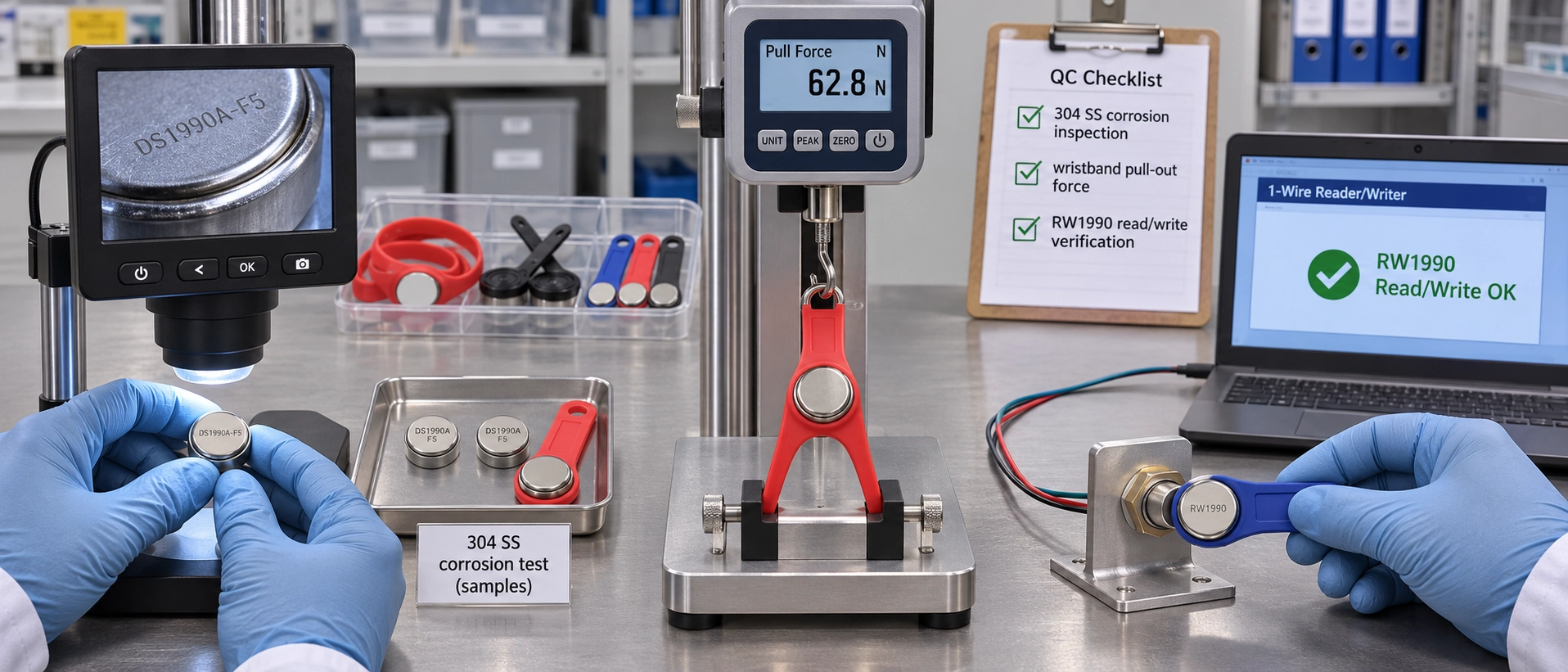
For an ABS fob, check whether a lifted edge or the handle hits the bezel before the button seats. For the wristband, repeat the check at the adjustment normally used by staff or guests. On a recessed reader, the band can bend and present the button at a different angle than it does on a bench. Check for movement and incomplete contact before and after the agreed exposure.
If your drawing specifies a retention method, request its confirmation on the quoted wristband and include it in the approved sample record. Ask for the relevant profile dimensions when bezel clearance is tight. Include the probe's panel position in the setup record so later samples can be assessed under the same conditions.
Approve the laser mark before the first production order
For the Syntek RW1990 laser marking option, decide whether staff need a lot code for sorting returns or a visible individual number for reissue. Specify the mark location, character format and legibility requirement. Review a marked sample after assembly to confirm that the holder leaves the mark visible. Include another legibility check after the agreed exposure if operators will rely on the mark during service.
If the visible number must match a record in your locker or patrol system, ask whether a unit-level mapping file is available for the quoted version. Compare the sample's visible mark with its electronic ID and the supplied file before approval. For custom marking, materials or sample arrangements, include your acceptance points in the Syntek OEM/ODM brief and ask which requirements can be supported for the selected iButton SKU.
Use One Approval Record for the Existing Part and the Syntek Sample
Keep one known-good key as the control and one returned key as the failure reference. Give each candidate its own sample line. Before running the comparison, record the test date, sample lot and revision, reader and controller models, firmware, sample count, number of attempts and first-touch acceptance threshold. Define a retry consistently so a key that needs to be lifted and reseated is scored the same way across all candidates.
| Acceptance record | What to capture | Decision before bulk purchase |
|---|---|---|
| Part and supplier identity | Chip designation, device manufacturer, ID type, holder material, exact supplier SKU and revision | Approve the quoted configuration and any allowed substitutions in writing. |
| Housing and reader fit | Contact faces, rim and seam condition, button movement, orientation and bezel clearance | Confirm that the sample seats consistently in its intended use position. |
| First-touch read and enrollment | First-touch results, retries, expected ID where diagnostics show it, and actual lock or patrol response | Compare with the agreed threshold. Keep raw read and host acceptance as separate results. |
| Marking and traceability | Marked sample, artwork revision, location, legibility and any required ID mapping | Approve the marking on the assembled sample and retain the mapping specification if required. |
| Wet-area performance | Agreed exposure, appearance, first-touch response and host behavior at the specified damp or recovery condition | Sign off both appearance and functional criteria for that condition. |
Use the same reader, controller and firmware for each comparison. For a writable-ID requirement, have authorized staff confirm readback and enrollment with a test credential. For a guard tour device, check that the intended host record appears for the enrolled sample. Keep the approved physical sample and record with the purchase specification so receiving inspection has a reference when a new lot arrives.
Request Syntek Samples for Your Installed Locker System
If you already know the chip and form factor, include the product name from the comparison table in your request. If the failure may involve the probe, include it as a separate line and tell Syntek which keys passed on your reference setup. For each item, ask for the exact quoted variant, sample availability, specification or drawing where available, and a quote for your expected bulk quantity.
Include these details in the inquiry:
- Installed equipment - locker or controller model, probe model, firmware if available, and a short note on what happens on the first touch.
- Existing credential - front and back photos with active credential numbers masked, chip marking or known part number, and the format you want to evaluate.
- Required variant - fixed or writable ID, card or fob profile, wristband material if specified, and any required marking or traceability file.
- Service and acceptance - the relevant exposure conditions, how the key is presented, and how you will judge a first-touch pass.
- Purchase scope - sample quantity, estimated order quantity and the requested options to quote separately.
Request an OEM TM card sample and quote from Syntek.
Send Inquiry