


Blank RFID Cards: How To Inspect A Batch Before Printing And Encoding
Nov 19, 2026
Leave a message

Buying blank RFID cards transfers an important part of the work to the buyer: the cards must be inspected before they are printed, personalized, encoded or issued. A clean white surface does not tell you whether the embedded credential is compatible with the installed reader. Equally, a successful chip read does not tell you whether that card will travel through your card printer or produce acceptable artwork.
This guide is for procurement, card-issuance and integration teams receiving blank RFID card stock for access badges, membership credentials or similar programs. Its job is to turn a supplier specification into a repeatable incoming inspection and release procedure. For deciding whether to purchase blank stock instead of factory-finished cards, see Syntek's separate blank-versus-preprinted card comparison. The instructions below start after the decision to receive blank stock has already been made.

Define what "blank" means on this purchase order
Unprinted plastic cards, unprinted chip-bearing RFID cards and unencoded contactless credentials are not synonyms. The words blank RFID card usually describe the absence of visible artwork, not necessarily an empty chip memory or a particular credential type. A supplied RFID card can have a factory-programmed identifier, predefined configuration, default memory or an application already loaded. Its exact state needs to be documented rather than inferred from the lack of a printed logo.
Start the receiving specification with the actual system requirement: frequency, protocol, approved chip or credential family, data/credential format, intended reader or controller, encoding responsibility and the approved card construction. There are multiple unrelated RFID technologies; a card with the right frequency may still fail in the customer's access system because its credential format or backend configuration is wrong.
| Order field | What the receiving team should have | What a mismatch may cause |
|---|---|---|
| Credential technology | Exact approved chip/credential designation, not "RFID" alone | Incompatible readers or applications |
| RF interface | Frequency and applicable protocol/reader requirements | No read or intermittent recognition |
| Data state | Expected factory configuration and whether personalization is pending | Incorrect write operation or failed issuance |
| Physical stock | Dimensions, thickness tolerance, substrate, finish and printing grade | Printer jams, poor transfer or handling damage |
| Batch identity | Supplier lot identification, packing list and approved specification revision | No reliable way to isolate a problem batch |
Never treat a chip UID as a substitute for a properly designed access credential or customer-account record. Depending on the chip technology, a UID may be factory-assigned, used as an identifier or exposed to a reader, but it is not universal proof of authenticity or access authorization. Rewriting or emulating identifiers may create additional security and compatibility problems and is not a generic acceptance test.
Receiving inspection begins before the packaging is opened
Set the sampling method before any carton is opened. A common mistake is to pull several cards from the top of one box, declare the shipment acceptable, and then discover that a later carton contains a different card construction. A receiving plan should identify which shipment or production lot is being accepted, how many cartons contribute to the sample, and how the sample is selected without letting visual appearance bias the choice. Where the buyer uses an AQL-based scheme, the applicable inspection standard, inspection level, lot size, defect categories and acceptance/rejection numbers must be agreed and documented. This article does not prescribe a universal AQL or a universal sample percentage.
Classify defects by consequence, not by appearance alone
| Example class | Illustrative card condition | Proposed receiving action |
|---|---|---|
| Critical for the intended system | Wrong approved credential family, unauthorized data state, or a credential that violates the security specification | Quarantine the affected lot; investigate identity and authorization before any issuance |
| Major | Verified card feed failure, failed authorized encoding, or print surface that cannot meet the approved artwork | Hold the affected stock and evaluate rework, supplier replacement or an agreed concession |
| Minor when contract permits | Small cosmetic variation outside a controlled artwork area with no effect on print or function | Record the deviation against the written visual acceptance criteria |
These are example classifications for planning, not a contract-wide definition: a cosmetic flaw may be critical on a customer-facing premium badge, while a different application may not require color consistency at all. The buyer and supplier set the actual thresholds before receipt.
Record the supplier name, purchase-order reference, received quantity, lot number, packaging condition and current storage requirements. If several chip variants or finish types are ordered, keep them physically separated and mark the cartons or trays with the expected SKU. A mixed lot is difficult to trace after printing begins.
Next inspect the packaging for contamination, moisture exposure, crushed corners or loose cards. These are grounds to investigate, not proof that every card is defective. Open a representative portion of each lot under clean conditions. Look for edge burrs, obvious warping, delamination, surface scratches and visible contamination. Note whether the cards are delivered in a format your printer or card-dispenser can handle safely.
The goal of this step is not to invent a universal defect allowance. The customer and supplier should agree on the inspection standard, sample quantity and disposition of nonconforming cards before shipping. A critical defect for a visitor badge program may be different from a cosmetic blemish acceptable on an internal temporary card.
Prove reader compatibility with known-good controls
Use a reader and software path already approved for the project. Keep a known-good reference card nearby and test it before and after the incoming sample set. This simple control distinguishes equipment or configuration faults from a suspect card lot.
- Record the environment. Capture reader model, firmware, operating settings, antenna position and application configuration. If the reader is connected to an access controller or backend, identify that dependency.
- Confirm the reference behavior. Present an existing approved credential and verify the expected reader result without modifying the reference card.
- Identify the sampled card. Read only the fields supported and authorized by the selected interface. Compare the observed chip type or other available characteristics with the purchase specification.
- Test the intended operation. If the order calls for future encoding, try the approved encoding workflow on designated samples. If cards are already encoded, check the authorized credential format and full application result.
- Check the system, not just the radio. Verify the downstream reader, controller and backend response. A reader's beep or a displayed UID does not prove that the door, membership or time-and-attendance system will accept the credential.
- Capture evidence. Keep a lot-linked record of tested cards, device configuration, pass/fail result and any re-test. Segregate samples that do not match the expected behavior.
The test must fit the security model. Some credentials are intentionally unreadable or unwritable without authorized keys; that does not make them defective. Verify the required operation with legitimate tooling and keys rather than attempting to bypass access controls or interpreting a protected memory area as an error.
A receipt of mixed cartons deserves a cross-carton test, even when all outer labels match. If the specification revision changed during production or a replacement lot was substituted, record that fact as a deviation requiring owner approval. The goal is to stop an unidentified card batch from entering a personalization workflow where its origin can no longer be recovered.
Printer suitability is a separate release gate
Blank does not automatically mean printable. Ask the supplier to state whether the delivered surface is approved for the exact intended printing method: direct-to-card dye-sublimation, retransfer, inkjet or another process. Surface coatings differ; the same card cannot be assumed compatible with every machine and consumable.
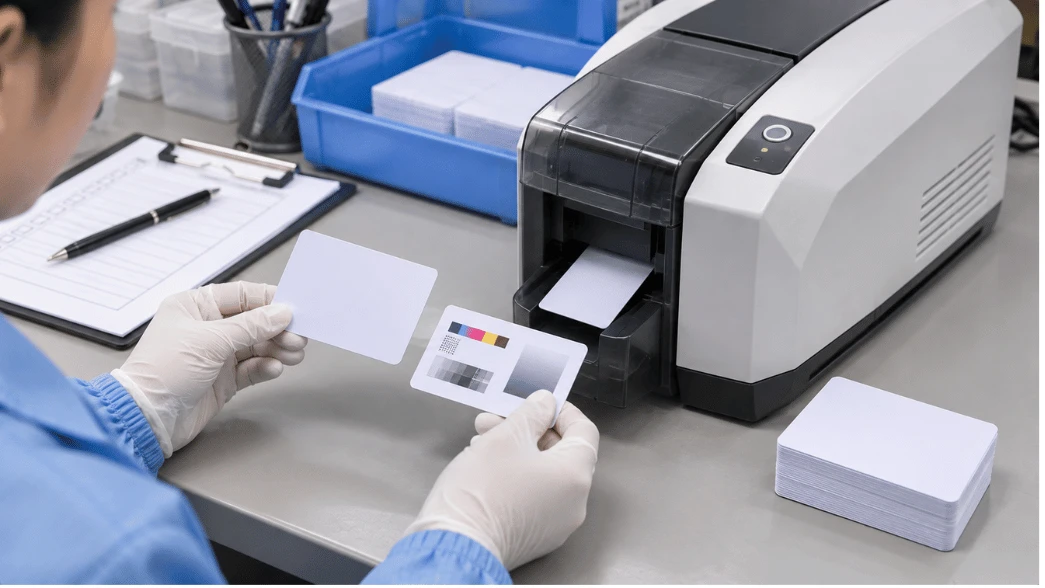
Use the real printer model and approved ribbon or ink on sample stock from the delivered lot. Review the machine's supported card thickness and feed requirements. Run a short sample job using the real design, including fine text, photograph, barcode, dark areas and edge details if those elements are part of the card program.
After printing, check print registration, scratches, image transfer, legibility, surface contamination and the behavior of the printer feed. Then test the contactless function again. Mechanical damage from inappropriate handling, aggressive finishing or hole punching may affect an internal antenna even where the card looks intact. Do not punch or cut an RFID card unless the approved layout identifies a safe zone.
Printer purchase decisions should be validated with the equipment manufacturer and the approved media specification. This receiving guide is concerned with qualifying a stock-and-printer combination already proposed for the program.
For print quality, keep the surface clean while loading the printer. Zebra's card-handling guidance for specified ZXP card-printer models recommends handling cards by their edges and keeping surfaces free of contamination; it is a model-scoped handling reference, not proof that every blank card works in every printer. The HID FARGO DTC1250e product information likewise illustrates that supported materials, card formats and encoding options belong to the actual printer configuration. Confirm the installed printer's current manual and consumables, then validate with delivered cards.
Separate stock, printer and printing-operation failures
If printed defects align at the same position on every card, inspect the printer and printhead before blaming the lot. If defects follow a particular carton or card face, isolate the card stock and handling. If the image looks acceptable but encoding fails after printing, compare a pre-print sample with a post-print sample under the same authorized read/write test. Hold the ambiguous cards rather than silently replacing the test equipment or changing settings mid-investigation.
Blank cards are only one part of the issuance data chain
A card stock acceptance test should define where a physical identifier becomes an authorized credential. In a typical issuance workflow, the card supplier provides blank or partially prepared media; a printer applies artwork; an encoder or enrollment station writes or associates approved data; and a downstream application maps that identity to a person, account or authorization. The responsible system owners must approve each connection.
Build one documented example from the proposed production workflow: read the intended record, compare it with the issuance file, enroll or associate the record using approved software, then perform the application's required action. If a test badge reads correctly but does not open the intended door, the supplier's RF hardware may not be the cause; a facility code, credential format, controller policy or backend mapping could be involved.
A separate data-quality issue occurs when visually identical cards are accidentally assigned to the wrong individuals. Define how the issuance team will compare the printed human-readable number, authorized chip data and backend account association before handoff. For secure credentials, use only the identifiers and validation operations allowed by the deployed platform.
Three identities need three owners
In an issued access or membership program, distinguish the supplier's physical lot ID, the chip or credential information visible to an approved reader, and the employee/member/account record. None of those is guaranteed to be the same number. Write down the permitted mapping for each credential technology. For example, a customer may receive a lot-marked blank card, load an authorized credential using its encoder, and only then assign that credential to an individual in the controller or membership database. The lot number establishes supplier traceability; it does not confer access rights.
Keep rejected demonstration cards away from live issuance. A rejected card with a partly completed write is a different control problem from an unused but visually damaged card. Mark its disposition, record whether it has been encoded, and follow the credential-system owner's secure disposal or rework procedure.
Incoming acceptance matrix for blank RFID card lots
| Gate | Proposed acceptance evidence | Hold or investigate if |
|---|---|---|
| Order and lot | Packing list, SKU and specification revision aligned | Chip or lot information is inconsistent |
| Visual finish | Inspected sample set and documented approved appearance | Warping, damage or contamination exceeds agreed criteria |
| RF and credential | Authorized reader test against known-good reference | Expected interface or application result differs |
| Printing | Actual printer, ribbon/ink, artwork and approved proof | Feed errors, poor transfer or unreadable text/code |
| Post-process integrity | Final read/transaction after printing or finishing | Card no longer supports intended function |
| Traceability | Lot-linked record and disposition of rejected samples | Failed samples are mixed back into usable stock |
Choose sampling levels and acceptance thresholds using a documented procurement quality plan suited to the failure impact. A proposed matrix is not a claim that a supplier ran these tests or achieved a particular yield. In a safety-critical or security-sensitive issuance environment, qualified stakeholders may require additional controlled validation.
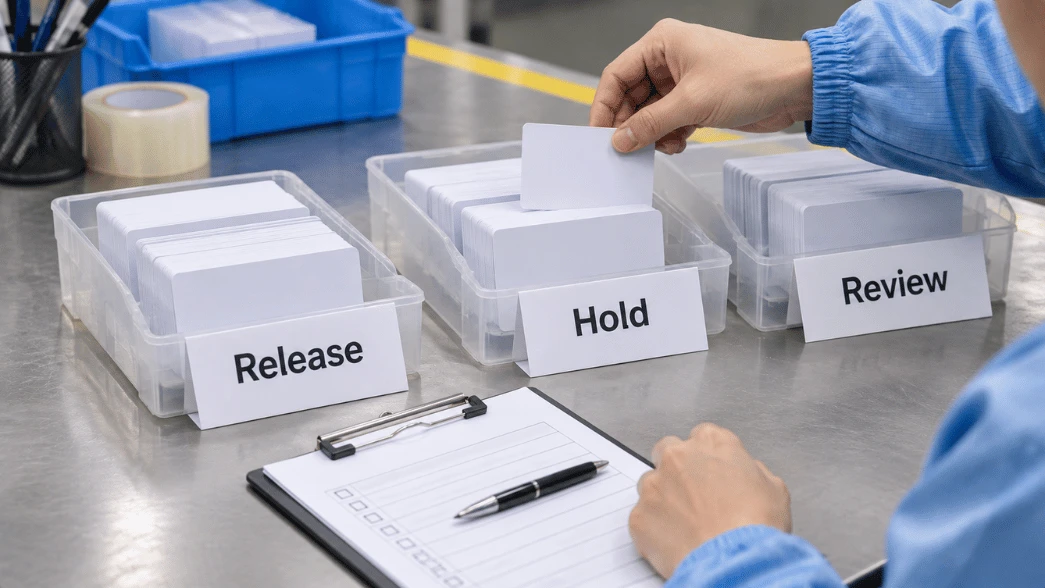
For a lot-level decision, distinguish three release conditions: release only when the specified visual, physical, approved-RF and print gates have passed; hold when a test or source document is incomplete; reject/return when a confirmed nonconformity cannot be repaired under an approved plan. Each decision should identify the person authorized to sign it and the evidence that was reviewed. A supplier's sample photograph or general certificate cannot replace these lot-specific results.
When a batch fails, isolate the variable before reordering
Multiple failures in one carton suggest a different investigation from a single card whose printed surface is scratched. Work from the most observable evidence backward and avoid changing reader settings, encoder configurations and card lots simultaneously.
- No card detection: Verify the known-good reference, reader power/settings, the ordered RF technology and whether the sample is damaged or belongs to a different lot.
- Readable identifier but rejected credential: Check approved credential format, enrollment data, controller rules and authorized authentication requirements.
- Write or personalization error: Confirm the expected card memory state, permitted write operation, encoder configuration and whether the chosen credential is intentionally protected.
- Print defect: Inspect surface grade, printer settings, consumables, contamination and the actual card construction.
- Failure after printing: Repeat the RF check on an unprocessed sample from the same lot and review whether the process created bending, heat, pressure or physical damage.
Keep the results for a supplier discussion. A useful complaint includes the lot reference, device configuration, symptom, sample count and controlled comparison with accepted stock. A generic statement that the "cards do not work" rarely isolates the problem.
Specify your next order so the inspection is repeatable
Before authorizing bulk replenishment, request a documented chip/credential designation, physical card grade, surface-print compatibility, state at shipment, authorized encoding requirements and lot-traceability arrangement. Include the agreed physical proof and reference stock. If an alternate chip or finish is proposed, do not accept it on the basis that it operates at the same nominal frequency; repeat the system-level qualification.
Use Syntek's RFID card product category to discuss commercially available constructions and customization options. Confirm the exact variant and its datasheet rather than treating every product under that category as identical. For programs involving both printed and chip-based credential data, the inspection record should identify the owner of each data field and the point at which cards are released for issuance.
A well-run blank RFID card program does not begin when the printer starts. It begins when the incoming lot can be identified, inspected, read, printed and traced under a known procedure. That discipline protects personalization work, prevents the accidental release of unverified cards and gives the buyer a reproducible requirement for subsequent orders.
Send Inquiry