


RFID Returnable Container Tracking: GRAI IDs, Partner Handoffs And Return Reconciliation
Nov 18, 2026
Leave a message

A reusable plastic tote can leave a factory with the correct shipment, arrive at a distributor, and still be reported as "missing" two weeks later. The goods may have been received, but nobody confirmed who now holds the empty container. An RFID tag can help capture a container at a gate or handheld checkpoint. It cannot, on its own, settle custody or prove that a business partner accepted the asset.
This guide explains how to build RFID returnable container tracking around a persistent container identity, explicit dispatch and receipt events, and a reconciliation record that survives partial returns, repairs and tag replacement. It is for packaging-pool managers, warehouse operators, integrators and B2B tag buyers operating reusable totes, crates, pallets or roll cages. It does not promise live GPS location or a particular supplier's read rate.
The object moving through the gate is not always the object being sold
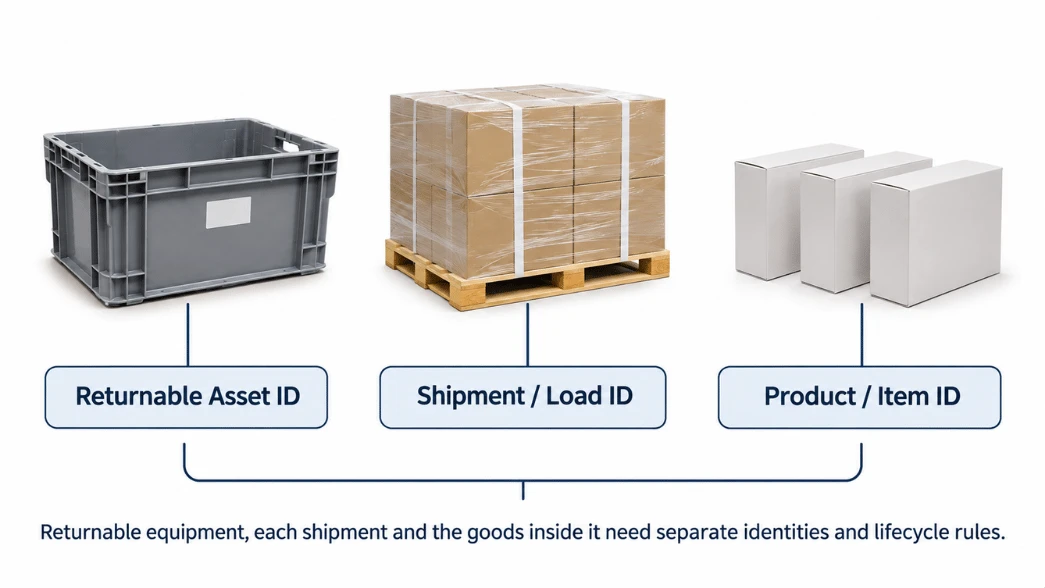
Three identifiers can coexist in a single pallet movement. The reusable carrier has its own asset identity. The shipment or handling unit has a logistics identity. The goods inside have trade-item identities. Treating all three as the same number can make the system look successful at shipping while silently losing the returnable pool.
| What needs an identity | What the record means | Why it should stay separate |
|---|---|---|
| Returnable tote, crate or pallet | A persistent reusable-asset identifier | The carrier comes back and may transport different goods on successive trips. |
| Loaded shipment or logistics unit | The movement or shipment identity used by the WMS/TMS | A shipment may be split, combined or completed while the carrier remains in circulation. |
| Product or component | The item, lot or serial identity managed by inventory or production software | Goods may be unloaded while the original crate remains with a partner. |
GS1 identifies the Global Returnable Asset Identifier (GRAI) as an identification key suited to reusable transport equipment. When a pool needs to distinguish individual carriers, the serialised identity matters. GRAI is an option for programs following GS1 rules; a private closed-loop pool may use its own controlled numbering scheme if all participating systems agree. Neither choice removes the need for a reliable mapping to the physical carrier.

Assign identity at the pool owner, not at every handoff
A common data error begins when each warehouse gives a tote a new local number. The receiving site then creates a second asset record for a carrier already known to the pool operator. Over time, the database shows two containers even though there is only one physical object.
Agree who allocates the durable asset ID, who manages duplicates, and what happens when the carrier is sold, retired or transferred permanently. A receiving partner may add a local location or account reference, but should not silently replace the pool's master identifier. For a serialised GRAI implementation, confirm the applicable GS1 assignment and EPC encoding rules with the owner and integration provider before printing labels or writing tags.
Keep descriptive attributes in the authoritative data system: container type, owner, dimensions, inspection state, assigned partner, permitted route, and service history. A tag typically needs to supply a resolvable identity; it does not need to store the entire movement history. This keeps partner operations from repeatedly rewriting data on the same transponder.
Choose the unit you can actually reconcile
Some pools track each tote. Others initially count a pallet stack or a cage. These are not equal levels of evidence. Reading one tagged outer cage proves the cage was observed; it does not prove the presence of every untagged tote inside it. If the contract charges for missing individual units, the identity design must support unit-level reconciliation or use a separate controlled count at each handoff.
Make four events explicit before choosing tags
Rather than specifying "automatic container tracking," define the handoffs where custody or condition changes. The following state model is a practical starting point, not a universal software specification.
| Event | Required evidence | What it does not prove by itself |
|---|---|---|
| Dispatch | Container IDs, sending site, destination, dispatch reference, time and approved load | That the receiving partner accepted all listed containers |
| Receipt | Observed IDs, expected dispatch, receiving site, timestamp, exceptions and acknowledgment | That every loaded item was inside each returned container |
| Empty return | Returned carrier IDs or approved count, condition, source partner and matching outgoing liability | That a damaged carrier is immediately ready for reuse |
| Repair, retirement or loss review | Asset identity, inspection decision, authorized status change and audit record | That a missing read proves physical loss |
GS1's EPCIS explanation describes visibility events in terms of what, when, where and business context. That distinction is useful even when a closed-loop implementation does not exchange EPCIS messages: a reader observation is evidence, while dispatch, acceptance and return are controlled business events.
A fixed reader might see a tote twice as a forklift turns in a loading lane. Those two RF observations should not automatically become two dispatches. Conversely, a reader can detect an ID from the neighboring staging area even if that container never crossed the dispatch boundary. Business-event logic therefore needs triggering, location, time windows, duplicate suppression and operator verification where required.
Partner handoffs need a reconciliation ledger
The simplest reconciliation is not "number of reads this week." It is an opening quantity plus authorized issues and returns, adjusted by approved corrections and disposition. Every variance should be traceable to the relevant asset IDs or, where individual tracking is not possible, to a documented quantity-count process.
Consider an illustrative pool: a sender dispatches 60 identified totes to a partner. The receiver confirms 58. Two appear on the sender's list but not in the receiver's accepted record. One of the 58 arrives broken and is quarantined. Later the partner sends back 45 empty totes. A careless dashboard might show "15 outstanding" from dispatch minus returns. The useful ledger distinguishes two unresolved receipt exceptions, one damaged-but-received tote, and the separate identities of all accepted and returned carriers. The numbers here are deliberately fictional arithmetic to demonstrate record structure, not field data or expected performance.
For each handoff retain an agreed source document, sender, receiver, event time, carrier IDs, physical condition, pending discrepancies, resolution owner and acknowledgment status. If the pool bills by rental duration or lost-unit liability, contract logic should consume accepted, disputed and returned states rather than raw portal read totals. A carrier may be observed at a site while the legal or commercial custody transfer remains unconfirmed.
How to handle five common differences
- Listed but not observed: check packaging records, gate logs and physical count; keep the asset in a pending state rather than automatically declaring it lost.
- Observed but not listed: identify whether the container belongs to another shipment, customer or pool; do not silently credit the wrong account.
- Read twice: consolidate observations into one permitted event, while retaining technical logs for troubleshooting.
- Partial return: close only the returned identities or approved quantities; keep the remainder tied to the correct partner and dispatch.
- Damaged return: record receipt and condition separately; move the carrier into inspection or repair rather than treating it as available stock.
For broader enterprise workflows, SAP's RTI process documentation shows how returnable assets, condition status and movement events can be managed in connected software. It describes that solution family, not a claim that every RFID system integrates with SAP automatically.
Select tag construction around the full journey
The tag must remain attached and readable after the carrier has been stacked, loaded, unloaded, cleaned, repaired and returned. An excellent bench read from a loose label does not establish that a tote will work in a nested stack or on a metal roll cage.
| Carrier condition | Tag or mounting question | Production-equivalent check |
|---|---|---|
| Rigid plastic tote | Bonding to textured or low-surface-energy plastic; protected placement | Adhesion and read behavior after actual handling, loading and cleaning |
| Metal roll cage | On-metal construction, shielded positions, moving doors and impact | Fixed or handheld reads in loaded and unloaded orientations |
| Wooden pallet | Damage, moisture, forklift contact and approved fasteners | Reads and attachment after representative route exposure |
| Nested empty totes | Tag-to-tag proximity, position overlap and physical shielding | Inventory the intended nested configuration rather than single containers |
| Washable or repairable carrier | Chemical and mechanical exposure, replaceability | Post-process re-read, physical inspection and replacement procedure |
If a project needs special or rugged constructions, Syntek's special RFID tag product category is a sourcing starting point. The category alone does not verify a particular tag's wash resistance, read distance, adhesive performance or reader compatibility. Request the exact part number, mounting drawing and supplier-approved environmental conditions. For metal carriers, the existing anti-metal RFID explanation owns the underlying RF problem.
A read zone should observe the planned handoff, not the whole dock
Passive UHF is often considered when multiple crates must be read at a controlled gate. The choice still depends on actual material, tag orientation, permitted regional settings, antenna design and density. A handheld reader may be better for an exception lane or damaged tote than a fixed portal, while a barcode can provide a useful fallback where presentation is easy and RF conditions are poor.
Map a physical boundary: where does the pallet or forklift enter; which adjacent staging positions must remain excluded; and what operator or system signal confirms dispatch? Test the empty lane, a loaded stack, a partially loaded stack and a vehicle stopped at the edge of the field. Include intentionally stationary tagged totes near the entrance as negative controls.
The reader does not determine legal custody or continuous GPS location. It supplies observations at equipped points. If the business requires live vehicle location between sites, it needs appropriate transport telematics or another location technology, integrated with the container events.
Prove the complete return cycle with a small pilot
Choose representative carriers rather than selecting only the easiest clean samples. Include normal wear, high and low stacks, a metal or liquid-containing neighboring load where applicable, realistic forklift movements, damaged tags and units whose printed number is temporarily unreadable. Before the test starts, agree on the denominator: which units were physically present, which events were expected, and what counts as a false event.
| Pilot test | Required evidence | Hold or investigate when |
|---|---|---|
| Enrollment | Visible ID, electronic identifier and pool database resolve to one carrier | Duplicate, unknown or incorrectly mapped identity |
| Dispatch capture | Expected carrier IDs produce one permitted dispatch event | Missed unit, duplicate event or false crossing |
| Partner receipt | Accepted IDs and unresolved differences are visible to both sides | Raw tag reads are booked as custody acceptance without confirmation |
| Partial and empty return | Returned IDs clear the correct liabilities while other units remain outstanding | Count totals hide missing identities or wrong-partner credits |
| Damaged carrier | Inspection state prevents unintended reuse | Damaged tote returns to active stock from an automatic read |
| Lost, replaced or unreadable tag | One asset record remains with a controlled old/new tag history | Retagging creates a second active container or erases history |
| Network interruption | Buffered or manual events reconcile without duplicate posting | Events disappear, replay twice or lose their partner reference |
Define pass criteria with the pool owner and receiving partners, using actual counts and documented tolerances. There is no responsible universal read percentage or gate power setting for every container pool. A public Turck returnable transport item example illustrates an implemented pool-management use case, but its specific results are not evidence of Syntek product performance or of outcomes at another site.
When the tag fails, keep the container history intact
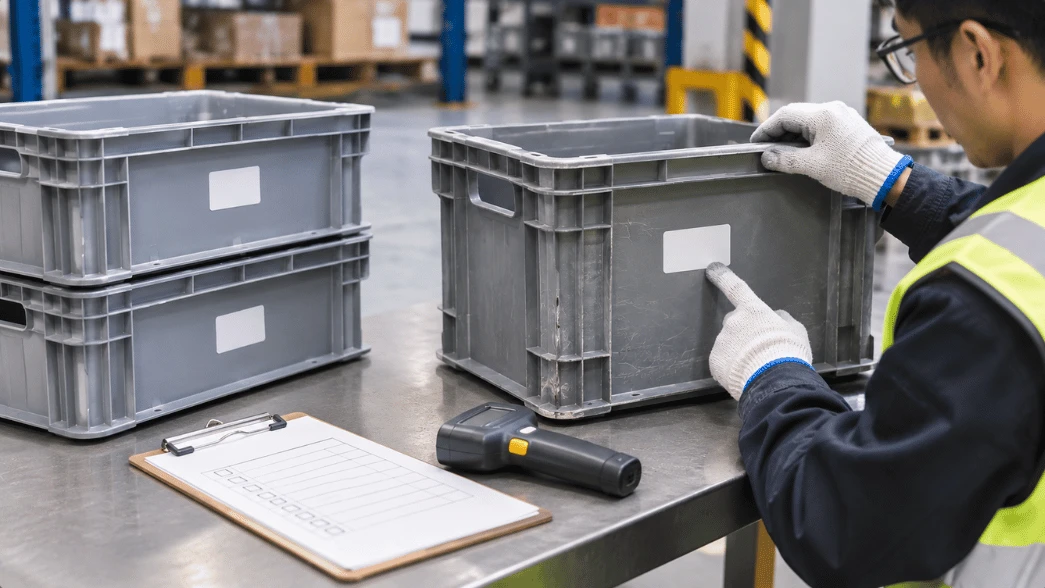
Retagging must distinguish a broken RFID transponder from a missing or retired carrier. Verify the physical unit through its durable visual mark and an authorized asset record. Quarantine the unreadable or damaged tag where possible, retire the old mapping under a documented rule, and attach a qualified replacement. Then check that the new electronic ID resolves to the same surviving container record and that any former ID cannot create an active movement for a second unit.
Some systems have special rules for whether an EPC-based object identity may be preserved while the physical transponder changes. That decision belongs to the pool's serialization policy and system integrator; never simply duplicate a live EPC without a controlled replacement procedure. The carrier's ownership and movement history should remain auditable across repairs, relabeling and final retirement.
What the supplier RFQ and partner operating agreement should cover
A tag quote by itself cannot specify a multi-party tracking system. The procurement request should list actual container materials, size and nesting configuration, approved attachment areas, cleaning and handling cycles, expected read points, required electronic identifier, printed fallback and number of samples. The partner agreement should separately describe the event model, custody acknowledgment, discrepancy resolution, access to records, and responsibilities for loss, repair and retirement.
- Physical asset: tote or pallet drawings, material, surface finish, stacking/nesting and life-cycle exposure.
- Electronic layer: approved HF or UHF protocol, identifier format, encoding and required reader/antenna hardware.
- Data ownership: pool master ID, partner account, asset register, integration system and change authority.
- Operational handoffs: dispatch, receipt, empty return, inspection, reallocation and documented dispute procedure.
- Pilot proof: the actual route, ground-truth IDs, expected/observed comparison, false-event checks and exception sign-off.
- Reorders: controlled tag/inlay and mounting revision, serialization handoff, sample approval and change-notification requirement.
For the tag procurement stage, begin with verified RFID tag product options and request production-equivalent samples for the specified carrier and reader setup. The commercial category owns supplier selection and custom ordering; this guide owns the pool's identity, partner handoff and return-reconciliation workflow.
The useful outcome is a reconciled pool, not a large pile of reads
An RFID project has succeeded at this task when each reusable unit retains a controlled identity, its journey can be interpreted at agreed handoff points, and partners can explain the difference between dispatched, received, returned, damaged and unresolved carriers. Start with the custody ledger and the exception decisions. Only then finalize tag construction and read-zone design. This ordering turns a passive RFID identifier into reliable evidence for container-pool operations without mistaking an RF response for a completed commercial transaction.
Send Inquiry