


NFC Product Authentication: Verification Workflow And Acceptance Tests
Nov 16, 2026
Leave a message

For a brand planning NFC anti-counterfeiting, the difficult question comes after the phone reads the label: what evidence will the system use to decide whether the physical item is authentic? A tap that opens a web page proves that an NFC interaction occurred. It does not, by itself, prove that the tag is genuine, that the tag belongs to this product, or that the product has not been relabeled. A workable authentication program needs an agreed threat model, a supported tag, a verification service, product-to-tag records, and clear results when a check fails.
This guide is for brand-protection managers, packaging engineers, NFC integrators, and procurement teams specifying a verification pilot. For the broader comparison of NFC, QR codes, security chips and anti-counterfeiting applications, see how NFC anti-counterfeiting technology works. Here the task is narrower: define what a verification system must check and how a buyer can test it before approving labels for production.

Start with the claim your verification result is allowed to make
"NFC verified" is too ambiguous for an acceptance document. There are three distinct claims, each requiring different evidence.
| Question | What may support an answer | What the result does not prove |
|---|---|---|
| Did the phone read a tag? | Compatible handset reads an expected record or URL. | Identity or authenticity of the chip or product. |
| Did the system recognize a chip or cryptographic response? | Successful verification of the specified chip feature using the correct keys, issuer data, and server-side checks. | That the genuine tag is still attached to the intended genuine item. |
| Is this tag authorized for this individual product? | Valid tag evidence plus an approved serial-to-product association, lifecycle state, and packaging/transfer controls. | That all forms of fraud are impossible. |
Make the user-facing wording match the evidence. "Tag recognized" and "Product authenticity confirmed" should not be interchangeable. When ownership or chain-of-custody evidence is missing, the service may need a qualified result such as "Tag valid; product association requires further review."
Map the complete verification journey before selecting a chip
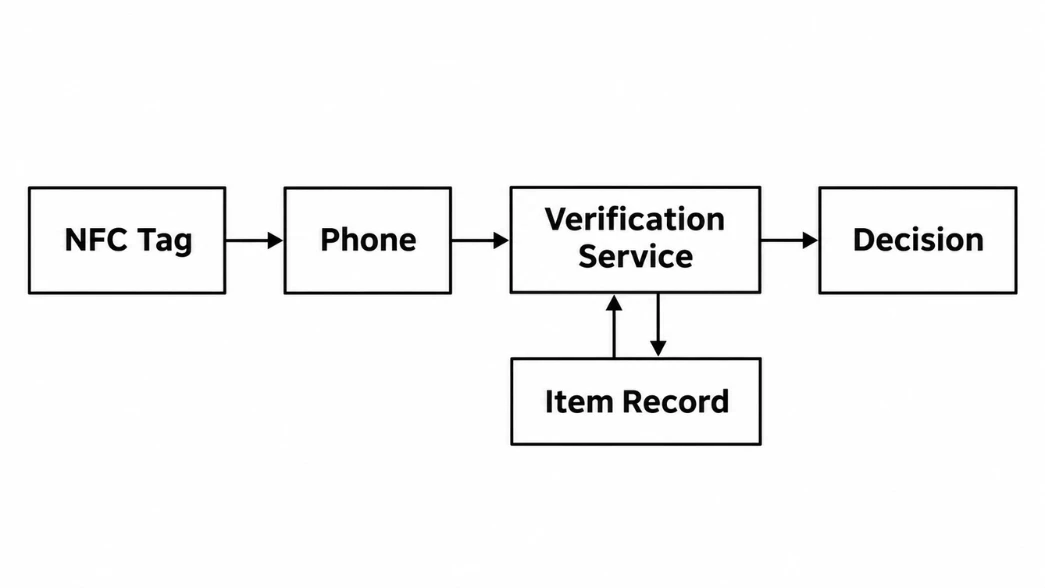
A typical consumer flow can be expressed as physical tag → NFC-capable phone → NDEF/URI handling → HTTPS verification service → authorized tag record → decision page. Some systems use a native application or a dedicated reader instead. The device, app or browser behavior must be chosen for the intended audience; merely naming a chip family is not a compatibility test.
- Issue: register a tag instance and assign an approved product or packaging identity; protect provisioning credentials and retain a traceable issuance record.
- Encode and assemble: write the expected message or secure-tag configuration and attach the inlay to the specified substrate and package position.
- Read: check that the target phone recognizes the tag and presents the expected URL or application action.
- Verify: have the server validate the appropriate chip evidence, request fields, replay state, and tag-to-item association according to the chosen security design.
- Decide: return a comprehensible result without exposing secret keys, internal rule details, or unnecessary personal data.
- Record and respond: log enough information for troubleshooting and investigations while applying a defined privacy and retention policy.
For conventional phone-openable URL tags, the URL can be copied or relayed to another carrier. A static serial lookup might support customer service or traceability but should not be sold as cloning resistance. NXP describes Secure Unique NFC (SUN) messaging and AES-based authentication for certain secure ICs, including the NTAG 424 DNA family. Such features only create an effective authentication workflow when provisioned, verified and operated correctly. Their availability on a chip does not establish that a particular Syntek label uses them.
Define the server verdicts before building the consumer page
One generic "authentic / fake" screen conceals important system failures. A stronger design agrees on machine-readable states, a nontechnical customer message, and an internal next action.
| Observed situation | Suggested internal classification | Customer-facing handling | Next action |
|---|---|---|---|
| Expected cryptographic evidence and authorized item association both pass | VALID | Verification completed for this registered item, subject to the program's stated scope. | Continue to product information. |
| Chip evidence passes, but item association is absent or suspended | REVIEW | Unable to confirm this item's registration. | Escalate to brand support. |
| Message is malformed or authentication data fails | INVALID | Verification could not be completed. | Retain an event for investigation without publishing exploit details. |
| Previously accepted dynamic evidence reappears contrary to the selected replay policy | REPLAY_SUSPECTED | Additional verification is required. | Review counters, retries and logging context. |
| Service or network is unavailable | UNAVAILABLE | Service temporarily unavailable; retry later. | Retry safely; do not label the item counterfeit. |
| Configured seal/tamper input indicates a changed state | TAMPER_REVIEW | Packaging seal requires inspection. | Apply product-specific escalation policy. |
These are example software states, not a claim about an existing Syntek platform. The decision logic must be documented for the deployed chip and system. For dynamic authentication, define what counts as a replay, how genuine retries are handled, and which event attributes are retained; an overzealous duplicate-tap rule may reject legitimate scans.
A secure tag is not automatically a secure product
Label transfer and replacement
If someone can remove a valid tag from an original package and attach it to a counterfeit, cryptographic tag verification can still succeed. Choose placement and attachment with the product's surfaces, handling conditions, and tamper threat in mind. A breakable inlay or tamper-status-capable design can support a control, but only when its physical installation and reader/backend interpretation are validated. Testing should include controlled removal attempts, not just intact samples.
Provisioning, key management and system access
Secure designs require more than a sophisticated IC. Decide who controls the keys, who can issue new tag identities, how rejects are quarantined, how records are deactivated, and how production partners report write failures. Avoid sharing production secrets in plain spreadsheets or putting verification credentials in a publicly readable NDEF payload. Establish separate test and production environments and define recovery procedures for lost or compromised credentials.
Reader and customer-experience boundaries
A standard phone may open a properly formatted URL, but supported NFC behavior varies by phone model, operating system, lock state, case thickness, and tag placement. The verification service may need internet access. Test representative phones in the real packaging configuration; do not promise that any NFC phone will read every security tag or that a browser opening equals a valid authentication.
Build a negative-test plan, not just a successful demonstration
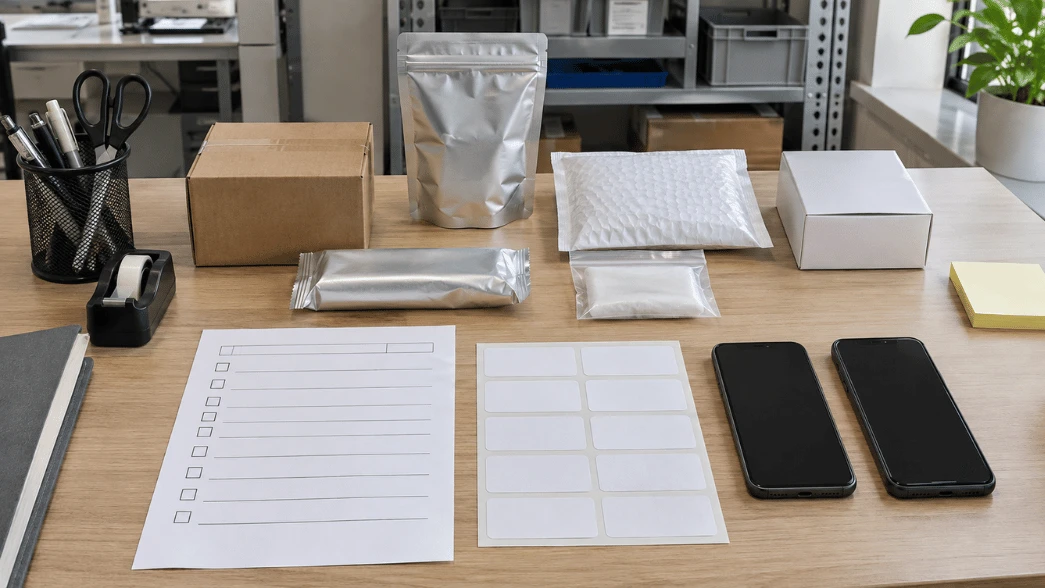
A demo in which one phone taps one label and gets a green screen cannot establish production readiness. The pilot should deliberately exercise valid, invalid, ambiguous and offline cases, using isolated test credentials rather than production secrets.
| Pilot case | Test input or condition | Expected observation to agree in advance |
|---|---|---|
| Known-good issued label | Approved tag and approved product registration | Correct item association and expected customer result. |
| Unregistered but readable tag | Tag outside approved registry | No false claim of genuine product. |
| Copied static URL | Replicated URL on a different carrier, where permitted in test | Shows why a static link is not an authenticity credential. |
| Altered verification parameters | Modify nonsecret input fields in test environment | Fails closed or enters review; no misleading pass. |
| Replay or repeated-tap scenario | Reuse test evidence and make legitimate repeated reads | Defined distinction between suspicious reuse and permitted retries. |
| Product-transfer scenario | Move an intact sample tag or attempt planned removal | Documented outcome for chosen tamper/attachment design. |
| Network outage | Disable connectivity or temporarily isolate test service | Clear "unavailable" result rather than a false counterfeit conclusion. |
| Representative phones | Approved iOS and Android test matrix in real package position | Read-to-result flow works within pre-agreed conditions. |
| Record deactivation | Recall or revoke a test serial | Changed lifecycle status is reflected consistently. |
Agree on sample quantities, test fixtures, pass/fail thresholds and rework procedures before testing. These depend on the product and program; no universal read-rate or service-availability target can be inferred from an NFC tag specification alone. The relevant output is a signed-off exception list and a repeatable acceptance protocol.
What to include in the NFC authentication RFQ
Procurement should separate the physical label from the verification service. A label vendor may provide inlays and encoding without providing a consumer application, an authentication backend, or operational support.
- Physical assembly: package surface, label size range, placement, tamper objective, adhesive/environmental conditions and approved artwork.
- Tag requirements: technology and candidate IC, NDEF support where required, secure feature requested, access conditions and whether the security configuration is part of the supplier scope.
- Provisioning ownership: key custodian, unique identity issuance, serial mapping, encoding file controls, reject reconciliation, sample approvals and re-order change control.
- App and backend: phone flow, URL domain ownership, message-verification method, server verdicts, data retention, alerting, availability handling and customer-help escalation.
- Test evidence: acceptable test matrix, golden samples, negative tests, packaging removal tests, reader devices and sign-off responsibilities.
For available physical NFC formats and customization discussions, start with NFC tags and stickers; cross-product manufacturing requirements can be discussed through OEM/ODM project planning. Ask explicitly which functions are available from the supplier and which must be delivered by your software integrator.
A practical approval decision
Approve the project only when the tag's security capability matches the threat model, each physical tag can be associated with the intended item under controlled records, the backend makes defensible decisions, and representative samples pass the agreed negative as well as positive tests. If the project only needs a tap-to-information feature, a regular NFC URL tag may be sufficient-but it should be described as an information link, not a product-authentication guarantee.
For design reference, NXP documents the chip-level features of secure NFC tag families; the NFC Forum specifications define the broader NDEF data format. The final security claim belongs to the tested end-to-end product and service, not to an unverified marketing description of a label.
Send Inquiry