


NFC Data Exchange: NDEF Records, Payload Design And Read Validation
Nov 17, 2026
Leave a message

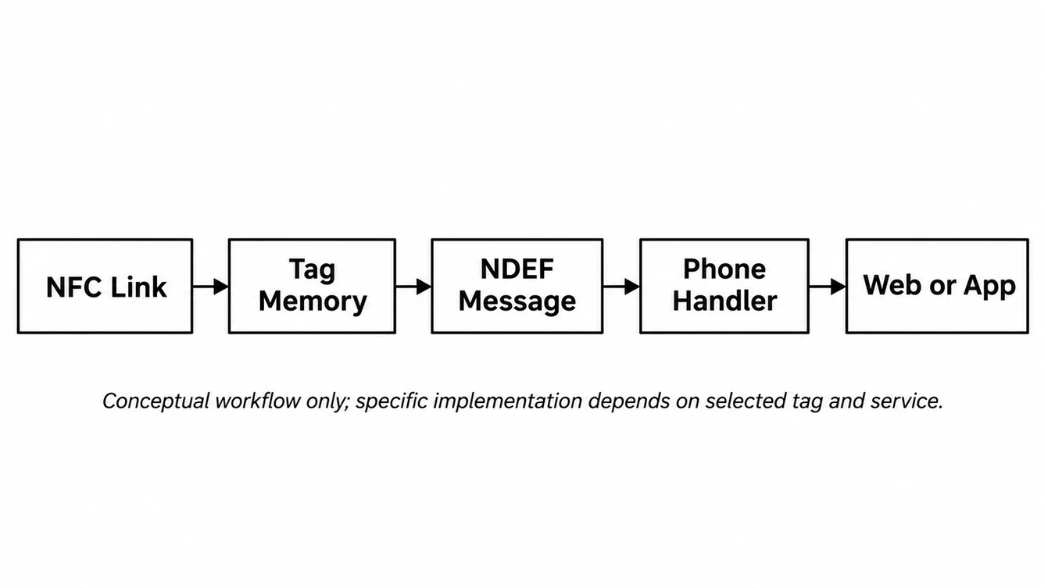
NFC data exchange becomes useful when a phone or reader can interpret the bytes it receives and complete the intended action. In a common passive-tag workflow, the tag carries an NDEF message containing a URI, text or another defined record. The phone reads that message and then decides what to do with it. A successful RF read is only the first part of that journey: the record has to be correctly formatted, fit in tag memory, be supported by the reader or operating system, and lead to a working destination.
This guide is for product teams deciding how to structure NFC tag data before production. It focuses on NDEF record choice, message size, mobile behavior and acceptance testing. For introductory chip selection, refer to what an NFC tag is and NTAG versus MIFARE sticker selection. Those are separate decisions from the question handled here: what exactly should be written and how will it be interpreted?

Where NDEF fits in an NFC interaction
The NFC Forum defines NDEF, the NFC Data Exchange Format, as a common format for application data. An NDEF message can contain one or more records. The record has a header and a declared type; depending on the type and encoding, its payload might represent an HTTPS URL, a short text item or application data.
NDEF does not specify everything about the radio interface. The chip's supported NFC Forum tag type and memory structure determine how the message is found and read. Nor does NDEF alone guarantee that any phone will perform a requested application action. The tag, reader, operating system, application and network destination each have responsibilities.
| Layer | What it answers | Example production check |
|---|---|---|
| Physical NFC link | Can the target device power and communicate with this tag at the intended placement? | Repeat taps on the actual mounting surface. |
| Tag data mapping | Is the memory formatted and accessible in the expected tag type? | Read the capability and write state with an approved tool. |
| NDEF message | Is the message syntactically valid, with correct record type and payload? | Decode the written bytes and compare against the approved source file. |
| Operating-system handling | Does the phone interpret the record in the desired way? | Record the actual user action on target iOS and Android devices. |
| Application or website | Does the destination complete the intended business task? | Test the browser, app and server response separately. |
Choose the record type for the task, not for the keyword
For many packaging, service and marketing projects, the smallest useful message is a single HTTPS URI record. The URL opens current online information, so the tag usually does not need to store a brochure, product catalog or complete customer record. The destination can be maintained without rewriting every deployed tag-provided the URL and redirects remain under the program owner's control.
URI records
A URI record is typically appropriate for a product-information page, a support page, a controlled verification endpoint or a web profile. Use an approved HTTPS destination and test its redirect chain, certificate, mobile rendering and behavior when the network is unavailable. A URL that resolves to a phishing lookalike or a retired domain is a service failure even though the NDEF bytes may be technically valid.
Text records
Text records can represent short multilingual strings in supported encoding conventions. They can be useful for reader applications or local information, but a phone's background tag handling may not display text automatically. The buyer must determine whether the experience relies on a dedicated application or only on default phone behavior.
MIME and application-specific records
Application-defined payloads can make sense in a controlled environment with a known app and parser. They are usually a poor substitute for a simple web URL when the audience is an unknown mix of consumer devices. Document the exact MIME type, data schema, versioning and error handling; do not assume that a generic phone will understand arbitrary bytes.
An NDEF message is a structured record, not a blank text box
A record includes a type name format, type identifier, payload length and optional record identifier, alongside control bits and other header information defined by the format. Exact bytes depend on the record format and implementation. The complete encoded message may occupy more storage than the visible URL or text because headers and type information also take space.
The safest sizing method is to encode the final payload, measure the actual resulting NDEF message, and compare it with the supported maximum message size of the selected tag. Do not purchase a tag solely because the supplier quotes "memory" without clarifying how much is available for the intended message. On Android, the documented Ndef API includes a way to query maximum message size for a discovered tag.
For a hypothetical consumer label, an approved message specification might say: one URI record using HTTPS, one controlled destination domain, one versioned short product reference in the URL path, no customer personal data and no second record. This is an example design rule, not a claim about a particular tag's capacity.
Why the first record and phone behavior matter
Multiple NDEF records are permitted, but the user experience is not simply "the phone displays everything." When tags are intended to work without a custom app, platform-specific processing matters. Apple states that compatible iPhones using background tag reading inspect URI records and use the first URI record for their action, subject to device state and supported schemes. Android describes an NFC tag dispatch system that routes NDEF content according to URI or MIME type and interested applications.
Therefore, a buyer should not rely on a single multi-record layout triggering identical behavior on every device. If a public marketing label needs one action, a single suitable URI is usually easier to validate. Where multiple records are required, specify the target application, record order, exact types and device test matrix. See the platform documentation from Apple and Android before locking a message design.
Design the write-and-read acceptance sequence
During production, encoding software may report a successful write while the final user journey still fails. Make acceptance a sequence of checks, each with its own evidence and failure category.
- Freeze the data specification: approve record type, payload schema, URL domain, allowed variable fields, version and any redirect or application policy.
- Confirm the target tag: verify the correct type, usable capacity, write permissions and reader compatibility on the actual purchased sample.
- Encode a controlled sample: use test destinations and non-sensitive sample identifiers. Record the tool/software version and batch identifier.
- Read back: decode the complete stored NDEF message; compare its type, record order and payload against the golden sample.
- Test the device action: use representative iOS and Android devices in relevant device states, recording what actually opens and whether the destination works.
- Test after finishing: repeat scans with the final print, laminate, adhesive, enclosure or mounting surface, because assembly can change RF performance.
- Decide lock policy: write-protect only when there is an approved operational reason and the chosen tag supports the required operation; irreversible locks should never be applied before validation.
Follow the planned life cycle. A one-time encoded marketing URL and a service tag that requires future rewrites need different write-protection policies. Likewise, secure-tag authentication and personalized encoding are separate projects even if their user experience begins with the same phone tap.

A failure matrix for NDEF data exchange
| Symptom | Likely check area | Practical diagnostic step |
|---|---|---|
| Tag is not detected | Phone NFC support, antenna, orientation, mounting, damaged tag | Read the same sample with another approved device and away from nearby metal. |
| Tag is detected but no NDEF appears | Formatting, unsupported tag type, missing/invalid message, memory access | Inspect the raw tag and decode its current data with an approved tool. |
| Message appears in a test app but no browser opens | Record type, record order, platform background reading, device state | Try a single valid URI record and document platform behavior. |
| Browser opens the wrong page | Encoded URL, redirect, encoding file, domain or server routing | Compare read-back URL with golden data and follow redirects. |
| Some tags fail after printing or mounting | RF assembly, adhesive, substrate, laminate or placement | Compare pre-finish and post-finish samples using the same phones. |
| Tag cannot be updated | Lock bits, permissions, security configuration or data capacity | Inspect write access against the approved tag documentation before attempting changes. |
These are diagnostic hypotheses, not guaranteed root causes. A well-structured production report records the evidence that confirmed or excluded each cause.
Keep format, security and business validation separate
NDEF is a data-format standard, not automatic encryption. A public HTTPS URI record should be treated as public information. The NFC Forum also specifies an optional signature record format, while particular secure ICs can implement cryptographic authentication features; neither protection is implied by the mere presence of an NDEF message. If authentication is the goal, define the tag's security feature, key or trust infrastructure, backend verification and negative tests independently. Our separate guide to NFC anti-counterfeiting technology introduces that adjacent task.
Similarly, a successful mobile tap is not proof of a successful order registration, warranty lookup or customer account operation. The backend data and business response must be tested under their own acceptance criteria.
What the purchasing specification should contain
Before ordering bulk NFC labels, send a one-page data specification alongside the physical requirements. This prevents disputes between the label vendor, encoding provider and application developer.
- Purpose and intended NFC user action: tap-to-web, app-specific read, local text or another defined outcome.
- Approved tag type and specific chip/IC under consideration, with capacity measured against the actual encoded NDEF message.
- Record count, exact types, expected order, allowed variable data, encoding scheme and example test payload.
- Destination domain ownership, redirect policy, URL/version lifecycle, network/offline behavior and privacy restrictions.
- Which party writes, verifies, locks and documents the tags; how failed or duplicated encodes are handled.
- Target phones/readers, substrate and final mounting configuration, sample size and acceptance criteria.
For physical format options, browse NFC tags and stickers. Where the job includes cross-product printing, personalization or packaging requirements, define these separately in the OEM/ODM specification. Confirm available chip and encoding services for the actual order rather than assuming every option is supplied.
Final decision: approve the observed behavior, not just the message file
The right NDEF design is the one a purchaser can describe precisely, encode reproducibly, read back correctly and demonstrate on target devices in the finished application. Start with the simplest record that completes the user task, reserve advanced data structures for projects that need them, and document every boundary between the chip, phone, application and service. That gives production teams a testable contract instead of an ambiguous instruction to "make the NFC tag work."
Send Inquiry