


NFC Bottle Label Serialization: Reconcile Every Encoded, Applied And Rejected Seal
Oct 17, 2026
Leave a message

A bottle can carry an NFC label that reads correctly yet still fail a brand's anti-counterfeit workflow. The label may have been encoded twice, applied to the wrong unit, removed from the line without a scrap record, or activated in the verification database before it was used. For packaging and brand-protection teams, the operational task is to reconcile every issued label credential with an actual packaging outcome.
This guide starts after the NFC label format, chip family and bottle placement have been selected. It explains a production-line serialization and exception-control workflow for bottle closures and other unit-level packaging. It does not choose a specific chip for your project or claim that a readable UID, by itself, proves a product is genuine. For cap construction and pilot-sample selection, use the separate existing overview of NFC anti-counterfeiting labels for baijiu bottles.
Start with a record of what each label is supposed to represent
Write down the object of identity before commissioning the encoder. Is the identifier assigned to a filled bottle, an empty container, a serialized closure or a production order? One identifier should have one defined business owner and one current packaging status. A scan of an encoded label is evidence that the label responded to a reader; it is not evidence that the label was attached to a saleable bottle.
For each physical label, the production database needs a controlled relationship between its public identifier or application token, the encoded verification payload, the production batch, the packaging unit and the event that last changed its state. Cryptographic secrets should be held by an approved key-management process rather than exposed in line-operator spreadsheets. If the authentication platform and the label converter are different vendors, agree on how token issuance and activation are reconciled without handing unrestricted credentials to the wrong party.
| Record field | What the field establishes | Reconciliation check |
|---|---|---|
| Label/credential reference | Which physical or digitally issued label is under control | Unique within the agreed issuing namespace; duplicates flagged |
| Encoding batch and version | Which approved format and equipment settings were used | Matches the work order and verified read-back |
| Bottle or packaging-unit reference | Which finished unit received the seal | No unapproved many-to-one or one-to-many binding |
| Application outcome | Applied, rejected, damaged, unused or awaiting decision | Every dispensed label has a disposition |
| Activation status | Whether the backend should recognize this unit as saleable | Activated only after the required line checks pass |
| Exception record | Why an unusual state occurred and who resolved it | Audit trail is preserved before the lot is released |
A controlled state sequence prevents orphaned and duplicate labels
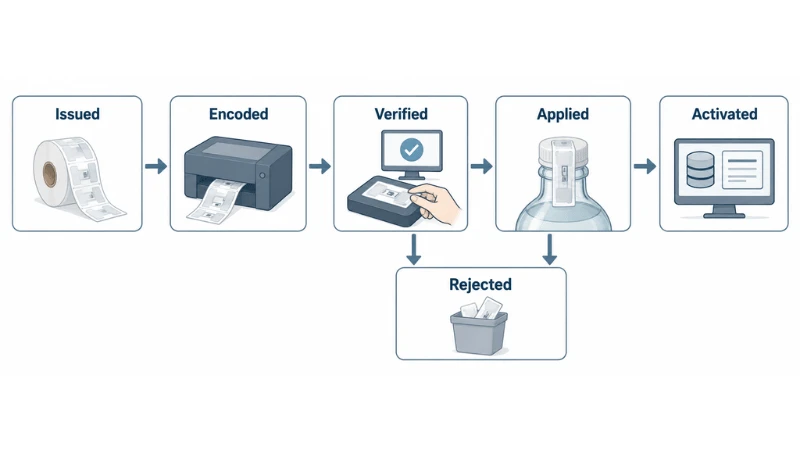
Use states appropriate to the system, such as issued → encoded → read-back verified → applied → line accepted → activated. They are not simply alternative words for the same event. An issued label may never be printed. A verified NFC tag may be damaged on application. An applied seal may be removed during a rework operation. Activating a label before the bottle has passed packaging inspection can leave a valid digital identity for a product that was never released.
Build transitions as explicit, logged events. When a reject occurs, move its credential to a controlled rejected or quarantined state. If the physical label is destroyed, record destruction according to the manufacturer's process. If the label can be recovered intact, manage it as a higher-risk exception: an intact genuine credential can potentially be moved to another package unless the physical design and backend controls address transfer.
Reprinting requires its own rule. A new print job should never silently create a second usable physical label with the same active credential. If rework calls for a replacement, retire or invalidate the earlier reference as the system permits, allocate a replacement according to the agreed uniqueness policy, and link the two records. Store who approved the change and which packaged unit it affected.
Who owns a credential at each production handoff?
A serialization process often crosses multiple organizations: the brand issues identities or authorizes their creation, the label converter encodes them, the packer applies physical seals, and a verification service responds when customers or inspectors scan. These parties may all call the same value a "serial number" while maintaining different files. Before production, map which system can create, change, suspend and finally activate each credential. There should be one authoritative record for each of those decisions, even where local systems temporarily hold copies.
The converter should be able to report what was produced and delivered, including unusable setup material, without receiving unrestricted access to authentication secrets. The packaging operator should report physical use and rejects rather than silently changing the issuing inventory. The brand or its approved service owner should authorize transitions that make an identity visible as a genuine, saleable unit. This division matters when a reel is replaced or a shift ends: physical consumption and digital activation are two records that must agree, not two alternative estimates.
| Handoff | Question to settle | Required evidence |
|---|---|---|
| Identity issuer → converter | Which credentials may be encoded, and under which approved revision? | Controlled issuance list, version, custody acknowledgement |
| Converter → packer | Which finished reels and rejects consumed those identities? | Reel identifiers, verified output manifest, scrap disposition |
| Packer → verification service | Which applied credentials belong to accepted finished units? | Unit-binding events, exceptions, release authorization |
| Verification service → brand | Which records can presently return an authorized response? | Activation reconciliation, disabled references, audit log |
Specify how each system acknowledges a transferred record. A file being sent is not the same as the receiving system accepting every row; track the accepted, duplicate, rejected and still-pending rows separately. When the brand audits a disputed bottle later, it needs the sequence of authorized changes, not simply the last value in a spreadsheet.
Three independent checks on the packing line
1. Confirm the encoded object matches the planned record
Read a sample of labels through the actual reader or compatible phones used in the project. Compare the interpreted application payload with the corresponding issued record. A human-readable serial number printed beside the antenna can help reconciliation, but it is not automatically the same identifier as the chip UID or the backend authentication token. Specify the mapping and test it. Treat a successful phone launch as evidence of NFC access, not a cryptographic authentication pass.
2. Confirm the applied seal belongs to the correct bottle
At the application point, associate the label reference with the unit or production sequence. Check the result under real capping and label-placement conditions, including the final container material. Metal caps, curvature, adhesive application and machinery can change the RF response. Read and physical-adhesion checks should be separate: a seal can read correctly even if it can be removed intact, and a strongly bonded label can still be unreadable.
3. Confirm verification service and physical status agree
Before release, send the system a controlled sample of verification requests and check the expected response for active, rejected, not-yet-activated and intentionally tampered labels. Document how the service handles an unavailable network, a second authentication attempt, and a label whose digital record exists but whose bottle-unit association is missing. A backend that merely returns "found" for any stored identifier is not a complete anti-counterfeit decision engine.
What tamper evidence can-and cannot-establish
Two mechanisms often appear in the same procurement discussion: destructible carriers and electronic tamper status. A fragile carrier is designed to break or damage its antenna when removed; after destruction, it may become unreadable. An electrical tamper loop can instead let a supported tag report a changed state after its monitored connection opens. Actual behaviour depends on the selected chip, antenna design, attachment and application conditions.
For example, NXP's NTAG 424 DNA TagTamper documentation describes current and permanent tamper status. The tag is passive: it evaluates the loop when powered during a supported reading operation, not by continuously transmitting a live alarm. The documentation also highlights why a physical seal needs resistance to an attacker opening and repairing the loop between interrogations. That limitation should be reflected in the risk assessment and in your acceptance tests.
A visible tear, an electronic "opened" status and a valid cryptographic response answer different questions. None proves that the bottle contents are genuine. Where regulatory requirements or high-value goods demand stronger assurance, define an independent product-provenance process rather than asking the NFC label alone to guarantee authenticity.
Exceptions that deserve their own recovery path
Not every anomaly can be handled by scanning the same label again. The correct recovery action depends on whether the physical seal exists, whether an identity is active and whether the team can prove which packaged unit it belongs to. In a rework area, a readable NFC label may have been removed from an unsaleable bottle. Reusing that same identifier on a new bottle without controlled transfer could produce a genuine-looking response for two different physical histories.
Missed scan at line speed. Confirm that the read station and bottle index were synchronized. Preserve the affected time window and segregate uncertain units for a controlled recheck. Do not auto-activate on the assumption that the label was probably present. If read-zone geometry or line timing is implicated, retest with the actual packaging and conveyor conditions rather than a detached label.
Reel splice or unexpected label count. Record the incoming and outgoing reel references, reconcile the remaining physical labels, and identify any encoded credentials that never reached the applicator. Quarantine unexplained consumption. A difference between print count and application count may be legitimate setup scrap, but it must have an authorized disposition before a lot closes.
Duplicated or reissued credential. Identify every affected physical unit and every digital reference. Determine whether the duplication occurred during identity issuance, print-file preparation, read-back parsing or rework. Hold the set until the platform owner decides whether records should be retired and replacements issued. A simple "last scan wins" database rule obscures which physical package is actually controlled.
Backend temporarily unavailable. Define whether the line must stop, may continue in a quarantined pending state or can use an approved offline buffer. Preserve event ordering, checksum or file-integrity controls appropriate to the system, and evidence of later acknowledgement. Never equate a queued activation request with a completed activation.
The resolution record should name an owner, the affected time/reel/lot or unit range, the containment action, the correction, the independent verification and the approval to resume. This is a proposed control framework, not a claim that a particular Syntek line operates in this manner.
Reconcile the physical roll against the digital ledger
At shift or lot close, compare counts by status: labels issued to the line, successfully encoded, destroyed during setup, rejected after application, applied to saleable bottles, held for rework and returned unused. The sum of all recorded dispositions should equal the controlled quantity issued into the run, with documented treatment of any stock carryover. Reconcile the count of accepted bottle references against the number of backend activations. Count equality alone is insufficient: spot-check the actual mappings to detect duplicates or incorrect unit links.
A useful example: an operator reports one damaged seal on a bottle that was already provisionally activated. The corrective action is not merely to print another label. The team should isolate the affected bottle, establish whether the old credential remains usable, record the new assignment if approved and verify that the old and replacement identities cannot both resolve to the same active item without an explicit exception rule. This is a hypothetical workflow, not a reported Syntek customer incident.
| Exception | Immediate action | Release evidence |
|---|---|---|
| Encoded value not found in issued list | Hold label and investigate encoder file/version | Reconciled issuance and corrected mapping |
| Duplicate identifier or token | Hold both affected records and packaging units | Uniqueness check and approved replacement treatment |
| Unapplied but active label | Quarantine credential and any corresponding stock | Backend state correction and disposition log |
| Applied tag reads but seal lifts intact | Hold physical construction and review transfer risk | Validated adhesion/tamper response on final substrate |
| Accepted bottle not active in backend | Keep lot from release until sync is complete | Successful verification on sampled packaged units |
Close a lot with two reconciliations, not one total
The physical reconciliation establishes that all labels issued to the run have known dispositions. The digital reconciliation establishes that the identities recognized by the verification service correspond to the intended released units. These are related but different statements. A lot can balance physically while the backend contains premature activations; it can also show matching activation counts while one accepted bottle is bound to the wrong credential.
For a production batch, define I as the controlled number of labels issued to the line. Define A as labels applied to accepted units, S as documented scrap, R as held or rejected labels awaiting disposition, and U as physically returned unused stock. The receiving and packaging teams should be able to explain I = A + S + R + U, after accounting explicitly for allowed transfers or carryover. That equation is an inventory-control example, not a universal industry standard or a performance target.
Next compare the unique identities in A with the unique identities authorized as active. Check both directions: every released bottle should resolve to the intended authorized record, and no credential from scrap, unresolved rejects or returned stock should remain unintentionally active. If the service stores several identity formats, normalize their mapping first; comparing two text exports without agreed field definitions can conceal mismatches.
Make rework part of the arithmetic. A rejected bottle may consume a label without yielding a saleable unit, while a replacement label consumes an additional credential. The event trail needs to show that replacement explicitly so the operator cannot "fix" a mismatch simply by changing the original line count. Close the batch only after the exception list, physical stock and digital authorization set have been independently reviewed.
Define the release evidence, not just the scan result
At the final decision point, the production leader should be able to answer four questions without reconstructing events from memory: which physical labels were issued, which packages consumed them, which identities are actually authorized by the verification service, and which exceptions remain open. That answer needs both a quantity balance and a unique-identity comparison. A shift total exported from the applicator is not sufficient if rework consumed replacement labels or a previously issued credential remains digitally active.
| Release gate | Evidence to retain | Decision if incomplete |
|---|---|---|
| Physical consumption | Issue, applied, rejected, scrapped and returned counts per reel or batch | Hold unexplained stock or line-count differences |
| Unit-level identity | Accepted bottle-to-credential association, with duplicate and missing-reference queries | Isolate affected units until their mapping is proven |
| Authentication state | Approved activation export and sampled expected responses for rejected or unissued references | Block release of ambiguous backend states |
| Exceptions | Ticket, affected range, corrective action and independent reviewer sign-off | Keep unresolved cases in quarantine |
Do not substitute a static UID check for an authenticated chip response where the project explicitly requires cryptographic verification. The approved backend must validate the actual security mechanism, including the selected chip and key configuration; it is not enough to display a page labelled "genuine." For an example of a chip family offering SUN authentication and, in one variant, electronic tamper status, see NXP's NTAG 424 DNA product documentation. The configuration and site-specific validation remain separate engineering tasks.

Agree on lot acceptance before production begins
Use a signed acceptance plan for the particular packaging line. It should name the authoritative issuance source, accepted payload format, reader or phone models, encryption/authentication validation method if applicable, sample locations across the run, environmental conditioning, traceability retention period and responsibility for resolving exceptions. Do not replace buyer-specific requirements with universal promises such as "100% read accuracy" or a fixed maximum read distance.
Sampling should cover startup, steady-state production, reel changes and rework. Increase or tighten inspection where a process change introduces new risk; record the rule in advance instead of changing it after a failure. A passing bench read is not proof that the final bottle and closure assembly will pass customer-tap or tamper tests.
Before a repeat order, confirm whether the approved construction, chip variant, adhesive, label pitch, encoding format, verification endpoint, line equipment or container geometry has changed. A seemingly minor change can invalidate the earlier acceptance baseline. The NFC tag product category is the commercial starting point for relevant physical formats, while cross-category changes can be scoped through OEM/ODM customization. Product availability, secure key services and exact construction must be confirmed for the particular quotation.
Prove the control model during a small production trial
A trial should deliberately create ordinary nonconformities, not merely scan a run of perfect bottles. Use approved sacrificial samples and a test or isolated backend environment so simulated failures cannot be confused with customer-facing product records. Have the team stop and restart a line, replace a reel, reject an applied seal, reprint a credential under authorization, and interrupt a network connection if offline operation is part of the design.
For each scenario, record the expected event, what the line operator saw, what the backend received, how the difference was resolved and whether another person could reconstruct the affected physical units. For example, an applied but rejected label should not become saleable merely because its NFC read-back succeeded; the physical reject event must govern the business state until an authorized resolution occurs. Test at the intended read point and line speed, with the actual bottle material and approved label construction.
Useful trial evidence includes the issued-identity snapshot, applied-unit mapping, exception tickets, authorization trail, sample tap responses and the final inventory-to-activation comparison. Buyers should insist on a named owner for each failure path before moving into volume production. The outcome is a reproducible acceptance procedure, not a claim of zero counterfeiting or universal phone compatibility.
Handoff package for operations and procurement
Ask the label provider and verification-platform owner to deliver one coherent release packet: approved artwork and construction revision, issued credential-range or controlled reference list, encoding/read-back evidence, reel and lot associations, sample inspection results, reconciliation of all dispositions, unresolved exceptions, approved rework records, and a clear statement of which backend records are active. Avoid exposing raw security keys or customer personal data in the release document.
The job is complete when production can explain where every issued credential went and the verification service recognizes only the package identities authorized for release. That audit trail is more useful than a photograph of a successfully scanned NFC sticker: it connects a physical bottle, a digital record and an accountable manufacturing decision.
Send Inquiry