


RFID Hospital Equipment Handoffs: Return, Cleaning And Ready Status
Oct 23, 2026
Leave a message

A hospital may know that an RFID-tagged wheelchair is near a storage room yet still not know whether the wheelchair is ready for the next patient. The tag can help identify the item at a controlled handoff point; it cannot confirm that cleaning was done, that a damaged component was repaired, or that a responsible person authorized reuse. Those facts belong to the facility's equipment-management and infection-prevention workflow.
This guide is for hospital operations, environmental services, equipment distribution teams, biomedical engineering, IT and RFID integrators planning to track shared, noncritical mobile equipment such as wheelchairs, transport aids and other equipment approved by the facility for this workflow. Its core question is how to convert a reliable asset read into a trustworthy record of return, cleaning assignment, cleaning completion, inspection, maintenance hold and release.
It does not describe RFID patient identification, newborn security, medication administration or surgical-instrument sterilization. Each is a separate clinical or system problem requiring different controls. RFID can support a record, but clinical policy and authorized human decisions determine whether equipment may be used again.
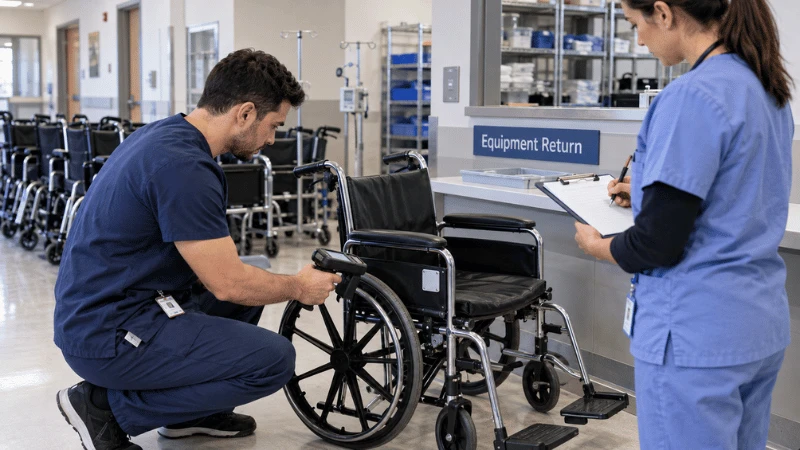
A Last-Seen Location Is Not a Ready-to-Use Status
Healthcare asset-tracking demonstrations often show a map of tagged equipment. Finding equipment matters, but a location-only view can be misleading in a busy facility. An item returned from one ward may be physically in the right room while it is still awaiting an approved cleaning process. Another may have completed cleaning but remain unavailable because its brakes, battery, wheels or other required components have been flagged for maintenance.
Four different facts should be represented separately. Identity says which specific asset the tag corresponds to. Observation says where and when a reader detected the identifier. Custody records which unit or team accepted responsibility at a handoff. Release status records whether required cleaning, inspection and maintenance checks have been completed under the hospital's policy.
| Recorded fact | Typical evidence source | What it does not prove |
|---|---|---|
| RFID observation | Reader and antenna event for an asset identifier | Equipment was safely returned or cleaned |
| Current custodian | Confirmed issue/return or department acknowledgment | Asset is physically present at this exact moment |
| Cleaning task | Assigned work order or environmental-services queue | Cleaning has actually been completed |
| Cleaning completion | Authorized staff completion record under local protocol | Required engineering checks also passed |
| Maintenance clearance | Biomedical/facilities release under approved rules | Cleaning protocol has been completed |
| Ready for use | Controlled rule combining required release evidence | A tag itself guarantees clinical safety |
The distinctions are important because two assets with the same 'last seen' location may have different operational eligibility. Designing separate fields and permissions reduces the temptation to infer a clean or available state from a reader ping.
The US CDC's guidance for noncritical patient-care equipment emphasizes defined cleaning responsibilities, manufacturer instructions and appropriate procedures. The published Environmental Cleaning Procedures page was prepared for global facilities with limited resources, so a hospital must also use its applicable local guidance and the device's instructions. See CDC environmental cleaning procedures and CDC disinfection and sterilization recommendations. This guide concerns how to record operational completion; it does not create a new cleaning method or prescribe a disinfectant.
Choose One Equipment Family and Draw Its Actual Route
Trying to tag every hospital device from the start can hide crucial differences in use, surface materials and cleaning responsibility. A small project should begin with one specific noncritical equipment family and map the real transfer path from issue to return. Wheelchairs used across several departments are a useful planning example, but only if the facility confirms they are in scope and documents the relevant cleaning and maintenance procedures.
Write down each actual stop. For example, a distribution point issues a wheelchair to a ward; a staff member uses it under local rules; the wheelchair is returned to a controlled collection area; environmental services receives a cleaning task; an authorized person records completion; the equipment team checks for outstanding maintenance; the wheelchair becomes available for reissue. The order and ownership may differ between facilities, and no scanning system should silently impose a generic sequence that conflicts with hospital policy.
A route diagram should identify the handoff point, the responsible role, the evidence required, the fallback for a missing RFID read and the point at which another department is allowed to request the item. This gives IT teams a transaction specification instead of an imprecise request to 'track hospital equipment in real time.'
The best location for an RFID reader is the point where an accountable action occurs: a controlled return counter, equipment distribution station, storage-room threshold or staff-assisted audit. Continuous location coverage may be unnecessary for a narrow custody process. If the project requires live location and clinical alarm rules, that is a different architecture and should be evaluated separately rather than inferred from passive tag capability.
Design a State Model That Cannot Skip Required Checks
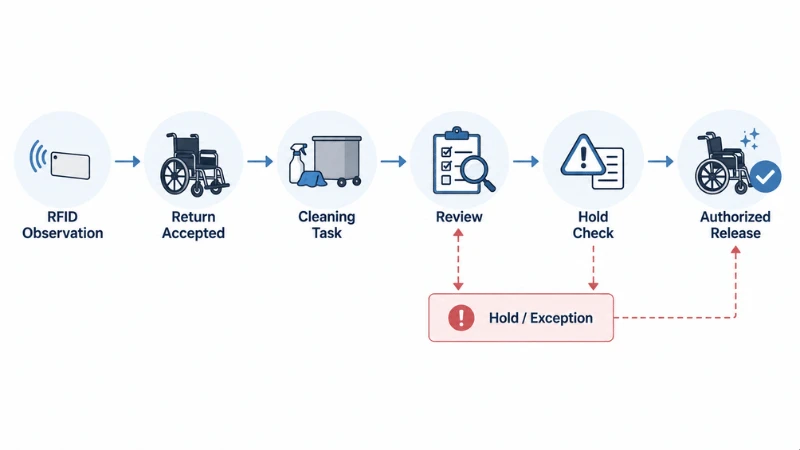
A workable state model is more useful than a dashboard of colored dots. States are project-defined business rules, not chip features. Suggested categories for discussion are assigned, return pending, returned / not yet assessed, cleaning required, cleaning in progress, cleaning completed, maintenance hold, release review, available and retired. The facility may combine or expand these states after workflow and infection-prevention review.
Do not allow the tag observation itself to advance the asset from returned directly to ready. The authorized state change should require the appropriate evidence for that equipment family. A cleaning-completion record should identify the approved process reference, responsible role, completion time and relevant exception. If a separate maintenance release is needed, a cleaning record alone cannot waive it.
| Event | Operational meaning | Authorized decision still required |
|---|---|---|
| Equipment detected at return point | RFID observation of an expected or unexpected ID | Acknowledge physical custody, investigate mismatches |
| Return accepted | Receiving team confirms the asset | Determine the required processing or quarantine path |
| Cleaning task assigned | Work has been scheduled | Perform the device-specific approved procedure |
| Cleaning marked complete | Approved operator records task completion | Check any remaining inspection or maintenance holds |
| Maintenance hold opened | Equipment requires biomedical/facilities review | Clear or retire based on responsible department process |
| Release authorized | All required evidence reviewed | Permit allocation under the facility's policy |
An important design detail is precedence. If cleaning is completed after an equipment engineer placed the item on hold, the later cleaning event must not erase the engineering hold. Similarly, a fresh RFID sighting in the equipment store must not set available=true when a task remains outstanding. These are business rules that can be simulated and tested before the system touches live operations.
The handoff record should also retain the difference between requested and confirmed transfers. A staff member might request a return, but the receiving team has not yet taken custody. Silent automatic posting can make equipment appear available when no one has physically checked it.
Make the Tag a Durable Identity Carrier, Not a Patient Record
A mobile equipment tag should contain only the identifier and any data explicitly justified by the system design. Detailed patient history, clinical notes, bed assignments, infection status or names generally belong in access-controlled hospital systems, not in openly readable tag memory. What to store, encrypt and retain is a local privacy and information-security decision. A facility should assess the RFID technology, reader access, system roles and applicable laws before deployment.
Where a healthcare organization needs interoperability, it can maintain an internal equipment ID and map it to the physical RFID identity. Any use of a GS1 identification key or medical-device UDI requires the relevant data governance. An RFID EPC is not automatically the manufacturer's UDI, and a tag attached by the hospital does not create or modify a device's regulatory identity.
Build an asset master with a stable equipment record, tag identifier, visible identifier or barcode fallback, equipment family, applicable cleaning-instruction reference, current department, current release status, and controlled links to maintenance systems. An example database might also maintain last_confirmed_custodian, last_reader_observation, cleaning_task_id, maintenance_hold_id and release_authorizer. These are illustrative fields, not a specification for any Syntek product or software platform.
If two tags respond with the same expected equipment ID, stop and investigate the allocation. If a tag is replaced, preserve the original equipment record and document old and new tag identities. If a tag is unreadable, use the approved visible identifier and supervised fallback; losing RF communication should not erase the equipment's cleaning or service history.
Where and How the RFID Tag Is Attached Matters
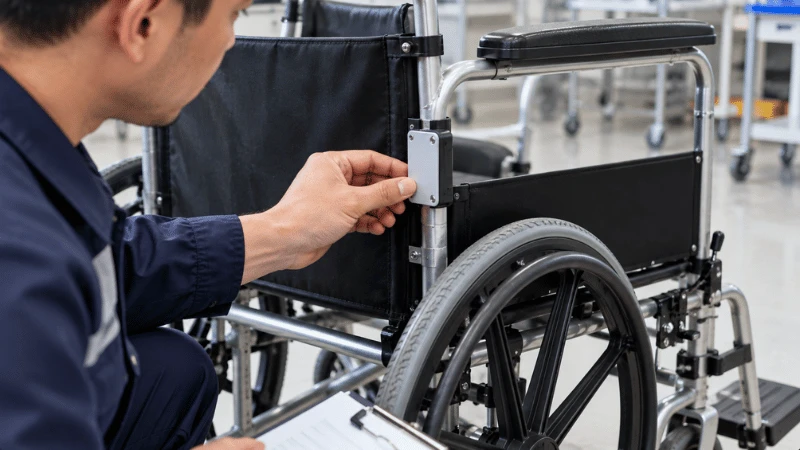
Healthcare equipment often combines curved metal tubes, painted steel, textured plastics, wheels, brakes, handles, seams and sensitive surfaces. The correct tag location must be approved for the equipment and its cleaning instructions. It should avoid patient contact or injury risk, interference with controls and moving parts, areas of repeated friction, and locations where cleaning staff cannot properly access or inspect the surface.
A generic adhesive label may not adhere to textured, high-touch surfaces after repeated cleaning. A rigid tag or on-metal tag may have better RF behavior in one position but add a physical protrusion or trap contamination in another. The project must test the finished mounted assembly, including its attachment method, rather than infer compatibility from 'waterproof' or 'on-metal' marketing language. Ask the equipment manufacturer or responsible department whether adding a tag is permitted and whether a specific mounting method can affect cleaning, servicing or device labeling.
Reader compatibility also matters. A 13.56 MHz wristband reader does not automatically communicate with a UHF asset label, and equipment tracking tags should not be specified from a hospital patient-band catalog without confirming the actual air interface and intended workflow. Syntek's hospital ID-band guide addresses the separate patient-credential problem; this article concerns tagged equipment, not patients.
Environmental exposure testing should use the approved cleaning product and method chosen by the facility, without inventing a universal number of wipe cycles. Record the tag model, installation method, equipment surface, preparation/curing conditions where applicable, cleaning protocol reference and post-exposure inspection. A tag that survives an RF bench check but begins to peel or obstruct cleaning is not an acceptable operational result.
For general RFID material-selection principles, Syntek's on-metal and harsh-environment tag overview can help form a preliminary shortlist. No specific device compatibility or cleaning resistance should be assumed without product-level documentation and testing.
Translate Reader Observations into Accountable Handoffs
Reader placement depends on how workers actually handle equipment. At a controlled return point, staff might present each item to a compatible handheld reader, verify a visible ID and tap a confirmation in the equipment application. A fixed threshold could automate observation at a storage entrance, but the application still needs rules for duplicate reads, equipment passing nearby, movement in both directions and unrecognized IDs.
The event pipeline can be described as capture → validate identity → determine expected transfer → request/record acknowledgment → apply approved state rule → audit. Every arrow represents a separate check. Capturing a valid EPC alone does not mean a unit was returned, cleaned or cleared for use.
An operator should be able to investigate an unexpected scan without corrupting the equipment record. Imagine an RFID reader observes a wheelchair near the return area while the item remains assigned to a clinical unit. Perhaps another wheelchair was parked nearby, a tag was detached, or the equipment moved without the required handoff. The system should record a candidate discrepancy and offer a resolution route, rather than silently reversing custody.
Consider missed reads as well. An authorized return may need to proceed with a supervised barcode/visible-ID fallback when the tag is damaged. That transaction should remain clearly marked as manual, with the operator, time, reason and later tag replacement linked to the same equipment asset. Designing these cases up front avoids incentives to create inaccurate records just to make a dashboard look complete.
Cleaning Evidence Must Come from the Responsible Team
The most important boundary is between asset data and infection-control decisions. An RFID reader cannot detect pathogens, verify disinfectant contact time, confirm that every required surface was addressed or decide whether a particular device is safe for reuse. Those decisions require the facility's validated or approved procedures and accountable staff.
CDC guidance for noncritical patient-care equipment supports assigning clear cleaning responsibility, following manufacturer's instructions and choosing appropriate procedures. The workflow software can record the reference to the approved procedure and the authorized completion event. It should never present a tag read as laboratory proof of disinfection. Critical and semicritical devices require different, more specialized reprocessing approaches and fall outside the scope of this guide.
The FDA's resources for health care facilities on reusable-device reprocessing reinforce that reusable-device reprocessing is a controlled quality and safety activity. This article does not replace the relevant manufacturer instructions, institutional policies or regulatory requirements.
For equipment moving between units, decide when cleaning is required under the applicable policy, which team performs it, which team can verify its completion, and whether maintenance and operational checks are also required before reissue. Record the completion evidence and exceptions without disclosing unnecessary patient information. A missed cleaning event should block automatic release; it should not be inferred from the item's return location.
Test the Full Return-to-Reissue Cycle
A useful pilot begins with a physically verified set of equipment and a written ground-truth log separate from the RFID application. The pilot should include equipment with different materials and tag orientations, the normal room and storage geometry, nearby tagged items, and ordinary staff movement. Confirm the exact hardware, frequency support, antenna setup, software filters and access permissions used for the test.
Measure two separate things. Observation quality asks whether expected items are detected in intended read zones without unacceptable stray reads or misses. Transaction quality asks whether the software creates the correct custody and release states, including holds and manual resolutions. These should not be combined into one unsupported 'RFID accuracy' percentage.
Test paths should cover routine return and cleaning, a maintenance hold added after return, a cleaning completion while a maintenance hold remains, an unidentified tag, equipment detected at the wrong doorway, an interrupted network connection, a manual-ID fallback, a duplicate identity, and tag damage found during cleaning. Confirm that a failed RFID read never causes the cleaning history to disappear and that an out-of-zone read cannot automatically authorize reissue.
| Pilot scenario | Correct system behavior to verify |
|---|---|
| Normal item returned | Receiving team confirms identity and custody; processing task begins |
| Reader sees adjacent equipment | No false return or unauthorized state change |
| Cleaning recorded; maintenance hold open | Equipment remains unavailable pending appropriate clearance |
| Equipment present but no cleaning completion | No automated ready-to-use release |
| Network temporarily offline | Authorized fallback logs and later reconciliation without duplicate releases |
| Tag damaged or detached | Alternate identification and accountable replacement process |
| Old asset ID appears after retirement | Exception generated instead of silent reactivation |
Acceptance criteria must be established by the facility's responsible clinical and operational owners. Record thresholds, test scenarios, allowable manual overrides, response time for exceptions and evidence retention before the trial. The percentages and times cannot be copied from a generic reader data sheet.
The general reader-and-zone validation process is explored further in Syntek's RFID asset-management pilot guide. This hospital-specific guide adds the custody, cleaning, maintenance and reissue authorization boundaries that a generic asset pilot cannot settle alone.
Procurement and Incoming Quality Checks
A hospital RFID procurement request needs a scoped equipment family and approved operating procedure. Send prospective tag suppliers the equipment material and mounting constraints, approved cleaning exposure (without unnecessary patient information), the intended reader and operating region, available tag space, required visible-ID fallback, data scheme, and sampling/test obligations. Require the supplier to distinguish what has been demonstrated from what the hospital will validate in its own pilot.
A supplier's tag can be technically compatible with the chosen RF reader while still failing the hospital's mounting or cleaning constraints. Conversely, a mechanically durable tag does not guarantee that middleware will map its identifier to the correct equipment record. Both product-level and workflow-level acceptance are needed.
Use a controlled approved sample, item specification and documented lot identification for future orders. Receiving checks may compare tag construction and attachment features, verify the encoding export, confirm uniqueness of allocated asset IDs and perform representative physical reads after mounting on approved test surfaces. An electronic uniqueness check should cover the full delivered ID list when pre-encoding is part of the contract; it does not replace physical sample verification. Maintain a clear hold process for duplicate, unreadable or visibly defective units.
For change control, ask suppliers to disclose relevant alterations to tag housing, antenna/inlay, adhesive, coating, printing, encoded format or packaging. Requalify affected scenarios rather than assuming a previous lot's approval extends to changed construction. Syntek's special RFID tag product category is an inquiry route for possible industrial tag forms, not proof that a listed tag is approved for any particular medical device or disinfectant.
Ownership, Access and Exception Reporting
Hospital operations rarely have one department responsible for every field. The asset team may control the master identity, IT may manage reader integrations, environmental services may record cleaning, biomedical engineering may own repairs and clearance, and clinical leadership may define equipment release requirements. Assign permissions before launch: who can register an asset, override a mismatched observation, certify task completion, remove a maintenance hold, replace a tag and retire an item?
A useful exception queue separates unknown ID, duplicate ID, unexpected location, missing return, incomplete cleaning record, maintenance hold, damaged tag and conflicting status changes. Give each category a responsible team, required investigation evidence and closure code. This is more actionable than a single 'not found' alert.
Audit logs should distinguish an automatic reader observation from a human-approved state change. Retain only the necessary information under the facility's security and privacy policies. If patient-related information is stored elsewhere in a hospital system, access to the equipment asset record must not become an uncontrolled route to sensitive records.
Review the pilot with staff who perform the physical handoffs. A workflow that works only when someone follows an unrealistic scanning ritual will fail under real ward pressure. If the RFID approach causes extra steps without improving custody or equipment availability decisions, a barcode or other controlled identification method may be a better fit for that specific handoff.
The Release Question That Matters
The hospital can move from pilot to purchasing decision when the equipment identity is stable, the intended read zones and manual fallbacks work, and the application prevents unauthorized transitions to ready. The team should know what happens when a tag fails, when an item moves unexpectedly, when cleaning remains unconfirmed and when biomedical engineering places an item on hold.
A credible result is not a marketing assertion that RFID 'makes hospital equipment safe.' It is a documented workflow in which the right people can find the equipment, take responsibility for its transfer, complete applicable tasks, resolve discrepancies and authorize reissue without confusing a radio signal with a clinical decision.
Send Inquiry