


Custom Magnetic Stripe Cards: Encoding Specifications And Batch Acceptance
Oct 21, 2026
Leave a message

A custom PVC magnetic stripe card can look perfect on the proof and still be unusable at the reader. The printed logo may be right, the card may fit the holder, and the stripe may visibly match an earlier batch-but if the delivered card cannot be encoded and read in the installed system, the project has failed its actual purpose. For a hotel, membership program, legacy attendance terminal or other established swipe-card application, the production handoff has to include much more than artwork and a choice between HiCo and LoCo.
This guide addresses that handoff. It shows how a buyer can document a legacy magnetic-stripe system, write a reproducible encoding specification, coordinate printed and electronic identifiers, approve a production-equivalent sample, diagnose rejected swipe cards and decide when a delivery lot can be released. It does not claim that every magnetic-stripe card is compatible with every reader, and it does not provide payment-card issuance instructions or sensitive payment credentials.
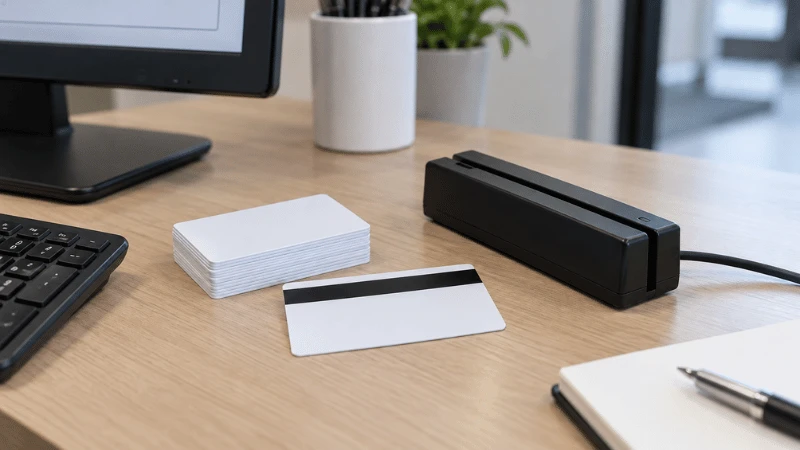
First, Identify the System That Will Actually Read the Card
Before placing a custom order, find the installed reader, writer or encoder and the software that processes the swipe. In a hotel, the door system and front-desk issuing equipment may be tightly coupled. In a membership program, a desk reader may return a number that is matched to a database. A time-attendance terminal may expect a particular track, character arrangement or legacy application format. Those systems do not become interchangeable just because they accept plastic cards with a dark stripe.
Ask operations for a working approved card, the reader or encoder model, the software version when available, and the exact behavior that constitutes a successful transaction. Is the card supplied blank and written on site? Is it pre-encoded by a card producer? Does the customer need a printed member number that matches the data read from the stripe? Is a local card re-issue process required? Every answer changes the purchasing specification.
A photograph of the back of a card is useful for stripe position and artwork placement. It is not an encoding file. Likewise, recording "tracks 1–3" on a purchase order does not reveal which track the existing terminal uses, whether its writer supports the required card stock or how records connect to the backend. The source of truth is the application's accepted credential format as documented by the system vendor or verified against a permitted test setup.
| Existing system information | Buyer needs to obtain | What can go wrong if omitted |
|---|---|---|
| Reader and writer | Brand, model, interface and supported stripe stock | Cards cannot be encoded or reliably read |
| Application software | Program or lock-system type and issuance method | Valid stripe data is not accepted by the application |
| Track specification | Track in use, record layout and permissible characters | Correct-looking cards encode the wrong data |
| Card construction | Physical sample, size, stripe position and thickness | Card jams, misfeeds or swipes poorly |
| Printed identification | Relationship between printed number and electronic value | Member or asset records become mismatched |
| Delivery method | Blank, encoded, grouped or serialized stock | Receiving team cannot reconcile the shipment |
Do not send live production credentials, payment details or sensitive customer data to an unapproved supplier merely to illustrate a format. Use a non-sensitive test record or a vendor-approved specification and a controlled secure data-transfer process when actual encoding is necessary.
HiCo and LoCo Describe a Recording Characteristic, Not the Whole Card
A magnetic stripe is a recording medium. "HiCo" and "LoCo" are broad industry shorthand for higher- and lower-coercivity stripe categories. Coercivity concerns resistance to magnetization changes; it is not a synonym for thicker PVC, better printing, stronger authentication or universal compatibility. A high-coercivity stripe is not automatically better if the installed writer cannot record it correctly or the specification calls for another construction.
The ISO/IEC 7811 family separates recording requirements by technology. The ISO listing for ISO/IEC 7811-2:2018 covers low-coercivity magnetic stripes, their recording technique and character sets. The corresponding listing for ISO/IEC 7811-6:2018 covers high-coercivity stripes. These references help frame a controlled specification; they do not prove that any particular supplier's batch conforms or that a customer's legacy encoder is compatible. Where the buyer needs formal conformity, obtain the correct edition, applicable test procedures and supporting test evidence.
Some product pages quote common coercivity figures such as 300 or 4000 Oe. Those are not safe universal defaults for every installed system, and they should not be treated as substitutes for a part specification. Ask the equipment vendor which media types the writer can handle and which stock has been validated in the application. If the buyer cannot confirm this, request several appropriately documented sample variants and test them with the intended writer before selecting the final production stock.
The choice also affects expectations. Coercivity relates in part to how readily magnetic content may be changed by external magnetic influence, but physical abrasion, poor storage, stripe placement, bad encoding and reader wear are separate failure paths. Buying "HiCo" alone does not solve a badly worn read head, a wrong backend format or an inconsistent batch of printing and encoding data.
Specify the Track and Record Layout Before Any Production Encoding
The word "encoded" is not enough. A supplier and customer need a common, testable description of the data that is to be written. Magnetic stripes can provide multiple recording tracks; legacy systems may use only one of them. The application may expect a defined record layout rather than just a visible membership number or arbitrary text.
For a non-payment membership or facility application, the controlled encoding specification can identify the track to be populated, a permitted sample value, allowed character format, expected record length if required by the system, whether cards ship blank or pre-encoded, and the rule for relating the stripe value to the printed card number. Only provide technical settings that have been verified from the installed system or vendor documentation. Do not invent generic track-capacity figures or claim that a reader supports every layout.
A common failure occurs when the print proof shows a member ID such as a short sequential number while the backend expects a different credential representation. A scanner may read the magnetic stripe successfully, yet the application rejects the transaction because the returned value cannot be mapped to a live record. That is a data-mapping failure, not proof that the stripe is defective.
| Encoding-spec field | Clear instruction | Acceptance evidence |
|---|---|---|
| Application and equipment | State reader/encoder and software owner | Approved technical reference |
| Stripe media | Approved HiCo/LoCo type and card stock reference | Sample and vendor confirmation |
| Track in use | Identify relevant track(s); leave others per vendor guidance | Controlled test record readback |
| Test record format | Authorized dummy value or redacted format | Independent reader comparison |
| Number assignment | Define allocation and duplicate prevention | Allocation log without exposing secrets |
| Printing-data relation | Define visible number versus encoded number mapping | Sample pair and record check |
| Blank vs encoded delivery | State exactly which party writes data | Purchase order and work instruction |
| Revision control | Version number and approval owner | Signed sample sign-off |
The most important principle is to keep record structure separate from record value. A vendor can help validate layout and sample readback without receiving the customer's full sensitive issuance database. When production values are required, agree the access controls, handling, deletion and transmission practices before exchanging those files.
Printing Approval and Encoding Approval Are Different Gates
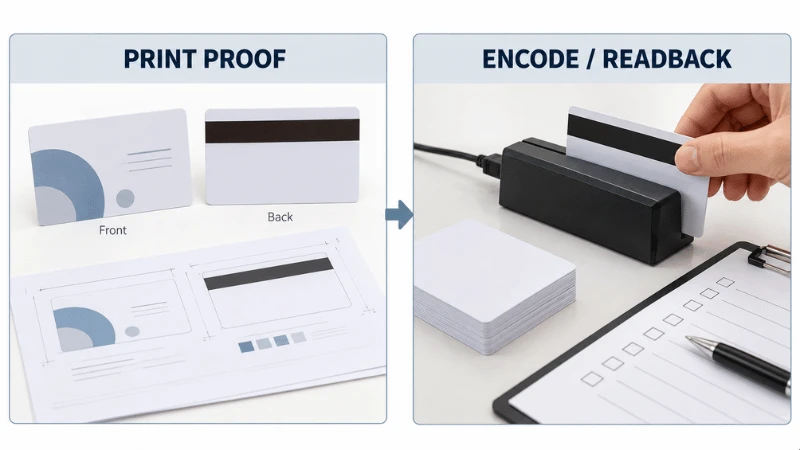
A full-color PVC card often goes through artwork proofing, print approval and physical sample approval. Those activities answer whether the design is correct and reproducible. They do not answer whether the stripe was positioned, coated and encoded in a way that the customer's equipment will use successfully. Buyers should approve the printed object and the functional credential as distinct requirements, even when the factory supplies both.
The visual proof should show front and back, orientation of the magnetic stripe, all copy and numbers, color references, barcodes if used, signature panels, slot punches and other features that might interfere with the intended readers or printers. A slot or shape change can affect how a card moves through equipment. A printed serial number may need to align with a separate numbering file. Artwork that looks symmetrical on screen can still end up reversed relative to the stripe when the card is swiped in a particular reader.
A physical sample should reflect the approved substrate, surface finish, card thickness, stripe location and encoding construction. When cards will be printed or personalized after receipt, test the receiving site's actual printer or personalization equipment rather than assuming any PVC stock will feed correctly. Where a glossy or coated finish changes printer behavior, the resulting print quality is an equipment-and-material interaction, not just an aesthetic choice.
For hybrid cards that contain an RFID or NFC component as well as a magnetic stripe, treat the two technologies as separate functions. The magnetic stripe is read by contact with a magnetic reading head; the RFID or NFC component communicates with a compatible radio reader. A hybrid card should be validated on both systems with the appropriate data mapping. Do not call a plain magstripe card an RFID card, and do not assume that adding a chip solves a legacy encoding incompatibility.
Syntek's current NFC PVC card product listing describes a magnetic-stripe add-on option, but exact availability, stripe variants, combined construction and batch specifications should be confirmed against a current quotation and production sample. This page does not establish that every requested standalone magnetic-stripe configuration is routinely manufactured by Syntek.
Design a Production-Equivalent Sample Test
The objective of a pilot sample is to expose the real failure modes before the buyer orders a larger printed batch. A useful sequence begins with a blank or authorized test card of the proposed material, uses the installed encoder or an agreed equivalent setup, reads the result independently, and then tests the actual application workflow. If pre-encoded delivery is planned, the supplier should demonstrate that its intended production method produces the agreed representation; the customer still needs to confirm acceptance on its own equipment.
Keep four events distinct: write attempted, write reported successful, readback matches the target, and application accepts the card. They are not synonymous. A writer can report success while an independent read is inconsistent; an independent read can succeed while the business application rejects an expired, unmapped or otherwise invalid credential. Recording the precise failure stage makes corrective action faster.
An operational acceptance run should use multiple approved samples rather than a single favorable swipe, with the number chosen based on the project's risk and purchasing quality plan. Test under the actual swipe orientation and normal operator behavior. If the card will be frequently handled or reissued, include representative handling and re-encoding tasks that the system vendor permits. The pilot need not simulate an invented lifespan; it needs to show that the proposed material and data path support the real operating task.
| Sample gate | Observation required | Typical correction if it fails |
|---|---|---|
| Physical fit | Correct card dimensions, stripe placement and reader feed | Adjust construction or placement |
| Write | Intended encoder writes the approved dummy record | Check stock/coercivity, writer setting and record format |
| Independent read | Reader returns the intended controlled value | Investigate track layout, recording quality or reader |
| Business transaction | Application accepts the credential in authorized test state | Correct backend mapping or application-specific format |
| Visual traceability | Printed number and controlled record reconcile | Repair print/encode file mapping |
| Repeat issue | Authorized test card can be handled per platform rules | Confirm allowed rewrite process and program behavior |
A supplier's statement that it ran an encoding test is useful only when the buyer knows the equipment, test data type, sample revision and what was actually accepted. This guide describes a method; it does not report a Syntek laboratory result, read-error rate or certification.
Keep Artwork, Numbering and Magnetic Data in One Controlled Handoff
Custom printed cards frequently involve several teams. Marketing approves a design, procurement issues a purchase order, operations owns the reader, IT owns the source records, and a manufacturer turns files into physical cards. Without a controlled handoff, an apparently minor change in numbering or print layout may break the physical-to-digital relationship.
Use one approved job package with a revision identifier. It should reference the latest print artwork, the approved stripe stock, the permitted encoding specification, the owner of any production data, the pack grouping method and the acceptance record. If the card contains a visible number that differs from its encoded value, specify the authorized mapping file and the party responsible for reconciling it. If a set of cards is supplied blank, state that clearly; a blank supply order should never inherit acceptance criteria intended for pre-encoded cards.
Do not solve data inconsistencies by improvising records at the printing or dispatch stage. When numbers are invalid or duplicated, stop the affected job segment and reconcile the approved source file. Record which physical cards were affected and whether they were destroyed, reworked, reissued or held. This is basic control of physical credentials and supports both stock accountability and user-support troubleshooting.
A versioned handoff is especially valuable for repeat orders. The customer might approve new artwork while keeping the same data structure, or a system upgrade might require a change in encoding without changing the logo. These are different revisions with different testing implications. Keeping them separate prevents marketing sign-off from accidentally replacing technical sign-off.
Troubleshoot Rejected Cards at the Right Layer
When a swipe fails, start by asking what was observed. Did the reader detect nothing? Did it show an unreadable-record error? Did it read a value that the system rejected? Did the card work on the encoder but fail at another reader? Did the printed member number differ from the returned record? Those outcomes suggest different investigations, and replacing the whole batch may be premature.
If there is no apparent read, check approved orientation, whether the swipe-reader head works with a known-good control card and whether the magnetic stock and track position match the reader's requirements. Visible scratches, curling and heavy wear may warrant physical inspection. Avoid attributing every failure to "demagnetization" without checking equipment or encoding first.
If the reader extracts a record but the application rejects the transaction, compare the authorized test output with the documented backend format and account state. Do not modify live access-control values on an ad hoc basis to make a sample appear successful. A door lock may reject a card because its permission period or issuance state is wrong, even when the stripe is readable. For a broader explanation of lock-platform behavior, Syntek already covers how hotel key cards operate; this article owns the procurement and batch-acceptance handoff rather than that system overview.
If failures occur only after printing, heat exposure, a finishing step or shipment, investigate what changed after the approved blank-stock test. Supplier and customer should agree what evidence distinguishes manufacturing defects, damage in handling and reader-side variation. A claim such as "100% compatible" is not a useful root-cause conclusion; a reproducible failure under recorded conditions is.
Receiving Inspection: Compare the Shipment With the Reference
The incoming QC stage should establish what was ordered, what arrived and which evidence allows it to be released. Check the purchase-order revision, job/package labeling, production lot, card count or allocation record, printed artwork version, stripe stock identifier and any pre-encoding declaration. A shipment with the right logo but the wrong coercivity or encoding plan is not a conforming delivery.
For functional checks, select samples through the buyer's documented sampling plan, not from only the most convenient top of a carton. If cards are packed by member range, site, hotel or program revision, include representative subgroups. Test the physical condition and the agreed controlled encode/readback or application acceptance procedure. Record the reader model, sample reference and results. A receiving test cannot provide exhaustive assurance about every card unless the contract defines and verifies such a process.
Pre-encoded lots also need identity reconciliation. Does the shipping manifest match the number ranges or file references agreed in the controlled job package? Are duplicates, omissions, unassigned printed identifiers or unexpected values handled with a written process? Do not publish live credential data in a public shipment report. A secure mapping record can reconcile the identifiers without exposing authentication-sensitive material.
| Delivery decision | Condition | Next action |
|---|---|---|
| Release | Approved construction, labeling, relevant functional tests and file mapping conform to the plan | Make the lot available for the intended operation |
| Hold | Discrepancy not yet explained or test evidence incomplete | Isolate the lot pending investigation |
| Rework review | Error may be corrected without compromising integrity | Require approved correction and repeat affected checks |
| Reject | Critical incompatibility or unapproved construction cannot be remedied | Handle under purchase agreement and buyer process |
The table is a proposed decision framework. It does not establish a fixed sampling percentage, acceptable failure rate or a Syntek production guarantee. Those values belong in the contract and the risk assessment for the actual application.
Write the RFQ as Two Parallel Specifications
A reproducible order needs a physical specification and a credential-data specification. The physical side describes PVC construction, size, finished thickness, surface and print method, magnetic-stripe placement, optional numbering and packaging. The credential-data side describes the authorized encoder/reader, stock suitability, track and data format, delivery state, test method and evidence expected with the shipment.
Attach a system-reference note that identifies the intended application, the equipment contact and a verified sample reference. If the supplier is asked to provide blank cards, the contract should not imply that the supplier has certified the customer's final encoding workflow. If the supplier provides pre-encoded cards, clarify who supplies, protects and approves the source data and who performs final application-level acceptance.
Procurement can then compare quotes fairly. Two suppliers offering "custom PVC magnetic cards" may be pricing different processes: one may supply printed blanks, another printed and encoded cards with readback records, and another a hybrid RFID/magstripe construction. Without the same statement of work, headline prices are not comparable and lower unit cost can shift expensive debugging work downstream.
Before changing supplier for a repeat order, ask for a sample that follows the new vendor's actual materials and equipment. An image of a previous batch or a generic blank card does not validate the proposed production process. Reaffirm the owner's sign-off for artwork, encoding and application behavior rather than relying on a single purchasing approval email.
A Worked Example: A Legacy Membership Card Reorder
Imagine a regional membership program still uses swipe readers at several desks. Its old PVC card has a printed membership ID on the front and a magnetic stripe on the back. The procurement team wants refreshed branding and a reordered stock quantity, but the installed readers and membership database will remain in place. This is an illustrative planning example, not a reported customer case.
A sensible first step is to collect a permitted working card, system documentation and the current encoder workflow. Operations verifies which track and record structure the system uses; IT documents the association between the visible member number and the encoded identifier. Marketing approves a new design, but the stripe placement and read path remain fixed unless a separate physical test proves a change is acceptable.
Next, a sample of the proposed card construction is encoded with a controlled test value, independently read and submitted to the test environment. The team checks whether the printed number maps to the expected sample record and whether the normal swipe procedure works on representative desks. Only then does procurement approve the exact print/stripe/encoding revision for the production order.
At receiving, staff verify the shipment groupings and selected physical samples, perform the agreed test and retain a record of exceptions. If one carton contains an unexpected stripe variant, it is held while the rest are evaluated according to the agreed lot structure rather than indiscriminately mixed. The example illustrates why "approve the design" and "approve the credential" must be separate decisions.
When Not to Order Another Magnetic Stripe Card
A legacy magnetic-stripe workflow may be the right constraint for an existing reader estate, but it is not automatically the best credential choice for a new system. Swipe-based media have limitations in wear, exposure to magnetic fields and resistance to unauthorized duplication. Security-sensitive programs should evaluate the complete access system rather than assuming a higher-coercivity stripe offers cryptographic protection.
If a client is migrating from magstripe to RFID or NFC, the decision belongs in a separate reader-and-credential design process. A modern radio card requires compatible hardware, software and data issuance, not just a new plastic blank. Conversely, a buyer with working magstripe readers should not order contactless cards simply because a supplier's catalog calls them "smart cards." The reader and application determine the effective credential requirement.
Syntek's RFID card category and printable PVC card selection guide cover related card sourcing and contactless-card choices. This article keeps the older magstripe encoding and delivery job separate. Any claim that Syntek can supply a specific legacy stripe, associated encoder service or regulated payment-grade product must be checked with the current supplier and supporting documents.
The Handoff That Makes a Printed Card Usable
A reliable custom magnetic-stripe card order is a chain of signed-off facts: installed equipment, media type, track and record requirement, physical sample, printed and digital identifier mapping, agreed functional test and receiving decision. One missing link can make a polished printed batch unusable.
Before committing to volume, have the operational system owner approve the technical requirement, the artwork owner approve the print, and the buyer approve the acceptance plan. Use controlled non-sensitive data for the pilot, then keep real issuance data under an appropriate authorized process. The finished product is ready only when the card can be handled by its intended equipment and the resulting business transaction is correct-not when the design looks good in a catalog.
Send Inquiry