

RFID Blocking Bag Specifications: Match The Device, Signal And Closure
Oct 20, 2026
Leave a message

An RFID blocking bag looks straightforward on a product page: choose a size, select a fabric, add a logo and request a bulk quote. The difficult part comes before the order. What is the buyer actually trying to isolate-a contactless card, an automotive key, a smartphone, or several different devices? Each creates a different verification problem. A bag that changes one device's behavior in one trial cannot automatically be described as blocking every wireless signal.
For distributors, promotional-product buyers and operations teams, the useful buying document is therefore not a generic promise of "RFID protection." It is a device-and-signal requirement sheet that specifies the intended equipment, the bag's usable internal space, how the opening is closed, the conditions under which performance will be checked, and which claims may be made about the delivered model. This guide builds that specification. A separate key-fob-only test protocol belongs with the operational testing guide, rather than being repeated here.

Start With the Device, Not the Word "RFID"
"Blocking bag," "Faraday pouch," "RFID sleeve" and "signal isolation bag" are often used as if they describe one interchangeable product. They do not tell a buyer which signals a finished enclosure attenuates, how reliably it closes, or which devices fit inside. The everyday term RFID may refer to contactless card applications, while a modern phone can communicate through several different radio systems. An automotive remote or passive-entry key presents another set of behaviors defined by the vehicle and key design.
A workable project brief begins with an observable outcome. A fleet administrator may need to store an authorized vehicle key in a closed pouch so that the vehicle does not respond under defined test conditions. A phone-handling team may want a sealed phone to lose specified wireless connectivity while it is stored. A card holder may need a sleeve that reduces the ability of a nearby compatible reader to communicate with a card. These are three different acceptance tasks, not three color choices for the same stock item.
| Intended item | Actual user task | Questions for the supplier | Practical verification boundary |
|---|---|---|---|
| Car key or key fob | Reduce specified communication while the key is stored | Which vehicle/key family, which pocket and closure, which operational test? | Test the target vehicle functions; do not infer all vehicle compatibility |
| Smartphone | Isolate selected cellular, Wi-Fi, Bluetooth or other connections during storage | Which phone sizes, cases, radios and closure positions? | Test each claimed behavior; one missed call is not full-band certification |
| Contactless card or passport | Reduce reader-to-card communication | Which credential family and reader conditions? | Check with relevant readers; do not claim universal protection |
| Mixed-device kit | Supply multiple suitable bags without confusing purposes | Separate sizes, instructions and validation records? | Each device class requires its own tested configuration |
A distributor selling one "universal RFID bag" without those distinctions can end up promising more than any single sample has demonstrated. A better product range may use different pouch dimensions and test instructions for different user tasks, while preserving a common appearance or private-label packaging.
Separate a Signal Claim From a Material Claim
There are at least four kinds of claims that routinely get compressed into one marketing sentence. A material claim describes the conductive fabric or film. A construction claim describes how panels, seams and the closing edge form a bag. A device claim describes what a particular phone, card or key does during a defined trial. A security outcome claim goes further and asserts that a threat is prevented. Each requires different evidence.
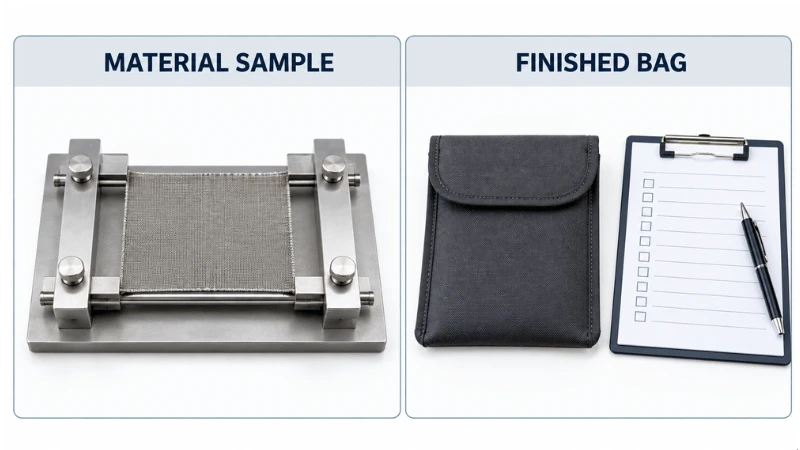
For example, a laboratory report about a flat sample of shielding fabric is useful when comparing material candidates. It does not automatically prove that the manufactured bag-with stitching, corners, an opening and the user's usual closure technique-has identical performance. Likewise, a smartphone that appears offline after being sealed supplies evidence for that phone and scenario. It does not certify a bag for all frequencies, all phones, GPS reception, or every car key system.
ASTM's current listing for D4935-18(2026) describes a method for measuring shielding effectiveness of planar materials in defined far-field conditions. Its scope is therefore relevant to material evaluation, not a blanket finished-pouch or vehicle-key certification. Buyers should ask the vendor to identify exactly what specimen was measured, the test conditions, the reported frequency interval, the report date and the connection to the actual bag material. The official scope is available from ASTM International.
If a quotation includes "all signals blocked," "100% protected," "military grade," or an unqualified attenuation figure, ask for the missing scope instead of copying it into your product listing. An evidence-ready description is narrower: it identifies the tested bag construction, device or band, test method and result under those conditions. Where this information is unavailable, describe the product as a shielding-bag candidate subject to sample validation.
The Frequency Question Is Really a System Question
The phrase "supports RFID" can obscure important differences. Contactless payment-style credentials often use high-frequency radio communication, while long-range inventory systems and some other credential technologies operate differently. A smartphone may have several radios active at once; its GPS function normally receives satellite signals, whereas cellular, Wi-Fi and Bluetooth involve their own transmit-and-receive behavior. A keyless vehicle system cannot be reduced to the operating frequency of a payment card.
Before requesting test evidence, write down the device family, the function you expect to stop, and the equipment used to check it. If you do not know the relevant frequency or protocol, say so and identify the device and system model rather than guessing a frequency. Suppliers can then state which construction they propose and which requirement they can actually verify.
| Buyer asks | Better technical question | Why the distinction matters |
|---|---|---|
| "Does it block RFID?" | Which card/reader or key/device pairing was evaluated? | RFID is not one universal test condition |
| "Does it block GPS?" | Was reception or subsequent location reporting tested on the named device? | A satellite receiver and a cellular reporting link are separate functions |
| "Does it block Wi-Fi and Bluetooth?" | What equipment, configuration, connection state and test were used? | Radio behavior changes with operating state and environment |
| "Is the fabric certified?" | Was the raw material measured, or the finished closed bag? | Openings, seams and closures alter a finished enclosure |
| "Will it stop car theft?" | Which vehicle/key behavior was evaluated, and what other controls apply? | One shielding test is not a guarantee against all theft methods |
The practical advantage of the matrix is that it turns a vague marketing negotiation into a measurable conversation. It also prevents a common support failure: a purchaser buys a bag described for a contactless bank card and assumes it has been validated for a cellular telephone or an automotive remote.
Fit Means Usable Space After the Closure Is Made
A posted outside dimension is not the same as usable device space. The finished bag may have side seams, binding, liner thickness, a flap, a fold or a fastening strip that consumes part of its interior. A phone case, key ring and bulky fob change the space requirement. The buyer must measure the actual object that the end user will insert, not just a bare handset size from a catalog.
Ask the supplier for both external dimensions and a practical interior-fit drawing showing where the object sits when the closure has been completed correctly. If a closure depends on a fold or overlap, the maximum supported device length should leave enough room to complete that overlap consistently. Where the vendor cannot supply the drawing, a production-equivalent physical sample is the fastest way to expose the issue.
Check the task in a normal working sequence: insert the item, close the bag as a user would, place it in its normal storage location, remove it, and repeat. The closure should not depend on an unusually careful one-off arrangement that users cannot reproduce. A pouch can be well made and still be the wrong size for a larger phone, a key with an attached bulky ring or a bundle of several cards.
For a mixed-device program, it may be more reliable to specify two or three sizes with a common visual identity than to market one oversized bag as suitable for everything. If stock-keeping simplicity is the priority, document which devices are excluded and why. That is more useful than a theoretical "fits all" description.

Why Seams, Pockets and Closing Instructions Belong on the Specification
The shielding material may be hidden behind a normal-looking fabric exterior. That means buyers must inspect construction features that product photographs often cannot show. Look at the full opening, the transition between the sidewalls and flap, internal pocket separation if the design uses it, seam wear points and the way the user can tell that the correct pocket is closed. A decorative outer flap is not necessarily the working shielding closure.
If a design has two pockets, do not assume that both are shielded. Require a labeled approved sample showing which compartment was validated. If the bag is sold with an instruction card, that instruction is part of the functional product; the same pouch used with a different fold or unfastened corner may not behave the same way.
A useful construction approval record identifies the fabric reference, intended finished assembly, seam/edge treatment, closure method, pocket arrangement, revision date and photo of the correctly closed specimen. None of these details establishes a shielding result on its own. Together, however, they let the supplier and buyer confirm that the bulk shipment reproduces what was tested.
Design changes deserve special attention. Replacing the fastening strip, shifting the stitching line, changing liner material or revising the pocket layout can be operationally meaningful even when the exterior color remains identical. The approved sample should be rechecked after a change relevant to fit or shielding integrity, rather than treating artwork approval as permanent product approval.
Build an Application Matrix Before Ordering Samples
For an everyday car-key storage program, the representative device set should reflect the fleet or customer group that will actually use the bags. A pouch that works with a single key in a controlled demonstration is evidence about that configuration only. The detailed vehicle test belongs in a dedicated car-key-pouch protocol; here the sourcing question is which key and pouch variations must enter the qualification list.
For smartphone storage, determine the devices to be used and the wireless functions that matter. If calls, mobile data, Wi-Fi and Bluetooth are all mentioned in advertising, each claim requires a defined observable check. A phone "not ringing" can be influenced by silence mode, call forwarding, network availability and other settings; it is not by itself conclusive evidence of radio isolation. Some apps may display cached or delayed information. Record the baseline condition outside the bag and repeat the chosen trial with the bag closed.
For contactless-card storage, the relevant reader and credential type define the interaction. Syntek already has a separate RFID blocking card testing guide; that card-format task should not be folded into bag-specific specifications. An unrelated phone NFC test may not cover the actual card program. A comparison may use the same card and reader outside and inside the proposed shielding sleeve, with the position, orientation and reader setting controlled as far as the intended application requires. Do not substitute this ordinary application trial for a formal laboratory report when the purchaser's contract calls for one.
| Verification record | Key-fob program | Smartphone program | Card/passport program |
|---|---|---|---|
| Device identifier | Vehicle/key family | Device model and radio setting | Credential and reader family |
| Baseline outside bag | Defined response operates | Target connection works | Reader reads normally |
| Finished-bag sample | Closed pouch and pocket identified | Closed pouch and case noted | Closed sleeve and insertion orientation |
| Expected result | Specified function fails to respond | Specified connection or activity unavailable | Specified read attempt fails |
| Retest trigger | Closure or material revision, device change | Device or network configuration change | Credential/reader or construction change |
| Evidence retained | Sample revision, test record, exceptions | Same plus settings documented | Same plus reader configuration |
These rows are a proposed buyer framework, not reported Syntek results, pass rates or a universal industry standard. The buyer chooses the sample size, repeat count and acceptance threshold in line with the consequence of failure.
Interpret an Imperfect Test Without Inventing a Performance Figure
A failed test is useful information if it is properly diagnosed. First confirm that the control setup works outside the pouch. Then confirm the correct pocket and closure are being used. Examine whether the inserted device prevents the flap from closing flat. Compare another sample of the same approved revision, and isolate the particular device or reader that produced the unexpected result. This sequence helps separate a wrong-size selection from a potential construction problem.
An intermittent result is not a pass. It can mean the measurement setup varies, the device reconnects in a different mode, the closure is inconsistent or the finished bag falls short of the stated requirement. Record when and how it occurs; do not simply retest until a favorable attempt appears. If failures cluster around one device family, the specification may need a narrower validated scope or a different bag model.
For supplier comparisons, a repeatable test setup matters more than an attractive number without context. Two reports can be incomparable if they use different specimens, frequencies, distances, antenna orientation, closure conditions or measurement methods. When a procurement contract needs quantified shielding effectiveness, agree the independent test method and acceptance definition before price comparison.
Turn the Results Into a Bulk-Order RFQ
A good request for quotation gives a supplier a target it can answer without pretending universal capability. Attach the intended product image or neutral drawing, actual contents dimensions, finished-bag functional requirement, use conditions, expected closure method and the list of tests you want the sample to undergo. Separate mandatory functionality from branding choices such as color, woven label, artwork or carton layout.
Use fields like these in an RFQ or purchase-order appendix:
| Required field | Buyer-supplied value or decision |
|---|---|
| Intended user and device | Key-fob fleet, phone fleet, card set or defined combination |
| Device size in normal use | Measured with relevant case, key ring or accessory |
| Functional claim under review | Exact radio behavior or card-reader interaction |
| Proposed enclosure | Approved bag/pocket/closure drawing and revision |
| Sample acceptance | Baseline method, observation, repeated trial requirements |
| Evidence requested | Finished-bag test record; material report separately identified |
| Customization | Artwork revision, print/label location, packaging instructions |
| Batch identification | Shipment lot reference and approved sample reference |
| Deviation control | Who may approve construction or test-method changes |
For pricing, ask for a quote based on the approved configuration. An "equivalent material" substitution should be reviewed as a proposed change, not silently accepted because the exterior appearance matches. Likewise, the material in a sample should not be treated as confirmed for bulk delivery without an agreed control mechanism.
Commercial details such as minimum order quantity, availability, lead time, and available customization vary by supplier and order. This article does not claim a particular MOQ, production tolerance or test capability for Syntek. The relevant commercial starting point on the Syntek site is its RFID signal-blocking product category and signal-blocking bag product listing, where a buyer can ask which current model, if any, matches a defined application. A public product claim is not a substitute for a test report on the requested configuration.
How to Accept a Shipment Against the Approved Sample
Receiving inspection should compare each lot with the approved sample and purchase-order record. Check that the packaging groups the correct bag model, revision and customization; examine the correct closure and pocket; inspect a risk-based sample for damage to relevant fabric, binding, corners and fastening points; and run the agreed functional check using the same defined device configurations. A supplier's statement of "QC passed" is not a substitute for the buyer knowing which characteristics were checked.
If a shipment arrives with an unexpected fabric, a changed flap construction, a different usable internal width or a test discrepancy, quarantine the affected lot or subgroup pending a documented decision. The correct disposition may be requalification, supplier correction, an application restriction, or rejection, depending on the written agreement. Do not mix held units with previously approved stock and do not convert a failure into a pass by silently changing the test conditions.
The inspection plan is deliberately not assigned a made-up universal acceptance percentage. A promotional campaign, a vehicle-key storage program and a controlled-device-handling operation have different costs of failure. Sampling frequency and decision criteria should come from the purchaser's risk process and contract, not from an unsupported line in a product description.
A Worked Specification Example Without Invented Test Data
Consider a distributor assembling a two-item retail range: one small pouch intended for key-fob storage and one larger pouch intended for selected smartphone storage. The distributor wants the same exterior color and brand label but does not need the products to claim the same shielding scope.
For the key pouch, the specification lists the intended key-fob family, usable compartment, approved closure photo and functional validation to be performed with that key/vehicle combination. For the phone pouch, the specification lists the handset models, actual cases, relevant radio states and separate test observations required for each claim. Both models share a print proof and packaging standard, but have independent construction references and test records.
If a supplier proposes a single bag to cover both devices, the distributor can evaluate it against both sets of requirements rather than relying on the bag name. If one device fits but compromises closure integrity, that configuration is excluded even if the exterior dimensions appear sufficient. The example is a specification exercise only; it is not a Syntek product test or an actual customer result.
A future reorder should point back to the approved revision and the device-and-signal matrix. That allows the buyer to distinguish an artwork refresh from a shielding-relevant construction change. The result is a smaller claim surface, fewer ambiguous customer promises and a clearer acceptance decision-without asserting that any bag prevents every possible wireless interaction.
Where This Guide Stops
This guide owns the device-and-signal specification task for multi-purpose RFID blocking bags. It does not certify a finished pouch, replace a laboratory shielding measurement, define a universal anti-theft guarantee or provide a vehicle-specific relay-attack assessment. It also does not duplicate the separate job of running a detailed key-fob pouch test before a bulk order. The buyer should preserve the validated model, the conditions of validation and the claims that are actually supportable.
The next procurement action is practical: write the device list, define the specific wireless behavior, request the finished-bag construction and correctly closed sample, and obtain a test plan appropriate to that use. Only then compare customization, packaging and order terms. A product page can show what a bag looks like; a controlled specification determines what a buyer may responsibly promise it will do.
Send Inquiry