


RFID Stickers On Cartons: Diagnose Peeling, Missed Reads And ID Mismatches
Oct 28, 2026
Leave a message

An RFID sticker that works on a supplier's desk can fail after it is applied to a corrugated carton and sent through a warehouse. The label may lift at a dusty corner, respond inconsistently near liquid-filled goods, or return a perfectly valid EPC that belongs to a different case. Buying a different sticker before identifying the failure layer can create another expensive trial without resolving the original problem.
This guide is for packaging engineers, warehouse integrators, contract packers and procurement teams troubleshooting finished UHF RFID stickers applied to shipping cartons. It separates three questions: does the label stay attached, does it read in the intended zone, and does that read identify the correct case in the business system? The practical result is a structured failure investigation, a limited pilot and a release decision. It is not a product catalogue, a roll-converter specification or a promise of any Syntek test performance.

Start With the Actual Failure, Not the Chip Name
The visible symptom should determine the first inspection. A missing label after handling calls for a surface and adhesive investigation. A firmly attached label that reads on the bench but not through the dock door calls for an RF and read-zone investigation. A readable label linked to the wrong shipment calls for an encoding or database investigation. These events can occur independently or at the same time.
| Observed failure | Likely first investigation | Immediate evidence to preserve |
|---|---|---|
| Edge lift or complete peeling | Carton coating, dust, adhesive, application pressure and handling | Failed carton, placement photo, lot and application conditions |
| Sticker intact, weak or absent RF response | Item material, antenna orientation, physical damage and reader geometry | Tagged carton, reference read result and read-zone setup |
| RFID reads, WMS reports the wrong item | EPC assignment, barcode mapping, relabeling and software event logic | Raw identifier, printed label and source shipping record |
| Extra or duplicate reads at a doorway | Adjacent read zones, repeated observations and event filtering | Reader logs with time, antenna and physical carton movement |
| Failure appears only in later deliveries | Change in carton, adhesive, inlay, encoding or process revision | Approved sample and current-lot revision records |
A useful incident report names the failing checkpoint: carton sealing, label application, case packing, pallet build, conveyor, handheld stock count, or fixed portal. A label that passes the first checkpoint may fail at a later one because the physical environment and business decision have changed.
Confirm That the Sticker Belongs to the Correct RFID System
The term RFID sticker describes a physical form, not a common radio interface. This guide concerns passive UHF/RAIN applications in which cartons are typically read by dedicated UHF hardware. A phone-readable NFC sticker is not interchangeable with a UHF EPC label, even when the adhesive label looks similar. Confirm the project's regional operating band, reader model and antenna, chip/IC family, memory layout and encoding scheme before testing carton placement.
Where GS1 identifiers are used, EPC encoding should follow the applicable GS1 data rules rather than a guess based on a visible serial. The GS1 RFID standards overview describes the relationship between electronic identifiers, air interfaces and business systems. Not every deployment uses GS1 identifiers; the system owner must identify the actual data scheme and its uniqueness requirements.
Ask the integrator to provide a known-good reference label and a known-good reader configuration. Use those as controls when testing suspected defective stock. Changing power, antenna angle, label type and software settings simultaneously makes a root cause hard to defend.
Why Adhesion Changes After a Sticker Meets a Real Carton
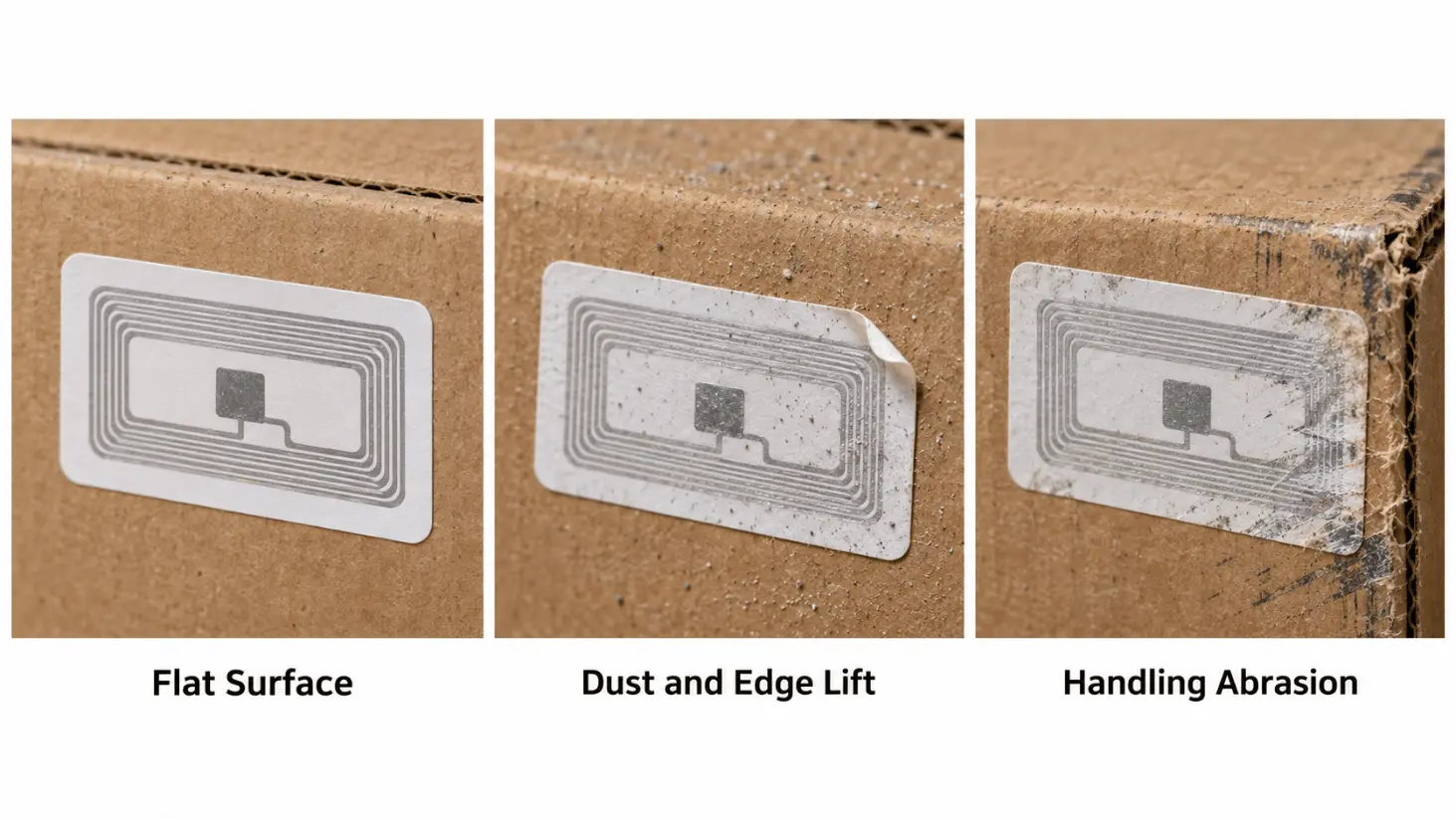
Corrugated cardboard is not one uniform surface. A smooth, coated outer liner may bond differently from porous, dusty or recycled stock. Printing varnish, moisture, paper fibers, waxes, dust from cutting, refrigeration condensation and the pressure used during application can all affect contact between pressure-sensitive adhesive and packaging. The effect depends on the actual adhesive formulation, face stock and process; a generic claim that a label uses "strong glue" cannot prove suitability.
Begin by recording the carton grade, surface finish and whether the label is applied before or after packing. Measure the labeled area's curvature or edge proximity if relevant. Check whether the applicator wipes across the entire label or only deposits it at a point. Look for folds, tension, trapped dust and an overlap with tape or carton seams. An apparently intact sticker may have poor adhesion at one edge that becomes visible only after stacking and abrasion.
Run a controlled adhesive trial on the actual carton stock, not only on a flat laboratory panel. Include freshly made cartons and cartons stored under normal conditions. Where operations involve cold rooms or variable humidity, assess application and subsequent storage separately. A label that adheres at room temperature does not automatically remain stable after humidity exposure or repeated handling.
Adhesive testing should be defined by the packaging owner with the converter or supplier: application pressure, dwell time, temperature, surface preparation, inspection point and failure classification. The acceptance result may be an agreed visual or handling test, a specified peel method, or another application-relevant criterion. It is not responsible to import an arbitrary universal peel-force threshold without a qualified adhesive specification.
Examine Label Placement Before Blaming the Antenna
A UHF inlay's antenna is sensitive to surrounding materials. Water-based contents, metallic foils, conductive printing, metal canisters and nearby racks can reduce or redirect usable RF energy. Carton folds, crushed corners and metal pallet strapping may place the inlay in a different electromagnetic environment from the approved flat sample. Even ordinary cardboard changes geometry once a case is filled and stacked.
Auburn University's RFID tagging location guidance calls attention to metal, foils, liquids, packaging conditions and the eventual read environments. Its location advice is a starting point; every warehouse must qualify its real item and reader setup. This is particularly important when multiple case orientations are mixed on pallets.
At the packaging line, mark candidate sticker positions that avoid tight creases, hinges, cut edges and abrasion zones. Evaluate the same positions when the carton is full, taped and placed within representative case packs. Take photos of each position so operators and suppliers are testing the same physical configuration.
Do not infer one ideal position for every product. A carton of folded clothing and a carton of bottled liquid may need different inlays or placement even if the boxes have equal dimensions. Where an existing barcode must also be read, preserve its required print quality and clear zones while accommodating RF placement. One identification method must not make the other unusable.
Separate Bench Readability From the Warehouse Read Zone
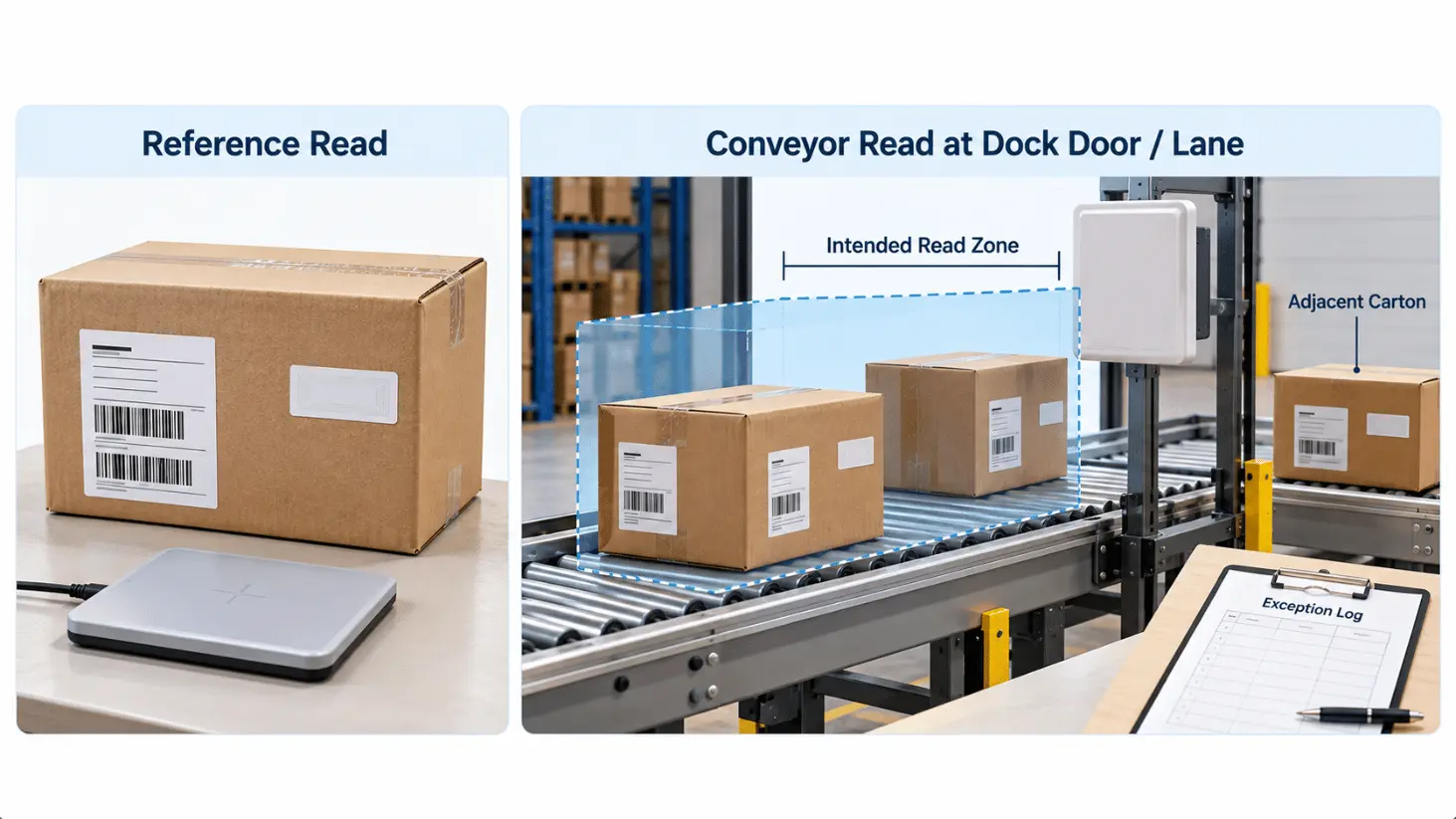
A handheld reader held close to one sticker asks whether the tag can respond under convenient conditions. A dock portal asks whether the correct group of moving cases can be captured at the required speed and direction without including cases in an adjacent lane. Those are different engineering questions. A good bench result is necessary evidence but is not a substitute for operational acceptance.
Document reader hardware, antenna position and polarization, power settings, physical zone dimensions, case speed and orientation, contents, neighboring cartons and software event rules. Record both expected and observed identifiers. For each test movement, distinguish a missed expected case from a stray case detected outside the zone. A false read may be as damaging to inventory accuracy as a missed read.
The Auburn ARC program emphasizes performance testing against end-use requirements, including packaging types and the RFID infrastructure. A tag model approved for one use case does not automatically pass another customer's assembled-carton deployment; certification or third-party tests must be tied to their stated scope.
A controlled investigation when one carton will not read
- Record the failing carton, sticker position, loading condition and exact reader settings before changing anything.
- Try the label at a fixed reference location using an approved control reader to establish whether the IC and inlay still respond.
- Compare an otherwise similar approved carton with the same contents and position. Change only one variable in each comparison.
- Inspect the label for bent or damaged antenna areas, creases, adhesive lifting and signs of mechanical abrasion.
- Repeat the operational read in the actual zone after any approved change, including cases around it and the normal process speed.
- Preserve the raw reads and the WMS transaction result separately; a radio observation should not silently stand in for an accepted shipment event.
When the benchmark tag also fails, investigate the reader, antenna, power, interference and software before declaring the lot defective. When the benchmark succeeds but multiple labels from one manufacturing batch fail under the same controlled conditions, quarantine and examine that batch.
Distinguish Radio Success From Correct Case Identity
The reader can capture an EPC accurately while the warehouse software assigns it to the wrong carton. This can happen when a print-and-encode system shifts a row, an operator relabels a damaged case without retiring the first ID, the same data is accidentally written twice, or an integration maps an EPC to an outdated record. The business consequence is different from a weak antenna: it is an identity-control problem.
For every sampled finished carton, compare three independent observations: the visible barcode or human-readable case reference, the raw decoded RFID identifier and the authorized shipping/order record. Use the system's declared identity scheme and data dictionary. Do not confuse a chip's TID with the customer's operational EPC, or a successful EPC inventory command with proof that the order line is correct.
If a case is relabeled, define whether the old identifier is retired, linked as historical evidence or physically destroyed. Confirm that the warehouse system cannot count both old and new stickers as separate active cases. A stray detached RFID sticker can continue to respond to a nearby reader; it should not silently create stock.
How to Run a Small, Useful Troubleshooting Pilot
Choose cartons that reflect real variation rather than an unrealistically clean sample: different contents, carton finishes, fill levels, case orientations and the usual handling route. Include known-good labels and controlled suspect samples, but avoid reusing labels whose history is unknown. Cover the important process checkpoints from labeling to the final read event.
Write the pass criteria before the test. They should separately address adhesion after the defined handling cycle, readability within the intended zone, exclusion of neighboring objects, EPC-to-printed-identifier agreement, exception treatment and reconciliation to the WMS. The project owner decides acceptable limits; no universal pass percentage, antenna power or sample size is appropriate across all systems.
| Trial gate | Evidence needed | Example hold trigger |
|---|---|---|
| Label application | Placement photos, carton lot, applicator settings and adhesion inspection | Edge lift or position change during defined handling |
| Reference RF test | Same reader and fixture for suspect and control cartons | Repeatable loss confined to one label batch |
| Operational read zone | Movement log with expected and observed EPCs | Unresolved misses or off-zone reads |
| Identity agreement | Barcode/EPC/WMS source-record comparison | Duplicate EPC or wrong case mapping |
| Rework and recovery | Approved replacement and record-retirement trail | Both old and new identities remain active |
| Lot disposition | Approved deviations, owner decisions, corrective actions | Failed units released without disposition |
Include restarts and end-of-shift conditions, not only the first uninterrupted run. An RF label may perform well while the operator is watching but fail because a new carton finish arrives, a roll is spliced, or software records a second observation as a second carton.
Which Failure Deserves Which Corrective Action?
Different root causes need different owners. The packaging engineer owns the substrate and adhesive review; the label converter may own die-cut damage, liner selection and application format; the reader integrator owns RF setup and read-zone boundaries; the software owner owns business events and identifier mapping. Procurement coordinates lot changes but should not be asked to solve a configuration problem by buying a more expensive inlay.
If adhesive is the failure, trial a qualified alternative adhesive or face stock on the same carton under documented conditions. If antenna interaction is the failure, consider tag geometry or placement and retest with a controlled reader setup. If decoding or identity mapping is wrong, correct encoding and master data under change control rather than increasing transmit power. If duplicate events occur, inspect reader localization and middleware filtering rules.
Only one controlled revision should enter the qualification comparison at a time. Record whether the fix addressed the original symptom and whether it introduced new failures downstream. A thicker face stock could improve handling and alter label stiffness; a different position could improve RF response and interfere with barcode access. Corrective action is complete only after the full intended user task still works.
Investigate Carton Damage and Detached Tags During Transport
Not every label loss is caused by the initial adhesive bond. A label near a corner may catch on stretch wrap, a conveyor guide or another carton when a pallet is built. A box face can abrade against a neighboring load, and a damaged carton flap may move after sealing. Compare the label's failed location with the actual handling route and the visible wear pattern; this can distinguish impact or abrasion from an adhesive formulation problem.
If a detached tag remains in a tote, on a conveyor or on the warehouse floor, a nearby reader may still detect it. The operational response should therefore include both physical collection of stray labels and record disposition in the inventory system. Do not simply replace every missing label without confirming that the original EPC will not be counted as an active case. When a rejected carton is reworked, tie the replacement identity to the same authorized shipment record under a documented rule.
For an incident spanning multiple sites, ask for photos and evidence at the final known good checkpoint and the first failed checkpoint. Differences in stretch wrapping, stacking, forklift contact and humidity may explain why a label holds at packing but lifts at receipt. Preserve these observations before changing the label construction; the most valuable fix might be repositioning or improving surface preparation rather than selecting an unrelated chip.
Keep Incoming Rolls and Applied Cartons as Two Separate Acceptance Objects
Roll-level dimensional, winding, defect-marking and registration requirements belong to the converter's incoming process. Syntek already covers those details in its RFID inlay roll specifications and incoming QC guide. The present guide starts after a finished sticker is applied to a real carton. Its acceptance object is the tagged shipping case, followed by the read and business event.
This distinction prevents false evidence transfer. An inlay can pass its delivery inspection while a completed label fails because the adhesive was changed, the antenna was cut during conversion or the label was applied across an unsuitable surface. Conversely, a finished label can work physically while the encoding file creates an identity collision. Keep component tests and in-use tests traceable but separate.
RFQ and Change-Control Details for Repeat Orders
When asking a supplier for a revised RFID sticker, share the approved carton and operational conditions rather than a vague request for "stronger signal" or "better glue." For UHF sourcing, Syntek's RFID tag product category is the commercial starting point; final specifications and supplier capabilities must be confirmed for the actual order.
- Application: carton type, contents, packaging line stage and intended RFID checkpoint.
- Technical system: region, air interface, reader/antenna models, required data format and source master-data owner.
- Sticker construction: approved inlay/IC, dimensions, face stock, adhesive/liner, printing, substrate conditions and orientation.
- Application process: surface condition, temperature, pressure, dwell, applicator and expected handling or storage exposure.
- Read-zone acceptance: reference setup, actual portal/handheld route, expected read and false-read cases.
- Identity acceptance: serialization rules, printed code to EPC mapping, replacement policy and duplicate handling.
- Lot governance: revision, packing quantity, rejected-sticker reporting, sample plan, escalation owner and repeat-order comparison.
Ask the converter to identify which changes require requalification. Changing the core RFID IC, antenna dimensions, label adhesive, print layout, carton substrate, application position or reader settings can each invalidate part of an earlier pilot. Tie the approved sample to a named drawing or controlled revision and keep a retained comparison piece where practicable.
Build a Simple Exception Record That Survives the Next Order
A failure investigation is useful only if the next shift can recognize the same problem. Define a minimum record: carton ID, packaging material revision, label lot, inlay or construction revision, reader station, raw EPC, expected item record, defect category, inspection time, technician and approved disposition. Attach photographs when position or physical damage matters. Keep the raw observation distinct from the interpretation; a note such as "bad label" is not a reproducible diagnosis.
Trend failures by checkpoint, not only by total count. A cluster at one portal suggests different corrective action from a cluster appearing only after cold storage. Compare current lots to retained approved lots under equivalent conditions. When a supplier or integrator proposes a change, record which symptom it is intended to address and which previously passed tests must be repeated. The resulting history makes repeat orders more stable without asserting a made-up factory accuracy rate.
A Release Decision That Procurement and Operations Can Share
The final disposition should be explicit: release if all agreed application, RF and identity criteria are met; hold if an unexplained failure remains; rework if a documented correction and retest are possible; or reject when the batch cannot meet the approved use case. A supplier's successful scan video is insufficient evidence of all four decisions.
Review a small exception ledger with location, carton and label lot, raw EPC, observed symptom, test condition, corrective action, retest result and approving owner. Avoid publishing fabricated read rates or assumed loss reductions. The business value comes from being able to decide which carton is safe to release and why.
Once the tagged carton has passed its own conditions, the label can support reliable warehouse identification. Without physical adhesion, controlled RF capture and correct item mapping, "RFID sticker" remains only a component description rather than a working supply-chain result. For broader differences between NFC, HF and UHF technology, see Syntek's RFID versus NFC buyer guide; this article deliberately stays with applied UHF carton stickers.
Send Inquiry