

Why Event Organizers Are Switching to Eco Friendly Conference Badges With RFID Integration
Jun 24, 2026
Leave a message

The Waste Math That Put Badges on the Sustainability Agenda
The switch to eco friendly conference badges isn't being driven by idealism. It's being driven by risk. The plastic badge that was the safe default for a decade has quietly become the exposure, and the eco alternative is what removes it. The waste figures are real enough: a single conference attendee generates close to 1.89 kg of refuse per day, most of it landfilled, and the bins on closing day make that abstraction physical. But the number planners actually act on is quieter. In audience surveys, a clear majority of attendees, around 60%, now say they prefer events that visibly run sustainable practices. What moves a planner from "we should" to "we're sourcing" is the recognition that the old default is now the liability, while sustainable conference credentials that still carry full RFID functionality keep the access control, check-in speed, and on-site analytics without it. And there's a catch most vendors won't raise on the call: the one component that makes these badges "smart" is also the one that quietly breaks their green credentials.

The Uncomfortable Truth: A Chip Can Break Your "Recyclable" Badge
Here is the part most badge vendors leave off the product page. The moment you embed an RFID inlay into a paper or "compostable" badge, you have changed what that badge is, and usually not in the direction the label implies.

An RFID badge is rarely as recyclable as the paper or card it's printed on, because the embedded chip and metal antenna act as contaminants in standard recycling streams. What that means on an actual paper-mill line is more specific than "it's complicated." In pilot processing of RFID-tagged paper, laminated copper-foil antennas don't break down and are pulled out early in pulping as non-recyclable solid waste, while printed silver-ink antennas tend to remain in the pulp and resist extraction (IndustryWeek). The badge a supplier called recyclable can, at volume, downgrade the batch it travels with.
The plastics side has its own version of the problem. Research on RFID tags in plastic-packaging recycling flags that the solder joining chip to antenna can release lead during reprocessing, and that accumulated metal content can push recycled material toward inconsistency, a real concern where rules cap metal content in recycled packaging at low thresholds such as the EU's 100 ppm limit (ScienceDirect). None of this makes RFID incompatible with sustainability. It means a recyclable eco friendly conference badge is an engineering claim, not a material default, and the chip is the variable that decides whether the claim survives contact with a recycling bin.
If you want the underlying reason the chip and antenna in eco friendly conference badges outlast processes that dissolve paper, it traces back to how the inlay is constructed at each operating frequency, which we break down in our guide to the common RFID tags used across frequency bands.
What Actually Makes an RFID Badge Sustainable
Strip away the marketing and there are only three credible routes to eco friendly conference badges with RFID integration. Each solves the contamination problem differently, and they are not interchangeable.

| Route | How it cuts impact | Best fit | The catch |
|---|---|---|---|
| Closed-loop reuse | Badge and chip collected, sanitized, and reprogrammed for the next event | Recurring or multi-day events in controlled venues | Only works if you actually recover the hardware |
| Recyclable substrate | rPET, bamboo, or Teslin body in place of virgin PVC | Single large events wanting a lower material footprint | The substrate recycles; the inlay still needs separate handling |
| Chipless / removable-chip | Printed paper RFID with no silicon, or a chip engineered to be recovered | Events chasing the lowest possible carbon figure | Best kept to controlled single-venue pilots where you can verify every exit, which usually means events that don't yet need multi-gate access control infrastructure; specify it in your 2026 RFP, not your 2026 order |
The table tells you which routes exist; it doesn't tell you which one your event can execute. That comes down to a single operational question the rest of this breakdown keeps returning to: whether you can actually get the hardware back.
The closed-loop route is, in practice, the only one that turns "sustainable" from a claim into arithmetic. A closed-loop program for eco friendly conference badges spreads each unit's manufacturing footprint across five or ten deployments instead of one, because the badge is collected and reprogrammed rather than reprinted. The catch is worth stating bluntly: the environmental case collapses if the hardware doesn't come back. Recover half your badges and you have roughly halved the benefit you printed in the brochure.
Recycled substrates (rPET, bamboo, FSC-certified paper) are the easy win for a one-off event, and they genuinely beat virgin plastic. The mistake is letting the material become the whole story: switching to a recycled body while ignoring the inlay produces a greener-looking pass that still carries the same chip-contamination issue into disposal. In practice, when collection infrastructure isn't feasible, a recyclable substrate is the honest call. Own that, rather than overpromising on a reuse program you won't be able to staff.
The newest option is also the least proven: chipless and removable-chip designs. A plastic-free eco friendly conference badge built from printed, metal-free paper RFID has been demonstrated with carbon reductions of up to roughly 70% versus conventional tags, against a backdrop of more than 18 billion single-use RFID tags produced worldwide each year (Positive News). More recent work goes further, with chipless tags that stay readable through sorting and then wash off during standard recycling so they don't contaminate the output (Plastics Engineering). For most organizers specifying badges this year, these are worth tracking, but not yet worth betting a 10,000-person event on.
What This Looks Like When It Works
The events already doing this well share one trait: they engineered the recovery, not just the badge.

The clearest evidence that reusable eco friendly event credentials with RFID work at scale comes from touring and recurring events that built collection into the operation rather than bolting it on. Coldplay's tours are the often-cited benchmark, recovering on the order of 86% of their wearable hardware for reuse, a rate only reachable because returning the device was designed into the attendee flow. The Royal Edinburgh Military Tattoo runs RFID credentials printed on recycled PETG and pairs them with a post-event recycling partnership, while the Royal Horticultural Society reuses passes across an entire show season instead of reprinting per event; both are publicly documented. The common thread is not the material. It's that someone owned the question of where the badge goes on day three. Which means your ops brief has to answer questions no material spec will answer for you, and the right answer changes with your venue format.
That distinction decides everything when you translate it to a conference. A multi-day medical congress held in a single convention center can realistically hit high return rates with a staffed drop-off at the exits, which makes a reuse program the right call. A sprawling outdoor festival with twelve gates and a younger crowd will not, and for that profile a recyclable-substrate or chipless eco friendly conference badge is a more honest choice than a reuse scheme nobody will complete.
How to Switch Without Getting Called Out for Greenwashing
The reputational risk has flipped. A few years ago the danger was looking behind the times. Today it's being accused of greenwashing by an audience that reads the badge in their hand more skeptically than they read your sustainability report.

Avoiding that comes down to a short list of non-negotiables when you specify an eco friendly conference badge program for a large event. Lock in a mandatory return mechanism (a deposit, a staffed exit drop, or a re-entry scan), because a reuse claim without a stated recovery rate is the textbook greenwashing flag. If you run that recovery as a published take-back program, you also give attendees a reason to comply rather than pocket the badge. Insist on certified materials, such as FSC paper or verified recycled rPET content, so any substrate claim you publish can actually be substantiated. Align the program with ISO 20121, the recognized management standard for sustainable events, which gives an auditor something concrete to check rather than a slogan. And have a clean data-handling answer for GDPR or CCPA, since RFID logs attendee movement and "eco" does nothing to excuse a privacy gap.
The honest version of a sustainability claim names its own limit. "These badges are recycled-content and we recovered 78% for reprogramming" beats "100% eco-friendly" every time, because the first sentence is checkable and the second invites a journalist to check it. When your published recovery rate sits in that range, you have a number worth putting in your sustainability report and one a journalist would have to work to disprove, and whether your event reaches it depends on venue layout, attendee flow, and how disciplined your collection point is. Those are the same variables that separate a supplier who can support the program from one who just sells you the badge.
What to Ask Before You Place the Order
Volume pricing on RFID event credentials sits near an industry benchmark of roughly $0.07 per unit above 5,000 pieces, which is exactly why unit cost is the wrong thing to optimize first. The variable that actually governs both your total cost and your sustainability story is whether the chip can be reprogrammed and the badge re-deployed. A working reuse program changes the math far more than a per-unit cent ever will.
A handful of questions separate a manufacturer who can genuinely support eco friendly conference badges with RFID integration from a reseller shipping whatever inlay is cheapest that month.
| Question to ask | What a strong answer sounds like |
|---|---|
| Can the chip be reprogrammed for reuse, and on which chip families? | Specific chips (e.g. MIFARE Ultralight EV1) and rewrite limits, not a flat "yes" |
| What substrate options do you offer, and what's the verified recycled content? | A documented materials range, not one token "eco" SKU |
| Do you control inlay assembly in-house? | In-house chip bonding and antenna winding, because that's the layer that decides recyclability. Red flag: "we work with certified inlay partners." That's a trader; the recyclability of the inlay is not their decision to make. |
| What's your defect rate and on-time rate at volume? | Real figures, since a failed batch at an event has no recovery window |
A manufacturer who can give strong answers to all four is a short list. The way you confirm a supplier belongs on it leads to the last question worth asking: who actually builds the badge, and on whose equipment.
Why the Factory Behind the Badge Matters

Most of what goes wrong with a sustainable badge program is decided before printing, at the inlay. A trader buying finished inlays can't change how the chip and antenna are mounted, and that is precisely the layer that determines whether your recyclable eco friendly conference badges behave as claimed, or whether a reprogramming workflow is even possible.
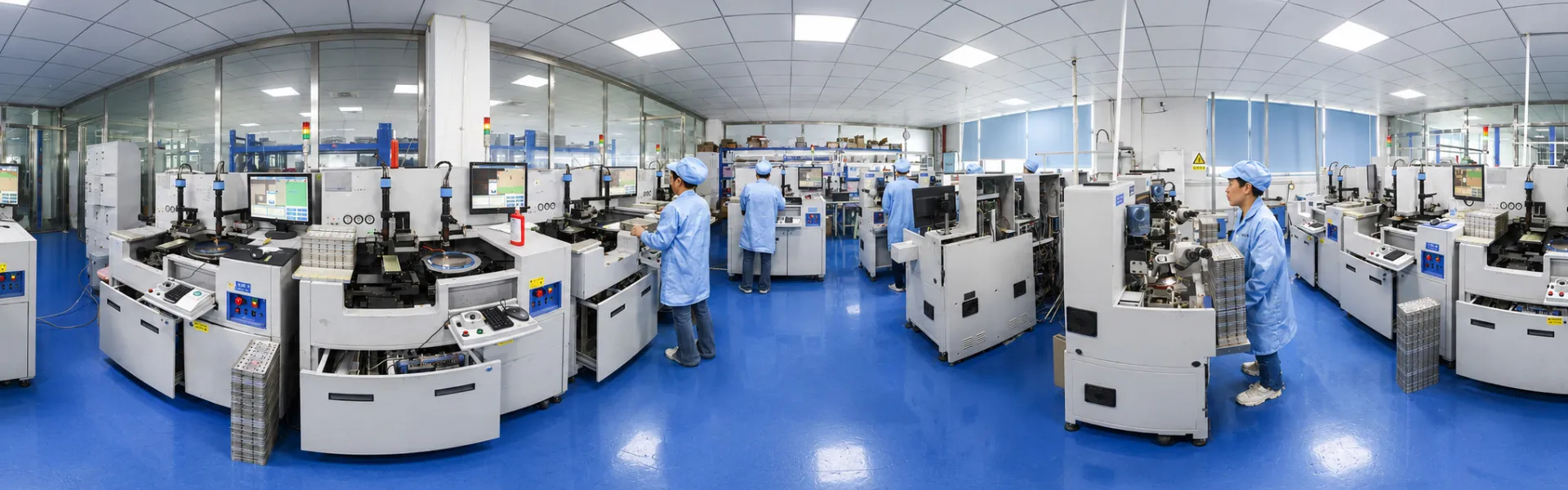
That's the practical case for sourcing from a manufacturer that builds the inlay rather than assembling bought-in parts. SYNTEK has run five dedicated inlay production lines since 2006, with chip bonding and antenna winding done in-house, which is what lets you specify a recycled rPET or card body and choose a rewritable chip for a closed-loop program instead of taking whatever a distributor stocked. Those lines sit in a 3,600 sqm facility staffed by 200-plus people, and every unit gets 100% pre-shipment electrical testing, the relevant number when a dead badge at a check-in gate has no recovery window and no second printing. None of that is a claim you have to take on faith; it's the kind of capability a buyer can verify with a video factory walkthrough before committing a purchase order.
The format you need depends on the event you read in section four. For a fixed-venue conference that credentials at check-in, the card is what you want: rigid, integration-ready, and easy to encode against your registration platform. That's the territory of our customizable RFID cards for event credentialing. For multi-day or outdoor formats where a wearable stays on and comes back at higher return rates, the reusable RFID wristbands built for collect-and-reprogram event cycles are where the sustainability arithmetic finally works in your favor.
FAQ
Q: Are RFID conference badges recyclable?
A: Not by default, because the embedded chip and metal antenna can contaminate paper or plastic recycling streams; they become genuinely sustainable only through collect-and-reuse, chip recovery, or chipless designs.
Q: What makes a conference badge eco friendly?
A: One of three approaches: a closed-loop reuse program, a recyclable substrate such as rPET or bamboo, or a chipless or removable-chip RFID design.
Q: Do eco friendly RFID badges cost more per unit?
A: Not necessarily; volume pricing is comparable to standard badges, and the real savings come from reusing and reprogramming the same hardware across multiple events.
Q: How do I avoid greenwashing with RFID event badges?
A: Build a mandatory return mechanism, use certified materials, align the program with ISO 20121, and verify your supplier's recyclability and reprogramming claims before you commit.
Q: How do I make event badges sustainable without losing RFID functionality?
A: Keep the RFID layer but design for recovery: choose a rewritable chip and a recyclable or removable-chip construction, then run a collection point so the same hardware is reprogrammed for the next event rather than discarded.
Send Inquiry