

RFID Laundry Tag Data Mapping: EPC, TID, Wash Count And Backend Records
Sep 29, 2026
Leave a message

An RFID laundry tag does not need to carry the entire history of a towel, uniform or sheet. In most deployments, the tag's most important job is to provide a stable machine-readable identity that the laundry software can resolve to a much richer record.
That distinction matters because many laundry explanations collapse several data layers into one sentence: "write the clothing information into the tag, then record the wash count." Technically, a UHF RFID tag may expose several different memory areas, and the software backend has a different job again. Treating them as one data store creates avoidable problems when tags are replaced, EPCs are duplicated, customer assignments change, or the same item is read several times at one process point.
This guide explains how to separate EPC, TID, optional User Memory and backend data for industrial laundry and linen tracking, then carry that design through encoding, wash-event counting, retagging and batch acceptance.
Start With One Rule: The Tag Identifies the Textile; the Backend Owns the Changing History
A practical laundry architecture normally separates a durable identifier from changing operational data.
Tag layer: a reader captures an identifier from the physical RFID tag.
Application layer: middleware resolves that identifier to the linen or garment record.
History layer: the backend stores changing information such as customer assignment, location, status, wash events, repair history and retirement state.
This is not the only possible architecture, but it is a useful default because the textile record can survive even when the physical tag does not.
Syntek's RFID laundry tag procurement guide owns the broader tag-selection task. This page begins after the project has already decided to use item-level RFID and needs a controlled data model.
EPC, TID, User Memory and the Backend Have Different Jobs
GS1's current EPC Tag Data Standard defines the memory organization used by Gen 2 UHF RFID tags and distinguishes business data, tag-manufacture information and other control data. For laundry teams, the important practical difference is this:
| Data layer | What it represents | Typical laundry role | Key caution |
|---|---|---|---|
| EPC memory | Application-facing identifier for the physical object | Primary item ID used to look up a linen or garment record | Programmable values can be duplicated if the encoding process is not controlled |
| TID memory | Information about the RFID tag IC itself | Optional chip/tag verification, diagnostics or traceability | TID is not automatically the business ID of the textile |
| User Memory | Optional application data area on tags that provide it | Small route codes, offline attributes or other project-specific data | Capacity and even availability are chip-specific |
| Backend record | Operational record maintained by the laundry system | Customer, item type, status, location, wash history, repair and retirement data | Needs a defined mapping to the tag identifier and event workflow |
EPC Is Usually the Operational Linen Identifier
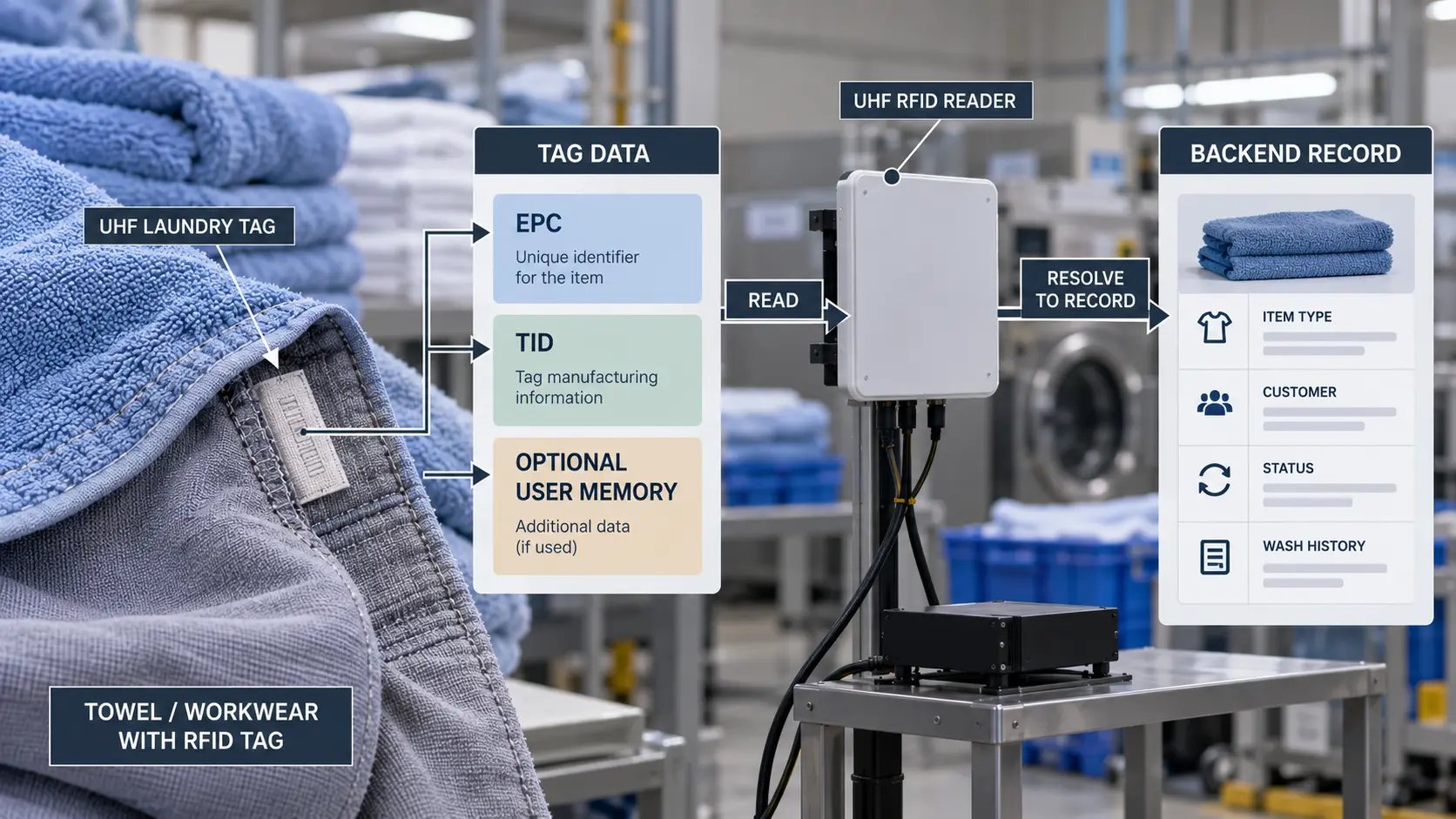
For a closed laundry system, the EPC memory bank is commonly used as the identifier that the reader captures and the software maps to a textile record. The exact numbering scheme can be company-specific or standards-based, but it should be documented before encoding begins.
An EPC should answer one operational question reliably: which asset record is this physical textile supposed to resolve to?
It does not need to contain the customer's name, department, garment size, current wash count and service status at the same time. Those fields can be retrieved after the identifier is resolved in software.
This "identifier first" model also keeps the air-interface transaction simple. Readers can inventory tags by their EPCs, while the backend handles the larger data structure and business logic.
TID Identifies the Tag, Not Automatically the Linen
GS1 distinguishes TID from EPC. TID memory contains information about the tag itself, such as chip manufacturer/model information and, on tags that provide it, a manufacturer-programmed serial number. That serial identifies the tag, not automatically the towel or garment to which it is attached.
This distinction becomes useful when a laundry program wants to validate tag authenticity, troubleshoot a batch, or keep a record of which IC was paired with which encoded EPC.
A project can choose to capture TID during commissioning, but it should not silently substitute TID for the application's linen ID unless the software and integration specification explicitly use that design.
User Memory Is Optional, and Not Every Laundry Chip Has It
One of the easiest mistakes in an RFQ is to assume every UHF laundry tag has spare User Memory for wash history or customer data.
GS1 defines User Memory as an optional bank for application data. The exact capacity depends on the selected IC. NXP's UCODE 9 data sheet, for example, lists 96-bit EPC memory and 96-bit TID memory but does not list a User Memory bank. That is enough to show why "store the wash count in User Memory" cannot be a universal laundry requirement.
If the workflow genuinely needs on-tag application data, confirm all of the following before specifying it:
- the chosen chip actually provides the required User Memory;
- the reader and software can read and, if needed, write that memory;
- the data format is defined;
- write permissions and passwords are documented;
- write endurance is appropriate for the intended update frequency;
- the project has a recovery rule when an update fails.
Where Should the Wash Count Live?
For many laundry operations, the most robust place for the wash count is the backend, not the tag.
| Architecture | How it works | When it can fit | Main trade-off |
|---|---|---|---|
| Backend wash count | Reader captures EPC; software records a qualified wash event and increments the item's history | Most connected laundry-management workflows | Depends on reliable event capture and database availability |
| On-tag wash count | Reader/writer updates tag memory after a defined process event | Special offline or distributed workflows that need the count to travel with the textile | Requires writable memory, write logic and failure handling |
| Hybrid | Backend remains authoritative while selected on-tag fields support local operations | Projects with disconnected stations or local sorting needs | Two data copies must remain synchronized |
The backend model has an important operational advantage: replacing the RFID tag does not have to reset the item's lifetime history.
It also avoids turning every reader point into a write station. A reader can capture the item's EPC, while software decides whether that observation represents a completed wash, a transfer, a sort event or only another duplicate raw read.
A Raw RFID Read Should Not Automatically Add One Wash
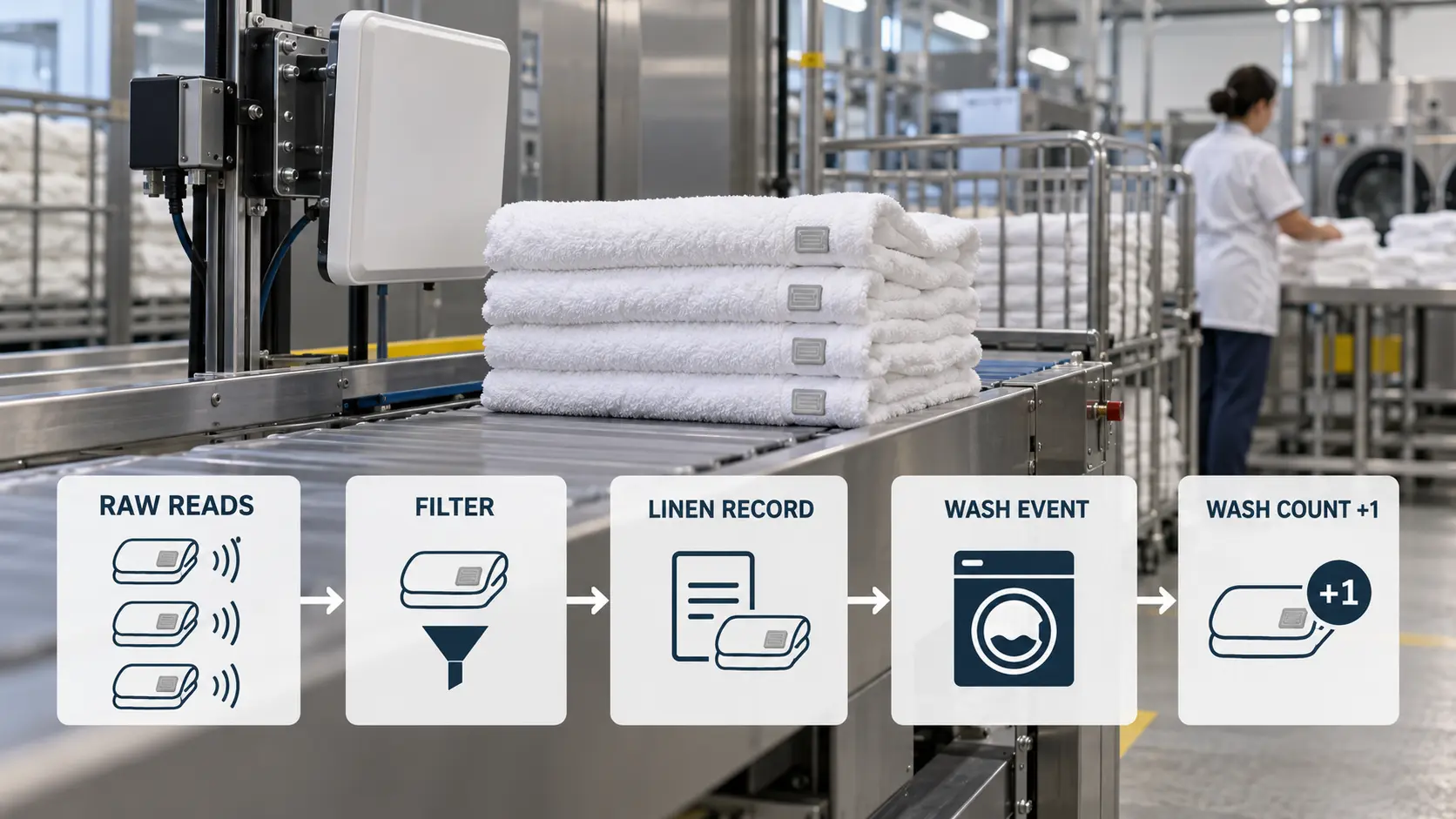
A single tagged sheet can be seen repeatedly by the same antenna or by several antennas. Therefore, "one read = one wash" is usually the wrong event model.
A better workflow is:
- Capture: the reader receives the EPC at the designated process point.
- Filter: middleware removes duplicate or out-of-zone reads according to the installation rules.
- Resolve: the EPC maps to the linen record.
- Qualify the business event: software decides whether the item has actually completed the defined laundry stage.
- Update: the backend changes status and, where appropriate, increments the wash count once.
- Audit: the event stores time, station and exception information needed by the operation.
This is the difference between RF detection and a business transaction. Syntek's RFID reader workflow guide explains the broader capture-filter-associate-trigger chain used to convert raw reads into reliable system events.
Define the Data Map Before the First Batch Is Encoded
A laundry encoding file should not contain one ambiguous column called "ID." Each identifier needs a defined owner and purpose.
A production and commissioning map may include:
| Field | Why it exists |
|---|---|
| Piece sequence | Production and packing control |
| Encoded EPC | Operational RFID identifier |
| TID | Optional tag-level traceability or verification |
| Printed serial / barcode / QR | Human- or camera-readable cross-reference where used |
| Linen record ID | Stable application record for the textile item |
| Customer / account code | Backend relationship, normally not required in the EPC itself |
| Item class | Sheet, towel, gown, uniform, mat or other controlled type |
| Tag status | Unissued, active, failed, replaced, retired or quarantined |
The supplier does not necessarily need the customer's full operational database. A cleaner handoff can keep production data separate from customer-sensitive fields, then let the laundry system bind the approved EPC to the internal linen record during commissioning.
Retagging Should Replace the Credential, Not Erase the Asset History
Laundry tags can eventually fail, detach, become unreadable or be removed when a textile is repaired. A replacement process should distinguish the linen asset from the RFID credential attached to it.
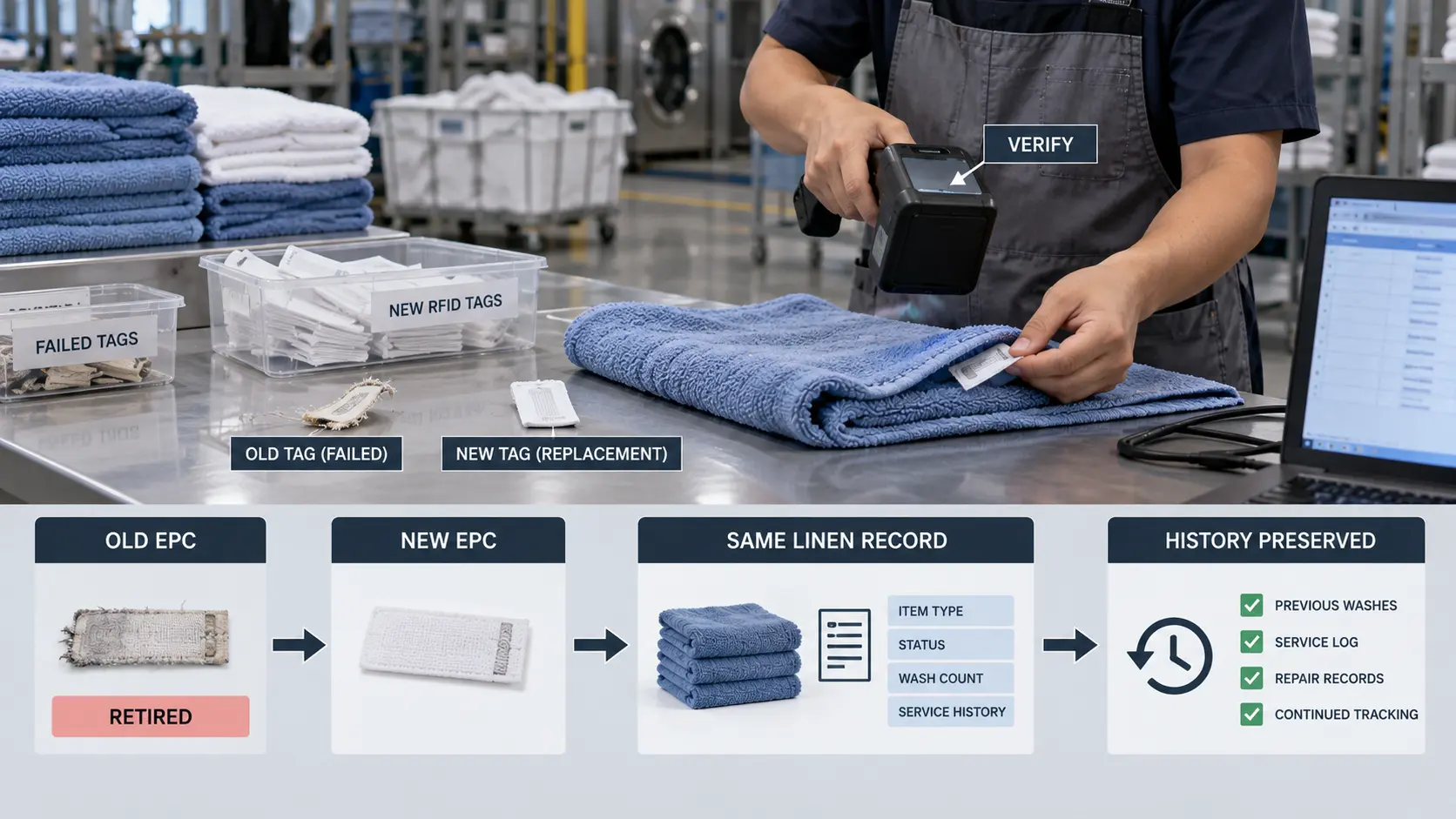
For a true retag of the same textile item, a controlled workflow can be:
- identify the existing linen record by another trusted reference;
- mark the old EPC/tag record as failed or retired;
- encode or commission a new EPC that is not already active;
- link the new EPC to the same linen record;
- preserve the previous wash and repair history;
- record the replacement date and reason;
- verify the new tag at the relevant read point;
- confirm the old EPC no longer creates active events.
If the physical textile itself is being replaced, that is different. A new sheet or uniform may deserve a new asset record rather than inheriting the retired item's history. The software rule should make that distinction explicit.
Duplicate EPCs and Orphaned Records Are Data Problems, Not RF Problems
Two tags can both read perfectly and still corrupt the laundry workflow if they were accidentally encoded with the same EPC. Likewise, a valid tag can become an orphan if its EPC was never mapped to an application record.
Batch acceptance should therefore detect at least four mapping failures:
- duplicate EPC: more than one physical tag carries an identifier that should be unique;
- missing mapping: the EPC reads but no linen record exists;
- wrong mapping: the EPC resolves to the wrong item, customer or class;
- stale mapping: a replaced or retired tag still appears active in the backend.
These failures will not be fixed by increasing reader power or changing antenna position. They require data reconciliation.
Keep Personal and Frequently Changing Data Out of the Tag Unless the Workflow Requires It
A laundry operation may know who is assigned a uniform, which customer owns a batch, which department uses an item and how many wash cycles it has accumulated. That does not mean all of those fields need to travel on the RFID tag.
Keeping mutable data in the backend has several advantages:
- assignments can change without rewriting the tag;
- access to personal or customer data can be controlled by the application;
- history can be preserved across retagging;
- the tag memory requirement stays smaller;
- data-format changes do not automatically require re-encoding the physical fleet.
On-tag application data can still be useful, but it should solve a specific offline or interoperability requirement rather than being included simply because memory is available.
Acceptance Testing Must Cover Both RF Performance and Data Integrity
A production sample is not approved merely because the reader detects it.
| Acceptance layer | Question |
|---|---|
| Encoding | Does each physical tag contain the expected EPC and any approved additional data? |
| Uniqueness | Are EPCs unique within the project's required namespace? |
| Mapping | Does each EPC resolve to the correct linen record? |
| Attachment | Does the tag still read after being sewn, heat-sealed or otherwise installed in the production-equivalent location? |
| Wash exposure | Does the tag and attachment survive the representative laundry process defined by the buyer? |
| Business event | Does the correct process event update status or wash count once, rather than once per raw read? |
| Replacement | Can a failed tag be replaced without losing the asset's historical record? |
| Retirement | Does an old EPC stop creating active events after replacement or disposal? |
For the broader hardware and environmental pilot, use Syntek's RFID system testing guide. The data checks above add the laundry-specific mapping layer that a generic read-zone test does not cover by itself.
What to Put in an RFID Laundry Data RFQ
| RFQ field | What to define |
|---|---|
| Tag technology | Frequency, protocol and approved chip family where relevant |
| EPC scheme | Length, numbering rule, uniqueness scope and who supplies the values |
| TID capture | Required or not required, and how it is used |
| User Memory | None, optional application data or mandatory field set; verify chip capacity |
| Printed cross-reference | Serial, barcode, QR or no visible variable data |
| Mapping file | Exact relationship among EPC, TID, printed data and linen record |
| Wash-count owner | Backend, on-tag or hybrid architecture |
| Event definition | Which validated process event increments wash count or changes status |
| Replacement policy | How old EPCs are retired and new tags inherit the correct asset record |
| Acceptance criteria | Encoding, uniqueness, mapping, attachment, wash exposure and business-event checks |
| Change control | Which chip, EPC, memory, mapping or attachment changes trigger revalidation |
For direct sourcing of washable RFID tags, Syntek's RFID laundry tag category is the commercial next step. The tag should be selected after the application has defined its identifier, memory and lifecycle requirements.
Reorders Need Data Change Control, Not Just "Same Tag"
A repeat purchase can look physically identical while changing the behavior of the data layer.
Revalidation should be considered when a reorder changes:
- chip model or available memory;
- EPC length or encoding rule;
- who generates the EPC list;
- TID capture requirements;
- User Memory content or format;
- printed serial, barcode or QR mapping;
- backend field names or import format;
- retagging or retirement logic;
- attachment location or textile construction where RF performance may change.
The goal is not to freeze the system forever. It is to know which changes are purely administrative and which changes can break identity, history or interoperability.
The Data Architecture Rule
For most laundry deployments, use the RFID tag as a durable identity carrier and let the backend hold the changing operational history.
A practical sequence is:
define linen record → define EPC scheme → decide whether TID/User Memory are needed → encode → verify uniqueness → map EPC to linen record → validate business events → test wash/attachment performance → define retagging → approve batch
That sequence keeps "RFID data" from becoming one ambiguous field. It also makes the system easier to maintain when a tag fails, a textile changes customer assignment, a wash event is read several times, or a future order uses a different IC with different memory capabilities.
Send Inquiry