


RFID Source Tagging For Apparel: EPC, Barcode And SKU Mapping From Factory To Store
Sep 29, 2026
Leave a message

RFID source tagging works only when the physical clothing tag, the encoded EPC, the printed barcode and the retailer or brand database all describe the same item correctly.
That sounds simple until production is split across a brand owner, garment factory, label converter, RFID encoder, distribution center and retailer. One duplicate serial number, one wrong GTIN-to-style mapping, or one label applied to the wrong size can create a tag that reads perfectly but resolves to the wrong garment.
This guide focuses on that handoff. It is for apparel brands, garment factories, RFID label buyers, converters and system integrators that need to serialize clothing at source before the goods reach a warehouse or store.
Source Tagging Is an Identity-Control Process, Not Just a Tag Application Step
In apparel, source tagging means applying and encoding the RFID identifier during manufacturing or another upstream labeling step rather than waiting until merchandise reaches a distribution center or store.
GS1 describes source tagging as encoding a Serialized Global Trade Item Number (SGTIN) into an EPC-enabled RFID tag so an individual product can be identified through multiple supply-chain touchpoints. The important word is serialized: two shirts with the same style, color and size may share the same product-class identifier, but each physical item needs its own item-level identity when the program requires serialization.
The basic chain is:
product master → GTIN / item class → serial number → SGTIN / EPC → printed label → physical garment → inventory events
Each arrow needs an owner and a validation rule.
For the broader uses of RFID across clothing management, Syntek's RFID clothing management overview covers the application layer. This page owns the narrower source-tagging and identity-mapping task.
Keep SKU, GTIN, Serial Number and EPC Separate
Apparel teams often use these terms interchangeably in spreadsheets. They should not be treated as the same field.
| Field | What it identifies | Typical owner | Key control |
|---|---|---|---|
| SKU | An internal commercial or inventory variant used by a brand or retailer | Brand / retailer | May be proprietary and is not automatically a GS1 identifier |
| GTIN | A trade item class, such as a particular style-color-size combination where assigned that way | Brand owner under GS1 rules | Must match the product master and barcode use |
| Serial number | One physical instance within the identified trade item class | Defined by the serialization owner | Must be unique within the applicable identification scheme |
| SGTIN / EPC | The serialized item identity encoded for EPC/RFID use | Generated from the approved GS1 identification and serialization rules | Must decode back to the intended product and serial |
| Printed barcode | A machine-readable visible data carrier for the product or serialized item, depending on the barcode design | Brand / retailer specification | Must not contradict the RFID identity |
A SKU may map to a GTIN, but it is not safe to assume they are numerically identical. Likewise, an EPC should not be generated by simply copying a SKU string into RFID memory.
The current GS1 EPC Tag Data Standard defines EPC encoding schemes and the memory content used on Gen2 RFID tags. If an apparel program uses GS1 identifiers, the encoding logic should follow that standard rather than a supplier-specific numbering shortcut.

Understand the Barcode-to-RFID Relationship Before Encoding
Many garments carry both a visible barcode and an EPC-enabled RFID tag. The two data carriers may operate at different levels of granularity.
A conventional retail barcode may identify the product class through a GTIN. The RFID tag can add a serial number so the system distinguishes one physical garment from every other garment with the same GTIN.
GS1's current General Specifications state that when EPC/RFID is used in addition to a barcode encoding a GTIN, the corresponding serialized GTIN EPC should be used. Where the associated barcode also carries a serial number, that serial must align with the serial used in the SGTIN EPC.
That gives a useful control rule:
the barcode and RFID tag do not always need to contain identical strings, but they must resolve to a consistent product identity and, where both carry serialization, a consistent item identity.
A mismatch can survive factory QC if the test only checks whether the barcode scans and the RFID tag reads. Both technologies can function correctly while identifying different records.
Choose Who Owns Serialization Before the Purchase Order Is Released
Duplicate EPCs are usually a process problem before they are a chip problem.
A source-tagging program should name one authority responsible for assigning or controlling serial numbers. Common models include:
- the brand owner generates the serialized EPC list and sends it to the tag or garment supplier;
- a designated service bureau generates serials within a controlled range assigned by the brand;
- an approved factory or converter generates serials under documented brand rules;
- a centralized platform issues serials through an integration or controlled production file.
The exact architecture can differ, but uncontrolled independent generation should be avoided. If two factories can create the same serial for the same GTIN without coordination, both tags may be electrically valid and still create an item-identity collision.
GS1 US publishes apparel-focused guidance for EPC-enabled RFID serialization management, including source serialization scenarios where manufacturing or labeling partners create item-level identities before delivery.
Build a Production Mapping File Before Printing Labels
The production file should make it possible to trace each physical label back to the item identity it was intended to represent.
A practical source-tagging dataset may include:
| Field | Purpose |
|---|---|
| Purchase order / production lot | Connects labels to the relevant manufacturing batch |
| Style / internal SKU | Links the label to the brand's internal product structure |
| Color / size / variant | Prevents cross-application among visually similar garments |
| GTIN | Provides the approved trade-item identity where GS1 is used |
| Serial number | Provides the item-level serialization component |
| Encoded EPC | Defines the value written to the RFID tag |
| Printed barcode value | Defines the visible machine-readable code |
| Human-readable reference | Supports operators during packing, exception handling and audit |
| Encoding / verification status | Records whether the label passed the production checks |
Not every project needs every field, but the relationship among product variant, visible data and electronic identity must be explicit.
Do Not Put the Whole Apparel Record Into EPC Memory
The RFID tag should normally carry the identifier needed to retrieve the item record, not the entire product database.
Information such as product description, season, supplier, retail price, current store, return status or stock state changes independently of the physical tag. Keeping those values in the business system avoids rewriting the RFID memory whenever operational data changes.
A clean architecture is:
EPC on garment → item identity → backend product record → current attributes and events
This also keeps the meaning of a read event clear. The reader reports an identifier; the software determines which garment that identifier represents and what business action follows.
For projects that need background on UHF RFID inventory behavior rather than source serialization, Syntek's UHF RFID inventory guide covers the read and inventory layer.
Match the Tag Format to the Source-Tagging Workflow
The data architecture does not decide whether the physical RFID carrier should be a hang tag, adhesive label or sewn care label. That decision depends on when the tag is applied and whether it must remain on the garment after sale.
| Format | Typical source-tagging fit | What to verify |
|---|---|---|
| RFID hang tag | Retail apparel where the ticket is normally removed at purchase | Artwork, barcode, EPC encoding, attachment point, packing orientation |
| RFID adhesive label | Price ticket, packaging or separate brand label | Label surface, adhesive, printer/encoder compatibility, fold position |
| RFID care / woven label | Programs that need the identifier to remain with the garment | Sewing position, comfort, durability and any wash exposure |
If a tag must survive repeated laundry, that becomes a different product-selection problem. Syntek's washable RFID tags on clothes guide owns that durability decision.
Tag Placement Must Be Tested in Every Real Garment State
A source-tagged garment may be read while hanging, folded, stacked, packed in a carton, received at a dock, counted with a handheld or processed at checkout. The same label can behave differently across those states.
Do not approve placement from a single tag lying flat on an empty table.
A useful pilot includes:
- garments hanging at normal rack density;
- folded items stacked in the expected shelf configuration;
- carton-packed merchandise using the actual packing quantity;
- garments with metallic zippers, snaps, foil decoration or other RF-sensitive materials;
- the actual handheld or fixed reader configuration;
- the attachment position used by production workers.
Placement consistency matters because the factory will repeat the approved position thousands of times. A small variation that looks harmless during sewing or ticketing can change antenna orientation inside a dense carton or rack.
Factory Encoding QC Needs More Than a "Tag Reads" Check
An apparel source-tagging line can produce several different failure types:
| Failure | Why a basic read test may miss it |
|---|---|
| Duplicate EPC | Both tags respond normally but represent the same serialized identity |
| Wrong EPC for garment variant | The RFID value is valid but was applied to the wrong style, color or size |
| Barcode/EPC mismatch | Both data carriers are readable but resolve to inconsistent identities |
| Print/EPC mismatch | The label looks correct but the electronic value belongs to another item |
| Encoding failure | The tag may still respond with its factory state even though the required EPC was not written correctly |
| Physical placement error | The data is correct but the final garment performs poorly in the intended read zone |
The QC system therefore needs to validate data correctness, uniqueness, physical association and RF function as separate checks.
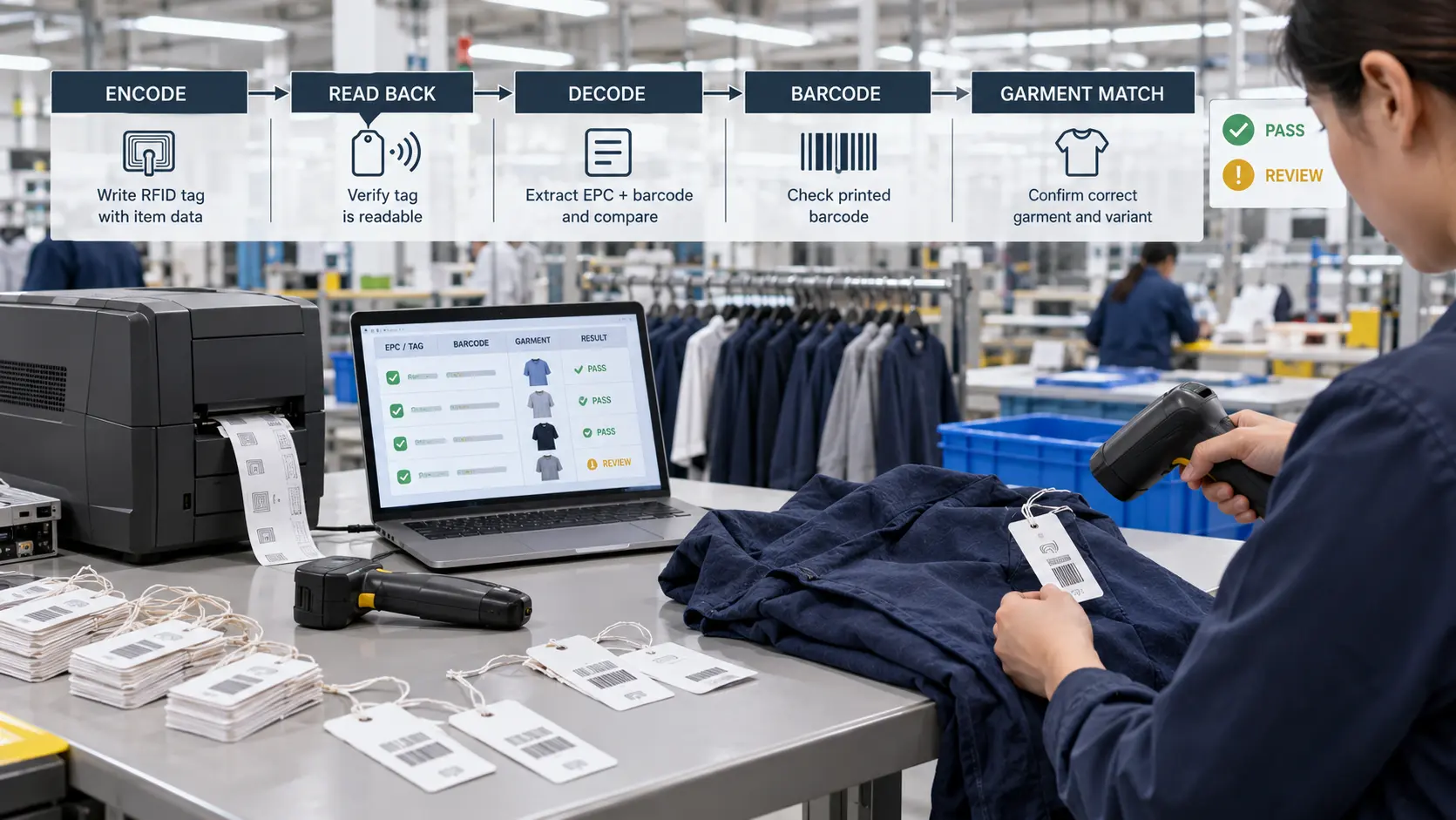
Use Decode-and-Compare Verification, Not Visual Assumptions
After encoding, the production process should read the EPC back and compare the decoded identity with the approved source record.
For GS1-based SGTIN programs, a robust logic is:
- read the tag after encoding;
- decode the EPC using the approved GS1 scheme;
- confirm the GTIN component matches the intended garment variant;
- confirm the serial number matches the source serialization record;
- scan the printed barcode;
- check that the barcode-to-RFID relationship follows the program specification;
- confirm the physical garment or ticket matches the expected style/color/size;
- record pass, rework or reject status.
The latest GS1 EPC Tag Data Standard is the authority for the EPC encoding itself. Production systems should not rely on a manually maintained spreadsheet formula if the same transformation can be validated against the applicable standard.
Control Reprints and Re-Encoding as Identity Events
Apparel production inevitably generates damaged labels, printer jams, rework and retagging. Those exceptions need a serialization rule.
The safest principle is that a reprint should not silently create a second active physical label carrying the same item identity.
Before reissuing a label, define:
- whether the original label was destroyed, quarantined or remains physically available;
- whether the same EPC may be reprinted under the retailer or brand program;
- whether a new serial must be generated instead;
- how the old EPC is marked in the production record;
- how the reprint is linked to the same purchase order and garment;
- who can authorize the exception.
The right choice depends on the trading-partner rules and backend design. What matters is preventing an exception station from becoming an uncontrolled duplicate-EPC generator.
Validate the Carton Before the Factory Ships
Source tagging is successful only when the right identifiers are attached to the right goods at shipment.
A production-equivalent outbound test can combine three layers:
- item check: sample or verify garment-to-label identity;
- carton check: read the packed carton under the intended RFID process and compare the observed EPC population with the packing record;
- data check: confirm the shipment, ASN or downstream file uses the identifiers expected by the trading partner where that data exchange is part of the program.
The exact retailer compliance process varies, so do not invent a universal read-rate or carton pass threshold. Use the buyer's published specification, approved inlay requirement, encoding rule and acceptance method.

Retailer Requirements Override Generic Tag Recommendations
Some apparel brands source tags for their own closed-loop inventory system. Others tag because a retail customer requires a specific EPC scheme, inlay qualification, label format or placement.
Those are different procurement situations.
If a retailer or trading partner supplies an RFID specification, treat it as a controlled input. Do not substitute a different chip or inlay because it has the same nominal frequency. Frequency match alone does not establish compliance with a retailer program.
The factory or tag supplier should verify the exact requirements that apply to:
- RFID air interface and IC/inlay qualification;
- EPC encoding scheme;
- serialization ownership;
- barcode content and format;
- visual label artwork;
- tag placement;
- packing and read validation;
- data files or shipment records;
- reprint and exception handling.
Consumer Privacy Is Part of Apparel RFID Deployment
RFID source tagging can continue to matter after the garment reaches a shopper, especially when the RFID element remains attached to the item.
GS1's Guidelines on the Use of EPC/RFID for Consumer Products address consumer notice, consumer choice, education and responsible handling of data associated with RFID deployments. The guidance also specifically discusses RFID integrated into fabric labels.
The RFID tag itself should not be treated as a place to store purchaser identity or other unnecessary personal information. If a business later links an EPC to customer information, that relationship belongs in the controlled information system and must follow applicable privacy requirements.
What to Put in an Apparel RFID Source-Tagging RFQ
| RFQ field | What to provide |
|---|---|
| Trading-partner program | Brand-owned closed loop or named retailer specification |
| Garment categories | Shirts, denim, underwear, outerwear, footwear or other defined product groups |
| Tag format | Hang tag, adhesive label, woven/care label or another approved construction |
| Inlay / IC requirement | Exact approved requirement where the buyer or system specifies it |
| GTIN / item master | Approved product-class data and variant mapping |
| Serialization owner | Who generates and controls unique serial numbers |
| EPC scheme | Approved GS1 EPC encoding or other customer-defined format |
| Barcode requirement | Symbology, data content and relationship to RFID identity |
| Visible data | Style, size, price, serial, text or other approved printed fields |
| Placement | Exact garment or ticket location and application method |
| Verification | EPC readback, decode/compare, barcode match, duplicate check and physical association |
| Exception process | Reprint, failed encoding, wrong-label and duplicate-handling rules |
| Packing validation | Required carton or shipment-level RFID acceptance method |
| Change control | Which IC, inlay, artwork, EPC, barcode or placement changes require reapproval |
For direct sourcing of passive RFID tags and customized label constructions, Syntek's RFID tag category is the commercial next step. The final tag should be selected only after the data and trading-partner requirements above are clear.
The Source-Tagging Control Sequence
A practical apparel RFID rollout follows this order:
trading-partner requirement → product master → GTIN/SKU mapping → serialization owner → EPC generation → barcode/print rule → tag format and placement → encode → decode and compare → apply to garment → carton validation → shipment
The important idea is that RFID source tagging is not completed when the encoder says "write successful." It is completed when the electronic identity, printed identity and physical garment remain aligned from the factory to the next business system.
Send Inquiry