


Replacing EM4100 With EM4200 Cards: Compatibility Checklist For 125 KHz Access Systems
Sep 30, 2026
Leave a message

EM Microelectronic designed the EM4200 as a direct replacement for its older EM4100/4102 and EM4005/4105 read-only transponder ICs at the communication-protocol level. That makes EM4200 a logical candidate when a legacy 125 kHz access system needs replacement cards.
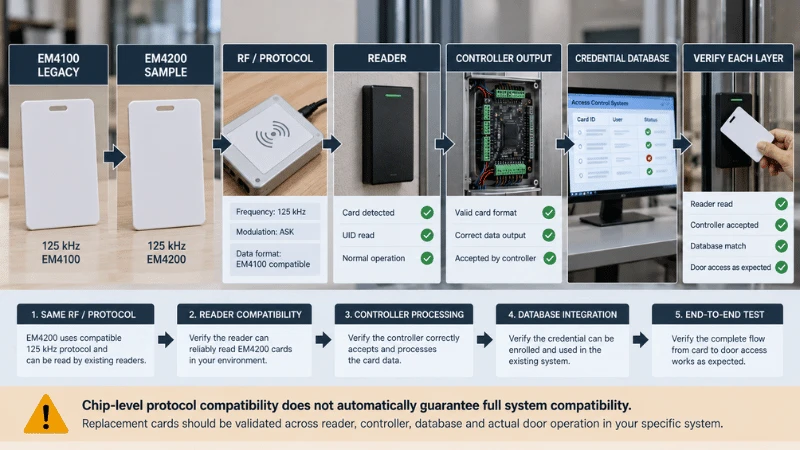
It does not mean every finished EM4200 card will automatically behave exactly like every old EM4100 credential in every installed access-control system. The chip, modulation option, reader decoding, reader-to-controller output and database representation all have to line up.
This guide is for facility managers, access-control integrators and procurement teams replacing legacy 125 kHz cards without changing the entire reader infrastructure.
Start With the Meaning of "Compatible"
Compatibility has several layers.
| Layer | Question |
|---|---|
| RF frequency | Does the reader operate in the LF range used by the credential? |
| Tag communication | Can the reader decode the EM4100/EM4200 communication format and selected encoding? |
| Identifier presentation | Does the reader extract and present the card number in the expected way? |
| Reader-to-controller output | Does the controller receive the expected bit length or interface format? |
| Access database | Does the new credential map to the correct user and site/facility logic? |
| Physical card | Does the finished card fit the printer, badge holder and user workflow? |
A frequency match is only the first gate. Two credentials can both be sold as "125 kHz" and still fail at a later layer.
Syntek's proximity credential compatibility guide explains this system-level principle in more detail.
What EM Microelectronic Actually Says About EM4200
EM Microelectronic describes the EM4200 as a low-frequency, read-only contactless identification IC intended to directly replace EM4100/4102 and EM4005/4105. Its current product documentation states that EM4200 is fully compatible with those communication protocols.
The same official documentation lists:
- a 100 to 150 kHz operating frequency range;
- laser-programmed read-only ROM;
- 64-, 96- or 128-bit ROM options;
- Manchester, Biphase, PSK and FSK encoding options;
- multiple data-rate options;
- different integrated resonant-capacitor options.
The authoritative reference is the EM4200 product page and its linked data sheet.
The phrase "direct replacement" therefore has a strong chip-level basis. The system still needs to verify which EM4200 configuration the finished card uses and which format the installed reader expects.
EM4200 Is a Replacement Path, Not a Security Upgrade
EM4200 is a read-only identification device. Its factory-programmed code is transmitted when the chip is energized by the reader field.
If the existing EM4100 system uses a fixed identifier as the credential, replacing the card with EM4200 can preserve that basic operating model. It does not add mutual authentication, encrypted credential exchange or application keys.
That distinction matters for upgrade planning. A project can have two different objectives:
- continuity project: keep a working legacy 125 kHz system running with compatible replacement credentials;
- security migration: move to a credential architecture with cryptographic authentication and different reader support.
EM4200 may fit the first objective. It should not be described as solving the second.
For the broader security and card-technology comparison, Syntek's EM card access-control guide owns that task.
Inventory the Installed Reader Population Before Ordering Cards
A site may have more reader variation than its card inventory suggests.
Before selecting a replacement credential, record:
- reader manufacturer and model;
- door or location;
- supported LF credential families if documented;
- reader firmware or configuration where available;
- reader-to-controller interface;
- the number shown in the access-control software when a known working card is presented;
- any site code, facility code, card-number range or bit-format rules used by the controller.
If several reader models are installed, every material reader family belongs in the sample test. A replacement that works at the front entrance but fails on an older parking reader is not a compatible site-wide replacement.
Use a Known Working Legacy Card as the Reference
Catalog names are often less reliable than a working credential from the actual site.
Choose one or more authorized existing cards and capture:
- the chip or credential technology if known;
- the number printed on the card;
- the identifier or credential number displayed by reader software;
- the controller's interpreted card number;
- the door readers on which the card works;
- the physical card dimensions and any printing requirements.
The replacement sample should then be compared against this baseline at the system level.
Do Not Assume the Printed Number Equals the Raw Chip Code
Legacy proximity systems frequently display the same underlying credential in different numeric forms.
A reader may output only a portion of the data it receives, rearrange bytes, represent a value in decimal rather than hexadecimal, or send a controller-specific credential format. The visible number printed on a card may be generated from a business rule rather than being a direct transcription of every raw bit in the chip.
For replacement projects, the relevant question is:
what credential value must the installed controller and access database receive?
Do not write a purchase order that says only "EM4200, 125 kHz, same number as old card" unless the numbering transformation has actually been defined.
Check the EM4200 Encoding and Data-Rate Option
The official EM4200 documentation supports several data encodings and data-rate options. That flexibility is useful for replacing older EM families, but it also means the words "EM4200 card" do not fully describe the RF data profile.
A procurement specification should identify the configuration expected by the legacy reader or require the supplier to match an approved working sample.
| Parameter | Why it matters |
|---|---|
| Frequency range | Confirms the reader and credential operate in the same LF band |
| Data encoding | Reader must decode the selected Manchester, Biphase, PSK or FSK mode |
| Data rate | Legacy reader decoding may expect a particular timing profile |
| Code length / ROM option | Reader and controller may only use or expose a defined portion of the available code |
| Coil / resonant design | Finished-card antenna design influences coupling and practical read behavior |
Finished-Card RF Performance Still Needs a Sample Test
EM Microelectronic notes that EM4200 was designed for improved read-range performance compared with the older EM4100/4102 family. That is a chip-level design statement, not a guaranteed distance for every finished PVC card.
Practical read behavior depends on the card antenna/coil, tuning, reader field, orientation and finished construction.
Test the final card with the real readers at normal user presentation positions. Avoid approving a replacement from a supplier's single generic centimeter figure.
Verify Reader-to-Controller Output, Not Just Reader Beeps
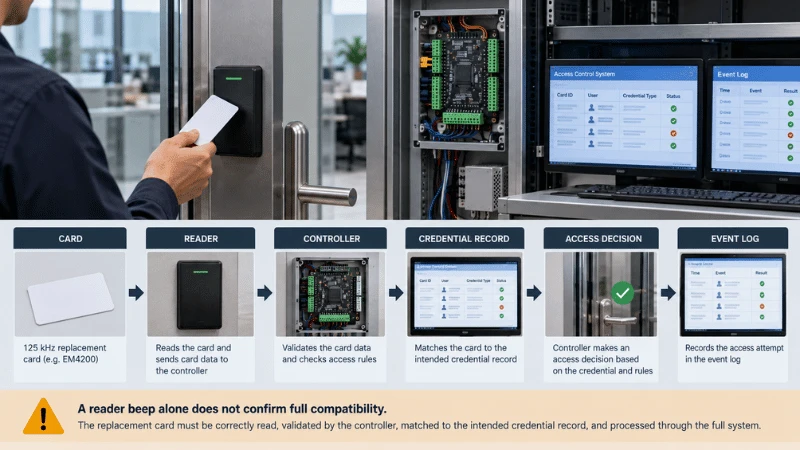
A reader beep proves only that the reader detected something it recognizes. It does not prove that the controller received the value expected by the access database.
For each sample card:
- present the card to the installed reader;
- capture the identifier or output at the reader/controller boundary if the system allows it;
- confirm the access-control software displays the intended credential number;
- enroll the card under a test user;
- verify the correct door decision;
- repeat on representative reader models;
- confirm event logs show the same intended identity.
The full test is:
card → reader → controller → credential record → access decision → event log
Check Facility-Code and Card-Number Rules Where the System Uses Them
Many installed access systems do not treat a credential as one unconstrained number. They may split a controller output into site/facility and card-number fields or use another fixed bit-format convention.
The RFID chip does not automatically know the building's access-control numbering policy. That policy lives in the reader/controller/database chain.
Before a bulk replacement, verify:
- the valid facility or site-code range;
- the valid card-number range;
- whether duplicate credential numbers already exist;
- how the reader converts the EM identifier into the controller format;
- whether newly issued cards must continue an existing number sequence;
- whether visible card numbering must match the software representation.
Separate Card Replacement From Card Cloning
A factory-programmed read-only EM4200 credential is not the same product class as a rewritable LF transponder used to emulate another credential number.
When a facility orders replacement credentials, the safer administrative model is normally to issue new approved identifiers and enroll them in the access database, unless the installed system and authorized migration plan explicitly requires another method.
This distinction also helps procurement avoid ambiguous requests such as "copy our old EM4100 cards." The RF technology, business requirement and authorization process should be stated separately.
Use a Mixed-Reader Test Matrix for Older Buildings
Legacy sites often accumulated hardware over many years. Build a compatibility matrix rather than relying on one entrance reader.
| Test point | Legacy card | EM4200 sample | Result to compare |
|---|---|---|---|
| Main entrance reader | Known working | Test | Detection + correct credential output |
| Parking reader | Known working | Test | Normal user presentation and event log |
| Older interior reader | Known working | Test | Compatibility with oldest retained hardware |
| Time-attendance terminal | Known working | Test | Correct employee mapping if same credential is reused |
| Enrollment station | Known working | Test | Card number shown and database assignment |
The actual rows should match the site's hardware population.

Define Duplicate Control Before Bulk Issuance
Read-only credentials depend on correct unique-code handling.
Before issuing a batch:
- define which identifier representation is checked for duplicates;
- compare the supplied card list with the active access database;
- confirm printed numbers map to the intended electronic credentials;
- quarantine cards whose numbers cannot be reconciled;
- retain an issuance record linking physical card, user and active credential number.
A valid RF response is not enough if two physical credentials resolve to the same access identity.
What to Put in an EM4100-to-EM4200 Replacement RFQ
| RFQ field | What to specify |
|---|---|
| Legacy credential | Known EM4100/4102 or approved working sample |
| Replacement IC | EM4200 configuration required for the installed reader profile |
| Frequency / communication | LF system and required legacy communication behavior |
| Encoding / data-rate option | Match approved reader requirement or approved reference sample |
| Code-length expectation | How the reader/controller uses the credential code |
| Visible numbering | Printed card number and its mapping to system credential value |
| Card construction | PVC/PET or other approved material, dimensions and printing needs |
| Reader matrix | Representative installed reader models for sample validation |
| Controller output | Required bit format / interface behavior where applicable |
| Sample approval | Door, parking, attendance and enrollment tests as relevant |
| Duplicate check | How supplied identifiers are checked before issuance |
| Change control | Which chip, coil, card construction or code-format changes require reapproval |
For direct sourcing, Syntek's EM4200 blank-card product page is the appropriate commercial owner. The technical replacement decision should be settled before artwork or bulk quantity becomes the main discussion.
Know When to Stop Preserving the Legacy System
Replacing EM4100 with EM4200 can be sensible when the business objective is to maintain an authorized legacy 125 kHz installation with minimal infrastructure change.
If the real objective is stronger credential security, mobile credentials, mutual authentication or a modern access-control architecture, a like-for-like LF replacement may only postpone the required reader migration.
In that situation, compare the installed reader/controller constraints with a phased smart-card migration rather than treating a newer LF chip as a security modernization.
The Replacement Decision Sequence
A practical sequence is:
known working legacy card → reader inventory → credential output → controller/database format → EM4200 sample configuration → mixed-reader test → duplicate check → user enrollment → event-log verification → bulk approval
EM Microelectronic's protocol-compatibility statement makes EM4200 a strong technical replacement candidate for EM4100/4102. The deployment decision is complete only after the finished card reproduces the expected identity through the actual reader, controller and access database.
Send Inquiry