


RFID Race Timing Tags: How To Choose Bib Tags And Test Them Before Race Day
Sep 14, 2026
Leave a message

An RFID race timing tag should not be approved because a supplier says it is "long range" or because it can be detected on a desk. For marathon and road-race timing, the real system is the complete chain from the runner's bib to the tag, antenna/read zone, reader, timestamp, athlete mapping and scoring software. A weak link anywhere in that chain can turn a successful RFID read into a missing or incorrect race result.
For most disposable bib-timing applications, passive UHF RFID is the technology class to evaluate. But the tag must still be validated on the finished bib, on representative runners, with the actual timing hardware and software, at realistic speed and traffic density. This guide focuses on that selection and acceptance process.
Start With the Timing Chain, Not the Tag Chip
The correct starting question is not "Which UHF chip should we buy?" It is "What must happen when a runner crosses a timing point?"
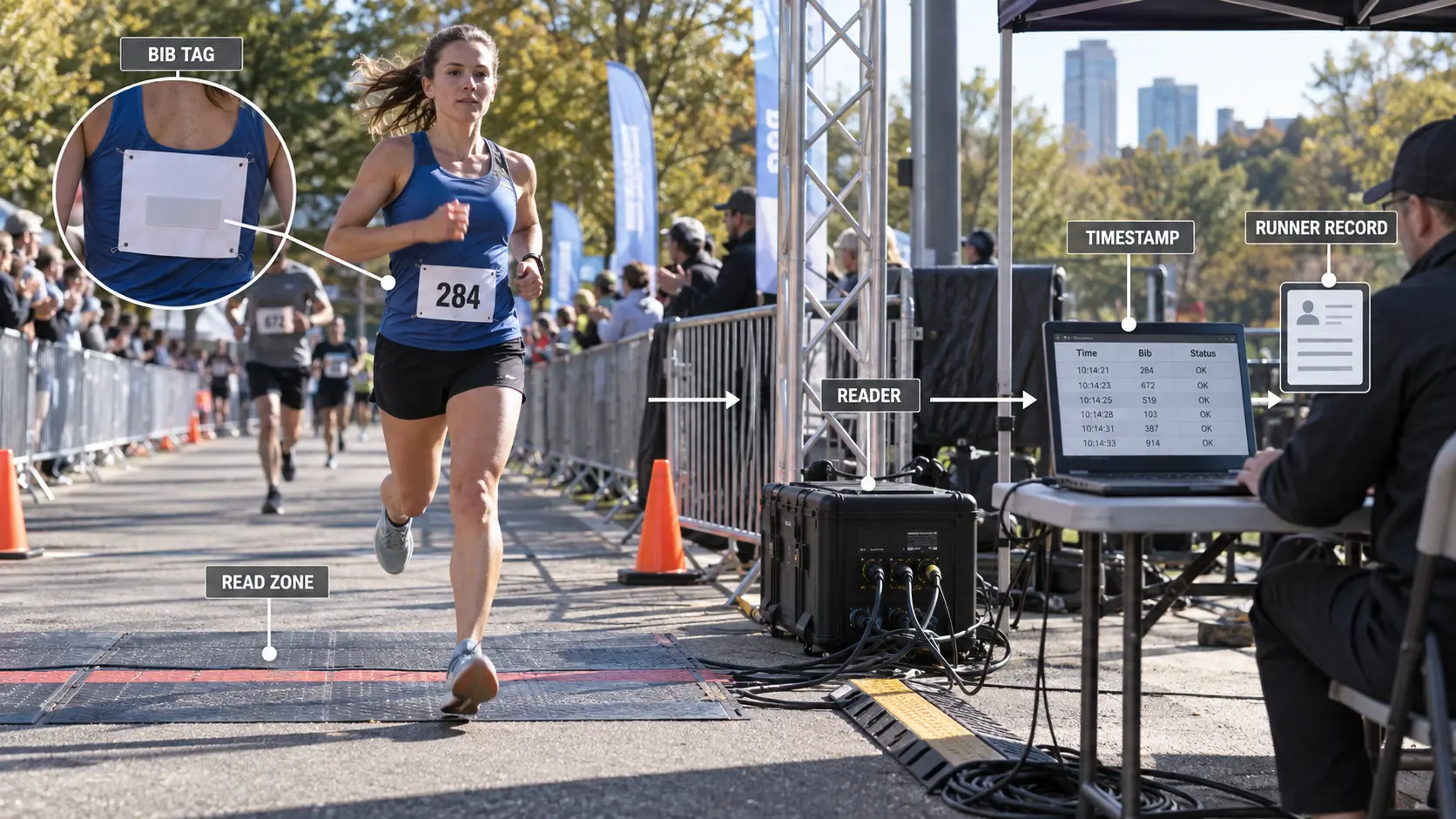
A practical race-timing chain looks like this:
- A runner wears a specific bib.
- The bib carries one or more RFID timing tags in a controlled position.
- The runner crosses a defined read zone at the start, finish or an intermediate checkpoint.
- The antenna and reader inventory the tag while the runner is inside that zone.
- The timing system records a tag identifier and a timestamp.
- Software maps that identifier to the correct athlete or bib number.
- Race logic selects or reconciles the reads needed to calculate the official split or finish result.
That is why "the tag was read" is not the same as "the timing transaction succeeded." A valid acceptance test must confirm the physical read, the correct identifier, the timestamp, the athlete mapping and the final result workflow.
Readers who need the underlying RF communication model can review Syntek's guide to how RFID tags communicate with readers. This article stays focused on race-timing deployment rather than repeating the full protocol sequence.
Use UHF Gen2 as the Air-Interface Baseline, Not as a Performance Guarantee
Passive UHF race timing commonly uses the GS1 EPC UHF Gen2 air interface, standardized in the ISO/IEC 18000-63 family. GS1 describes Gen2 as the physical and logical air interface between passive UHF tags and interrogators; the current GS1 standard is maintained as the EPC UHF Gen2 Air Interface Standard.
Older supplier sheets may still use "ISO 18000-6C," "EPC Class 1 Gen 2" or similar wording. Treat that wording as the beginning of the compatibility discussion, not the end. The timing system still has to match the intended regional UHF band, reader configuration, tag construction, antenna arrangement and software workflow.
A standards-compatible tag can communicate with a standards-compatible reader and still perform poorly in the actual race setup. Air-interface compatibility does not define how well a particular inlay behaves against a runner's body, how the read zone is shaped, how many useful reads are captured during a crossing, or whether the correct athlete record receives the timestamp.
Choose the Bib Construction Around the Runner, Not Around a Free-Air Read Test
A race bib is not a neutral RF test fixture. The tag sits close to a moving human body, may flex with clothing, and can be partially covered by a jacket, hydration belt or the runner's arms. Those conditions can change tag behavior compared with a loose inlay measured away from the body.
Evaluate the finished bib assembly, not only the IC or inlay name. Important variables include:
- the inlay or antenna geometry;
- the tag's position on the bib;
- the distance between the antenna and the runner's body;
- any foam, spacer, label stock, adhesive or laminate in the final construction;
- bib size and stiffness;
- the direction in which the bib naturally curves while worn;
- runner clothing and common race accessories;
- the antenna/read-zone geometry used by the timing system.
If the approved design includes a foam or other spacing layer, that layer is part of the RF construction and should not be removed during the race. Likewise, pins or clips should stay outside the actual RFID antenna area. The safe pinning zone should be defined from the finished tag layout rather than assumed from the outer rectangle of the bib.
Participant instructions should therefore be operational, not decorative: wear the bib in the approved location, keep the timing area unfolded, do not pierce the tag, and do not cover it with equipment. Major running events using bib timing commonly issue similar handling instructions because the runner's wearing condition is part of the system.

Do Not Use a Supplier Read-Distance Number as the Acceptance Criterion
There is no single useful "read distance" for a marathon bib tag without a test condition. The result depends on the reader, antenna, transmit power, regulatory settings, orientation, runner position, tag construction, body proximity, surrounding materials and read-zone design.
For race timing, the better question is: Does the finished bib produce the required identification event inside the intended timing zone while avoiding reads outside the zone that could confuse event logic?
That shifts acceptance from a static distance number to a functional read-zone test. A timing point may use floor antennas, side antennas, overhead antennas or a combination. The geometry should be evaluated as a system because a tag that performs well over a mat may behave differently in a side-read configuration.
If the project also includes reader procurement, the current Syntek UHF RFID reader category is a commercial starting point. The final reader/antenna choice still requires project-specific validation; a category specification should not be treated as proof of race-day performance.
Control the Mapping Between Bib Number, RFID Identifier and Athlete Record
RFID timing depends on identity integrity as much as RF performance. Each physical bib must be associated with the intended athlete record, and that relationship must survive printing, encoding, packing, registration changes and race-day distribution.
A useful control table looks like this:
| Physical item | RFID/data field | System record | What must be verified |
|---|---|---|---|
| Race bib | Visible bib number | Athlete registration record | The visible number belongs to the correct participant |
| RFID tag | EPC or system-used tag identifier | Timing-system identifier | The encoded/read value matches the assignment file |
| RFID chip | TID, if the project uses it | Optional production/QC reference | TID is recorded only if the timing workflow actually needs it |
| Timing point | Reader event + timestamp | Split/finish result | The correct athlete receives the correct timing event |
The mapping architecture does not have to use the same identifier in every layer. A closed timing platform may use an internal tag ID that is mapped to a bib number and athlete database record. The important requirement is controlled uniqueness and traceable association.
Uncontrolled numbering can also create unwanted tag reads from unrelated UHF-tagged objects in the environment. Impinj's discussion of standards-based RAIN RFID numbering uses marathon timing as an example of why identifier strategy and reader filtering matter. A race does not automatically need a particular global numbering scheme, but it does need a deliberate one.
Approve the Read Zone, Not Just the Tag
The timing zone is where antenna geometry, reader settings, runner movement and software logic meet. It should be designed so the system has enough opportunity to identify each intended bib while controlling reads from outside the actual timing point.
During setup, record the conditions that materially affect the test:
- antenna type and position;
- reader and antenna-port configuration;
- target regulatory region and reader settings;
- lane or chute width;
- runner direction and likely path through the zone;
- bib height and body orientation;
- nearby barriers, metal structures, vehicles or tagged inventory;
- reader filtering and timing-software event logic;
- network and power conditions at the timing point.
Do not tune the system only for a stationary person standing in the center of the antenna field. A race is a dynamic event. Runners may cross on different paths, at different speeds and in groups.
Run Dynamic Acceptance Tests Before Race Day
A production-equivalent sample should be tested through the intended timing setup before the bulk deployment is accepted. The goal is not to create a laboratory-perfect scenario; it is to exercise the conditions that the event will actually encounter.
| Test dimension | What to vary | What to verify |
|---|---|---|
| Bib placement | Approved chest/torso position and normal bib curvature | Tag is identified in the intended read zone |
| Runner profile | Representative body sizes and clothing | Performance is not dependent on one test person |
| Movement | Walking, jogging and representative race pace | Valid timing events are created during motion |
| Lane position | Center and practical edge paths | Coverage matches the usable timing corridor |
| Group density | Multiple runners crossing together | All assigned identifiers are captured and mapped correctly |
| Bib condition | Normal flexing and race-wear condition | No dependence on an unrealistically flat presentation |
| Software path | Reader event through scoring/timing application | Correct athlete, timestamp and timing point are recorded |
The acceptance threshold should be defined by the timing-system owner based on event risk, race format and scoring requirements. It should not be invented from a generic tag datasheet. For a critical finish line, teams may also use redundant timing infrastructure, backup timing methods or multiple read opportunities, but those decisions belong to the complete timing-system design.

Use Production-Equivalent Samples and Lock the Approved Build
A prototype that uses a different inlay, spacer, adhesive, label stock or encoding rule is not a valid proxy for the production bib. Once the project passes testing, retain a controlled reference for the approved construction.
At minimum, the sample-approval record should identify:
- bib artwork revision;
- tag/inlay or approved equivalent definition;
- chip family only where it is actually part of the requirement;
- spacer or layer stack-up;
- tag position and orientation;
- encoding rule and data-file revision;
- visible bib-number mapping;
- packing/sorting method for unique units;
- reader/antenna configuration used for acceptance;
- software or timing-system version where changes could affect the workflow.
If a later production run changes the inlay, chip, antenna geometry, spacer, bib stock, adhesive, encoded data structure or reader configuration, revalidate the layer affected by the change instead of assuming the old approval still applies.
Separate Tag QC From End-to-End Timing Acceptance
Supplier-side RFID inspection and race-system acceptance solve different problems.
Tag QC may confirm that a label is present, visually correct, readable and encoded according to the agreed data file. End-to-end acceptance must go further: the tag must work on the finished bib, on a runner, through the race reader/antenna zone, into the timing application, with the correct athlete mapping.
This distinction matters for procurement. A batch can pass electrical or encoding inspection and still fail the event if bib placement, mapping, timing-zone geometry or software integration is wrong.
For general UHF labels and customized tag sourcing, Syntek's RFID tag category is the appropriate commercial anchor. Race-specific performance should still be approved with production-equivalent samples in the intended timing system.
Troubleshoot Missed or Wrong Times by Layer
When a runner has a missing or incorrect result, avoid starting with "the chip is bad." Diagnose the chain in order.
- Physical bib layer: Was the correct bib worn? Was the timing area folded, covered, damaged or pinned through?
- RF layer: Did the reader see the tag in the timing zone? Were antenna geometry, power, cabling and local conditions unchanged?
- Identifier layer: What EPC or other identifier was actually read? Is it unique and does it match the assignment file?
- Timing-event layer: Did the reader or middleware create the expected event and timestamp?
- Athlete-mapping layer: Did that identifier map to the correct runner and bib number?
- Scoring layer: Did event rules select the correct crossing and calculate the intended split or finish time?
This layered method separates an RF failure from a database or scoring failure. Replacing tags will not fix a mapping error, and changing software will not fix a bib that is being worn outside the validated read condition.
What to Put in the RFQ and Sample-Approval Brief
| RFQ field | What the buyer should define |
|---|---|
| Event use | Marathon, road race, triathlon, school race or other timing workflow |
| Timing system | Reader/antenna platform and integration owner |
| RFID technology | Required passive UHF air interface and target regulatory region |
| Bib construction | Final bib stock, tag location, spacer/layer requirements and attachment method |
| Encoding | Identifier format, uniqueness rule, source data file and write/lock requirements if applicable |
| Variable print | Bib number, barcode/QR if used, and mapping relationship |
| Data handoff | Required file format and fields for registration/timing software |
| Sample test | Production-equivalent bibs tested on representative runners in the intended timing zone |
| Acceptance | Event-defined criteria for correct reads, mappings and timing events |
| Change control | Which inlay, material, encoding, print or construction changes require reapproval |
The Selection Rule
Choose a race timing tag as part of a timing system, not as an isolated label. Start with the race platform and read-zone architecture, then define the finished bib construction, body-worn condition, identifier mapping and production data flow. Only after those requirements are clear should you compare inlays, chips, spacers and manufacturing options.
The final approval should answer one practical question: Can this production-equivalent bib, worn as instructed, create the correct athlete timing event through the actual race system under realistic movement and crowd conditions?
If the answer is proven by a controlled pre-race test, the project has moved beyond a tag specification and into a validated timing workflow. That is the standard procurement teams and timing integrators should use before releasing bulk production.
Send Inquiry