

Can RFID Track Animals? Using Ear Tags For Everyday Livestock Checks
Nov 23, 2026
Leave a message

Yes. Ordinary RFID animal ear tags can help farmers track individual livestock by identifying them during a scan and linking that identification to a dated farm record. A cow can be identified during weighing, a ewe during a routine inspection, or an animal when it is moved to another pen. These records are useful even on a farm that uses a notebook or spreadsheet rather than specialized livestock software.
However, a passive RFID ear tag cannot independently report the position of an animal in a distant field. Knowing which animal was last checked and knowing where it is right now are different tasks. For ordinary farm work, the important decision is whether a visual tag is sufficient or whether repeated electronic identification would make the work easier. Neither requires a location-tracking platform.
What kind of animal tracking can ordinary RFID provide?
For livestock identification, tracking usually means building a history around an individual animal. A farmer can look up an animal's previous weighing results, find out whether it has been inspected, or confirm its recorded pen assignment. The electronic identifier makes it easier to associate those records with the correct animal.
There are three useful distinctions to make before buying equipment.
| Tracking requirement | What is needed | What the farmer learns |
|---|---|---|
| Recognize an individual animal | Readable visual tag, or electronic tag and compatible reader | Which animal is present at the check |
| Review earlier activity or movement | Identification plus dated records of actual activities or locations | Where or when an animal was previously observed |
| Find an animal's current position remotely | Separate location-tracking equipment appropriate to the coverage area | Location information when that equipment can obtain and deliver it |
If the problem is identifying similar-looking cattle during routine handling, a standard electronic ear tag may be suitable. If the problem is finding a missing animal somewhere on open grazing land, ordinary RFID is not a remote search tool. A missing scan is not evidence that an animal has escaped, and an old scan does not establish that it is still in the same place.
How passive RFID animal tracking works
A conventional plastic ear tag identifies the animal through visible markings. A passive electronic ear tag adds a transponder containing a chip and an antenna. A compatible reader energizes that transponder when the tag is within a usable reading position. The reader then receives its electronic identification data. The Journal of Animal Science's review of livestock monitoring explains this reader-powered operation.
For a normal handheld scanning task, the worker approaches an animal that is already being handled safely, brings the reader toward the electronic tag and checks the returned number. There is no need for the ear tag itself to maintain a battery charge or a network connection. The reader still needs power, and its ability to store or export results depends on the model.
Many livestock identification devices use low-frequency animal RFID. FDX-B and HDX are examples of different communication formats found in this area. A matching frequency alone does not establish compatibility. A buyer should check the exact tag format, reader support and displayed number, particularly when adding tags to a farm that already owns scanning equipment. For a more detailed frequency comparison, see our LF and UHF animal ear tag guide.
Internet access is a separate question. A reader with local storage can collect identifiers offline, while a display-only reader may require the operator to record each number immediately. The DAERA electronic cattle identification FAQ discusses offline reading, local storage and model-dependent transfer options. For a small farm, the most useful device may simply be one that reliably reads the tags already in use and presents the number in a form that staff can record.
What information does the tag actually provide?
The electronic identifier is the starting point for the animal's record. Standard identification tags should not be treated as miniature health monitors or as complete databases of an animal's history. Some transponders have additional memory, but a routine identification workflow does not depend on storing changing farm information inside the chip.
| Information | Where it comes from |
|---|---|
| Electronic tag number | Compatible reader decoding the transponder |
| Visible farm number | Printed or marked ear tag, associated with the electronic ID if used |
| Date and location of a check | Operator's record or configured reader record with location context |
| Body weight | Scale measurement associated with the correct animal |
| Health observations or treatments | Farm or veterinary records |
| Current remote geographic position | Separate location equipment, not an ordinary passive ID tag |
This distinction is particularly important when an animal receives treatment. Scanning confirms an identifier; it does not confirm that a treatment was administered. The worker must record the actual action. Similarly, an animal's weight should be entered against the correct individual after the weighing result has been obtained. If staff enter the previous animal's number by mistake, an otherwise successful scan cannot correct that error.
Using RFID ear tags during everyday farm work
Preparing for a group check
Before bringing animals through the handling area, decide which animals are expected and what the check is intended to establish. Prepare a list with one row for each animal, a place to record the result and a separate space for exceptions. Charge the reader, test it against a known working electronic tag and make sure the displayed number agrees with the register. If there is no local storage, prepare a notebook or a spreadsheet instead of assuming the reader will remember each scan.
During the check, keep the current animal separate from animals waiting to be handled as far as the safe handling arrangement allows. Verify that the number returned belongs to the animal being examined, particularly when another tagged animal is nearby. Record the actual result before moving on. After the check, compare the confirmed list with the expected animals and investigate any differences. This is a practical routine for an ordinary handheld reader; a fixed reader or automated gate is not needed.
Registering animals for the first time
A farm needs a consistent way to recognize each animal before electronic records become useful. Record the existing visible identifier and any relevant official identification. If a suitable electronic tag is present, scan it and enter the complete number against the animal's permanent farm record. Where local rules permit additional management tags, keep those numbers distinct from official identifiers.
For example, a farm might use the short internal number C-018 on a large visible panel and retain the full electronic identifier in its register. These two values need not be identical, but they must lead to the same animal. Before the animal leaves the handling area, compare the visible marking, scanned number and register entry together. Correcting a mismatch at this stage is much easier than resolving months of records attached to the wrong animal.
Weighing and routine inspections
Electronic identification is useful when the same group of animals is checked repeatedly. At a weighing session, identify the individual, obtain the weight, enter the result and confirm the entry before proceeding to the next animal. A small operation can do this with a handheld reader, ordinary scales and a paper register. An electronic connection between the reader and scale is optional, not a prerequisite.
During an inspection, record the result separately from the identification. A tag that has been scanned while the animal waits in a pen does not prove that its inspection has been completed. A completion column allows staff to distinguish animals that were identified but not yet examined from animals whose checks are finished. Where several workers share the task, agree on who records the outcome and how unfinished checks are handed over.
Moving animals between groups or pens
When livestock are moved to a new group, identify them at the destination when practical. Record the actual pen and date, rather than copying the intended destination from a plan. If a sheep was expected in one group but is found in another, update the record using the confirmed observation. The old entry can be retained as history.
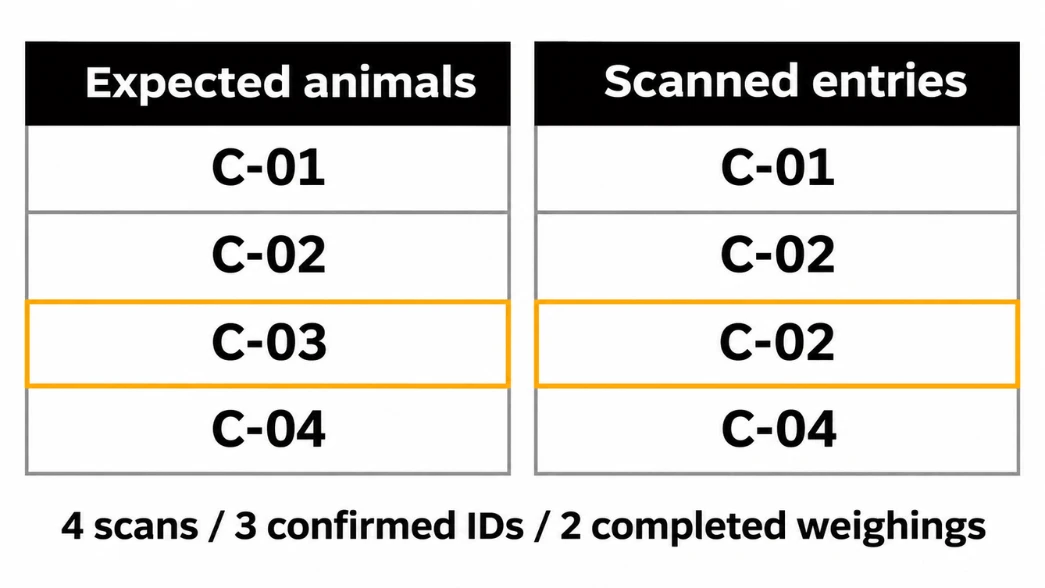
Checking individual numbers also helps prevent mistakes when head counts are equal. Suppose a farmer expects four animals, C-01 through C-04, after a pen change. Four scans may have been collected, yet C-02 may have been scanned twice while C-03 was never recorded. Counting only scans hides this difference. Comparing the expected list with distinct confirmed identifiers identifies the exception.
Identifying livestock for sale or transfer
Before a planned transfer, workers can use the same method to compare the animals being handled with the intended list. If an identifier cannot be confirmed, resolve the discrepancy before treating the list as complete. A subsequent arrival check can establish a new observation. Ordinary passive tags provide no information about the journey between those checks.
Private farm records support these tasks but do not replace mandatory identification, movement reporting or other official records. Requirements differ by destination, species and purpose. Confirm the appropriate tags and procedures with the responsible animal identification authority.
Choosing ear tags for these everyday identification tasks
If the farm relies entirely on occasional visual checks and electronic identification is not required, ordinary numbered ear tags without chips may be sufficient for its management needs. A clearly marked panel can be useful where workers need to recognize a number by sight. Such a tag cannot be detected with an RFID reader.
For repeat individual checks using a scanner, choose an electronic tag with a suitable reading format and physical design. Syntek's electronic livestock ear tag listing includes a round TPU tag. Confirm the ordered configuration, markings and reader compatibility rather than assuming that every product with the same shape or color contains the same chip.
A small electronic button and a larger visible marking can serve complementary purposes. The former enables electronic reading; the latter makes a farm number easier to recognize without a reader. Choose a species-appropriate tag arrangement and follow applicable identification and animal welfare requirements. Extra tags should not be added unnecessarily. Color can help distinguish management groups but cannot substitute for individual identification.
For a new order, match the tag and applicator to the animal species and the existing identification arrangement. If the customer already uses a visual panel, confirm whether it can remain in use under the relevant rules and whether its number will be linked to the electronic ID. For broader product and attachment choices, refer to the animal ear tag buying guide.
Keeping accurate animal identification records
A practical register can be divided into two parts: a permanent animal list and a dated activity log. The first stores the association between the animal and its identifiers; the second records what happened on each occasion. This avoids repeatedly typing static identification details and makes it possible to preserve previous observations when a tag is replaced.
The example below uses fictional farm references and electronic-ID placeholders. It illustrates the structure of a record rather than actual customer data or electronic codes.
| Farm reference | Electronic ID reference | Observation | Record status |
|---|---|---|---|
| C-018 | ID-A | Morning weighing | Weight recorded against confirmed ID |
| C-019 | ID-B | Morning inspection | Scan recorded; inspection pending |
| C-020 | ID-C | Expected in pen 2 | Not yet confirmed at destination |
In actual records, add the date, time or session, confirmed location where relevant, operator and any measurement or action. Keep full electronic identification numbers as text in spreadsheet fields, not rounded numeric values. Leading zeros or long identifiers can be lost when spreadsheet software automatically changes their formatting. Check an exported or copied number against the original reader display before relying on a new recording method.
Count animals, not reader signals
Two reads of the same animal during one head count should not become two animals. The same individual scanned during separate morning and evening checks may represent two valid observations. Some readers have configurable duplicate filtering, as illustrated by the Tru-Test SRS2 product documentation. Check whether the device in use counts every read or only distinct IDs within a session. Test this by reading one known tag twice and another tag once before beginning work. This is a useful way to understand the counter without relying on an assumed reader feature.
A count of distinct IDs still cannot establish that every animal was examined. In the four-animal example above, if C-02 was identified but its weighing was interrupted, only C-01 and C-04 may have completed the intended task. Use separate fields for identification and the work itself. The following example shows how the same session could be closed out on paper.
| Expected farm reference | Identification status | Weighing status | Next action |
|---|---|---|---|
| C-01 | Confirmed | Complete | No further action |
| C-02 | Confirmed twice | Pending | Finish weighing; retain one result for the session |
| C-03 | Unconfirmed | Pending | Check the group and verify identity |
| C-04 | Confirmed | Complete | No further action |
Here, four scan entries represent three confirmed identities and two completed weighings. An unconfirmed animal is an exception to investigate, not automatically a missing animal. If a later check confirms C-03, add the actual observation rather than retrospectively marking it as present at the first check. Keep a session date or reference with each entry, even when a handwritten register is used.
Why an RFID ear tag may not read
A failed scan can have several causes, and replacing a tag immediately may not solve the problem. Start by checking the reader's charge and settings, then test a known working tag of the same supported type. If that tag reads normally, inspect the unreadable tag and the way it is being presented. If several previously readable tags now fail, investigate the reader or its configuration first.
| Symptom | Possible explanation | Practical check |
|---|---|---|
| One tag does not respond | Physical damage, unfavorable reading position or incompatible format | Compare with a known good tag; retry from a safe permitted position |
| New batch fails but old tags work | Different chip or communication format | Compare ordered specification and actual samples with reader support |
| Reading works intermittently | Changing distance, orientation or surrounding conditions | Repeat under consistent safe handling conditions, following equipment guidance |
| Tag reads but wrong animal appears in register | Incorrect ID association or transcription | Compare the electronic number and visible marking with original registration |
| Tag is loose or missing | Attachment damage, snagging or application problems | Review tag components, installation instructions and animal welfare with trained staff |
Separate attachment problems from electronic problems
If tags repeatedly become loose or disappear, review the physical attachment before changing the chip type. The livestock tagging guidance from Oklahoma State University Extension explains why position in the ear matters, why the applicator pin should be in good condition and why the two halves must align. Incorrectly positioned tags can snag or pinch. A replacement tag with a different electronic format will not correct an unsuitable attachment. Inspect matched components and follow the particular manufacturer's placement and application instructions with trained handlers. Seek veterinary advice if the ear is injured or shows signs of infection.
Record whether failures involve the same tag design, applicator, group of animals or handling environment. If the problem occurs in a newly received batch, set the remaining stock aside until the component match and order specification are checked. A damaged tag can still return a number; a physically secure tag can still be unreadable. Both physical condition and electronic operation matter.
If the electronic component cannot be read but the animal has a legible, reliably associated visual identifier, record the check using that identifier and flag the electronic tag for follow-up. Keep the manual identification distinct from a successful electronic scan. If neither identifier is reliable, leave the record unresolved until the animal can be identified.
A reader's advertised distance is not a guarantee of usable distance on a moving animal. Reader design, tag orientation, surrounding materials and the way the animal is handled can affect the result. Test the actual combination of reader and tag under representative conditions before bulk purchasing. A handheld stick ear tag reader is one equipment format to consider for ordinary livestock identification; confirm its supported tag formats and operating instructions for the intended application.
What happens when an animal loses its ear tag?
The animal's identity should remain separate from the physical tag. Where an existing animal can be confidently identified through its remaining identifiers and reliable records, retain the permanent animal record and document the change of tag. For internal management tags, record the old identifier, replacement identifier, date, reason and method used to confirm the animal. Keep historical observations attached to the same animal.
For official tags, use the replacement procedure required by the relevant authority. Some programs permit particular replacements while imposing conditions on number reuse or additional tags. For example, buyers supplying the United States can start with the USDA APHIS animal disease traceability resources and the relevant state authority. A private management tag is not a substitute for an official tag where one is required.
For a private management record, a replacement can be documented with a simple entry: permanent farm reference C-018, retired electronic ID reference ID-A, replacement reference ID-D, date of change and the evidence used to establish identity. These are fictional references. Preserve the previous identifier for historical lookup but mark it inactive in the current register. If the old number appears again during a later scan, investigate before creating another animal record. For official identification, follow the authorized procedure rather than this internal example.
If the animal cannot be confidently identified, mark it as unresolved and investigate using reliable existing records or authorized assistance. Assigning it to whichever number is absent from a list risks joining two animals' histories incorrectly. An electronic tag replacement cannot repair that uncertainty by itself.
What buyers should confirm before ordering RFID animal tags
For farm suppliers and livestock equipment distributors, a clear order specification is more useful than a long list of advertised features. Start with the animal species, the identification purpose and whether the product is for private management or an official program. Then agree on the exact tag type, physical components and marking requirements before requesting a production quantity.
| Order detail | What to confirm on samples |
|---|---|
| Tag type and physical design | Correct electronic or non-electronic version, matched parts, dimensions and intended species |
| Color and visible identification | Agreed color, print layout, legibility and number sequence |
| Electronic format | Exact ordered format; successful decoding using the buyer's intended reader |
| Number association | Electronic and visible numbers match the agreed relationship or mapping list |
| Applicator | Suitable tool and correct component alignment according to the instructions |
| Batch packaging | Counts, labels and sequence ranges agree with the order; approved sample is retained |
Approve a sample before committing to a batch
Request representative samples in the actual ordered configuration, not just a different tag in the requested color. Use the reader already owned by the farm or the model intended for purchase. Check the samples individually in a controlled setting before any use on animals. Record the model, tag type, displayed identifiers and test conditions. For numbered products, agree on whether the visible number is the full electronic number, a shortened display or a separate farm reference with a mapping list. Verify the agreed relationship rather than assuming the numbers must always be identical.
| Sample check | Suggested acceptance decision | If it fails |
|---|---|---|
| Physical parts | Match the approved design and intended applicator; no visible damage | Confirm components before animal use |
| Electronic read | Each tested RFID sample returns the expected complete identifier on the intended reader under agreed conditions | Check format and reader; hold approval |
| Numbering | Visible markings and electronic numbers agree with the order or mapping list; no unintended duplicates among checked units | Resolve numbering discrepancy before release |
| Record handling | Numbers remain intact when written down or transferred using the intended method | Correct the entry or import method and retest |
Use the agreed sample criteria as the starting point for a production order, then agree separately on the inspection scope, numbering-list requirements, sampling plan where appropriate and how rejected units will be handled. A satisfactory sample confirms the checked configuration, not the performance of every future batch or the retention of tags in actual use.
When reordering, supply the previous approved specification and the next required numbering range. A tag that looks the same may have a different electronic configuration, while accidental overlap in printed or electronic numbers can cause confusion in the farm register. A documented repeat order helps avoid those problems without requiring complicated equipment.
Browse Syntek's RFID animal tags for ordinary visual and electronic identification products. When requesting samples or a quotation, include the animal species, preferred tag design, color, required quantity, numbering requirements and reader model if applicable. If the farm already has a reader, include a sample of its current tag or the tag specification when discussing a repeat order. This helps establish the correct product before comparing prices.
Send Inquiry