


Woven rPET vs. Silicone RFID Wristbands: Lifecycle Costs for Waterparks, Gyms and Events
Nov 25, 2026
Leave a message

Choosing between woven rPET and silicone RFID wristbands starts with how your venue issues, tracks, and recovers credentials-not with unit price alone. A wristband that works well for single-day event admission can create cleaning and drying bottlenecks in a waterpark or gym locker loop, while a reusable silicone band only lowers total operating cost if your team can actually collect, clean, inspect, and reissue it reliably.
Before requesting quotes or samples for RFID wristbands, operations managers, procurement teams, and access-control integrators should align on three things: the issue model for each user group, a single lifecycle cost denominator across candidate materials, and live testing on every gate, locker, and POS reader on site.
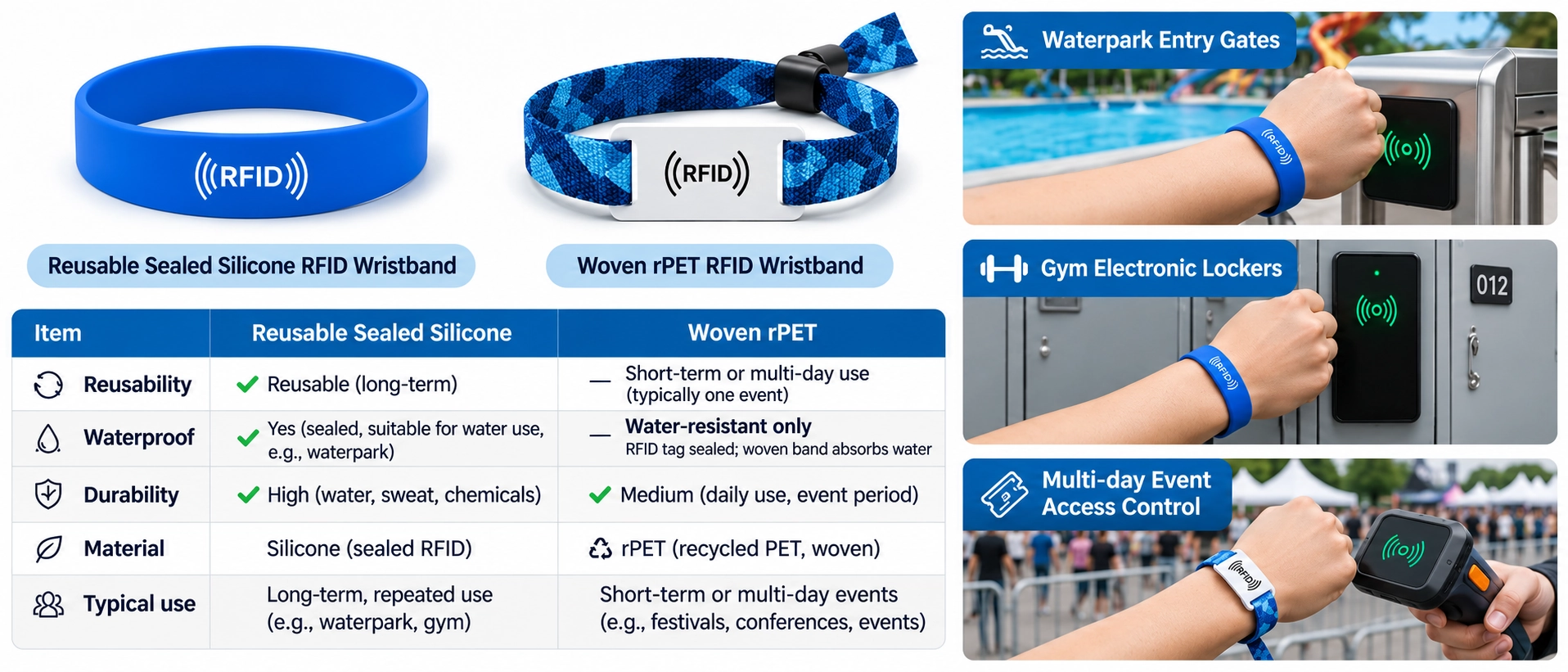
Choose the Issue Model Before the Material
The same venue often runs more than one credential workflow at the same time. Treating single-use guest passes, multi-year member bands, and reusable staff or locker bands as one inventory distorts stock planning and hides where replacement costs come from.
Use the matrix below to define permissions, removal rules, and return workflows before shortlisting wristband materials or closures.
| Scenario & User Group | Issue Model | Removal / Transfer Control | Terminals to Validate | Return & Reissue Requirement | Material Shortlist Condition |
|---|---|---|---|---|---|
| Waterparks & Resorts (Primary): Day Guests & Resort Guests | Single-visit admission or controlled return-and-reissue pool | Depends on pass type; cashless spending and room access require account revocation on loss | Entry gates, electronic lockers, room locks (if applicable), POS terminals | Only viable for reuse if exit collection, sanitizing, inspection, and buffer stock are staffed | Prioritize sealed silicone for managed wet-area reuse; evaluate woven bands with appropriate closures only if wet-drying and single-use rules fit |
| Gyms & Fitness Clubs: Long-Term Members | Assigned to individual member account across months or years | Revoked in access software on loss or cancellation | Turnstiles, electronic lockers, multi-site readers (if applicable) | Stays with member; replaced on loss or damage | Evaluate closed-loop or buckle silicone, or woven bands with durable reusable clasps |
| Gyms & Fitness Clubs: Same-Day Locker Loans | Unassigned anonymous loan stock or temporary single-visit record | Restricted to locker operation (and single-visit entry only if explicitly configured) | Electronic lockers (and entry gate only if policy allows) | Must be returned at exit, inspected, cleaned, and reissued | Prioritize fast wipe-down formats (such as sealed silicone) unless drying turnaround and extra buffer stock support fabric |
| Multi-Day Events: Attendees | Single-use issuance per authorized pass | Physical anti-transfer closure (typically one-way locking slider) plus system-level ticket rules | Entry gates, zone checkpoints, cashless POS terminals | Generally not recovered for reissue | Woven rPET or fabric with one-way locking sliders when tamper-evident removal and artwork space matter |
| Multi-Day Events: Crew, Staff & Volunteers | Controlled issuance with shift or post-event recovery | Account-linked permissions that can be revoked and re-authorized | Back-of-house doors, restricted zones, staff checkpoints | Collected, inspected, and re-authorized where policy requires | Reusable silicone or woven bands with reusable clasps |
For event teams balancing sponsor artwork, bamboo or fabric aesthetics, and attendee-versus-crew closures in greater detail, review our dedicated guide to festival wristband closures and artwork.
Waterpark Guest Bands
In waterparks and resorts with pools, RFID wristbands for waterparks often carry multiple operational roles on one credential. Public resort guidelines illustrate how tightly physical custody and account permissions interact: Great Wolf Lodge's Northern California FAQ notes that guest wristbands can handle waterpark entry, guest-room door access, and optional charging privileges, with a potential replacement fee if a band is lost (Great Wolf Lodge).
That multi-function setup determines material selection. If your park collects and reissues bands between guest visits, sealed silicone is typically the primary candidate to validate because it wipes down quickly after chlorinated water, sunscreen, and repeated handling. If your park issues single-visit credentials that guests keep as souvenirs or dispose of at exit-or uses distinct wristbands for day passes versus hotel stays-woven rPET or other single-use formats may stay in the comparison, provided wet-wrist read reliability is verified on site.
Gym Membership and Locker Loans
Gym RFID rollouts run into friction when front-desk teams mix long-term member credentials with temporary visitor locker bands. Public venue policies show why operators separate them: Glasgow Club distinguishes between member wristbands linked to compatible venue access and temporary wristbands issued solely for lockers, which visitors return after use to recover a deposit (Glasgow Club). Similarly, Bannatyne's Cardigan Fields club rules separate initial member wristband issuance from Spa Day and Day Pass bands that must be returned the same day (Bannatyne Health Club).
Exact access rights depend on your club's membership tiers and access-control configuration rather than a single default setup. Map hardware permissions and custody rules using the breakdown below:
| Credential Type | Record / Account Binding | Gates / Turnstiles | Electronic Lockers | Multi-Site Access | Return / Termination Rule | Responsible Owner |
|---|---|---|---|---|---|---|
| Member-Assigned Band | Linked to active member account | Configured per membership tier and system policy | Configured per club policy (free-use or assigned) | Optional; depends on membership tier and multi-site system setup | Revoke in access software on loss or cancellation; collect on exit if policy requires | Membership Desk / Club Ops |
| Same-Day Locker Loan | Either an unassigned anonymous locker credential or linked to a temporary single-visit record | Blocked by default (or single-visit entry only if explicitly configured) | Enabled for single-session lock/unlock per locker controller rules | Single site only (unless chain policy specifies otherwise) | Return at exit; close loan record, inspect, and clean before reissue | Front Desk / Shift Lead |
| Front-Desk Backup / Spare | Unassigned until issued | Blocked until encoded and authorized | Blocked until encoded and authorized | None until assigned | Stored separately from returned or uncleaned loan stock | Facility Manager |
Because gym RFID wristbands assigned to members grant recurring entry, the access-control system must support revoking a lost band without disrupting the underlying member account (Glasgow Club). Keep in mind that credential revocation is a system-level process rather than a standalone wristband feature; how quickly a revoked band stops opening doors or lockers depends on whether readers stay online, cache credential lists locally, or share a synchronized database with locker controllers. Visually distinguishing member bands from visitor loans through distinct colors or laser-engraved numbering also helps reduce the risk of staff accidentally handing a member-tier credential to a day-pass guest.
For same-day locker loans, restricting permissions to locker operation (and single-visit entry only if explicitly allowed) ensures an unreturned band cannot grant future entry. Because these bands may cycle through multiple visitors over a week depending on check-in volume, stock levels depend on peak concurrent demand, return turnaround, and cleaning time rather than total monthly check-ins.
Event Attendees and Crew
Event access wristbands split cleanly into two operational groups. Attendees on single-day or multi-day passes generally require a closure that discourages casual band-swapping-most commonly a woven strap with a one-way locking slider-paired with backend ticket validation, since physical tamper evidence is only one part of access control. Crew, contractors, and volunteers follow a different pattern: where teams rotate across shifts or return credentials after an event, reusable closures and controlled re-authorization prevent unnecessary replacement orders.
Compare the Finished Wristband and Its Lock
Evaluating woven rPET RFID wristbands against silicone RFID wristbands requires comparing the complete finished product-strap, encapsulated RFID module, and closure-under your actual site conditions. A bare inlay spec or a fabric mill certificate does not verify how the assembled wristband behaves after pool immersion, sweat, disinfectant wiping, or repeated fastening.
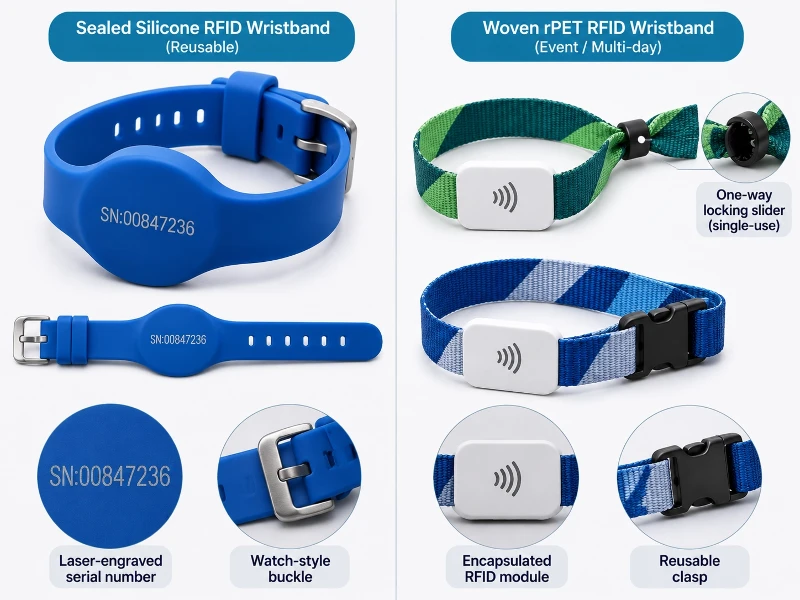
| Evaluation Criteria | Silicone RFID Wristband | Woven rPET RFID Wristband |
|---|---|---|
| Waterpark & Wet-Area Exposure | Validate ingress protection on the finished sealed band under site pool water, showers, sunscreen, and cleaning routines. | Validate wet performance for both the woven strap and the RFID module housing; account for fabric moisture retention and drying time. |
| Gym Member & Locker Loops | Check elastomer comfort, adult/youth sizing range, wipe-down speed, and disinfectant compatibility between shifts. | Check sweat comfort, washing and drying turnaround, and whether extra buffer stock is needed for drying queues. |
| Event Attendees & Crew | Suitable for reusable crew/VIP pools or wet-area festivals; specify separate tamper-evident hardware if single-use anti-transfer is required. | Common shortlist option for attendee passes when paired with one-way locking sliders; viable for crew reuse only with a durable reusable clasp. |
| Repeat Use & Closures | Inspect closed-loop elasticity or watch-style buckle/pin durability under repeated flexing and fastening. | Suitable for managed reuse only when fitted with a reusable clasp or adjustable fastener. |
| One-Way Locking Sliders | Not standard for reusable silicone formats. | Event-style one-way locking sliders must be cut off and are unsuitable for recovery and reissue. |
| Procurement Documentation | Request finished-product test reports matching the exact SKU, chip, and enclosure you plan to buy. | Request both finished-module test documentation and scope/transaction proof clarifying whether recycled-content claims cover the woven strap only or additional components. |
Silicone for Wet Venues and Managed Repeat Use
Closed-loop or adjustable-buckle silicone RFID wristband formats are commonly shortlisted for waterparks, resort pools, and gym locker loops because the transponder is sealed inside a wipeable elastomer body. However, "waterproof" is not a standardized procurement specification on its own. Under IEC 60529, ingress protection ratings classify enclosure protection against solids and liquids under defined test conditions (IEC). As accredited testing laboratories note for continuous immersion categories such as IPX8, actual test depth, duration, orientation, and pass criteria must be agreed upon for the specific product and use case (Applus+ Keystone).
In real venues, chlorinated water, hot showers, cleaning chemicals, and mechanical flexing around the buckle stress the enclosure differently than static water immersion. When evaluating silicone samples on site, verify:
Enclosure integrity: No visible seam separation around the chip housing after repeated flexing, wet exposure, and wiping with your site's actual disinfectant, followed by a live read check on installed readers.
Closure repeatability: Watch-style buckles or snap pins hold securely during swimming or workouts without tearing strap holes; closed-loop bands cover your required adult and youth wrist sizes without excessive stretching.
Readable numbering: Laser-engraved or debossed serial numbers remain legible after water exposure and routine sanitizing so staff can match a band to an account or loan log if a reader is offline.
When Woven rPET Fits the Shortlist
Woven RFID wristbands made with recycled polyester (rPET) are a common market option for events, resorts, and clubs looking for softer textile comfort, detailed woven branding, or recycled-content straps. If you are reviewing woven RFID wristband configurations, confirm directly with Syntek whether a specific SKU uses rPET yarn and what supporting documentation applies to that order.
A woven band belongs on the same shortlist as silicone for managed reuse only if it satisfies three operational conditions:
1. Closure matches the issue model: One-way locking sliders are designed for single-use attendee admission and must be cut off. Only woven bands fitted with a durable, reusable clasp or adjustable fastener can enter a recovery-and-reissue workflow.
2. Cleaning and drying turnaround: Woven fabric retains water and sweat. Operations teams must verify whether straps can be sanitized and dried fast enough between waterpark shifts or gym locker loans-or whether wet turnaround requires a larger spare-stock pool to cover washing and drying queues.
3. Verifiable recycled-content documentation: If your procurement policy requires recycled-material claims (such as GRS), confirm the exact component scope. Certification for recycled yarn or woven fabric does not automatically extend to the RFID chip, inlay, plastic housing, or clasp on the finished wristband. Textile Exchange maintains a public directory to check certified companies (Textile Exchange). For eligible GRS and RCS material flows, Textile Exchange uses eTransactions through eTrackit to support chain-of-custody traceability (Textile Exchange). Verify both the supplier's active scope certificate and the applicable transaction records against the certified material and shipment.
Calculate Cost per Successful Issue
Comparing a single-use woven wristband against a reusable silicone wristband by unit quote alone leads to flawed budgets. A lower unit price ignores replacement orders and higher total band consumption; a higher-priced reusable band ignores front-desk collection, cleaning labor, failed-inspection retirements, and peak-hour buffer stock.
To compare candidate materials fairly across the same venue, accounting period, and service scope, use one unified denominator:
Cost per Successful Issue = Total Period Cost ÷ Successful Issues in Period
A successful issue is one authorized credential successfully fulfilling its intended service period for one user:
Waterpark day passes & gym locker loans: Each completed single-visit rental or valid reissue counts as one successful issue (multiple locker opens or gate taps during the same visit still count as one issue).
Multi-day event attendees: One band issued to one attendee for the full event pass counts as one successful issue.
Gym long-term members: One active member credential per membership period counts as one successful issue (subsequent turnstile scans are tracked separately as usage, not new issues).
Lost or damaged replacements: Reissuing a band merely to restore an existing pass or active membership increases total cost while leaving the denominator unchanged.
Compare Quotes on the Same Basis
Align every supplier quote before entering numbers into your cost model. Request quotes in the same currency, Incoterms, order quantity tier, and configuration-including chip model, closure, artwork, and any RFID wristband OEM customization options such as pre-encoding or visible serialization.
Include all direct operating inputs for the accounting period in Total Period Cost:
Hardware and setup: Opening usable stock, landed cost of replenishment orders, shipping/duties, setup, serialization, and encoding fees. Do not double-count lost bands if their replacement cost is already captured in actual replenishment purchases.
Inventory carry-over: Account consistently for ending usable inventory (or net residual value) across both candidate options so multi-period reusable stock is not distorted.
Handling and recovery labor: Front-desk issuance, exit collection, washing/sanitizing, drying, physical and read inspection, credential revocation, and re-authorization time, plus cleaning consumables and disposal fees.
Incremental system costs only: Include reader, software, or POS changes only if one wristband configuration requires hardware or integration work that the other does not.
Separate policy fees: Keep guest deposits, deposit refunds, and member replacement fees on a separate accounting line; venue fees reflect customer policy, not hardware cost.
Find the Break-Even Point Using Your Return Rate
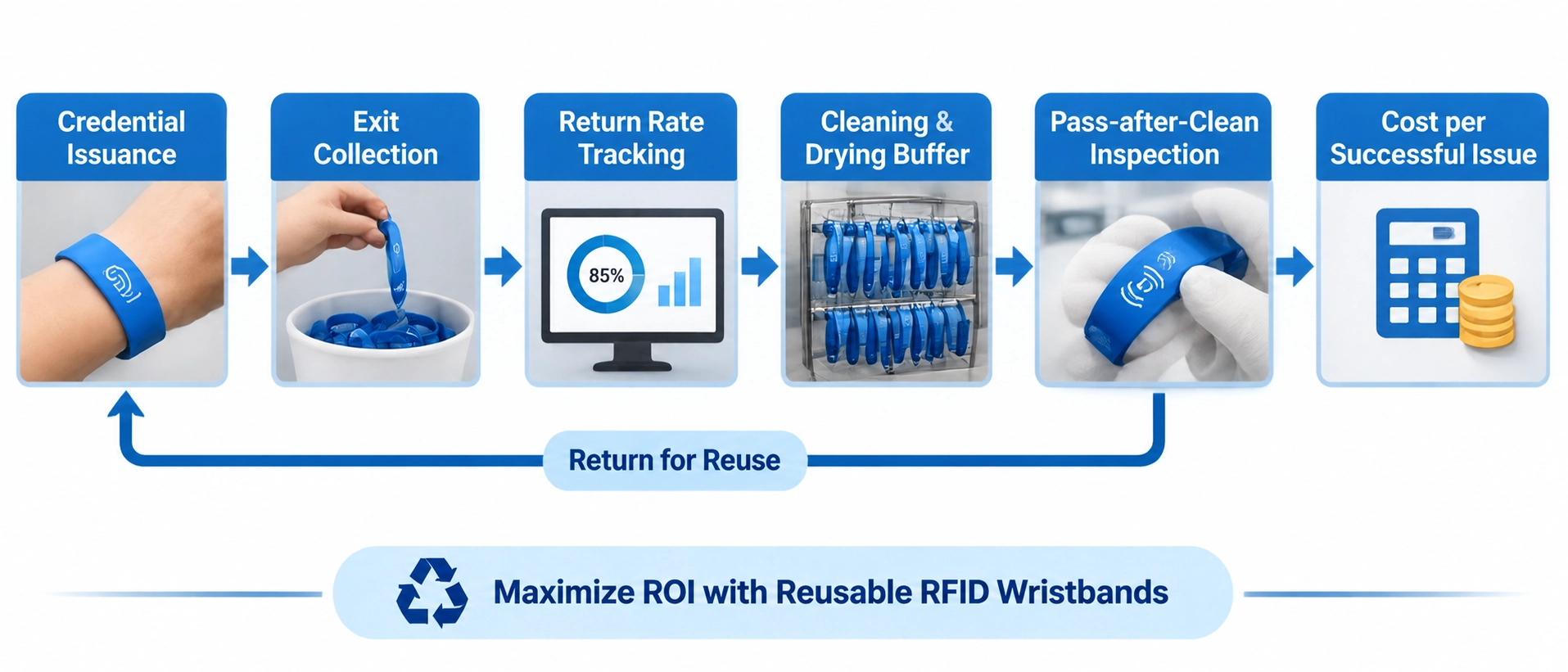
Reusable wristbands only beat single-use options when enough bands survive collection, cleaning, and inspection to offset their higher upfront price and handling labor. Track two operational rates alongside your ledger:
Return Rate = Returned Bands ÷ Expected Returns
Pass-after-Clean Rate = Bands Passing Inspection After Cleaning ÷ Total Bands Inspected
Buffer stock is a critical operational variable when sizing a reusable pool. Your minimum working inventory must cover:
Peak concurrent bands worn by guests, members, or staff on site;
Returned bands waiting in the cleaning and drying queue;
Bands awaiting read and closure inspection before returning to circulation;
Safety stock covering your supplier's replenishment lead time.
To find your conditional break-even point, run the same planned issue volume through both configurations using your actual quotes, observed or pilot return rate, pass-after-clean rate, and per-band cleaning labor. The earliest feasible issue volume where the reusable configuration's total period cost is less than or equal to the single-use configuration is your crossover point. If no crossover occurs under your site's return rate and labor inputs, single-use remains the lower-cost option under those conditions.
| Input Category | Unit & Accounting Basis | Single-Use Candidate (Fill In) | Reusable Candidate (Fill In) |
|---|---|---|---|
| Service Scope & Volume | Accounting period; planned successful issues; peak concurrent wear | Period: [ ] / Issues: [ ] / Peak: [ ] | Period: [ ] / Issues: [ ] / Peak: [ ] |
| Landed Hardware & Setup | Same currency & Incoterms; unit price, encoding, serialization, shipping | Initial + replenishment: [ ] | Initial + replenishment: [ ] |
| Recovery & Inspection Rates | Return rate (%); pass-after-clean rate (%); failed-inspection retirements | N/A (or track lost replacements: [ ]) | Return %: [ ] / Pass %: [ ] / Retired: [ ] |
| Handling & Cleaning Labor | Minutes per band × labor rate; cleaning supplies; revocation/reissue time | Issue + replacement labor: [ ] | Issue + clean + inspect + reissue labor: [ ] |
| Buffer Stock & Ending Inventory | Cleaning/drying queue stock; replenishment buffer; ending usable inventory value | Ending stock adjustment: [ ] | Buffer size: [ ] / Ending stock adjustment: [ ] |
| Total & Unit Output | Total period cost; cost per successful issue (log deposits/fees separately) | Total: [ ] / Cost per issue: [ ] | Total: [ ] / Cost per issue: [ ] |
Validate the Wristband on Your Readers
A wristband that triggers a smartphone NFC reader is not automatically ready for a waterpark gate, gym locker, or cashless POS terminal. RFID chip families differ in communication protocols, memory architecture, and security features depending on the exact IC model-for example, NXP's MIFARE DESFire EV3 specifications detail ISO/IEC 14443 Type A and 14443-4 interfaces specific to that IC family (NXP Semiconductors), which cannot be assumed across other chips or payment systems. Furthermore, embedding an inlay inside silicone, woven fabric, or a rigid housing alters antenna tuning and read performance; compatibility must be confirmed when you test RFID inlays in the finished wristband, not on a bare inlay alone.
Confirm that your test units match production specs. Commercial RFID wristband suppliers note that stock showcase samples may not be an exact replica of the final ordered product (PC/nametag). Always request production-representative samples carrying the exact chip, enclosure, closure, and surface finish you intend to buy.
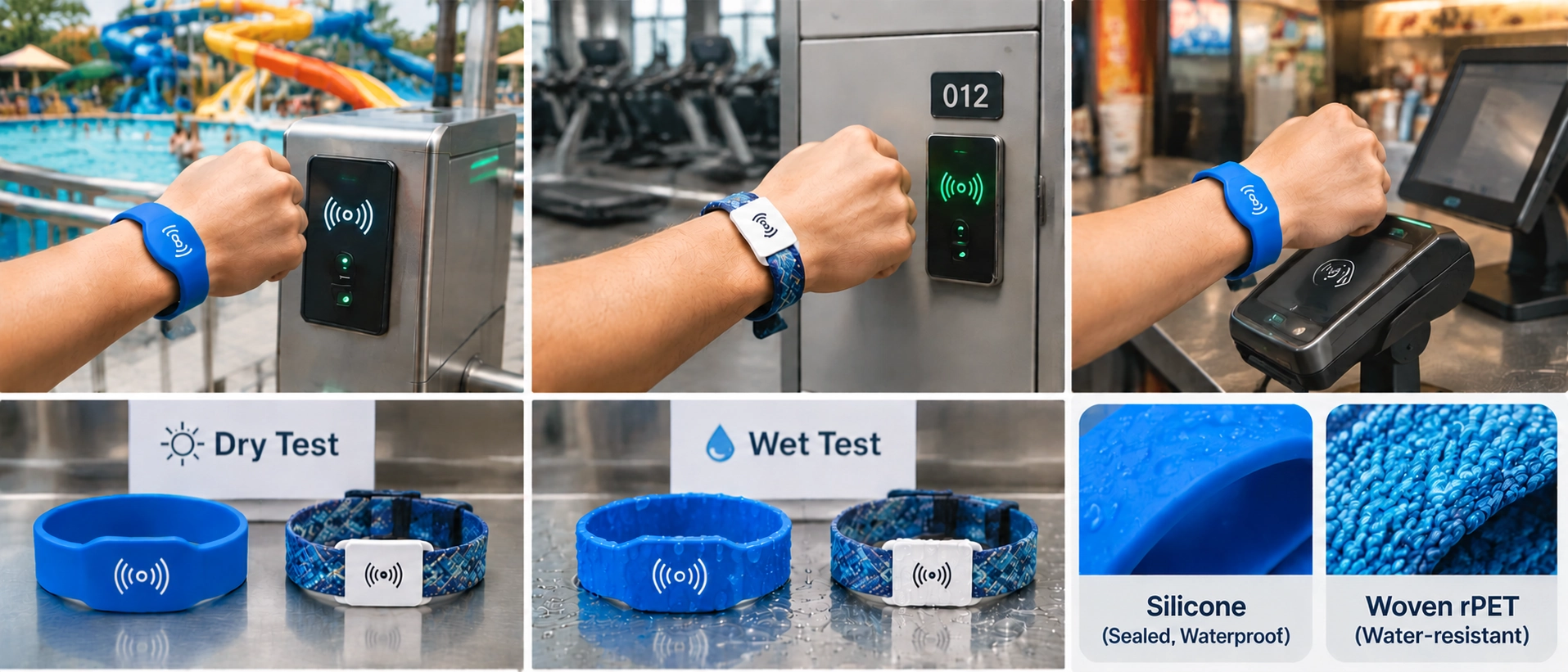
Test Gates, Lockers and POS
Venues with multiple zones, renovations, or multi-site portfolios frequently run mixed hardware-such as older turnstiles at the entrance, newer electronic lockers in changing rooms, and separate cashless POS terminals at food-and-beverage counters. Test production-representative samples on every reader model in service:
Dry, wet, and post-wipe reads: Verify consistent reads with the band dry, wet from pool or shower exposure, and wiped with your facility's standard disinfectant.
Natural wrist presentation: Confirm guests and members can tap comfortably at gates, lockers, and POS counters without removing the band.
Full POS transaction flow: If wristbands handle cashless spending or account lookup, verify complete authorization, balance deduction, receipt/account mapping, and error handling-never equate basic UID reading with payment compatibility.
Revoke, Clean, Recheck and Reissue
Hardware read tests only cover half of operational risk. Multi-day venues and festivals also rely on dedicated replacement and re-authorization workflows-for example, Intellitix's operational case study for the Seabreeze Jazz Festival documents pre-issued wristbands paired with on-site replacement stations to manage entry and reissuance exceptions (Intellitix). Run a complete exception drill with your front-desk team and authorized system integrator before placing a bulk order:
| Test Step | Verification Action | Expected Result | Owner & Status (Pass / Fail / Retest) |
|---|---|---|---|
| 1. Gate, Locker & POS Read (Dry & Wet) | Tap production-representative sample on every gate, locker, and POS reader model (dry, wet, post-wipe) | Consistent read without repeated taps or read errors | [ ] |
| 2. POS Transaction & Spending Check | Execute a test purchase or account lookup on each POS terminal model (if cashless is used) | Transaction authorizes and maps cleanly to the guest/member record without manual override | [ ] |
| 3. Locker Loan / Rental Closure | Issue loan band, lock and unlock locker, return band at desk, close loan session | Locker releases cleanly; band returns to available stock pool | [ ] |
| 4. Lost Credential Revocation & Sync | Report active band lost; deactivate in management software; test gates, lockers, and POS under networked and offline-cache conditions | Old band is rejected within the agreed authorization sync window; offline caching and reconnect sync behave per integrator specs | [ ] |
| 5. Reissue & Recovered Old Band | Issue replacement band; test new band and re-test recovered old band across all terminal types | New band works across authorized zones; recovered old band cannot regain access or spending rights | [ ] |
| 6. Multi-Site / Mixed Hardware Check | Test authorized band across secondary sites or mixed reader generations (if applicable) | Permissions match configured tier without front-desk workaround | [ ] |
| 7. Closure & Legibility After Cleaning | Fasten/unfasten repeatedly, soak or wipe with site disinfectant, and dry | Closure stays secure; printed or engraved serial number remains readable | [ ] |
Prepare Your RFID Wristband Sample Brief
Once your issue model, cost worksheet, and reader checklist are defined, sharing concrete site specifications allows a manufacturer to match the right enclosure, chip, and serialization workflow without guesswork. Clarifying scope up front also avoids deployment delays:
Syntek's scope: Physical wristbands (silicone, woven, PVC, and elastic formats), chip and inlay selection, encapsulation, custom numbering, agreed pre-encoding, and production-representative sampling through its OEM/ODM workflow.
Customer and authorized integrator scope: Guest/member permissions, locker business rules, access-control and POS software, reader authorization policies, and live security key provisioning.
Joint confirmation: Chip family, communication protocol, reader compatibility, and sample acceptance criteria verified on site before bulk production.
Prepare these eight details before requesting samples:
1. Application scenario & total issue volume: Waterpark, gym, event, or mixed venue; planned single-use or reusable issue volume per period, plus existing credential model (if replacing current stock).
2. Peak concurrent wear & cleaning buffer: Maximum bands worn simultaneously on site, plus expected buffer stock needed for cleaning, drying, and inspection queues.
3. Chip, frequency & encoding: Known chip family, operating frequency, protocol, and whether you need blank UIDs, printed serial matching, or agreed pre-encoding.
4. Installed reader & POS models: Brand and model numbers for all turnstile readers, electronic locker locks, room locks, and POS terminals in service.
5. Material, build & closure: Preferred silicone or woven format (including whether you need Syntek to confirm rPET availability and documentation), adult/youth sizing, and closure type (closed-loop, buckle, reusable clasp, or one-way locking slider).
6. Artwork, color-coding & serialization: Distinct colors for user groups (such as members vs. locker loans or attendees vs. crew), branding artwork, and laser-engraved or printed serial numbering requirements.
7. Wet exposure, cleaning method & expected return rate: Pool/shower/steam conditions, exact sanitizing chemicals or washing process, and target return turnaround.
8. Sample acceptance criteria & delivery timeline: Required production-representative sample quantities, on-site test sign-off steps, and target bulk delivery date.
To review available materials and form factors before sampling, Compare Syntek RFID wristband configurations. When your hardware list and quantities are ready, Send Syntek your RFID wristband sample brief so our team can confirm compatible chip, enclosure, and sampling options.
Send Inquiry