


Wooden RFID Cards for European Hotels: A Procurement Guide
Nov 23, 2026
Leave a message

Before ordering wooden RFID cards for a European hotel, procurement and engineering teams need two sign-offs: verifiable compliance and material documentation (separating EU packaging rules, WEEE e-waste scope, and finished-card FSC Chain of Custody) and physical sample testing across every on-property touchpoint. Skipping either step creates avoidable risks-from publishing unsubstantiated sustainability claims under EU consumer-protection rules to ordering ~1.3 mm cards that jam 0.76 mm kiosks or fail to encode on updated door locks.
(If you are still at the early research stage and need an overview of basic chip families, wood finishes, and standard ordering steps, start with our foundational guide on how to choose RFID wooden key cards for hotels.)
Which EU Rules Apply to Hotel Key Cards and Their Packaging?
The EU Packaging and Packaging Waste Regulation (PPWR) does not ban PVC hotel key cards. For European hospitality buyers, packaging rules, electronics waste rules, consumer-facing green-claim rules, and voluntary eco-certifications each govern a different part of the procurement workflow.
Packaging vs. Electronic Credentials: PPWR and WEEE
Regulation (EU) 2025/40 (PPWR) entered into force on February 11, 2025, and applies generally from August 12, 2026 (European Commission; Regulation (EU) 2025/40). For hotels, PPWR governs packaging and packaging waste-such as paper key card sleeves and shipping cartons-and introduces restrictions from January 1, 2030, on designated single-use plastic packaging for toiletries, hygiene, and cosmetic products supplied for a single booking.
An RFID hotel key card itself is a functional electronic credential, not packaging. Under Section 3.7 of the European Commission's WEEE Directive (2012/19/EU) FAQ, active and passive RFID tags generally meet the definition of Electrical and Electronic Equipment (EEE), subject to the exclusions in Article 2 (European Commission WEEE FAQ). That classification depends on the embedded electronics rather than the outer shell. Because wooden RFID cards contain a silicon chip, a copper or aluminum antenna, and lamination adhesives, they should not be marketed as compostable or discarded as ordinary wood or organic waste. Instead, hotels should confirm applicable national and municipal B2B e-waste collection pathways for retired credentials.
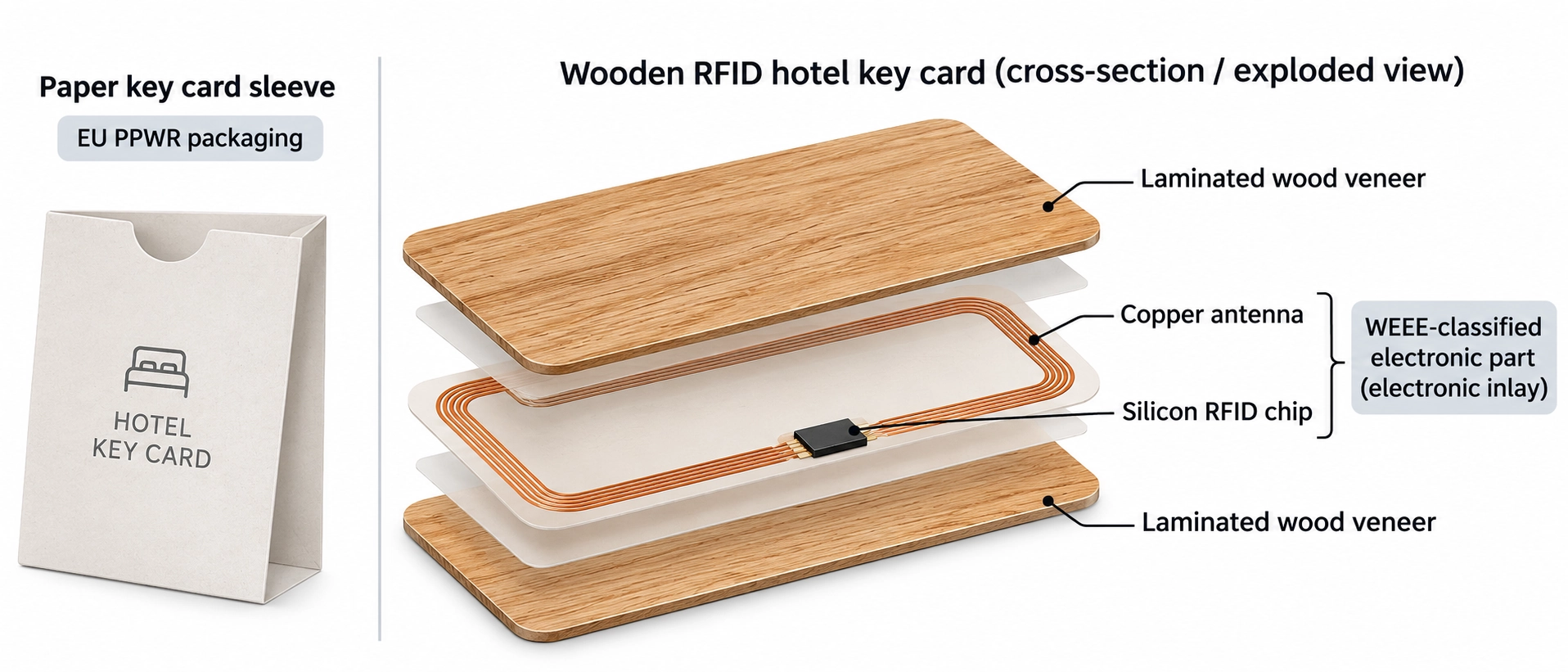
Anti-Greenwashing Rules (EmpCo) and Voluntary Certification (Green Key 2026–2031)
Two separate frameworks shape how European properties evaluate card materials and communicate sustainability claims to guests:
Directive (EU) 2024/825 (EmpCo): EU Member States must apply national transposition measures from September 27, 2026 (European Commission). For business-to-consumer communications, the Directive restricts unsubstantiated generic environmental claims (such as "eco-friendly" or "green" without recognized excellent environmental performance relevant to the claim), prohibits presenting a feature that applies only to part of a product as if it applied to the entire product, and requires sustainability labels to be backed by an independent third-party certification scheme or established by public authorities.
Green Key Criteria 2026–2031: The updated international framework takes effect on October 1, 2026, for new hotel and hostel applicants, with a transition period running through December 31, 2027, where renewal timing depends on whether an existing certified property requires an on-site or off-site audit (Green Key Criteria 2026–2031; Green Key Certification Process). Properties should treat card material changes as an internal procurement decision, confirm any country-specific criteria with their national Green Key operator, and not assume that wooden key cards are mandatory or automatically earn certification points.
| Framework | Key Effective Date | Scope of Application | Practical Procurement Action |
|---|---|---|---|
| EU PPWR (Reg. 2025/40) | Feb 11, 2025 (in force); Aug 12, 2026 (general application); Jan 1, 2030 (designated mini-amenity packaging) | Packaging and packaging waste | Review paper key card sleeves and shipping cartons under packaging rules; do not treat the RFID card itself as packaging. |
| EU WEEE (Dir. 2012/19/EU) | Active (verify national transposition) | Active/passive RFID tags generally fall under EEE (subject to Art. 2 exclusions) | Do not market wooden chip cards as compostable; verify local B2B e-waste collection and disposal arrangements. |
| EU EmpCo (Dir. 2024/825) | Sep 27, 2026 (Member State measures apply) | B2C environmental claims and sustainability labels | Avoid unsubstantiated generic claims, partial-as-whole claims, and unverified labels; align guest-facing wording with legal review. |
| Green Key 2026–2031 | Oct 1, 2026 (new applicants); transition through Dec 31, 2027 (varies by renewal audit path) | Voluntary hospitality eco-certification | Confirm any national-level criteria with your local Green Key operator; do not assume wooden cards are mandatory or automatically earn certification points. |
Note: Regulatory summaries above reflect official EU and certification texts verified as of November 2026. Confirm project-specific obligations with your legal compliance team or national certification operator.
Auditing FSC Claims and Avoiding Greenwashing on Finished Cards
An upstream veneer mill's FSC certificate does not make a finished laminated RFID card FSC-certified. Treating wood-sourcing claims as finished-product certification is one of the most common documentation gaps in wooden key card procurement.
"FSC-Sourced Wood" vs. "FSC-Certified Finished Cards"
FSC Chain of Custody (CoC) certification (standard FSC-STD-40-004) verifies that certified material is tracked across processing, lamination, ownership, and controlled outsourcing arrangements (FSC Chain of Custody). If a card factory without an active CoC certificate purchases FSC-sourced veneer independently, laminates RFID inlays, prints artwork, and sells the finished card, the Chain of Custody is broken. In that case, the wood substrate may originate from certified forests, but the finished card cannot be marketed or labeled as FSC-certified.
A 3-Step FSC Verification Checklist for Hotel Procurement
Before approving card artwork or guest-facing sustainability copy, procurement teams should verify three separate gates:
Check the invoicing entity and product scope on search.fsc.org: Confirm that the exact legal entity invoicing your hotel holds an active FSC CoC certificate whose certified product scope covers the finished card item-not a certificate belonging only to an upstream timber trader (FSC Certificate Search).
Require finished-card FSC claims on sales documents: A standalone PDF copy of a supplier's certificate is not sufficient proof. Sales and delivery documents must list the finished card line item with its specific FSC claim (such as FSC 100% or FSC Mix) and the supplier's certificate code (FSC Promotional Use).
Separate on-product labeling from external hotel promotion: Only certified entities authorized under their CoC scope may apply FSC on-product marks. A non-certified hotel that wants to use FSC trademarks in guest communications, websites, or ESG reports must confirm applicable promotional licensing and artwork approval rules-an FSC promotional licence does not authorize a hotel to label cards itself or operate as a CoC processor (FSC Promotional Use).
| Procurement Scenario | Factual Wording Direction (Subject to Legal / FSC Review) | High-Risk Wording to Avoid |
|---|---|---|
| Verified CoC invoicing entity + covered product scope + invoice claim + approved trademark/promotional authorization | Reference FSC-certified wood strictly in line with the invoice claim and approved FSC trademark guidelines. | "100% biodegradable," "zero-impact," or "plastic-free" claims that ignore the internal chip, antenna, and adhesives. |
| FSC-sourced veneer processed by a factory without finished-card CoC certification | Use accurate material descriptions such as "wooden RFID key cards." Any claim of virgin-PVC reduction requires documenting both your previous card baseline and the new card's actual composition. | Printing the FSC logo on the card or describing the finished card as "FSC-certified." |
Evaluating Wood Species, Moisture Limits, and Pilot TCO
Choosing between wood substrates and evaluating total cost of ownership (TCO) requires controlled comparisons on your own property rather than generic durability rankings or mismatched distributor price lists.
Comparing Bamboo, Beech, and Black Walnut for Sample Testing
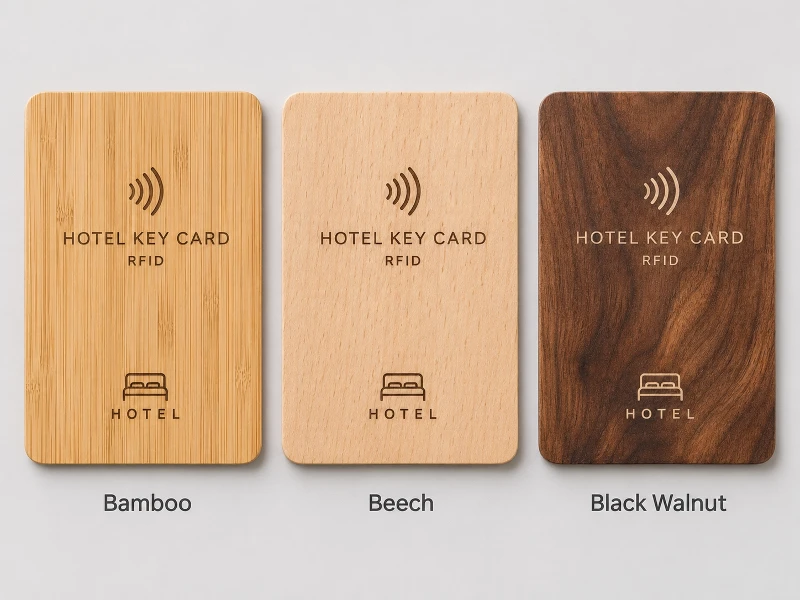
Syntek's core wooden RFID card substrates are bamboo, beech, and black walnut (with cherry available on select OEM configurations). Rather than assigning fixed lifespan tiers or brand brackets without controlled test data, evaluate physical samples on grain consistency, artwork legibility, and surface wear under your hotel's cleaning routine:
| Wood Species | Visual & Grain Profile | Artwork & Finish Suitability | Sample Acceptance Variables to Check |
|---|---|---|---|
| Bamboo | Fine linear grain with light, warm tone | High contrast for pure laser engraving and full-color UV print | Edge sealing along linear fibers; shade consistency across sheets |
| Beech | Smooth, even pale grain with minimal knots | Clean legibility for fine logos, small typography, and QR codes | Surface ink adhesion after damp-cloth wiping |
| Black Walnut | Rich dark brown with distinct organic grain | Best paired with metallic/light inks, Spot UV, or deep tactile engraving | Contrast legibility under dim corridor lighting; natural grain variance |
Like-for-Like Pricing and Pilot TCO Measurement
Public online price listings for PVC and wooden key cards are rarely directly comparable. One listing may quote EXW (Ex Works) China factory terms for 1,000–4,999 offset-printed PVC cards, while another quotes US retail/distributor pricing for full-color wooden cards with different chips, shipping, and duties included. Comparing mismatched quotes creates misleading assumptions about material premiums or landed European costs.
For rough budgeting context only, 2026 public US and European third-party distributor listings show full-color custom wooden RFID key cards ranging from roughly $1.60 per card at 500 units down to $0.80 per card at 100,000 units, compared with distributor reference pricing for SALTO-compatible PVC cards at $0.10–$0.30 (Classic 1K / Ultralight C) or $1.02–$1.25 (DESFire EV2/EV3). Treat these figures strictly as Western distributor benchmarks rather than factory-direct China OEM pricing.
Instead, request project quotes on an identical specification sheet-locking in chip IC, order quantity, print finish, Incoterms, currency, and duties/taxes-and pair unit pricing with a controlled property pilot. Qualitative operational feedback compiled by the Green Pearls® hotel network notes that under high-frequency daily use, some properties observed wooden chip cards wearing out in roughly two years while plastic cards lasted over ten years (Green Pearls / Inkaterra). Because those reports are informal observations across uncontrolled materials, coatings, and occupancy levels, treat them as a risk prompt rather than a fixed lifespan benchmark.
Measure real TCO on a single property over a defined pilot window using one consistent formula:
Cost per Successful Issuance = (Landed Purchase Cost + Incremental Replacement + Encoding, Cleaning & Disposal Costs) ÷ Total Successful Guest Issuances in Pilot Period
Avoid double-counting replacement stock that is already included in your initial landed purchase cost. Log pilot duration, guest loss or souvenir retention rates, physical damage causes, and retirement criteria so procurement and operations share the same decision threshold.
Moisture Limits, Cleaning Validation, and Wet-Zone Credentials
Factory surface treatments-such as the penetrating waterproofing agent and surface waterproof coating described on Syntek's wooden key card product page-are designed to reduce moisture absorption from daily handling, not to make wood immersion-proof. Because product descriptions are not independent laboratory immersion or wipe-cycle certifications, test pre-production samples using your housekeeping team's exact damp-cloth and sanitizer procedures before scaling up. For bulk shipments, also maintain dry, climate-controlled transit and back-of-house storage so unopened cartons do not absorb ambient humidity and warp before issuance.
For pools, beaches, thermal spas, and high-humidity wellness zones, separate guestroom cards from wet-zone access:
Issue wooden cards for standard guestrooms and dry areas.
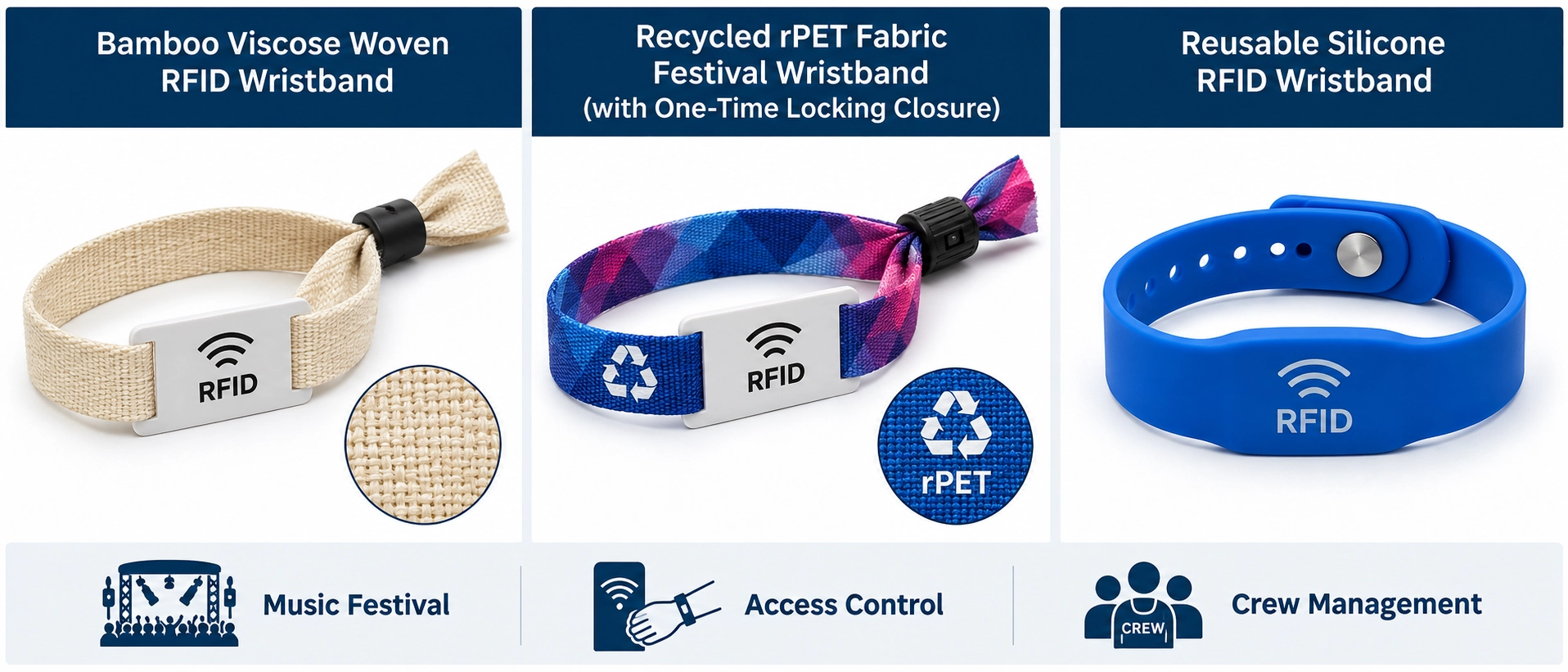
For water-immersion environments, specify qualified silicone models from an RFID wristband lineup-confirming immersion ratings, door-lock credential compatibility, and cleaning protocols for the exact SKU rather than assuming woven or fabric wristbands are suitable for submersion.
Mechanical Thickness, Lock Credentials, and the 5-Touchpoint Sign-Off
Nominal frequency (13.56 MHz / ISO/IEC 14443-A) and standard card dimensions do not guarantee smooth rollout. Engineering teams must validate mechanical slot clearance and lock-system credential authorization separately before releasing a bulk order.
Mechanical Thickness vs. Equipment Slot Tolerances
Standard CR80 PVC key cards measure 85.5 × 54 mm at 0.76 mm thick. Syntek's standard custom wooden RFID cards are nominally around 1.3 mm thick to protect the laminated wood veneer and internal antenna. By contrast, certain lock-OEM credentials-such as SALTO's bamboo hotel guest key cards-are specified at 0.76–0.85 mm with an NXP Ultralight C chip. Each nominal specification applies only to its respective product and does not guarantee clearance across third-party hardware.
Narrow mechanical slots engineered tightly around 0.76 mm PVC create the highest risk of day-one failure:
Self check-in kiosk dispensers: Hopper rollers and exit bezels may jam or double-feed thicker wooden cards if the dispenser is calibrated exclusively for 0.76 mm plastic.
In-room energy-saver switches: Mechanical micro-switch and narrow electronic energy-saver switches vary in slot width and sensing method; verify against equipment manuals and physical sample insertion so guests are not left without room power.
Confirming Active Chip Credentials After Lock Security Updates
Visually identical wooden cards can contain different 13.56 MHz ICs, including MIFARE Classic 1K / F08, MIFARE Ultralight C, MIFARE Ultralight AES, or MIFARE DESFire EV2/EV3. Following legacy hospitality lock security updates, lock vendors such as dormakaba recommend MIFARE Ultralight AES while continuing to support MIFARE Ultralight C depending on the installed lock model, firmware, and security mode (dormakaba Keycards & Credentials; dormakaba Hospitality Security Support).
Do not rely on an outdated purchase order or a quick smartphone scan to approve a bulk credential specification. Smartphone NFC utilities such as NXP TagInfo only provide preliminary IC identification clues. Obtain written confirmation of your active credential specification from your lock OEM or authorized integrator, and verify encoding on site using authorized test credentials. Never mail active guestroom key cards to an external factory.
For lock-brand matching context (Saflok, VingCard, Salto, Onity, dormakaba), see our custom RFID hotel key cards and lock compatibility guide. To compare memory and encryption structures across chip families, review MIFARE Classic vs. Plus vs. DESFire vs. Ultralight.
5-Touchpoint Physical Sample Sign-Off Table
Use the table below to record physical sample verification across every applicable property touchpoint. If any required touchpoint fails, halt bulk production, re-verify specifications with your lock vendor or card supplier, and retest on site before sign-off.
| Touchpoint | Test Action | Pass Criteria | Fields to Record | Failure Action |
|---|---|---|---|---|
| 1. Guestroom Door Lock | Encode approved sample credential and present to active lock | Unlocks reliably per property security configuration | Lock model/firmware, sample batch, Pass/Fail/N/A, owner | Block bulk order; re-verify credential spec with OEM/integrator and retest. |
| 2. Front-Desk Encoder | Issue, verify, and re-encode samples through PMS (Property Management System)/encoder workflow | Completes read/write cycle cleanly without errors or mechanical binding | Encoder model/software version, sample batch, result, owner | Halt approval; inspect chip IC match, antenna alignment, or slot clearance. |
| 3. Self Check-In Kiosk | Load samples into dispenser hopper and run test dispense cycles | Feeds and ejects smoothly within OEM thickness limits without jams or double-feeds (mark N/A if unused) | Kiosk model, OEM thickness spec, sample batch, result, owner | Reject ~1.3 mm build for kiosk use; confirm thinner compatible options or restrict to front-desk issue. |
| 4. Elevator Access Reader | Present encoded sample to elevator cab or turnstile reader | Grants access to authorized floor(s) only | Reader model, sample batch, result, owner | Escalate to integrator; verify antenna coupling and access-control mapping. |
| 5. Energy-Saver Switch | Insert and remove sample across all room switch variants | Sits flush, triggers lighting/HVAC circuit reliably, and removes without forcing (mark N/A if unused) | Switch model (mechanical/RFID), sample batch, result, owner | Do not deploy in incompatible rooms; verify thinner card option or switch fit. |
Physical Sample Acceptance for Wood Finishes and Artwork
Surface finishes affect legibility, tactile feel, and wear resistance, but natural wood does not behave like uniform white PVC. Evaluate decoration methods directly on pre-production samples:
Pure Laser Engraving
Uses zero ink when left unfilled, etching the design into the wood grain for durable tactile contrast.
Full-Color UV Printing
Supports multi-color logos, fine text, and scannable QR codes on lighter grains such as beech and bamboo; treat Pantone codes as target color references rather than exact color-match guarantees on natural wood.
Spot UV & Embossing
Adds raised gloss or tactile relief that helps logos stand out on darker black walnut cards.
Before approving mass production, sign off on physical samples covering four checks: (1) an acceptable light-to-dark shade and grain-direction range, (2) logo and QR code readability under actual lighting, (3) ink abrasion performance after your property's standard damp-cloth wipe test, and (4) security hygiene-never print room numbers on key cards. For artwork templates, safe margins, and QR quiet-zone setup, refer to our guide on wooden hotel key card design for logos, printing, and QR codes.
6-Step Procurement & Sample Validation Workflow
Use this six-step release sequence to align procurement, sustainability, front-office, and engineering teams before committing to volume production:
Lock in verifiable guest wording and local disposal: Confirm what your documentation supports (verified finished-card FSC CoC vs. factual wooden card wording) and verify local B2B WEEE disposal procedures.
Confirm active lock credentials in writing: Obtain your lock model, encoder model, and approved chip specification from your lock OEM or authorized integrator-do not mail active room keys.
Audit SKU-level supplier compliance files: Do not rely on generic factory certificate thumbnails as proof of product compliance. For radio-enabled credentials placed on the EU market, verify the manufacturer's legal entity, RED Directive (2014/53/EU) applicability, and valid EU Declaration of Conformity (DoC) covering the specific SKU (Directive 2014/53/EU). Where quality management certification (such as ISO 9001:2015) is referenced, confirm the certified entity, scope, and validity period-noting that management-system certificates do not replace product-level compliance. JingZhou SynTek Smart Technology Co., Ltd. (founded in 2006) publishes CE certification (No. LH-23031912044 under RED 2014/53/EU) and ISO 9001:2015 quality management credentials, and supports factory-direct OEM/ODM reviews and SKU-level documentation checks prior to bulk confirmation; buyers should verify current certificate validity and project-specific EU DoC coverage for their chosen chip SKU.
Run the 5-touchpoint hardware validation: Test physical pre-production samples across every applicable lock, encoder, kiosk, elevator reader, and energy-saver switch, documenting pass/fail results by batch.
Sign off on visual, grain, and wipe-test samples: Archive physical golden samples establishing acceptable shade variance, QR scannability, and housekeeping wipe durability.
Launch a controlled pilot and re-verify every reorder: Start with a low-volume pilot batch (Syntek supports a standard MOQ of 100 on standard catalog options, with project-confirmed sample and pilot terms) to measure real issuance volume, loss, and wear. Document the approved chip IC, nominal thickness, and artwork profile using our RFID hotel key card reorder checklist, and re-verify key specification fields on every replacement batch rather than assuming automatic cross-batch compatibility.
Send Syntek your lock and encoder models, approved credential type, slot requirements, and estimated quantity via our Wooden RFID Cards sample request form so we can confirm which wooden RFID card samples to evaluate on your property. Free sample availability, custom chip configurations, and pilot terms are confirmed per project requirements. If your property needs custom die-cut shapes or private-label sleeves after confirming hardware fit, review our OEM/ODM manufacturing workflow.
Send Inquiry