


How to Choose RFID Wooden Key Cards for Hotels?
Jun 16, 2026
Leave a message

Wooden key cards have quietly become one of the easiest ways for a hotel to upgrade a guest's first physical touchpoint. For boutique properties, resorts, eco-conscious brands, and wellness retreats, a wood RFID key card turns a throwaway plastic credential into something a guest notices, comments on, and sometimes even keeps.

Here is the part most buyers learn the hard way, though: the wood is the easy part. A beautiful card that your front-desk encoder cannot program, or that your door locks read unreliably, is just an expensive coaster. So this guide puts compatibility first, then walks through wood, structure, branding, durability, sustainability, and cost - in the order that actually protects your order.
Quick Answer: What to Confirm Before You Order
Before anyone discusses wood tone or logo finish, lock down these six points, roughly in this order:
- Your hotel lock platform and front-desk encoder requirements
- The exact RFID chip type and encoding format your system needs
- Card size, thickness, and internal structure
- Wood material and surface finish
- Branding method - laser engraving, UV printing, or both
- Sample testing on your real locks before mass production
Steps 1 and 2 carry the most risk. Everything after them is design and preference; those first two decide whether the card works at all.
What Are RFID Wooden Key Cards?
An RFID wooden key card is a hotel access card with a real wood surface and an embedded RFID inlay - a tiny chip and a coiled antenna. To a guest it looks and feels like a thin wooden card. To your lock system it behaves like any other RFID hotel key card, as long as the chip and encoding match.

A typical card combines a wood veneer surface (bamboo, maple, walnut, or birch), the RFID chip and antenna, a core layer that carries the inlay, a protective coating, and any custom engraving, printing, numbering, or QR code.
One distinction worth getting straight early, because it causes real confusion: RFID for the lock and NFC for the phone are not the same job, even though both live in the 13.56 MHz band. The card opens the door because the lock reads its access credential; a guest tapping the card with a phone is an NFC interaction used for things like Wi-Fi, a digital concierge page, or a review link. A single card can do both, but you specify them separately. If that line is fuzzy, the difference between RFID and NFC is worth a two-minute read before you write a spec.
Step 1 - Start With Lock-System Compatibility
Compatibility comes before material, design, or price. Most hotels run a specific lock platform and front-desk encoder, and each can demand a particular chip, memory layout, or encoding format. The wood surface has nothing to do with it - the embedded chip and the way it's encoded are what decide whether the card works.

Major hospitality lock ecosystems - for example dormakaba (Saflok), ASSA ABLOY Global Solutions (VingCard), Salto, and Onity - each have their own encoders and encoding logic, and some legacy systems still run on 125 kHz low-frequency credentials or even magnetic stripe. The point isn't to memorize which is which; it's that you must match the card to your specific system. If you want a clear primer on the formats in play, see how hotel key cards actually work across RFID and magnetic stripe.
Before ordering, confirm your lock brand and model, the required frequency, the chip type in your current cards, the encoder or issuing software at the front desk, whether the system requires encryption or a specific data format, and whether you need blank or pre-encoded cards.
The single most reliable shortcut: if you already have a working plastic key card, send one to your supplier for chip identification. Reading the real card removes almost all of the guesswork.
Which RFID Chips Are Common in Hotel Key Cards?
Most hotel access runs on 13.56 MHz high-frequency cards built to the ISO/IEC 14443 proximity-card standard, with a typical read range of a few centimeters. Within that, the usual chip families come from NXP's
MIFARE line: MIFARE Classic, Ultralight, and DESFire.
Security differs more than buyers expect, and it matters for a building full of doors:
- MIFARE Classic 1K/4K is the most common and the most affordable, but it uses the older Crypto-1 cipher, which has been publicly broken. It's fine for many low-risk deployments and a poor choice where cloning resistance is a priority. (Background: what a MIFARE 1K card is.)
- MIFARE Ultralight is a low-cost option often used for short-stay or disposable credentials.
- MIFARE DESFire (EV2/EV3) uses AES encryption and carries high-grade security certification, which is why properties that care about credential security lean toward it.
The chip name alone is rarely enough - two cards in the same family can still need different memory configuration or authentication. If you're weighing technology and budget at the same time, the gap between 125 kHz and 13.56 MHz access credentials is the comparison that usually settles it. Match the card to the actual lock and encoder, not to a catalog line.
Why Sample Testing Is Non-Negotiable
Photos prove appearance; they prove nothing about RFID performance. A proper sample test means encoding the card on your front-desk system, opening several real room doors, checking repeated taps, confirming the chip reads cleanly through the wood, and reviewing logo, color, engraving depth, and edges - then carrying the card in a pocket or wallet the way a guest will. Approve mass production only after the sample passes both the technical and the visual check.
Step 2 - Choose the Wood and the Card Structure
Wood drives appearance, brand feel, and how engraving reads. Before the table, it helps to understand why wood works as a card body at all - it's the surface and core that surround and protect the antenna.

| Wood | Best for | Strengths | Watch-outs |
|---|---|---|---|
| Bamboo | Eco hotels, resorts, wellness brands | Light, clean grain, strong sustainability story | Can read as casual for ultra-luxury |
| Maple | Modern, business, minimalist brands | Smooth surface; crisp logos and printing | Light tone shows marks and stains sooner |
| Walnut | Luxury resorts, boutique, premium brands | Dark, rich, elegant | Low contrast for dark engraving unless the design accounts for it |
| Birch | General and cost-conscious projects | Versatile, flexible for many styles | Less premium feel than walnut or select bamboo |
In practice: a calm eco brand usually pairs well with bamboo; a premium resort tends to look right in
walnut; maple or birch give clean, flexible surfaces for detailed logos.
Why Structure Matters More Than the Surface
A good wooden card isn't a flat slice of timber. The construction is usually one of three approaches: a thin wood veneer bonded over a stable core (the most common, and the most consistent for RFID), a thicker solid-wood body, or a wood-plastic composite that balances feel and durability. The core protects the antenna and resists bending, cracking, and warping.
Two physical facts are easy to overlook and expensive to ignore. First, these cards follow the credit-card-style ID-1 format (about 85.6 × 54 mm), but a standard plastic card is roughly 0.76 mm thick while a wood card is usually a little thicker - which is exactly why you must confirm it still feeds your encoder slot and any card holders. Second, more wood over the inlay can affect read distance, so reading "through the wood" is part of sample testing, not an afterthought.
When you evaluate samples, check that the card sits flat, the edges are clean, the coating is even, the stiffness feels right, and read distance is stable. For a hotel, the best card balances looks, RFID performance, and day-to-day reliability - not maximum decoration.
Step 3 - Choose the Branding Method
Wooden cards get chosen because they feel personal, and the right finish reinforces that. Common options include a laser-engraved logo, full-color UV print, room or card numbering, a QR code for Wi-Fi or a digital concierge, custom shapes or rounded corners, and branded sleeves.

| Method | Best for | Advantages | Limitations |
|---|---|---|---|
| Laser engraving | Natural, minimalist, premium looks | Permanent, tactile, works with the grain | Tonal/burned effect, not full color |
| UV printing | Full-color logos, brand colors, artwork | Color graphics and fine detail | Depends on ink adhesion and coating |
| Laser + UV | Premium cards wanting texture and color | Strong, flexible visual impact | More production steps and cost |
One practical note the spec sheet won't tell you: engraving contrast depends on the wood. On light maple or birch a laser mark reads clearly; on dark walnut a burned logo can disappear, so dark woods often pair better with selective printed-card finishing or a carefully designed engraving. Decide the look against the actual wood, not against a render.
Step 4 - Match Durability to the Guest Environment
A wooden card has to survive real life: pockets, bags, wallets, beach totes, phones nearby, and dozens of re-encodes by staff. Worth checking before approval: moisture resistance, scratch resistance, edge sealing, bending resistance, stable RFID reads, engraving or print wear, and performance after repeated encoding.
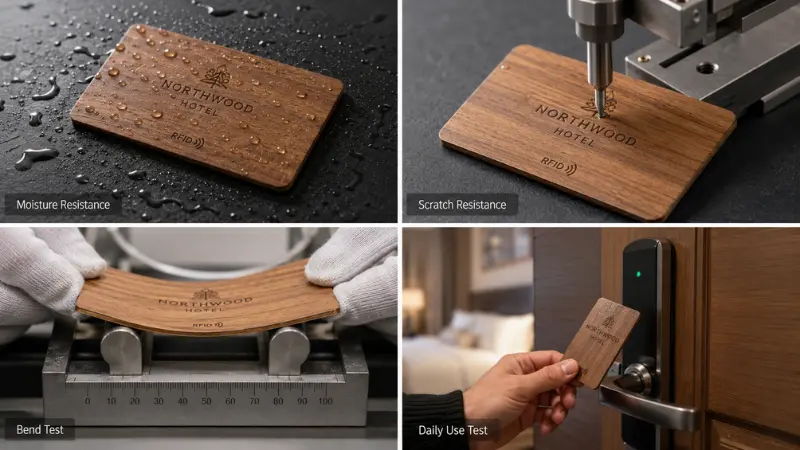
Be honest in your own marketing, too. Properly coated wooden cards are water-resistant, not waterproof - don't claim "waterproof" unless your supplier will stand behind it. For genuinely wet settings - beach resorts, spas, poolside, ski lodges - ask for stronger sealing and test under realistic conditions. And for pools, saunas, and wristband zones specifically, a wooden card may not be the right tool at all; hotel RFID wristbands are often the more practical credential for water-heavy areas.
Step 5 - Read Sustainability Claims Carefully
Sustainability is a leading reason hotels switch to wood, and it's also where it's easiest to overpromise. Ask your supplier what wood is used, whether FSC-certified or responsibly sourced material is available, what the core is made of, whether packaging is plastic-free or recyclable, whether material documentation exists, and how used cards should be collected.

The honest framing: a wooden RFID card is rarely fully biodegradable, because the chip, antenna, adhesive, coating, and core may still contain non-wood components. What a wooden card genuinely does is reduce the plastic feel, improve material perception, and support a credible sustainability story when the materials are responsibly sourced. That honesty protects long-term brand trust far better than a "100% eco" claim you can't defend.
Step 6 - Compare Cost, MOQ, Lead Time, and Value
Wooden cards cost more than standard plastic RFID cards, but unit price is the wrong place to anchor. Final cost tracks chip type, wood, thickness and structure, branding method, quantity, sampling, packaging, encoding support, and lead time. Minimum order quantities and lead times vary widely by finish and customization, so confirm both in writing rather than assuming - a custom engraved walnut card with numbering is a different timeline from a plain printed run.

When comparing quotes, make every supplier quote the same chip, material, finish, and method, or you're comparing nothing. And weigh brand value, not just unit price: guests handle the card at check-in, at the door, and at checkout, and a well-made wooden card makes that experience feel deliberate. If you want the bigger picture of what RFID actually changes in hotel operations, it reframes the card as part of the system rather than a line-item.
Common Mistakes When Ordering Wooden RFID Hotel Cards
- Choosing by looks first. The prettiest sample is useless if your encoder can't program it - confirm chip and encoding before anything else.
- Assuming all 13.56 MHz cards are equal. Same frequency, different chips, memory, and security: a Classic card and a DESFire card both tap, but they aren't interchangeable in your system.
- Skipping sample testing. A photo can't open a door. Test physical samples on your actual encoder and locks.
- Overpromising sustainability. "Eco-friendly" is fair; "fully biodegradable" usually isn't, once you count the chip and antenna.
- Ignoring the environment. A city business hotel, a beach resort, and a ski lodge have different durability needs - spec the coating and structure for the real setting.
Pre-Order Checklist for Hotel Buyers
Have this ready for your supplier before mass production:
- A current key card sample (the fastest path to chip identification)
- Hotel lock brand and model
- Encoder model or front-desk system details
- Required chip type, if known
- Card size and thickness requirements
- Quantity and reorder plan
- Preferred wood material
- Logo file in vector format
- Branding method: engraving, UV printing, or both
- QR code or numbering needs
- Packaging requirements
- Sustainability documentation needs
- Sample approval process
A capable OEM/ODM card manufacturer should verify chip compatibility, produce samples, and adjust details before bulk production - not just take the order.
A Simple Way to Decide
If you're stuck, narrow it in this sequence: confirm the chip and encoding your locks need, pick the wood that fits your brand, choose engraving or printing based on that wood's contrast, set durability by environment, and only then compare prices on identical specs. If you'd like it laid out as a repeatable checklist, here's a five-step way to choose the right card.
Conclusion
RFID wooden key cards are a strong upgrade for hotels chasing a more premium, natural, sustainability-minded guest experience - but the right card is never chosen on looks alone. Start with lock compatibility, then work through wood, structure, branding, durability, sustainability, and cost, and test samples on your real locks before you commit. Done well, the card does more than open a door; it carries your brand from the moment a guest checks in. For broader context, this complete guide to RFID cards covers the technology behind the surface.
FAQ
Q: Are RFID wooden key cards waterproof?
A: They're water-resistant when properly coated with sealed edges, which suits normal hotel use. They shouldn't be treated as fully waterproof unless your supplier specifically confirms it. For pools and spas, consider wristbands instead.
Q: Will wooden cards work with my Saflok, VingCard, Salto, or Onity locks?
A: They can, but it isn't automatic. Each platform has its own encoder and encoding rules, so the card must carry the right chip and data format for your specific system. The reliable test is encoding a sample on your front desk and opening real doors before you order in bulk.
Q: Are wooden key cards thicker than standard plastic cards?
A: Usually slightly. They follow the same ID-1 card format, but the wood layer can make them a touch thicker than a standard 0.76 mm plastic card - so confirm they still feed your encoder slot and any holders.
Q: Can guests tap a wooden card with a phone?
A: If it carries an NFC-readable chip, yes - useful for Wi-Fi, a digital concierge, or a review page. That NFC function is specified separately from the access credential your locks read; one card can do both.
Q: Which chip should a hotel choose - Classic or DESFire?
A: It depends on your locks and security needs. MIFARE Classic is common and economical but uses an older, broken cipher; MIFARE DESFire uses AES and suits properties prioritizing cloning resistance. Confirm what your encoder supports before deciding.
Q: How long do wooden cards take, and is there a minimum order?
A: Both vary with wood, finish, and customization. Custom engraving, numbering, or combined branding extends timelines, so confirm minimum order quantity and lead time in writing for your exact specification.
Q: Are wooden RFID key cards more eco-friendly than plastic?
A: They support a more sustainable brand image, especially with responsibly sourced wood and reduced-plastic packaging. Avoid claiming the whole card is fully biodegradable, since the chip, antenna, and coating typically aren't.
Q: Should hotels order samples before mass production?
A: Yes - strongly recommended. Test the cards against your real lock system, encoder, and front-desk workflow, and approve the design, before confirming any bulk order.
Send Inquiry