


Custom Mold RFID Keyfobs: A Sourcing Guide for Access Control Distributors
Nov 26, 2026
Leave a message

Moving a private-label access-control key fob from a stock housing to a dedicated injection mold changes your upfront tooling spend, your reorder minimums, and your supplier exit risk-not just how the shell looks on a key ring. For distributors supplying apartments, multifamily residences, and property management accounts, the real question is whether a custom housing still makes commercial sense after the first order, across smaller repeat orders, and when a property asks to verify a batch on installed readers.
This guide breaks down what dedicated tooling actually controls, how to quote a stock shell and a custom mold on the same credential specification, which mold ownership clauses belong in your Request for Quotation (RFQ), and how to separate supply-chain provenance checks from credential verification and access-control authorization.
What a Dedicated Mold Changes for Your Private-Label SKU
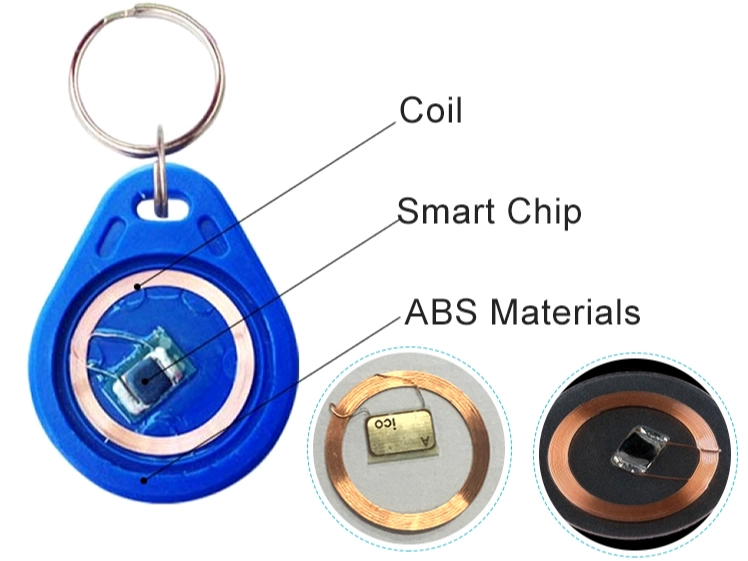
A dedicated injection mold controls the physical geometry, structural tolerances, and branded silhouette of the outer housing for your private-label stock keeping unit (SKU). It does not change the RFID chip inside, the encoding format, or how an installed reader validates the credential. Treating housing design, operating frequency, and system compatibility as three separate checks prevents costly assumptions during private-label sourcing.
Before committing to new tooling, compare three distinct layers of the product:
Stock shell with custom branding: You select an existing housing shape and add your logo, color matching, or laser-engraved numbering. You avoid new mold fabrication fees and shorten initial lead time, though other buyers can typically source the same physical shell shape when it is a shared catalog housing without separate exclusivity terms. If you want to benchmark standard shapes first, review existing ABS RFID key fob housings before requesting custom tooling.
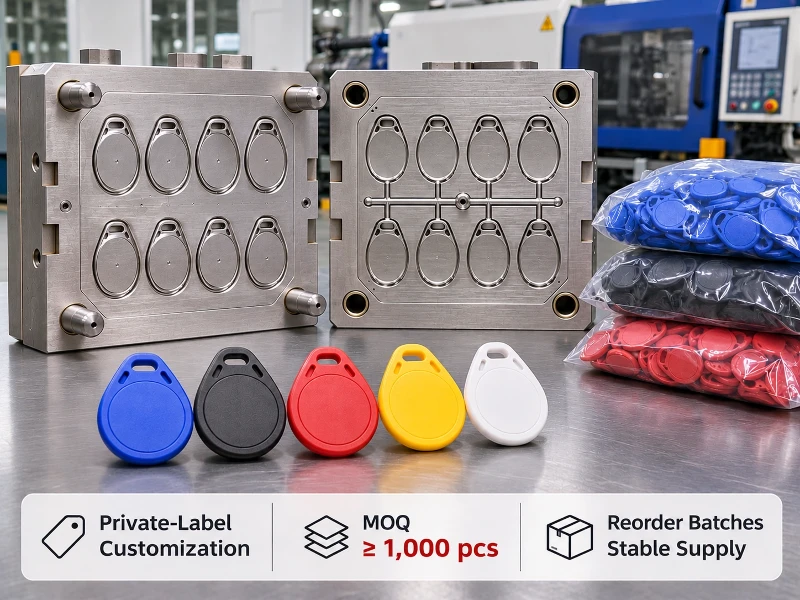
Dedicated injection mold: You commission a custom shell geometry built to your approved drawing. This adds upfront tooling cost and development lead time compared with existing molds, and it introduces ongoing responsibilities for tool custody, maintenance, and change control.
Credential configuration (independent of the shell): The transponder chip part number and memory architecture are defined by the selected integrated circuit (IC), while the encoding format, application configuration, and authentication requirements must be selected and verified against the installed access-control system. For example, IC-level capabilities such as mutual authentication, application-level authentication, and AES key management are defined by the specific chip family, such as the MIFARE DESFire EV3 IC, rather than by the outer plastic housing (NXP Semiconductors).
In practice, two RFID key fobs can share an identical custom shell and still fail to work on the same door if the internal chip part number or encoding differs. Conversely, a stock shell built with the exact approved transponder and encoding can deliver the same credential functionality without a new dedicated tooling charge. Even then, the finished, sealed key fob still requires live reader compatibility and read-performance verification during sample approval, because housing material, internal geometry, antenna placement, key rings, and nearby metal can affect actual RF performance.
Compare the First Order and the Next Reorder
A dedicated mold often looks viable on an initial launch order and breaks down on the second or third reorder. Distributors carry the financial weight of repeat-order minimum order quantities (MOQs), per-batch setup fees, and slow-moving inventory if a property contract renews at lower volume than forecast.
Quote the Same Credential Both Ways
To make an apples-to-apples decision, freeze the credential specification first and request two quotes: one for a stock shell with custom branding, and one for a dedicated injection mold, using the exact same chip part number, encoding, numbering, packaging, and sample-approval requirements. Public on-demand injection molding terms show that commercial suppliers may separate upfront tooling, per-part pricing, and per-run production costs in their own service models (Protolabs). Your RFQ should require the same line-item separation so hidden per-batch charges do not distort unit pricing.
If you have not yet locked down chip, encoding, and production tolerances for the quote package, align your technical fields against an OEM key fob specification checklist before asking for pricing.
| Quote Line Item | Stock Shell + Custom Branding | Dedicated Injection Mold | What Must Stay Identical or Be Verified |
|---|---|---|---|
| Credential & Finished-Good Spec | To be quoted by supplier | To be quoted by supplier | Exact chip part number, approved encoding/format, identical finished-sample approval, same marking and packaging scope. |
| One-Time & Per-Batch Charges | To be quoted by supplier | To be quoted by supplier | Tooling fabrication, printing plates/fixtures, mold trial and first-article inspection, storage/maintenance, per-batch setup or encoding fees. Count items included in unit price only once. |
| Purchasing & Volume Terms | To be quoted by supplier | To be quoted by supplier | Currency, Incoterms/delivery basis, lead-time start trigger, initial MOQ, reorder MOQ, planned number of batches in the period, freight and duty basis. |
| Volume & Reorder Sensitivity | To be entered by buyer | To be entered by buyer | Same low / base / high sales-volume scenarios, factoring in minimum reorder lot sizes, ending inventory, and accepted sellable units. |
| Quality, After-Sales & Continuity | To be confirmed by technical / QC team | To be confirmed by technical / QC team | Installed-system sample sign-off, lot/serial traceability granularity, engineering change control, retained reference samples, and supplier exit terms. |
Check the Cost at Lower Sales Volumes
Evaluate both options over the same planning horizon (for example, 12 or 24 months), in the same currency, and under the same delivery and after-sales assumptions. Separate upfront tooling cash outlay (what you must pay before launch) from procurement cost per accepted unit over the evaluation period, and recalculate both across low, base, and high demand scenarios on the exact same basis:
Keep three accounting rules consistent across all three scenarios:
Define tooling allocation as a purchasing scenario rule: Decide whether Allocated Tooling Cost reflects 100% of the mold fee assigned to the initial planning period or a pro-rata share amortized over the planned evaluation window, and apply that same scenario rule consistently (separate from formal financial-statement accounting treatment).
Define landed cost and denominator cleanly: Include unit purchase price, freight, duties, and customs charges inside Landed Purchase Cost, and base the denominator on accepted sellable units received in the period (units that pass receiving and quality inspection and are ready for sale, rather than raw ordered quantity or unadjusted sales forecasts).
Track inventory carrying costs on a separate line: Record ending inventory (accepted units received minus units actually sold in the period) alongside warehousing, tied-up working capital, insurance, and slow-moving or obsolete stock exposure on a separate line so you do not double-count inventory already included in landed purchase cost.
Pay close attention to the low-volume scenario: if a dedicated mold requires a higher reorder MOQ than your slow-season demand, you either lock cash into excess stock and carrying costs or pay per-batch setup surcharges that erase the unit-price advantage of custom tooling.
As a practical decision boundary, prioritize a branded stock shell when demand is uncertain, repeat volumes are modest, or an existing housing already meets your brand and durability requirements. Evaluate a dedicated mold when a distinct physical geometry is commercially necessary, repeat order volumes are predictable across multiple reorder cycles, and tooling control can be secured in writing. Without live quotes for your specific chip and volume profile, no universal break-even quantity or payback timeline applies.
Put Tool Ownership and Reorder Terms in the RFQ
Paying a mold fabrication fee does not automatically guarantee that you legally own the steel, that no other buyer can use the cavity, or that you can move the mold to another factory later. Commercial molding suppliers handle these terms differently. For instance, Protolabs separately outlines tool ownership, storage terms, quality documentation, and per-run production options within its own on-demand molding service tiers (Protolabs). Because molding suppliers structure exclusive use, third-party production restrictions, and cross-factory tool transfers differently across their commercial agreements, distributors should negotiate and document those rights directly in their written supply contract.
At Syntek, we support customer-exclusive mold projects, and we recommend confirming every commercial term-ownership, exclusivity scope, custody, idle storage, and transfer-in writing within the project quote and supply agreement before releasing a deposit, rather than relying on general website descriptions.
Document Custody, Maintenance, and Transfer
Include the following commercial clauses directly in your RFQ and purchase contract:
Tool identification and drawing revision: Assign a unique mold ID tied to the exact 2D/3D housing revision and cavity count.
Legal ownership vs. exclusive use: State clearly who holds title to the mold upon payment, whether exclusivity covers the full housing geometry or only branded inserts, and whether the supplier is prohibited from producing or subcontracting that housing for third parties.
Custody, maintenance, and shot life: Define who pays for routine cleaning, preventive maintenance, wear-part replacement, and repairs over the mold's expected service life.
Idle-storage period: Specify how long the factory will store an inactive mold at no charge, what triggers storage fees, and the notice period required before disposal.
Transfer and exit procedure: Detail the exact release conditions, export/transfer documentation, packaging responsibility, and any transfer or decommissioning fees if you move production to another facility.
Reorder change control: Require written buyer approval before the supplier modifies mold cavities, changes resin grade, switches inlay or chip sources, or alters encoding procedures on repeat orders.
To understand how tooling fabrication, trial runs, and mold inspections are structured before you negotiate contract milestones, you can review Syntek's mold production process.
Check the Source of a Lookalike Fob and the Credentials You Order
Distributors often consider custom molds because lookalike RFID key fobs appear in the field or because property managers ask how to prevent unauthorized copies. Managing those risks requires separating three distinct layers that involve different teams and different evidence:
Supply-chain provenance: Where a physical key fob came from, verified through contractual records, shipping documents, and batch traceability.
Credential verification and authentication: How the reader and access-control system validate the credential-whether by reading a static unique identifier (UID) or card number, checking chip and application compatibility, or executing cryptographic authentication when configured.
Access-control authorization: Whether the access-control system grants door entry based on that credential's assigned user permissions and schedule rules.
A reader detecting a key fob or reading its static UID does not prove cryptographic authentication took place, nor does it mean the user is authorized to open the door.
Match the Physical Serial to the Shipment Record
A distinctive custom housing helps warehouse staff and property managers spot obvious visual mismatches during receiving, but appearance alone is not proof of origin. If a lookalike fob surfaces without contractual or channel evidence confirming its source, treat it as an unverified unit and audit it against shipment records rather than relying on visual inspection alone.
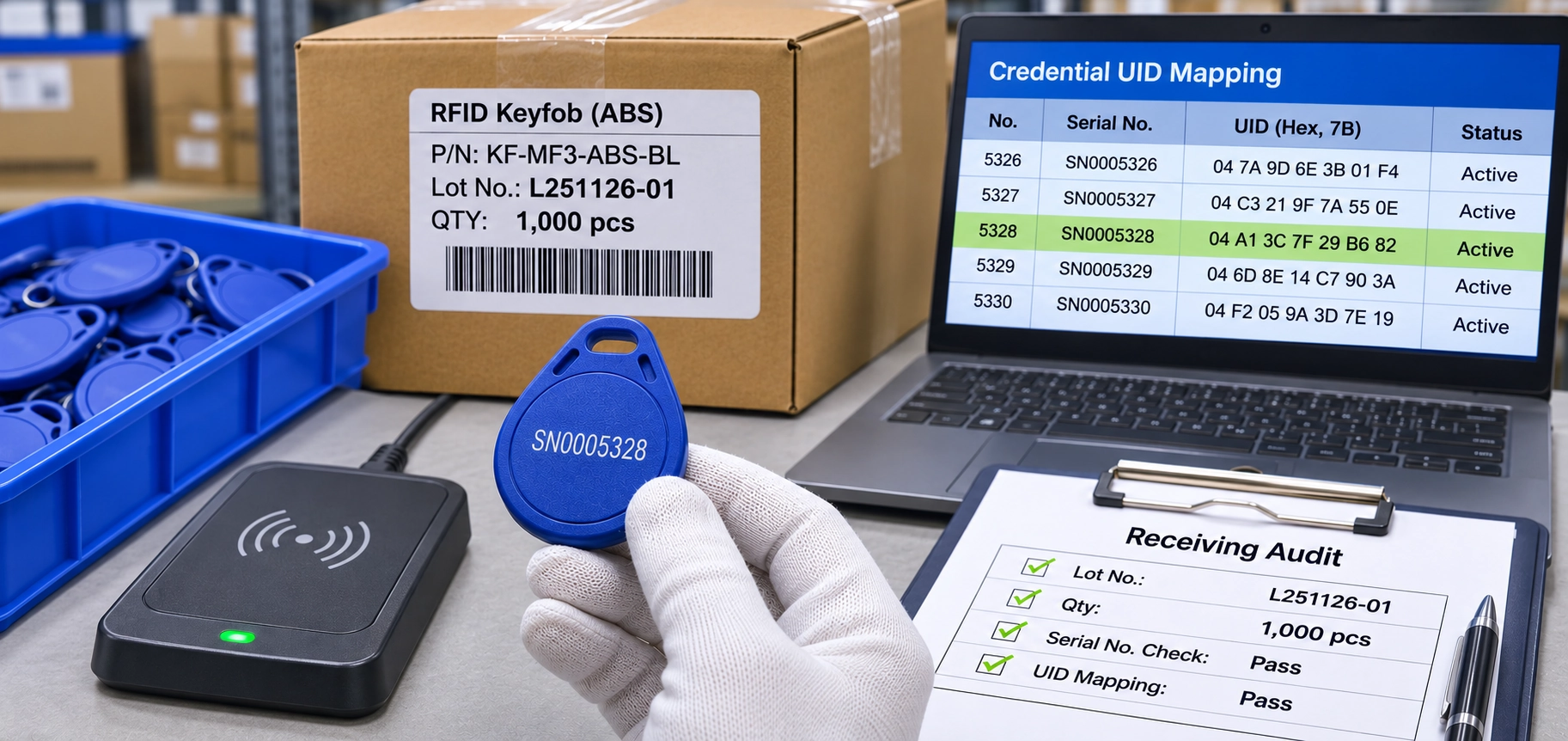
Supply-chain traceability standards distinguish between class-level identification (product or part ID), batch/lot-level identification (product ID plus batch or lot ID), and instance-level identification (product ID plus serialized unit ID) linked to specific shipping and receiving events (GS1). In private-label RFID key fob procurement, the visible number laser-engraved on the shell, the internal RFID identifier, and the number imported into the property's access-control software are not always the same field. Define the mapping rule in your project file, clarify which electrical and read checks the factory performs versus which live enrollment checks the customer or integrator completes, and require a matching batch record with every shipment.
| Field | Sample Structure (Template) | Procurement & Receiving Purpose |
|---|---|---|
| SKU / Revision | SKU-A-Rev2 | Ties the delivery to the approved housing drawing and credential spec revision (class-level reference). |
| Physical Shell Serial | Visible laser-engraved ID | Enables warehouse and property staff to log field units without a desktop reader (instance-level reference). |
| Internal Credential Reference | Mapped system ID / UID rule | Aligns the factory-encoded identifier with the format imported into access-control software. |
| Carton Lot Number | Outer carton lot ID | Isolates affected production groups quickly if a quality or read issue appears (batch/lot-level reference). |
| Shipment Batch / Date | PO number & ship date | Links physical stock back to a specific purchase order and commercial invoice. |
| Receiving & Acceptance Status | Pending / Approved / Quarantined | Records warehouse intake and prevents unverified units from mixing into sellable inventory. |
Note: Whether your project uses GS1-formatted identifiers or internal distributor numbering depends on your ERP and customer requirements; in either case, record integrity depends on disciplined supplier documentation and warehouse receiving checks.
Confirm How the Reader Validates the Credential
A custom plastic shell cannot stop credential cloning if the underlying chip and installed reader rely on an unauthenticated identifier. Credential security is determined at the system and IC level, not by the outer housing:
Check IC capabilities against actual system configuration: While specific chip families such as MIFARE DESFire EV3 support mutual authentication and AES-based application security at the IC level (NXP Semiconductors), putting a secure chip on a quote does not mean an installed building system is configured to use those security features.
Verify legacy compatibility branches separately: If an existing property still runs legacy hardware, confirm with the integrator whether backward compatibility is required or whether a migration is planned. NXP directs security-relevant applications away from MIFARE Classic toward its DESFire or Plus families (NXP Semiconductors).
Let system risk drive authentication: As reflected in the risk-based authentication principles outlined for physical access control in NIST SP 800-116 Rev. 1-a U.S. federal Personal Identity Verification (PIV) standard cited here strictly for its system-level selection principle, not as a mandate for commercial apartments-the authentication mechanism must be chosen to match the facility's actual security requirements and installed infrastructure (NIST).
In your RFQ, record the exact installed reader and controller models, the active authentication mode, and the authorized integrator who will sign off on credential behavior before finalizing chip selection.
Set Mold-Specific Sample and Reorder Approval Gates
Even when the outer mold stays identical, repeat orders can fail if an unannounced change occurs in the inlay, antenna coil, chip batch, or encoding script. In real-world deployments, hardware and credential compatibility must be checked together. For example, during a campus reader upgrade, the University of Illinois Facilities & Services advised users to check whether their existing cards carried HID/Seos markings to confirm compatibility with the new reader technology (University of Illinois Facilities & Services).
To protect dedicated-mold projects from informal substitutions, structure your distributor procurement workflow around five mold-specific approval gates (and confirm exact milestone deliverables with your supplier before issuing a PO):
Freeze the credential and housing specification: Lock the exact chip part number, encoding format, numbering rule, resin type, and artwork/3D file before releasing tooling payment.
Approve mold drawings and commercial terms: Sign off on the 2D/3D tooling drawing, cavity layout, revision code, and written mold ownership, custody, and transfer clauses.
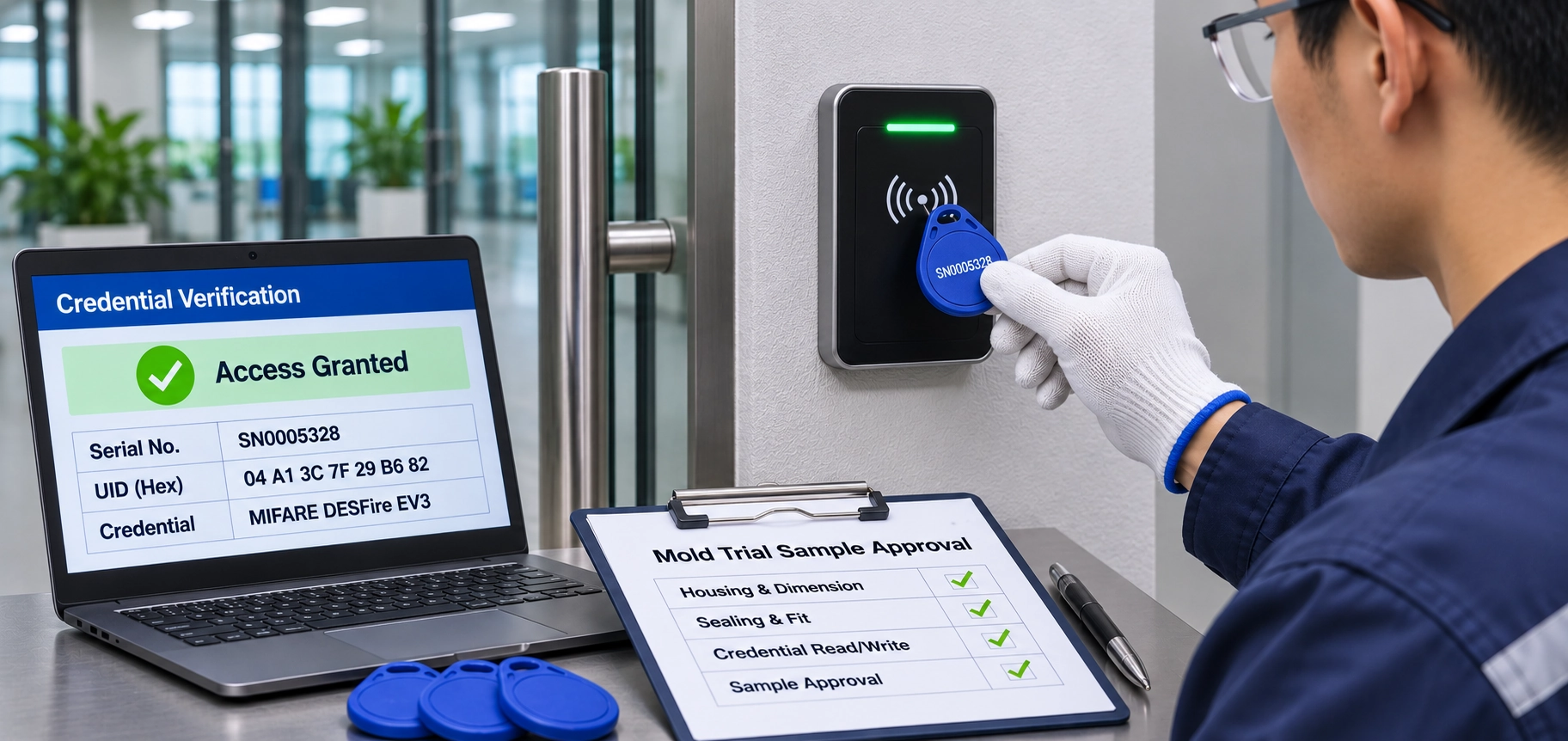
Complete mold trials and approve finished samples on live hardware: Do not release mass production based on a loose chip or a generic desktop reader. Once the dedicated mold produces finished, sealed key fobs, follow a structured process to test the finished RFID key fob on installed readers and controllers with the property's integrator before approving mass production.
Archive revision-controlled reference samples: Retain signed reference samples from the approved mold-trial batch at both the factory and your warehouse, tied to the exact mold ID and spec revision.
Enforce reorder change-control triggers: Write a "no substitution without written approval" clause into every repeat PO. Any change to the chip supplier or part number, inlay construction, resin formulation, encoding version, or mold cavity work that affects housing geometry, internal fit, antenna placement, or RF performance must trigger a new finished-sample approval before shipment. Minor routine mold maintenance that does not alter dimensions or component positioning should still be logged under change control and reviewed by risk level.
Request a Stock-Shell and Dedicated-Mold Quote
When you are ready to compare real numbers instead of estimates, send both options in a single RFQ package so the quotes stay directly comparable. Include four core technical and commercial inputs alongside your documentation requirements:
Installed reader and controller models: Include the hardware models and the integrator-approved credential specification (chip part number, encoding format, and active authentication requirements).
Target housing design: Provide your target dimensions, 2D/3D design file (if quoting a custom mold), and logo, color, or laser-serialization requirements.
Initial and repeat-order quantities: Share your forecasted launch volume, realistic repeat-order batch sizes, and target delivery terms (Incoterms and timeline).
Batch documentation and mold terms: Specify required carton lot numbering, physical-to-system serial mapping files, reference-sample retention, and the mold ownership, exclusivity, storage, and transfer clauses you need confirmed in writing.
If you want to evaluate both paths side by side on the same credential specification, send us your reader details and volume targets to request two RFID key fob quotes from Syntek-one for a branded stock shell and one for a dedicated mold. You can also review Syntek RFID OEM and ODM services to confirm customization, encoding, serialization, and sampling options before submitting your RFQ.
Send Inquiry