

Contactless Smart Card Technology: From ISO 14443 To Real System Compatibility
Nov 26, 2026
Leave a message

A contactless smart card works as a chain of technical layers, not as one feature called "13.56 MHz" or "ISO 14443." The reader first creates the RF field that powers a passive card. The card and reader then discover each other, select a communication path, exchange protocol data, access an application, perform authentication if required, and finally pass a result to a controller or backend.
That layered model explains a common purchasing problem: two cards can operate at the same frequency and still fail in the same reader or application. Frequency does not define the exact IC, activation behavior, command set, authentication method, data format or host-system logic.
This article focuses on that technology stack. It does not repeat the broader question of whether a project needs an electronic card at all; Syntek's PVC cards with or without RFID guide owns that decision. It also does not compare contact and contactless interfaces inside dual-interface cards; that is covered separately in the dual-interface versus hybrid smart card guide.
Contactless Smart Card Technology Is a Stack, Not a Single Specification
The commercial phrase "contactless smart card" is often used too loosely. In practice, it can only be understood correctly when several layers are separated.
| Layer | What it answers | What it does not answer |
|---|---|---|
| Card body | What physical credential is being produced? | Which reader or application will accept it |
| RF interface | How does the reader power and communicate with the card? | What business data or security model is used |
| IC / card platform | What memory, processing and card-side functions are available? | Whether those functions are enabled in the deployed system |
| Application | Which files, commands or credential objects are used? | Whether the backend will authorize the user |
| Authentication / keys | How does the system verify permitted access to protected functions? | Whether the business transaction is approved |
| Reader / host | Which credential technologies and data formats are supported? | Whether another reader model behaves the same way |
| Backend / controller | What does the credential mean in the business system? | Nothing about the RF interface by itself |
A supplier phrase such as "ISO 14443 smart card" therefore identifies only part of the chain. It does not automatically define the IC family, application, security configuration or system compatibility.
Inside the Card: Antenna, IC and Finished Card Construction
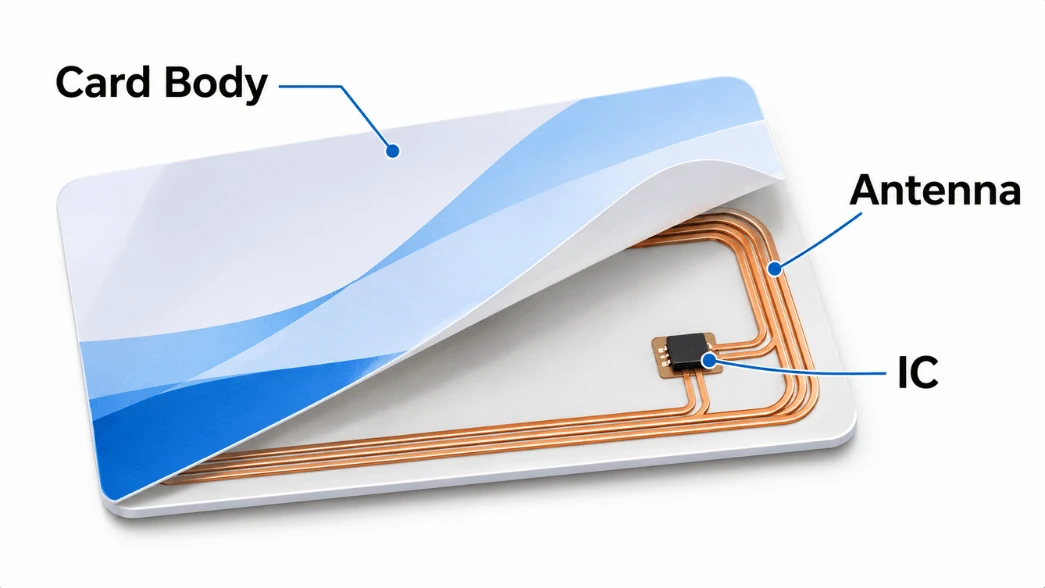
A typical passive contactless smart card contains an integrated circuit connected to an antenna. The reader provides an RF field; the card couples energy from that field and uses it to power the IC. The RF link is then used for communication between the reader and card.
The Secure Technology Alliance distinguishes smart cards that use a microcontroller with internal memory from cards based mainly on secured memory. That distinction matters because different IC architectures can support very different levels of processing, file management and authentication.
The finished card body is another layer. ISO/IEC 7810 covers identification-card physical characteristics, construction and dimensions. It does not define the contactless protocol or the access-control application. Buyers should therefore treat card dimensions, material and finish as separate requirements from the RF interface and IC.
Physical production can also influence RF performance. Antenna position, lamination, metallic decoration, slot punching and other construction changes can alter coupling. For that reason, a bare inlay or generic sample should not be assumed to behave exactly like the final printed card.
What Actually Happens When a Card Is Presented to a Reader?
The easiest way to understand contactless smart card technology is to separate the tap into four stages.
Stage 1: RF power and card discovery
The reader creates the contactless field. A passive card inside that field powers up through its antenna. The reader then polls for compatible cards or objects.
Stage 2: Initialization, anticollision and selection
If one or more compatible cards are present, the communication rules allow the reader to initialize communication and select a card. Anticollision is a
radio/protocol function for dealing with multiple cards; it is not user authentication.
Stage 3: Transport and card application
After selection, the communication may enter a higher transport protocol and then an application or IC-specific command set. The reader may select a file or application, request data, or start an authentication process. The exact sequence depends on the IC and the system design.
Stage 4: Host-system decision
The reader or attached host passes the resulting credential information to the next system layer. An access controller can allow or deny a door. A membership system can map the credential to an account. A ticketing platform can validate a travel right. The card does not independently make those business decisions.
This gives a useful troubleshooting rule: card detection, card communication, card authentication and business authorization are four different outcomes. A beep or LED at the reader may prove only the first one.

ISO/IEC 14443 Parts 1–4: What Each Layer Actually Covers
"ISO 14443" is often used as if it were one feature. It is a multi-part standard family for contactless proximity objects, and each part covers a different layer.
| Part | Current published reference | Main scope | Buyer implication |
|---|---|---|---|
| Part 1 | ISO/IEC 14443-1:2018 | Physical characteristics of proximity cards/objects | Does not define the application or security policy |
| Part 2 | ISO/IEC 14443-2:2020 | RF power and signal interface between reader and card | Describes the radio layer, not backend compatibility |
| Part 3 | ISO/IEC 14443-3:2018 | Polling, initialization, anticollision and selection | A card can be detected and selected before any application authentication happens |
| Part 4 | ISO/IEC 14443-4:2018 | Block transmission protocol and protocol activation/deactivation | Higher transport support still does not define the application keys or business rules |
Part 3 is especially important for understanding the boundary. ISO's own description states that protocols and commands used by higher layers and applications come after the initial phase. In other words, anticollision and card selection are not the same thing as application-level authentication.
Type A and Type B are contactless interface families within ISO/IEC 14443. They should not be treated as security levels. A Type A card is not inherently more or less secure than a Type B card; the security outcome depends on the IC, authentication method, key handling and application.
Standards also continue to evolve. ISO/IEC 14443-3:2018 is currently under revision, and a 2026 amendment to ISO/IEC 14443-4 addressing relay-attack protection mechanisms is under publication. A project with strict interoperability or security requirements should therefore name the exact standard revision or platform requirement instead of using "ISO 14443 compatible" as timeless shorthand.
Not Every ISO/IEC 14443 Type A Card Uses the Same Technology Stack
One of the clearest examples is within the MIFARE product family.
NXP lists MIFARE Classic EV1 as supporting ISO/IEC 14443-3 Type A. By contrast, MIFARE DESFire EV3 is listed as supporting the ISO/IEC 14443 Type A stack through Parts 1–4 and also provides a richer application and security model.
This difference is useful because both products may be described commercially as "13.56 MHz MIFARE cards," yet they are not interchangeable at the application layer.
| Question | MIFARE Classic example | MIFARE DESFire EV3 example |
|---|---|---|
| 13.56 MHz HF? | Yes | Yes |
| ISO/IEC 14443 Type A? | Yes | Yes |
| Same card-side command/application model? | No | No |
| Same authentication/security capability? | No | No |
| Can frequency alone prove reader compatibility? | No | No |
NXP itself directs security-relevant applications away from MIFARE Classic toward MIFARE DESFire or MIFARE Plus families. DESFire EV3, for example, supports application-level authentication, AES-based functions, multiple keys and applications, transaction MAC, secure messaging options and proximity-check functionality. Those are IC capabilities; the deployed reader and application still have to use them correctly.
Memory Card vs Secure Microcontroller: Why the IC Architecture Matters
The words "memory card" and "smart card" are often mixed together in supplier catalogs, but the card-side architecture can change what the system is capable of doing.
A memory-oriented card mainly stores identifiers or structured data and may provide limited access-control logic around that memory. A secure microcontroller card can support more complex application selection, authentication, cryptographic operations, multiple keys, protected files and transaction logic.
That does not mean every project needs the most capable IC. A simple membership lookup may only need a stable identifier. A controlled-access or multi-application credential may need authentication and protected data. The correct question is not "Which card has more memory?" but "What operation must happen on the card, and what must the reader prove before data is accepted?"
This is also why a supplier's memory-capacity figure is not a security specification. Larger memory does not prove stronger authentication, and a secure IC does not make the whole system secure if keys or backend rules are poorly managed.
UID, Authentication and Application Data Are Different Things
Another frequent source of compatibility and security confusion is the UID or card serial number.
A UID can help identify or select a card at the protocol or application layer, depending on the technology. It should not automatically be treated as a secret credential. A system that only reads a public identifier and compares it with a database has a different security model from a system that performs cryptographic authentication before accepting protected application data.
| Layer | Question | What success proves |
|---|---|---|
| Detection | Can the reader see a compatible card? | RF and early protocol communication work |
| Identification | Can the system obtain the expected identifier? | Identifier handling works |
| Authentication | Can the card and/or reader prove possession of the required secret or credential? | The configured authentication step succeeds |
| Application access | Can the system read or update the intended protected object? | Application permissions and keys are correct |
| Authorization | Does the backend allow the requested action? | The business rule accepts this credential in this context |
This distinction is the reason "the reader can see the card" should never be the only acceptance test for a contactless smart card project.
NFC and Contactless Smart Cards Overlap Without Being the Same Thing
The NFC Forum technology overview shows that NFC devices can communicate with several existing contactless technologies, including ISO/IEC 14443 Type A and Type B cards, ISO/IEC 15693 cards, ISO/IEC 18092 devices and NFC Forum Tags. NFC devices can also operate in reader/writer mode and card-emulation mode.
This means NFC is not a synonym for one specific smart-card IC. A phone may detect a contactless card but still be unable to use its protected application. The application may require authentication keys that the phone does not have, or it may use an issuer-controlled command structure rather than an NDEF record.
Conversely, an NFC Forum Tag carrying a URL can work perfectly for phone-tap engagement without behaving like an access-control smart card. For that simpler phone-interaction task, Syntek's NFC tag guide is the more relevant owner.
Compatibility Must Be Verified Across the Whole Chain
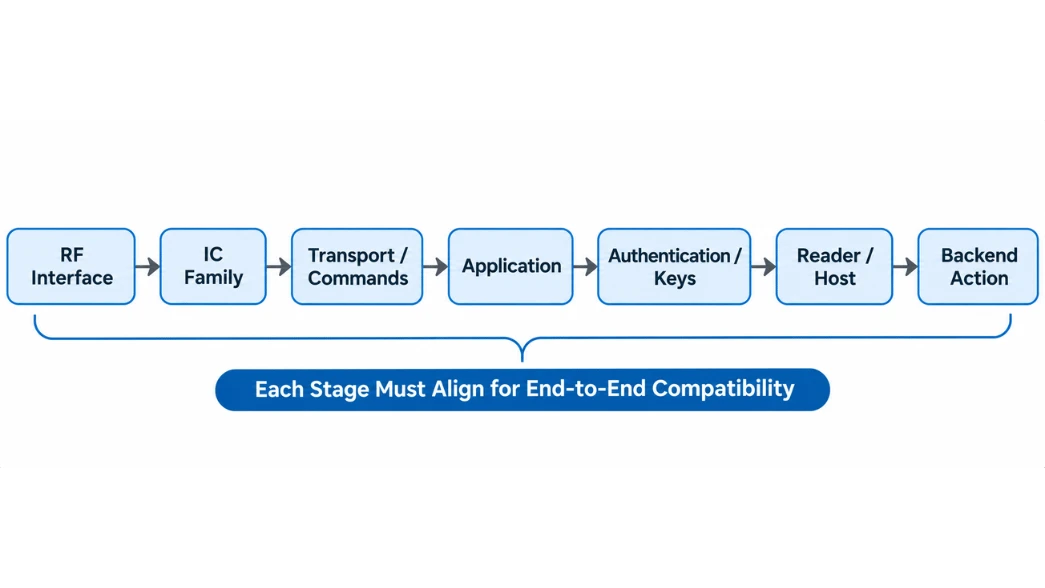
The practical compatibility question is not "Are both products 13.56 MHz?" It is whether every required layer lines up.
| Compatibility layer | What to verify | Typical evidence |
|---|---|---|
| Frequency / RF interface | Required HF band and Type A/Type B or other interface | Reader and IC datasheets |
| IC family | Exact card family or platform supported by the reader | Reader compatibility list |
| Transport / commands | Whether the reader stack can communicate beyond card detection | Reader SDK, middleware or platform documentation |
| Application | Required files, applications, data objects or credential format | Application specification |
| Authentication / keys | Supported algorithm, key ownership and production key configuration | Personalization and key-management records |
| Host data | What identifier or application data reaches the controller/software | Captured test output and mapping specification |
| Backend action | What business action must succeed | End-to-end acceptance test |
Real reader documentation supports this layer-by-layer approach. HID's current Signo Reader 40, for example, lists named 13.56 MHz credential families such as Seos, iCLASS, MIFARE DESFire EV1/EV2/EV3 and MIFARE Classic rather than claiming support for every card operating at the same frequency.
If the project is specifically a hotel lock system, the existing hotel key card technology guide goes deeper into lock and encoder compatibility. This page stays at the general contactless smart-card technology layer.
What Buyers Should Verify Before Ordering
For most B2B projects, a short technical verification sheet is more useful than a long generic RFQ.
- Exact IC or approved card family: do not approve a quote that only says "13.56 MHz smart card."
- Required interface: confirm the relevant ISO/IEC 14443 Type A, Type B or other interface requirement.
- Actual reader model: record the reader that will be used in production, including software or firmware details if they affect support.
- Application behavior: define the data, file, application or credential object that the system must use.
- Authentication: state whether the system only reads an identifier or must perform protected authentication.
- Host result: define the exact output expected at the controller or software layer.
- Finished card construction: confirm that the production sample uses the intended body, printing, lamination and personalization state.
The Syntek RFID Card category remains the commercial owner for card inquiries. For projects requiring custom printing, encoding or other manufacturing work, the OEM/ODM page is the appropriate commercial next step. Current manufacturing capability and order terms should be confirmed there rather than inferred from a technical article.
A Five-Step Sample Test Is Usually Enough to Expose Compatibility Problems
- Identify the sample. Record the exact IC/card family and production-relevant card construction.
- Use the intended reader. Test on the reader model that will be deployed, not only on a universal desktop reader.
- Go beyond detection. Confirm that the reader enters the required application or command path rather than only displaying a UID.
- Complete the intended transaction. Verify the real host result: access decision, account lookup, ticket validation or another defined action.
- Freeze the approved configuration. Keep the IC, reader, application, key profile where applicable, card construction and expected host result as the reference for production.
Batch-level receiving checks belong to a different task. If the next question is how to inspect blank cards after delivery, use the existing blank RFID card incoming-QC guide.
The Core Rule: Match the Whole Stack
Contactless smart card technology can be summarized as a chain:
card construction → RF power and interface → card selection → transport → IC/application → authentication and keys → reader/host → backend authorization.
ISO/IEC 14443 is a critical part of that chain, but it is not the whole system. The same is true for 13.56 MHz, NFC and a familiar commercial IC family name. Each describes only part of the credential.
For buyers and integrators, the safest technical question is therefore not "Is this card contactless?" It is: Which exact card, reader, application and backend path must work together, and what end-to-end result proves that they do?
Send Inquiry