

RFID Anti-Counterfeiting in 2026: A Procurement Guide for Commodities
May 28, 2026
Leave a message

The $467B Problem Most Brand Protection Stacks Aren't Built For
In 2021, the most recent year with comprehensive customs data, counterfeit and pirated goods accounted for an estimated $467 billion in global trade, or 2.3% of all commerce and 4.7% of EU imports specifically (OECD-EUIPO, Mapping Global Trade in Fakes 2025). Dangerous categories such as counterfeit automotive parts and falsified medicines kept climbing post-pandemic. The procurement question that follows is whether an rfid anti-counterfeiting program is the right defensive layer to add, and which version of it.
Against that backdrop, RFID is the fastest-growing technology slice of anti-counterfeit packaging. MarketsandMarkets projects the rfid anti-counterfeiting packaging market to reach $110.1 billion by 2030, a 17.95% CAGR that outpaces holograms, forensic markers, and tamper-evident seals (MarketsandMarkets press release).
Growth numbers like that don't tell a procurement manager which RFID to actually buy. This article focuses on UHF and item-level commodity authentication. The consumer-tap NFC layer is covered in a separate deep-dive on NFC anti-counterfeiting. The point is to spare you the eighteen-month learning curve most brands go through before figuring out which questions to even ask vendors.

What an RFID Anti-Counterfeiting System Actually Has to Do
Most vendor pitches collapse the system down to one layer: the tag. That's a problem. A working rfid anti-counterfeiting deployment lives at three layers simultaneously, and weakness at any one of them collapses the whole thing.
The physical layer is the chip, the antenna, and the substrate. This is where the unique identifier lives, where tamper-evident design either works or doesn't, and where you decide whether labels can be peeled off and reused on a counterfeit. The communication layer is the frequency band and the air-interface protocol (UHF EPC Gen2v2, HF ISO/IEC 14443 or 15693, NFC NDEF), plus any cryptographic authentication wrapped around the read command. The backend layer is the database, the optional blockchain or cloud verification service, and the analytics that turn a stream of reads into an actual authenticity verdict.
Most articles that come up when you search this topic focus on layer one and ignore layers two and three. That's where rfid anti-counterfeiting deployments fail in the field, and where procurement budgets get wasted late in the project.
01 // Physical Layer
The physical layer is the chip, the antenna, and the substrate. This is where the unique identifier lives, where tamper-evident design either works or doesn't, and where you decide whether labels can be peeled off and reused on a counterfeit.
02 // Communication Layer
The communication layer is the frequency band and the air-interface protocol (UHF EPC Gen2v2, HF ISO/IEC 14443 or 15693, NFC NDEF), plus any cryptographic authentication wrapped around the read command.
03 // Backend Layer
The backend layer is the database, the optional blockchain or cloud verification service, and the analytics that turn a stream of reads into an actual authenticity verdict.
Frequency Selection: UHF, HF, NFC, or Chipless
Each band serves a different rfid anti-counterfeiting role, and trying to use the wrong one for your scenario is the single most common procurement mistake we see.
UHF read range and unit economics in the table align with field data published by the Auburn University RFID Lab (Auburn University RFID Lab).
Our stance: for most commodities (apparel, consumer electronics, cosmetics packaging, automotive parts, mid-tier wine, OTC pharma), a UHF tag using a cryptographic Gen2v2 chip is the right choice for the supply-chain layer. NFC becomes useful only if you also want consumers to verify with their phones at the point of sale. Choosing NFC alone because "consumers can scan it" is how brand-protection projects end up with no upstream visibility, because no warehouse worker is going to tap a smartphone to every box on a pallet.
Chipless RFID fits only where a forensic non-cloneable signature is required and scan volume is low, such as high-value art, collectibles, or documents read on specialised scanners. For commodity rfid anti-counterfeiting above a few thousand units annually, it has no cost or logistics advantage over cryptographic UHF.
But the conclusion has a click-gap most articles skip: which specific UHF chip you select determines whether the system actually resists cloning, or just looks like it does. That's the layer down.
| Dimension | UHF / RAIN (860–960 MHz) | HF (13.56 MHz) | NFC (13.56 MHz subset) | Chipless RFID |
|---|---|---|---|---|
| Typical read range | 1.5–3 m passive | ~10 cm | <4 cm | 0.5–5 cm |
| Bulk read capability | Hundreds per second | Limited | One tag at a time | One at a time |
| Per-unit tag cost at volume | $0.05–0.10 plain; $0.15–0.40 cryptographic | $0.08–0.25 | $0.08–0.30 | Sub-$0.05 printed |
| Consumer smartphone read | No (specialised reader) | No | Yes, any NFC phone | No |
| Strong native crypto | Yes, Gen2v2 + ISO/IEC 29167-11 (M775, UCODE DNA) | Yes | Yes (NTAG 424 DNA) | Indirect (PUF-style) |
| Best authentication role | Supply chain, warehouse, retail back-of-house | Closed-loop access | Consumer POS verification | Inherently non-cloneable signature |
Can RFID Anti-Counterfeiting Tags Be Cloned?
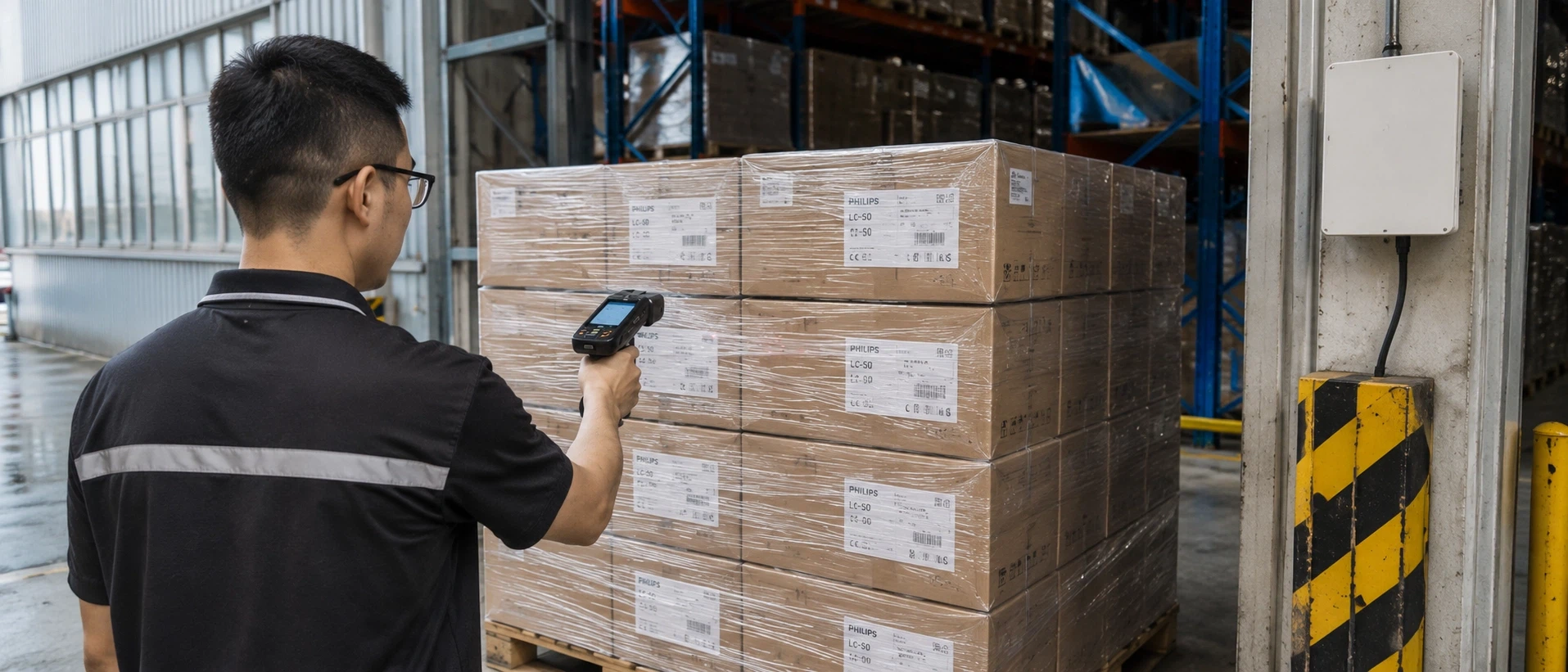
Yes, plain UHF EPC tags can be cloned. With an off-the-shelf reader/writer, an attacker can copy a static EPC UID onto a fresh chip and walk a counterfeit through the same scanners the genuine items use. Academic teams have demonstrated the attack repeatedly against pharma supply chains (PLOS One, Kamaludin et al., 2018).
That's the version of the story competing brand-protection vendors build their pitch on, and they're not wrong about the baseline. The version most don't tell is that the chip industry already solved this in 2014–2022.
NXP's UCODE DNA was the first UHF tag IC to combine long-range performance with AES-128 cryptographic authentication compliant with ISO/IEC 29167-10. Each read triggers a fresh AES calculation tied to a unique per-tag key, so a recorded response is invalid by the next scan (RFID Journal coverage of UCODE DNA). Impinj followed with the M775, which supports the GS1 Gen2v2 Authenticate command and ISO/IEC 29167-11 (Impinj M775 product brief). For any UHF rfid anti-counterfeiting project launched after 2023, choosing a plain UID-only chip is a procurement decision, not a technology limitation.
So the cloning problem is solved at the chip layer. The cloning problem worth actually worrying about is the one no one is selling against: legitimate tag transfer. A dishonest distributor peels a genuine, cryptographically authentic tag off a real product and applies it to a counterfeit. The tag is real. The crypto checks out. Only tamper-evident substrate design, such as fragile-inlay and destructible-antenna constructions, defends against this. It's documented in U.S. Patent 10,664,734 and in IET Blockchain research (IET Blockchain, Wiley, 2024). Our sales team gets called into this scenario two or three times a year, usually after a brand traces grey-market product back to a distributor's warehouse.

What an Item-Level RFID Anti-Counterfeiting Program Actually Costs
Procurement teams usually arrive at this section first. We've put it fifth on purpose, because the costs of an rfid anti-counterfeiting solution only make sense once you've narrowed the chip choice down.
Across the deployments we've shipped for apparel, cosmetics, and OEM electronics brand-protection projects, the cost stack looks roughly like this. Plain UHF wet inlays and stickers, suitable for closed-loop inventory plus basic UID lookup, land between $0.05 and $0.10 per unit at order quantities above one million. Cryptographic UHF (M775, UCODE DNA) runs $0.15 to $0.40 per unit at comparable volumes, with MOQ typically 100,000–500,000 depending on chip family and antenna design. NTAG 424 DNA for the consumer-tap NFC layer sits in the same range as cryptographic UHF. Encoding, ERP integration for serialisation, reader infrastructure, and the cloud authentication service add another layer on top.
The rule of thumb for procurement teams: if your retail price is above $15, an item-level rfid anti-counterfeiting label using cryptographic UHF stays under 2% of unit cost. Below $15 retail the math gets tight unless you use basic UHF with database lookup, which has the cloning problem we just walked through. This is why fast-moving low-margin goods rarely run cryptographic item-level RFID; they batch up to case-level instead. For current per-unit pricing across UHF wet inlay, sticker, jewelry-tag, and coin-tag SKUs, a sample request is the fastest route to specific quotes against your form factor.
Where RFID Anti-Counterfeiting Already Works
Five industry patterns show up repeatedly in deployments we've supplied components for, or are well-documented in the trade press. They map onto different procurement decisions.
In pharmaceuticals, the WHO estimates roughly 1 in 10 medical products in low-regulation regions is substandard or falsified, with the May 2025 WHO Medical Product Alert N°3/2025 on falsified IMFINZI (durvalumab) in Iran and Türkiye driving renewed enforcement urgency. The falsified vials reportedly contained no active ingredient. This followed an earlier WHO Medical Product Alert N°5/2024 covering Armenia, Lebanon, and Türkiye. UHF on case-level shippers plus serialisation at the unit-dose level has become the de facto rfid anti-counterfeiting architecture in pharma as DSCSA enforcement has tightened.
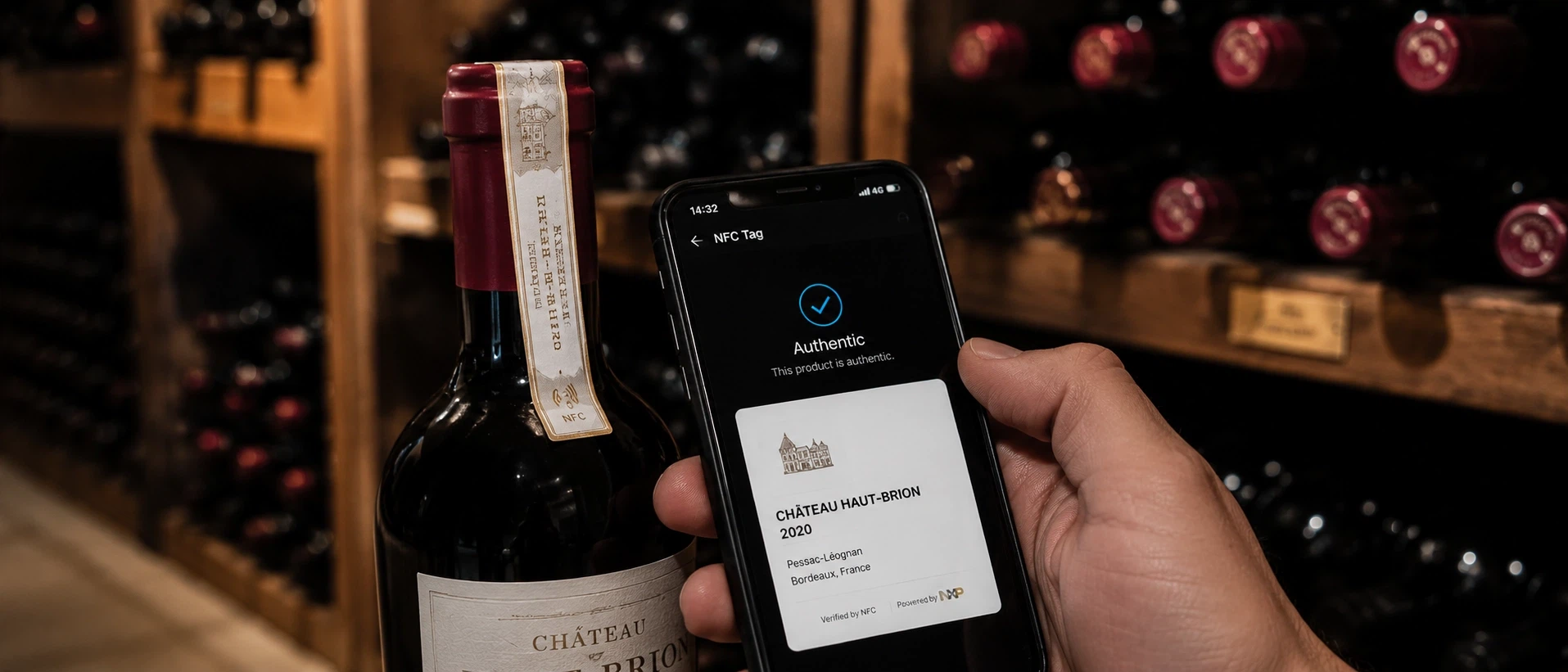
Wines and spirits have been a poster category since the early 2010s. Across the bottle-neck NFC programs we've supplied for European and APAC wineries, clients running this rfid anti-counterfeiting architecture report 80–90% reductions in verified counterfeits across controlled distribution channels within the first 18 months, numbers consistent with the published Tuscan DOCG case studies, and that we can speak to directly because our inlays sit on the bottles.
Luxury leather goods have shifted toward NFC + blockchain item identities, including SATO's APAC programs and the Swiss collectID platform, where each tag interaction generates a non-replayable encrypted message recorded on-chain (NFC Forum case study). Fashion accessories took a different route: Luxottica embedded UHF RFID into the bridge of its sunglasses for online-purchase verification, useful for products where a hidden inlay outperforms a visible label.
Consumer electronics with consumables show the cleanest economic case. STMicroelectronics embedded NFC readers in electric toothbrush bodies that authenticate replacement brush heads (STMicroelectronics NFC counterfeiting use cases). The host device is the reader, so there's no smartphone dependency.
The pattern across all five categories: an rfid anti-counterfeiting deployment that succeeds is the one where the read scenario, the chip class, and the substrate were chosen together at the start. Patching a frequency or substrate mismatch six months in is what makes brand-protection projects go over budget.
Five Failure Modes Most Vendors Won't Mention
After roughly two decades of supplying RFID components, here are the deployment problems that come up in client conversations more often than they appear in marketing material.
The first is legitimate tag transfer, already mentioned. Cryptographic chips don't help if a genuine tag is peeled off a real product and stuck onto a fake. Fragile substrates and tamper-evident inlay design matter as much as the chip choice, which is why fragile-label adoption has accelerated across luxury and pharma packaging.
The second failure mode is backend abandonment. A centralised verification service is a single point of failure. We've watched at least two mid-tier brand programs go dark this way between 2020 and 2024. Architectures with offline-verifiable signatures or blockchain anchoring survive this scenario; pure database lookups do not.
Third, "we use RFID" doesn't mean "we resist cloning." A large share of deployments labelled rfid anti-counterfeiting in 2024–2025 still rely on static UID + database matching, the version academic teams have been cloning for fifteen years. Ask vendors explicitly: does the chip support Gen2v2 Authenticate and ISO/IEC 29167-10/11? If not, what you bought is traceability, not authentication.
Fourth, cold-chain adhesive failure. In field testing on wine cellars and pharmaceutical cold storage below −15°C, water-based PSA adhesives lose roughly 30–40% of bond strength versus their room-temperature spec. We've moved clients in those environments to solvent-based acrylic or cryo-rated constructions. An anti-counterfeiting label that falls off in transit is no longer an anti-counterfeiting label.
Fifth, and this one is useful rather than purely a failure, genuine tags get scanned more often than counterfeit ones. E-pedigree research finds genuine products read at roughly 50% higher frequencies, because they pass through more legitimate checkpoints. Backend anomaly detection in any serious rfid anti-counterfeiting program can lean on this signal heavily, though few brands actually do.
Why EU DPP 2027 Changes the Math
Starting in February 2027, the EU's Ecodesign for Sustainable Products Regulation (ESPR) mandates Digital Product Passports for industrial and EV batteries, with textiles, electronics, furniture, and several other categories following through 2028–2030. RFID and NFC are both explicitly listed as approved DPP data carriers, which puts any rfid anti-counterfeiting investment on the same physical layer. The chip industry is already shipping DPP-targeted products, including NXP's NFC tags designed for DPP requirements.
The procurement implication that almost no 2024–2025 RFID brand-protection article discusses: an rfid anti-counterfeiting program launched today is also infrastructure for the DPP requirement coming next year. If your category is already in DPP scope, running a separate DPP program after your current anti-counterfeiting tags go live doubles the cost of physical identifiers with zero additional margin. This is the strongest non-cost argument for moving now rather than waiting that we've seen in twenty years of supplying this market.
A Procurement Decision Checklist for RFID Anti-Counterfeiting
Eight questions to answer with internal stakeholders before signing any tag order. If you can't answer three of them confidently, the rfid anti-counterfeiting project isn't ready for procurement yet.
| # | Question | Why it determines your tag choice |
|---|---|---|
| 1 | What is the unit retail price? | Below ~$15, cryptographic item-level UHF is usually uneconomic; batch to case-level |
| 2 | Who reads the tag: staff, distributor, consumer, or all three? | Determines UHF vs NFC vs hybrid |
| 3 | Does the chip support Gen2v2 Authenticate or ISO/IEC 29167-10/11? | If no, the system gives you traceability, not authentication |
| 4 | Is the substrate destructive on removal? | If no, you're exposed to legitimate-tag transfer |
| 5 | Is the verification backend yours or a vendor's SaaS? | If vendor's, model the failure mode where they shut down |
| 6 | Does the product enter the EU after Feb 2027? | If yes, design for DPP carrier compliance from day one |
| 7 | What environment does the tag have to survive? | Cold chain, autoclave, UV, and metal-adjacency all change inlay class; defer to bench testing |
| 8 | What is the supplier's encoding and pre-test capability? | Field failures usually trace back to mass-encoding QC; request the supplier's reader-mix test report |
These cover the foundational decisions. The harder questions, such as category-specific MOQ trade-offs, chip-family upgrade paths over the next five years, and the bench-test protocols we run before every cryptographic UHF batch ships, get resolved during sample evaluation, not on a static checklist. A free-sample request anchors questions 7 and 8 against your actual environment.
Working with Syntek
Syntek has manufactured RFID and NFC components since 2006: five automated production lines, more than 200 workers, over 100,000 chip-bonding operations per day across a 3,600 m² ISO 9001:2015-certified facility in Hunan. Annual exports exceed $3 million USD, with the majority shipping to Europe, North America, Russia, and the Middle East. CE and ICAR certifications cover the products that need them.
What that translates to for brand-protection procurement: we encode and pre-test every cryptographic UHF batch across multiple reader platforms before shipment, we maintain inventory in both standard and fragile-substrate formats, and we ship free samples for field validation before any production commitment. For any rfid anti-counterfeiting deployment, adhesive performance, read distance, and substrate durability should be tested in your actual environment. Our UHF wet inlay, sticker, and jewelry-tag product range is the natural starting point for tag evaluation; free samples ship within a week of request.
Frequently Asked Questions
Q: What is RFID anti-counterfeiting and how does it work?
A: RFID anti-counterfeiting uses radio-frequency tags carrying unique, often cryptographically protected identifiers to verify product authenticity in the supply chain. A reader interrogates the tag and validates the response against a backend database or cryptographic authentication service. This is far harder to forge than a static QR code or hologram.
Q: Can RFID anti-counterfeiting tags be cloned?
A: Standard UHF tags using a static EPC UID can be cloned. Modern cryptographic UHF chips (Impinj M775 and NXP UCODE DNA, supporting GS1 Gen2v2 Authenticate and ISO/IEC 29167 encryption) generate a fresh cryptographic response on every read, making practical cloning infeasible.
Q: UHF or NFC: which is better for RFID anti-counterfeiting?
A: For supply-chain RFID anti-counterfeiting, UHF suits bulk authentication at warehouses, distributors, and retail back-of-house, readable from 1–3 m, including case-level and pallet-level. NFC is designed for consumer-tap verification via smartphone at point of sale. Mature brand-protection deployments combine both.
Q: How much does an RFID anti-counterfeiting program cost per item?
A: Standard UHF inlays run $0.05–0.10 per unit at volume. Cryptographic UHF and tamper-evident NFC chips typically run $0.15–0.40 per unit. For most branded goods this is under 2% of retail price.
Q: Does RFID anti-counterfeiting comply with the EU Digital Product Passport?
A: Yes. The EU's ESPR framework lists RFID and NFC as approved DPP data carriers, with batteries mandated from February 2027 and other categories, including textiles, electronics, and furniture, following through 2030.
Send Inquiry