

RFID Tags For Manufacturing: Select The Tag, Map WIP Events And Validate The Read Zone
Nov 20, 2026
Leave a message

RFID tags can help a factory identify work-in-process (WIP), track returnable totes and verify that the right material reaches the right station. The business result, however, does not come from attaching more tags. It comes from deciding what is being identified, which event matters and where that event can be captured reliably. A tag that works on a desk can behave differently beside a steel fixture, liquid-filled part, moving conveyor or heat-treatment process.
If you are selecting RFID tags for manufacturing, define the production decision before selecting a label. For example: "At Station B, confirm that the correct tote for Work Order 126 has arrived before the operator starts the next task." The work order number here is an illustration, not a documented customer project. It describes a testable event and a consequence when the event is missing. That provides a much better specification than requesting an unspecified "long-range industrial RFID tag."
Identify the correct object: part, container, pallet or fixture
Start with a simple change-of-ownership question: does the physical tag remain with the individual product, or does it identify a reusable carrier whose contents change? The answer sets the identity rules. When a tray holds a batch, the tray may be the object that a reader observes. The application must separately record which parts are in it and when that relationship changes; it would be incorrect to report that the reader individually verified each part merely because the tray tag was detected.
Identity lifecycle at a WIP station
| Operation | What needs an explicit transaction | Potential failure if skipped |
|---|---|---|
| Load a carrier | Associate work order, lot or serialized parts with an identified tote/rack | Reader sees a valid carrier but the wrong contents are inferred |
| Station entry | Apply a zone rule and validate that the work order is permitted at that step | Adjacent stationary carriers trigger false arrivals |
| Rework or partial removal | Update contents and processing state before the next read point | Completed or scrapped material inherits stale progress |
| Empty and return | Clear the prior association while retaining the reusable carrier identity | New work may be associated with the previous customer's or lot's record |
Tagging each manufactured part may be justified for high-value serialized products that need lifetime identification. In other processes, a durable RFID tag on the returnable carrier provides more value. If five identical parts move together in a tray, the production application may need to track the tray and its current contents rather than every item. That relationship must be captured in software and updated when parts are added, removed, reworked or scrapped.
| Identification target | Typical reason to tag it | Important limitation |
|---|---|---|
| Individual finished part | Serial-level routing or traceability | Tag must survive or remain usable through the intended lifecycle |
| WIP tray or tote | Movement between production stations | Contents may change, so the tray-to-part link needs a control process |
| Returnable rack or fixture | Asset location, usage and maintenance history | The tag identifies the fixture, not automatically the work loaded onto it |
| Pallet or material container | Receiving, replenishment and material flow | Bulk reads may identify neighboring units unless the read zone is engineered |
| Reusable tool | Tool check-in/out or calibration association | Metal, size and handling constraints may drive the tag housing |
A clear object model avoids double counting. Ask which object is the system of record, whether child parts are associated with a parent carrier, how that association changes and who is permitted to resolve exceptions. A successful scan by itself does not say what the object contains or whether the next process step is authorized.

Choose HF, NFC or UHF for the actual workcell
Many line-side identification applications use passive UHF, also called RAIN RFID, when multiple tags may need to be inventoried without direct contact. HF RFID and NFC can be useful where a deliberate short-range interaction is preferable. Low-frequency technologies also exist for specialized environments. The best selection depends on system architecture, tag placement, approved regional reader settings and the operational need, not a universal ranking of "better" frequencies.
GS1 describes UHF RAIN systems as using the EPC Gen2/ISO/IEC 18000-63 family, while common NFC operates at 13.56 MHz. Refer to GS1's frequency overview for the distinctions. Frequency is only one piece: antenna arrangement, chip protocol, identifier format, reader settings and middleware all need to match the project.
For a conveyor with multiple adjacent workpieces, the objective may be to recognize the intended carrier while excluding tags waiting beside the station. A wider read range can make that task harder rather than easier. For operator-confirmed tasks, a deliberate close-range tap or scanner action may be easier to audit. Avoid deciding between technologies based solely on the advertised maximum read distance.
Industrial technology suppliers demonstrate that RFID WIP is a combined hardware-and-software task: the Impinj/Xemelgo manufacturing solution overview describes software that uses reader observations to track work-order location, status and priority. It is not evidence that a particular Syntek tag or reader is compatible with that integration. Buyers still need to qualify their specified devices, identifiers and software interfaces.
Plan for metal, liquids, heat and mechanical abuse
Manufacturing environments are unforgiving to generic adhesive labels. Metal can detune or reflect RF energy and alter the antenna interaction. Water-rich products or liquids can absorb or change RF propagation, particularly in UHF applications. Heat, chemicals, abrasion, oil, washdown and vibration may degrade the label substrate, encapsulation or attachment before the IC itself fails.
Use the actual installation surface and process sequence to select the form factor:
- On-metal fixture or tool: consider an on-metal-rated tag and test it on the same metal profile, mounting orientation and spacing used in production.
- Plastic tote or bin: confirm that the adhesive or mechanical attachment survives cleaning, stacking and normal impacts.
- High-temperature route: specify the maximum process temperature, dwell time, number of cycles and whether the tag must be readable during the hot stage or only after cooling.
- Liquid or chemical exposure: provide the exact substance, concentration, exposure method and cleaning schedule when asking for material compatibility.
- Changing assemblies: check whether nearby parts are added later and whether their presence changes the read behavior or damages the tag.
For on-metal applications, request a product-specific attachment method and test it against the real fixture. The task here is to qualify the complete manufacturing workflow, not simply to find an on-metal SKU.
Build the read zone around a business event
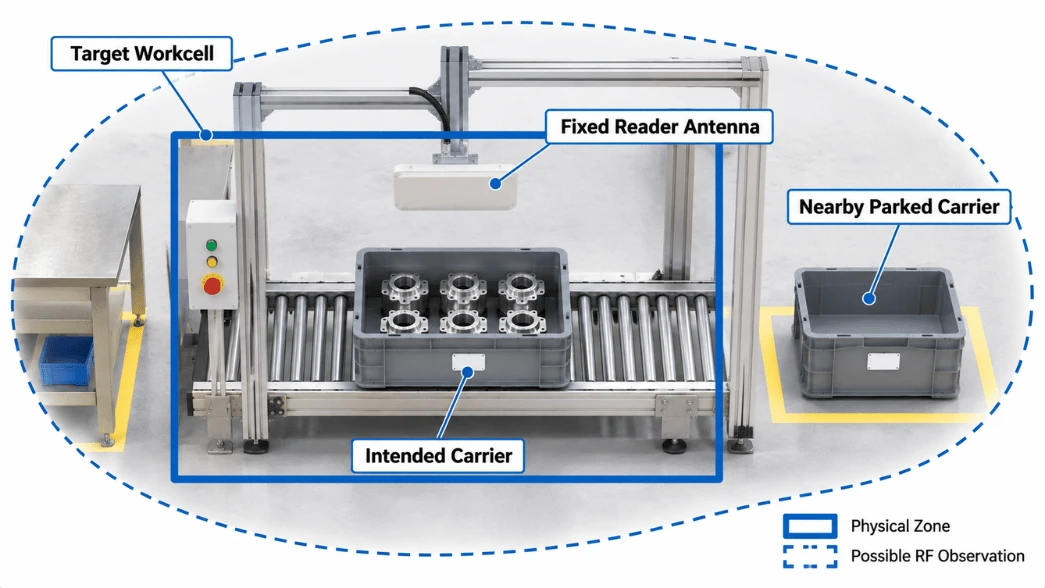
A reader detects RFID responses within its physical RF environment. The application needs to interpret those responses as meaningful production events. The two boundaries are not identical. A fixed reader at a workstation might see the next rack, a nearby parked tote and the intended arriving tote at the same time. Without rules governing event timing and location, a dashboard can register material that has not truly entered the station.
For each proposed read point, document the following:
- Trigger: What physical action or state should cause an event-arrival, departure, operator confirmation or completion of a specific process?
- Read zone: Which tag positions must be captured, and which nearby locations must be excluded?
- Identity: Is the tag bound to a product serial, carrier asset ID, batch or work order, and who maintains that association?
- Event rule: How are repeated reads within the same dwell handled? When should a new arrival be recognized?
- Exception behavior: What happens when the tag is absent, unreadable, unexpected or associated with the wrong job?
- System acknowledgement: What confirms that the application accepted and recorded the event, beyond the reader simply seeing the tag?
Antenna placement, power settings, shielding or physical guides may help constrain a zone, but their effectiveness depends on the actual workcell. Test with neighboring tagged objects present and normal production motion restored. Do not present a successful empty-cell demonstration as proof of a reliable live read zone.
Station-level failure isolation
A line-side failure should be classified at the layer where it occurs. If a tag is not observed, test mounting, antenna geometry, tagged-object material, reader configuration and interference. If it is observed at the wrong station, investigate read-zone boundaries and event filtering. If the correct observation reaches middleware but the work order does not advance, check object-to-work-order association, permitted process sequence and MES acknowledgment. These failures require different owners; treating all three as "bad tags" produces the wrong corrective action.
For busy stations, pair the RF observation with an appropriate physical or software condition: a gate sensor, a fixture occupancy signal, an operator confirmation or a valid process-order transition. The condition must come from the actual station design, not an assumed universal rule. Keep negative test objects in neighboring zones during commissioning so that false-positive behavior is visible.
Make the manufacturing event data useful downstream
RFID hardware often returns an identifier. The production system must transform that identifier into a useful event: the object, time, observed location and business operation. A small but coherent event record lets a factory investigate where an object was last seen and whether the expected step occurred.
For teams needing interoperability, the GS1 EPCIS overview describes visibility events through the familiar what, when, where and why dimensions. EPCIS is not a requirement for every internal project; it is a helpful reference for disciplined event modeling. RFID and barcode capture can both feed an event-oriented system when appropriate.
| Sample event field | Purpose | Source of truth |
|---|---|---|
| Object ID | Identifies the tracked part, carrier or tool | Approved serialized identity registry |
| Read point / workcell | States where the observation occurred | Configured and validated reader location |
| Event time | Places the observation in the production timeline | Time-synchronized approved system |
| Business step | Classifies the operation or process milestone | MES/WMS or process rule |
| Work order association | Relates the observed object to planned work | Controlled production records |
| Exception status | Records whether review or intervention is required | Application logic and authorized operator |
An illustrative data flow is tag response → reader observation → filtered event → manufacturing-system check → accepted business action. Each arrow has an owner. If a tag is read twice, the event service may need to prevent an accidental duplicate move. If a tag is seen at the wrong station, the system needs a rule for hold, warning or operator override; that is a business control, not a tag feature.
The important distinction is between a radio observation and a business event. GS1 explains EPCIS visibility data as records describing what happened, when, where and in which business context. A factory does not have to implement EPCIS merely to benefit from this separation; a proprietary MES event can implement the same design discipline. If formal EPCIS interoperability is required, the event identifiers, business step, location vocabulary and export format must follow the actual GS1 specification rather than this illustrative table.
Run a production-equivalent pilot, not a bench-only demo
The acceptance plan should include a representative shift or operating pattern with actual line-speed conditions, materials, fixtures and nearby tagged objects. Build the pilot around expected and deliberately challenging cases. A meaningful pilot checks the complete system outcome, including exceptions and recovery, rather than reporting a read percentage without a test method.
| Scenario | What to validate | Evidence to retain |
|---|---|---|
| Correct object at correct station | Expected business event is created once | Reader log and accepted MES/WMS event |
| Neighboring or parked objects | Unintended items are not released as completed | Location map and false-positive review |
| Object arrives in several orientations | Coverage remains acceptable in defined normal handling | Orientation and movement test notes |
| Tag damaged or absent | Process reports an exception and permits approved fallback | Failure-handling and manual recovery record |
| Carrier content changes | Association is updated before the next event | Association history and reconciliation |
| Network or backend interruption | Events are preserved, retried or safely held according to design | Recovery test and duplicate-event check |
Agree in advance on the lot of tags, sample sizes, run conditions, target thresholds and how failures are classified. Include device firmware, antenna geometry, mounting details, software versions and the operational state at each failure. These records allow a supplier and integrator to investigate changes without relying on memory or informal demonstrations.
Define pass criteria as business outcomes
Document the denominator of every performance result. A trial in which one carrier is presented ten times is not equivalent to a shift involving many carriers, changing loads and adjacent RF zones. Classify a missed intended event, an unintended neighbor event, a duplicate accepted event and a data-association error separately. Specify the allowed outcomes for each class before the pilot begins, including whether the system pauses work, requests operator intervention or retries safely.
For each scenario retain a ground-truth record: the operator-confirmed object, station, sequence and actual intended business state. Compare this record with reader observations and the events accepted by the MES. Report a denominator and test conditions alongside any measured rates; without those details, a headline "read accuracy" is not reproducible or comparable. The method is a proposed acceptance framework, not a claim of field performance.
Stage rollout by failure consequence
- Qualify a single read zone with a reference object, full normal load and neighboring objects.
- Run a controlled set of correct-route, wrong-route, duplicate, absent-tag and backend-interruption scenarios.
- Compare the system's accepted state transitions against independent ground truth.
- Freeze the tag construction, attachment, reader setup and software revision that passed.
- Expand to another station only after the specific change in environment and workflow has been evaluated.
Keep the RFQ aligned with the factory process
When requesting quotations, provide the tag vendor with more than a label size and frequency. A practical RFQ contains the object to be tagged, mounting substrate, mechanical clearance, movement path, exposure to metal or liquids, expected temperature and cleaning cycles, required lifetime, desired identification event and intended reader architecture. Ask for an exact model datasheet and production-equivalent samples.
Specify whether the supplier delivers blank tags, pre-encoded serialized tags, printed tags or a mixed solution. Determine who owns the identifier namespace and how it maps to production records. If a part may be scrapped, reworked or placed back in circulation, document the reassignment policy. Avoid copying credential identifiers or serial schemes between orders without an approved data-governance process.
For industrial form factors, Syntek's special RFID tag category is a commercial reference point; confirm the exact SKU against your environment before purchase. The UHF warehouse logistics guide covers a different adjacent task-distribution and warehouse movement-rather than production workcell event control.
Measure useful production decisions, not only successful reads
After a pilot, ask whether the factory can distinguish a correctly routed item from an unintended neighbor, recover from a damaged tag, reconcile carrier contents and identify which event was accepted by the production system. These outcomes are more informative than a headline read-range claim. They also help decide whether RFID should be deployed at every station or only at the handful of process points where automated identity changes a decision.
RFID tags for manufacturing become valuable when the object model, physical tag and event logic are qualified together. Start with one critical WIP movement, test it with the real materials and operators, then make the RFQ and repeat-order specification reflect the conditions that actually passed.
Send Inquiry