

RFID Technology for External Personnel and Vehicle Access Control System
Sep 12, 2025
Leave a message
RFID Technology: Building a New Cornerstone for Intelligent Visitor and Vehicle Management
Safe, efficient, and orderly management is a core requirement in modern industrial parks, large enterprises, high-end communities, logistics hubs, and large venues. The management of visitors and vehicles has always been a weak link in traditional security systems. Traditional manual registration methods are not only inefficient and prone to congestion at entrances and exits, but also suffer from numerous drawbacks, such as information errors, easy forgery of credentials, and difficulty in data traceability. With the rapid development of the Internet of Things (IoT), RFID (Radio Frequency Identification) technology, with its unique advantages, is becoming a key enabler for intelligent visitor and vehicle management and achieving a "digital intelligence" security upgrade.
Pain Points of Traditional Management: The Dual Challenges of Efficiency and Security
Before the introduction of RFID technology, visitor and vehicle management typically faced the following pain points:
Inefficiency: Manual registration, identity verification, and issuance of paper credentials are cumbersome, resulting in long queues at entrances and exits during peak hours.
Poor Security: Paper passes are easily forged and lent, and if lost, they cannot be promptly reported, posing a significant security risk.
Information siloing: Registration information forms "data islands," making it difficult to integrate with visitor management, parking systems, and access control systems, preventing full process traceability.
Poor user experience: The complex registration process is a poor experience for visitors; for administrators, the heavy workload is prone to errors.
Introduction to RFID Technology: The Silent "Smart Sentinel"
RFID is a contactless automatic identification technology. It uses radio signals to automatically identify specific targets and read and write relevant data, without requiring mechanical or optical contact between the identification system and the target.
A typical RFID system consists of three components:
Electronic tags: Attached to the object to be identified (such as a vehicle windshield or a personal badge), they contain a built-in antenna and chip, storing a unique ID and specific information.

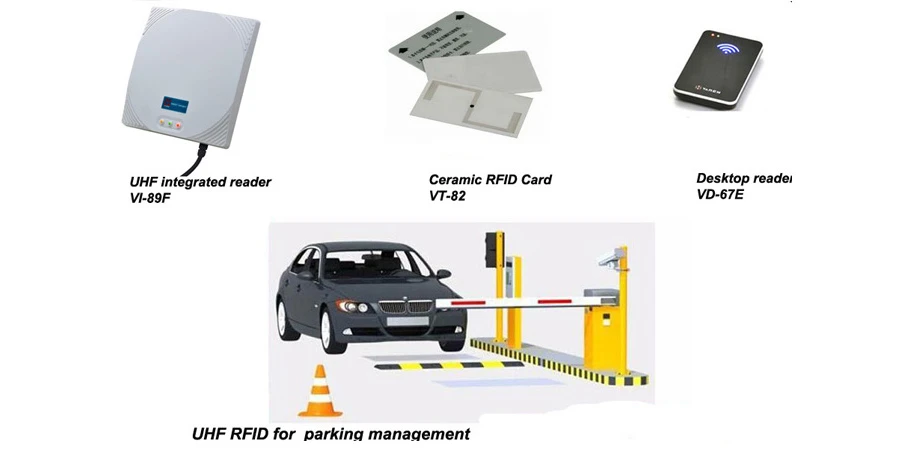
Readers: Devices used to read or write tag information, installed at key locations such as entrances and exits.
Antennas: Connected to the reader, they transmit radio frequency signals between the reader and the tag, establishing a communication bridge.
Backend management systems: Process the data collected by the reader, performing identity verification, assigning permissions, storing records, and implementing linkage control.
How Does RFID Enable Smart Management of Visitors and Vehicles?
Applying RFID technology to manage visitors and vehicles enables automation, precision, and visualization of the entire process.
For Visitors: Achieve "Contactless Passage" and Precise Management
Appointment Registration and Remote Authorization: Visitors make an appointment in advance through the online platform and submit their license plate, visitor information, and other information. Upon approval, the system remotely associates the license plate number with an RFID electronic tag (typically a UHF tag) or directly authorizes the license plate number (as a virtual electronic tag).
Instant Entry and Exit, Contactless Verification: When a vehicle arrives at the entrance, an RFID reader automatically identifies the tag or license plate information from a distance (up to several meters to tens of meters), and the system completes verification instantly. The barrier automatically raises, eliminating the need to stop or roll down windows, significantly improving traffic efficiency and avoiding congestion.
Route Restrictions and Timeout Alerts: The system can set authorized driving routes and dwell times for vehicles. If a vehicle enters an unauthorized area or overstays, the system will immediately issue an alarm, notifying security personnel to intervene, enabling precise control.
For outsiders: Implement "One-Card Access" and full traceability.
Quick Card Issuance and Identity Binding: After registering their identity at the front desk, visitors receive an RFID badge or wristband (typically a high-frequency tag). This tag is linked in real time to their identity information and access rights (such as the building, floor, and time period allowed).
Seamless Access Control: Visitors no longer need to pull out their card and hold it close to the door. Simply wear it, and the reader will quickly identify and verify their access rights, automatically opening the door for a seamless and seamless experience.
Tracing Movement: By deploying readers at key access points, the system records visitors' real-time location and movement trajectory. In the event of a security incident or when locating a person, their historical movement paths can be quickly traced, providing critical data support for emergency response.
System-Level Advantages: Data-Driven Decision-Making and Joint Defense
Data Integration, One-Screen Overview: All personnel and vehicle entry and exit records, dwell time, and real-time status are aggregated on a unified management platform and presented on a large, visually-rich screen, enabling a "one-screen overview" of the entire situation and a clear overview.
Intelligent Interaction, Proactive Security: The RFID system seamlessly integrates with video surveillance, intrusion alarms, and fire protection systems. When the system detects an unusual intrusion (such as an untagged person entering a restricted area), it automatically triggers nearby cameras to capture the situation and issue an alarm, forming a closed loop of "perception-identification-warning-action."
Data Analysis, Optimized Operations: Data accumulated over the system's long-term operation can be used to analyze visitor peaks, parking patterns, and other factors, providing data support for optimizing resource allocation and improving management efficiency.
Send Inquiry