


Event Passes: How To Choose The Right Credential For Your Event
Sep 01, 2026
Leave a message

Event passes do more than identify attendees. Depending on the event, they may communicate a person's role, show when a credential is valid, help staff recognize access levels or connect the wearer to a digital access-control system.
A general-admission guest, VIP, artist, production crew member and security contractor can all be inside the same venue without needing the same credential.
That is why event-pass selection should start with the operating rule rather than the material catalogue:
role → access rule → verification method → form factor → material → data → issuance → sample approval
Once those decisions are defined, choosing between a laminate, badge, wristband, QR credential or RFID event pass becomes much easier.
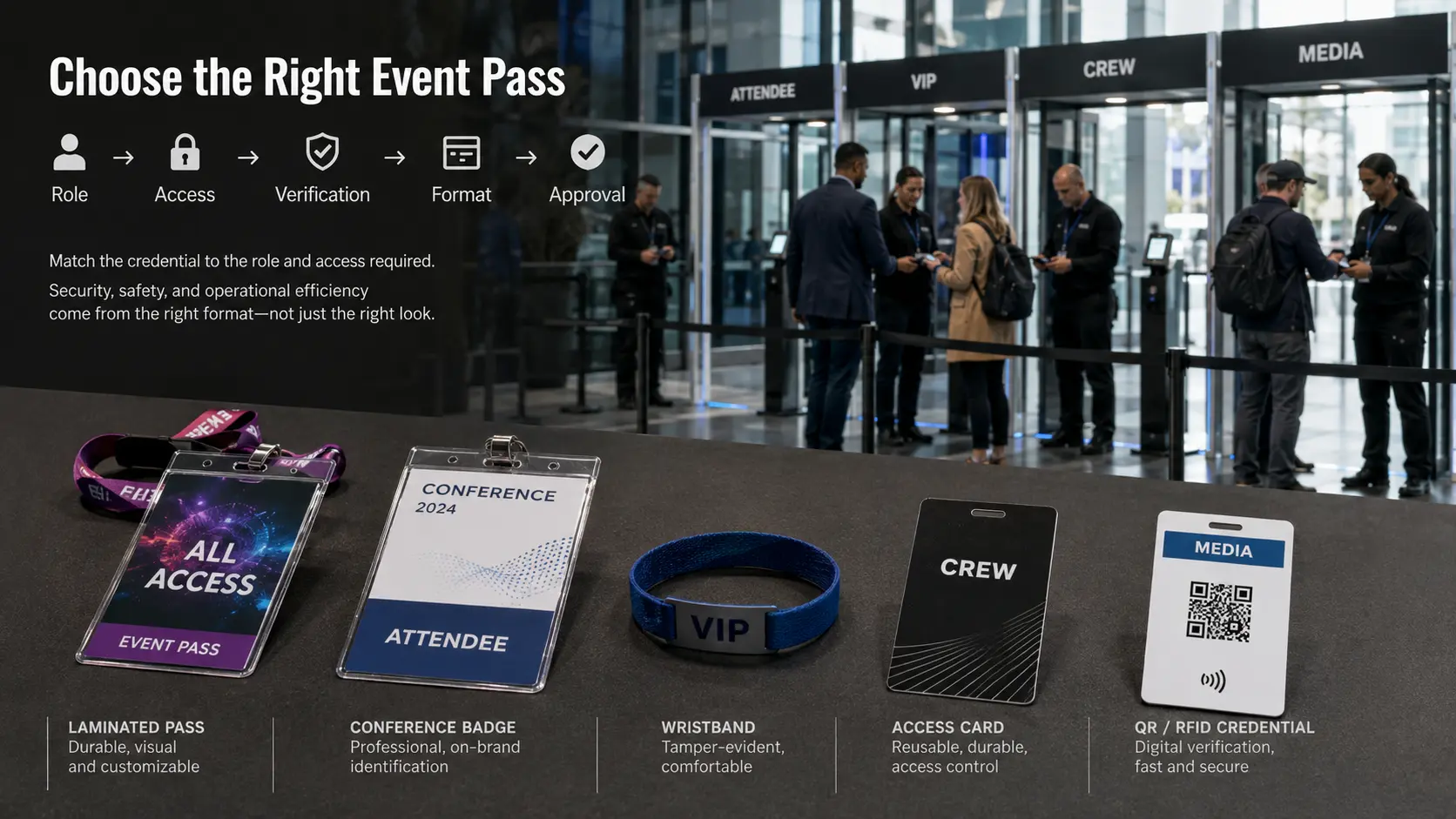
Quick Answer: Which Event Pass Fits Which Requirement?
| Requirement | Practical Starting Point | Main Question |
|---|---|---|
| One-day visual admission | Printed pass, badge or wristband | Does staff only need fast visual confirmation? |
| Conference identity | Name badge or printed credential | Do staff and attendees need to see the person's name, company or role? |
| VIP or backstage access | Clearly differentiated credential plus stronger verification where required | What happens if the pass is copied, shared or lost? |
| Multi-zone crew access | Durable badge, card or electronic credential | Do permissions change by zone, day or shift? |
| Repeated digital validation | QR/barcode or RFID | Which reader and software system decides whether access is valid? |
| Production vehicle | Separate vehicle credential | Is the vehicle itself authorized, not just its driver? |
The format should follow the operating rule, not the other way around.
What Is an Event Pass?
An event pass is a credential used to identify a person, role, vehicle or access entitlement during an event.
The physical carrier might be a laminated pass, conference badge, rigid card, adhesive credential or wristband. The verification method might be visual inspection, a serial number, QR/barcode scanning or RFID/NFC.
These are different decision layers:
| Layer | Example |
|---|---|
| Role or entitlement | VIP, STAFF, ARTIST, MEDIA |
| Physical carrier | Laminate, badge, card, wristband |
| Material | Paper, synthetic stock, PVC |
| Verification method | Visual, QR/barcode, RFID/NFC |
A laminated pass is a physical format. VIP is an access level. RFID is an electronic credential technology. Treating all three as competing "types of pass" makes procurement unnecessarily confusing.
Start With Roles and Access Rules
Before choosing a material, list the groups that actually need credentials. A festival might have general admission, VIP guests, artists, crew, media, security, vendors and contractors. A conference may instead need attendees, exhibitors, speakers, staff and press.
Then define where and when each group is allowed to go.
| Role | Main Entrance | VIP Lounge | Backstage | Production Area | Validity |
|---|---|---|---|---|---|
| General Admission | Yes | No | No | No | Event day |
| VIP | Yes | Yes | No | No | Event day |
| Artist | Yes | Conditional | Yes | Limited | Performance period |
| Crew | Yes | No | Yes | Yes | Assigned shift or event |
| Media | Yes | Conditional | Conditional | No | Accredited sessions |
This access matrix can later become printed role text, colors, serial ranges, QR permissions or RFID rules. For venues with several permission tiers, the same principle applies when designing custom all-access passes: "all access" should be a defined entitlement, not simply decorative wording.

Choose the Physical Format for How the Credential Will Be Used
| Format | Best Fit | Main Limitation |
|---|---|---|
| Laminated pass | Visible roles, VIP, artist, crew and sponsor credentials | Can usually be transferred unless another control is used |
| Event badge | Conferences and events where identity and role need to be visible | Requires suitable holder, clip or lanyard design |
| Wristband | High-throughput admission or situations where the credential should remain attached | Provides less printable area than a large badge |
| Adhesive pass | Short-duration or lower-complexity identification | Not intended to solve every long-wear credential requirement |
| Rigid card | Reusable staff credentials or repeat access | May add unnecessary durability for a short one-day event |
Buyers evaluating temporary adhesive formats can review the guide to satin sticky passes. For large admissions where a wrist-worn format is more practical, see the guide to durable admission wristbands.
If the choice is specifically between a large visible badge and a wearable carrier, the comparison of RFID event badges and printed lanyards provides a more focused discussion. Event organizers considering wrist-worn electronic credentials can also review RFID wristbands for events.

Choose Material From the Wear Conditions
Material affects durability, printing, appearance and how the pass behaves during the event. It does not automatically determine security.
| Material or Construction | Typical Reason to Consider It | What Still Needs Approval |
|---|---|---|
| Paper or card stock | Short-duration, indoor or holder-protected credentials | Print quality, moisture exposure and attachment |
| Synthetic stock | More handling, moisture or abrasion than ordinary paper is expected to tolerate | Finished-product durability under actual conditions |
| Laminated construction | Greater handling resistance and a finished visual presentation | Slot position, print readability and actual access controls |
| PVC or rigid card | Reusable staff credentials or electronic card formats | Printer, reader and system compatibility where electronic functions are used |
Organizations considering rigid personalized credentials can continue with the custom ID card guide.
Lamination can improve the physical pass, but it does not automatically prevent copying, credential sharing or the use of a credential whose permission has been revoked.
Separate Visual Identification From Access Verification
Different credential features solve different problems. A well-designed pass does not expect one feature to do every job.
| Credential Element | Main Function |
|---|---|
| Color | Fast visual classification |
| Printed role | Explains who the wearer is |
| Date or session | Shows visible validity |
| Sequential number | Supports issuance and manual traceability when records are maintained |
| Name or photograph | Supports personal identification |
| QR or barcode | Provides a machine-readable identifier for a scan-based workflow |
| RFID or NFC | Provides contactless electronic identification or authentication within a compatible system |
| Hologram or UV feature | Adds a visual or inspection-based authenticity cue |
Sequential numbers become useful when the event records what happened to each credential or number range. The same principle is discussed in more detail in the guide to numbered event credentials.
QR Codes and Barcodes
GS1 defines barcodes as machine-readable representations of information, and its 2D barcode standards include QR-style data carriers. GS1's barcode standards overview provides a useful reference for the data-carrier layer.
For an event, however, the printed code is only the identifier. The application still needs rules for validity, duplicate scans, expiration, revocation and replacement.
Projects using dedicated optical checkpoints can also review available scan-code readers.
RFID and NFC
RFID is an electronic verification layer, not a material. The inlay or chip can be integrated into a badge, card, wristband or another physical carrier.
NFC Forum describes NFC as a contactless technology operating at a base frequency of 13.56 MHz. That technical fact does not mean every 13.56 MHz credential is automatically compatible with every reader or software platform. NFC Forum's technical overview provides the frequency and interoperability context.
Buyers who need to distinguish the two terms can review RFID vs NFC. If the project specifically requires an electronic badge, the guide to choosing an RFID access badge covers the next layer of credential decisions.
NIST's RFID guidance describes RFID systems as including readers, middleware and analytic or business applications, which is why "the badge has RFID" is not enough to define how an event's permissions work. NIST SP 800-98 provides the broader system and security context.
For more detail on finished card-style RFID credentials, see the RFID badge card guide.

Map Printed and Electronic Data Before Production
A modern event pass may carry several identifiers at the same time:
- registration ID;
- printed attendee name;
- pass serial;
- QR or barcode value;
- RFID credential identifier;
- access level.
Those fields should have a defined relationship before the supplier begins variable-data production.
| Registration ID | Printed Name | Pass Serial | QR ID | RFID Credential ID | Access Level |
|---|---|---|---|---|---|
| REG-00125 | Alex Smith | 010452 | QR-010452 | Credential A | VIP |
| REG-00126 | Jamie Lee | 010453 | QR-010453 | Credential B | STAFF |
The values above are illustrative only. The actual structure depends on the event platform.
What matters is that the printed identity, digital identifier and access record are not created as unrelated datasets. Buyers planning logos, barcodes, numbering and other variable information can use the custom printing and variable-data guide as a deeper production reference.
Match Security Controls to the Actual Risk
Event-pass security is not a single scale running from paper at the bottom to RFID at the top.
| Risk | Relevant Controls to Evaluate |
|---|---|
| Copied artwork | Controlled artwork, serial ranges, holographic or UV features where justified |
| Stolen blank stock | Secure storage, controlled issuance, recorded stock and unused-pass reconciliation |
| Credential sharing | Wearer-bound format, photo/name, controlled closure or electronic validation depending on the use case |
| Revoked access | Digital validation capable of rejecting a canceled credential |
| Lost pass | Replacement workflow that records the new credential and disables or voids the old one where applicable |
VIP credentials deserve particular attention because the visual pass, holder or lanyard does not by itself determine authorization. Syntek's guide to RFID VIP lanyards and event security examines that distinction in more detail.
Plan Issuance and Replacement Before the Event Opens
A credential system is incomplete until the event knows what happens when a pass is lost, damaged or issued incorrectly.
Define who can create and issue credentials, how spare stock is controlled, what proof is required for replacement, whether the old credential must be invalidated and how the replacement is recorded.
Consider an RFID VIP pass that is lost during a multi-day festival. If staff simply issue another credential without canceling the original authorization, the event may now have two physical credentials associated with valid access.
Replacement is therefore part of access control, not merely a printing task.
Separate Person Credentials From Vehicle Credentials
A vehicle pass is not simply a larger staff badge.
A crew member may have permission to enter backstage while their private vehicle is restricted to public parking. A delivery truck may be allowed into a loading zone only within a defined time window even though its driver carries a broader staff credential.
For controlled sites, plan the person and vehicle as separate access subjects, then decide whether the vehicle credential needs registration details, route, zone, date or delivery-window information.
Treat Sustainability as a Defined Specification
Terms such as recyclable, recycled, biodegradable and plastic-free describe different properties. They should not be treated as interchangeable environmental rankings.
If sustainability matters to the procurement decision, ask what the finished pass contains, whether it uses lamination or mixed layers, whether electronic components are embedded and what end-of-life route is actually available. A recyclable base material does not automatically prove that the complete converted credential will be accepted by a local recycling system.
Approve the Finished Credential, Not Just the Artwork
A PDF proof can confirm layout, spelling and visible data. It cannot prove that the finished pass works at the event.
The production-equivalent sample should represent the intended material, dimensions, printing, lamination, variable data, slot or punch, holder, QR/barcode and electronic credential where applicable.
| Area | Acceptance Question |
|---|---|
| Role visibility | Can staff identify the intended credential category quickly? |
| Readability | Are names, dates and access levels clear at the intended viewing distance? |
| Durability | Does the finished pass tolerate the expected handling and environment? |
| Attachment | Does the slot, clip or lanyard work without damaging critical print or electronics? |
| Variable data | Do names, serials and other identifiers match the approved data file? |
| QR/barcode | Does the final printed code scan with the intended device? |
| RFID/NFC | Does the finished credential work with the intended reader and application? |
| Permission | Does each test credential receive only the access assigned to it? |
| Packaging | Are designs, roles and number ranges grouped correctly? |
| Packaging | Are designs, roles and number ranges grouped correctly? |
For electronic credentials, verify the complete workflow rather than confirming only that a reader detects the chip. The same principle is covered in Syntek's guide to RFID system testing.

What Changes the Cost of Custom Event Passes?
There is no useful universal price for custom event passes because the quote depends on the finished specification.
Common cost drivers include material, quantity, dimensions, lamination, artwork versions, names and photographs, serial data, QR/barcode generation, RFID/NFC technology, security finishes, holders or lanyards, controlled packaging, sample requirements and delivery.
A plain printed laminate and an RFID badge containing unique names, QR codes, encoded credentials and sorted packaging are not equivalent products even when their dimensions look similar.
Compare supplier quotations only after the specifications have been normalized.
What to Include in an Event Pass RFQ
A useful RFQ should describe the credential system as well as the physical product.
- event type and date;
- required arrival date;
- expected quantity;
- credential roles and access levels;
- validity dates, sessions or shifts;
- preferred form factor and dimensions;
- material and finishing requirements;
- number of artwork versions;
- names, photographs or other variable data;
- serial-number requirements;
- QR/barcode requirements;
- RFID/NFC requirements;
- known reader and software platform where applicable;
- holder, lanyard or attachment requirements;
- packaging and sorting logic;
- spare-stock and replacement requirements;
- production-sample approval requirement.
If the physical credential has not been chosen yet, send the role and access matrix first. A supplier can make a more useful recommendation from who needs access, where they can go, when the permission is valid and how it will be checked than from a request that only says, "Please quote custom event passes."
Four Event Pass Mistakes to Avoid
| Mistake | Better Approach |
|---|---|
| Choosing material before access rules | Define role, zone, validity and verification first |
| Treating RFID as a material | Specify physical carrier and electronic technology separately |
| Assuming lamination or color equals security | Match security controls to the actual threat |
| Approving artwork without testing the finished credential | Approve production-equivalent samples with the intended reader, attachment and data |
Final Takeaway
The best event pass is not the credential with the most features. It is the one that makes the event's access rules clear and enforceable.
Start with:
who is this person → where can they go → when is the permission valid → how is it verified → what happens if the credential is lost
Then choose:
form factor → material → printed data → QR/RFID layer → issuance → sample approval
A simple one-day event may only need a clear visual credential. A role-heavy festival may benefit from a large badge or laminate. High-throughput admission may favor a wristband. Repeated electronic checks, multi-zone permissions or revocable credentials may justify QR or RFID.
The pass should follow the access rule-not the other way around.
FAQ
Q: What Is The Best Event Pass For A Festival?
A: There is no universal best format. Choose according to wear duration, role visibility, transfer risk, access zones and whether verification is visual, scan-based or electronic.
Q: Are Laminated Event Passes Secure?
A: Lamination can improve physical durability and appearance. It does not by itself prevent copying, sharing, theft or the use of a revoked credential.
Q: Can Event Passes Include QR Codes?
A: Yes. The code can identify a pass or record, but the software must decide whether that identifier is currently valid and what happens after a duplicate, expired or canceled scan.
Q: Can Event Passes Include RFID Or NFC?
A: Yes. RFID or NFC can be integrated into several credential formats, provided the credential technology works with the intended reader, application and access rules.
Q: Is RFID Always Better Than A Printed Event Pass?
A: No. A simple event with visual access rules may not need electronic credentials. RFID becomes more useful when repeated validation, changing permissions, revocation or account-linked functions justify the additional system complexity.
Send Inquiry