


Carnival Ride Wristbands: Unlimited Rides, Tickets Or RFID?
Aug 15, 2026
Leave a message

Carnival ride wristbands do a different job from ordinary admission bands. Admission answers one question: has this guest entered the fair? Ride credentials answer another: what may this guest ride, and for how long?
One visitor may have unlimited rides until closing. Another may have five ride credits. A third may have admission only and purchase rides separately. Those packages should not automatically use the same credential just because they belong to the same event.
Quick answer: Start with the ride-sales model. Use a clear visual wristband when the entitlement is simple and repeated visual checks are enough. Use tickets or tear-off tabs for fixed physical redemptions. Consider QR, NFC or RFID when permissions, balances, re-entry or replacement must be checked against a live system.
If admission itself is still being specified, review the broader considerations for durable admission wristbands first. This guide focuses on ride entitlement after the ticket model has been defined.
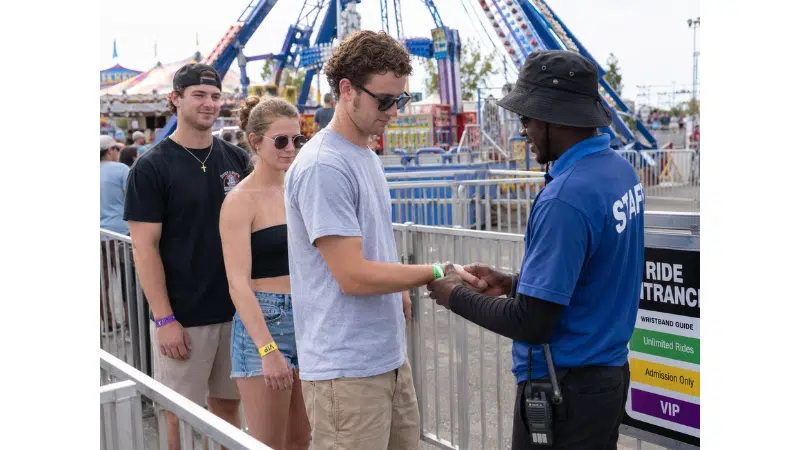
What Does a Carnival Ride Wristband Actually Prove?
A ride wristband is a wearable credential showing that a guest holds a defined ride entitlement. In the simplest case, ride staff see the band and allow the guest onto participating attractions without collecting an individual ticket each time.
The important word is defined. "Unlimited rides" still needs boundaries. It may mean all participating rides for one day, only an afternoon session, only an evening session or a selected group of attractions.
A tear-off tab solves a different problem. Each removed tab represents one predefined redemption. A digital credential solves another problem again: the visible wristband may stay the same while the platform record behind it changes.
| Credential question | Typical example |
|---|---|
| Has the guest entered? | Admission wristband |
| Does the guest have unlimited ride access? | Unlimited ride wristband |
| How many physical redemptions remain? | Tickets or tear-off tabs |
| What is the guest's current digital entitlement? | QR, NFC or RFID credential linked to a platform |
Start With the Way Rides Are Sold
The ride-sales model should be fixed before anyone chooses the wristband material or color.
| Ride-sales model | Credential starting point | Main operational question |
|---|---|---|
| Unlimited rides for one session | Clearly identified ride wristband | Can staff recognize the correct session immediately? |
| Unlimited rides for one day | Dated or color-coded ride wristband | Can staff distinguish today's band from another day? |
| Fixed number of rides | Tickets or detachable tabs | Can each redemption be counted reliably? |
| Ride credits can be added during the event | Ticketing or digital account | How is the changing balance represented? |
| Admission plus ride package | Distinct combined credential | Can staff distinguish it from admission only? |
| Several access or ride zones | Scanned credential or RFID | How are zone permissions maintained? |
| Cashless or account-linked ride spending | Integrated digital system | Which platform holds the authoritative balance? |
A static color band can show that someone belongs to a ride package. It cannot show whether that person's balance changed from twenty credits to two. Once value changes repeatedly during the day, a static visual credential becomes less useful as the source of truth.
This distinction is also why a simple school fair and a large attraction should not be pushed toward the same technology. The wider theme park wristband planning guide covers more complex attraction and access environments.
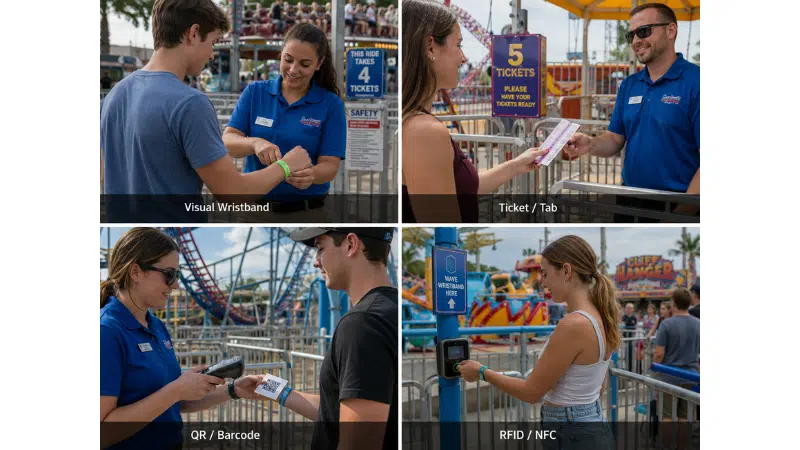
Ride Wristband, Ticket, QR or RFID?
The best choice is normally the least complex system that can enforce the actual ticket rules without creating unacceptable queue, fraud or support problems.
| Option | Works well when | Main limitation to plan for |
|---|---|---|
| Visual wristband | Entitlement is static and staff need rapid visual checks | Cannot show a live balance or canceled backend status |
| Ticket or tear-off tab | The guest receives a fixed number of simple redemptions | Frequent top-ups or different ride values can complicate physical counting |
| QR/barcode | A scan can check a unique digital record and camera/scanner presentation is practical | Scanning speed, screen or print quality, lighting, network and duplicate presentation need testing |
| NFC/RFID wristband | Repeated electronic validation, live permissions, replacement or account-linked workflows justify dedicated infrastructure | Readers, software, integration, data and support processes become part of the project |
NFC is one branch of contactless RFID technology rather than a synonym for every RFID system. The NFC Forum describes NFC as operating at a base frequency of 13.56 MHz with very short-range interaction. Buyers who need a deeper technical comparison can review the difference between RFID and NFC and the NFC Forum technical overview. :contentReference[oaicite:7]{index=7}
Make Unlimited Ride Wristbands Easy to Recognize
Ride staff should not need to study a narrow band for several seconds while a queue grows. Operational information needs to win over decorative detail.
A useful visual system may combine:
- a distinct color or pattern;
- large wording such as UNLIMITED RIDES;
- event date;
- day or session;
- package type;
- a sequential number where stock tracking is useful; and
- a scannable or electronic credential when visual verification is not enough.
Color works best as a shortcut rather than the entire security model. For example, blue could represent Friday and yellow Saturday, but that convention should not be reused at the midway so that yellow suddenly means unlimited rides.
A simple rule is more useful than a complicated color chart: within the same checking context, one visual cue should have one clear meaning.
When sequential numbers are added, they only improve control if someone records the ranges that were received, allocated, issued, voided and returned. The guide to numbered wristbands for events explains that distinction in more detail.
Choose Material and Closure From Ride-Day Conditions
Ride wristbands may be worn more actively than a simple admission ticket. Guests can spend hours outdoors, perspire, handle food and drinks, use water attractions and move repeatedly through checkpoints.
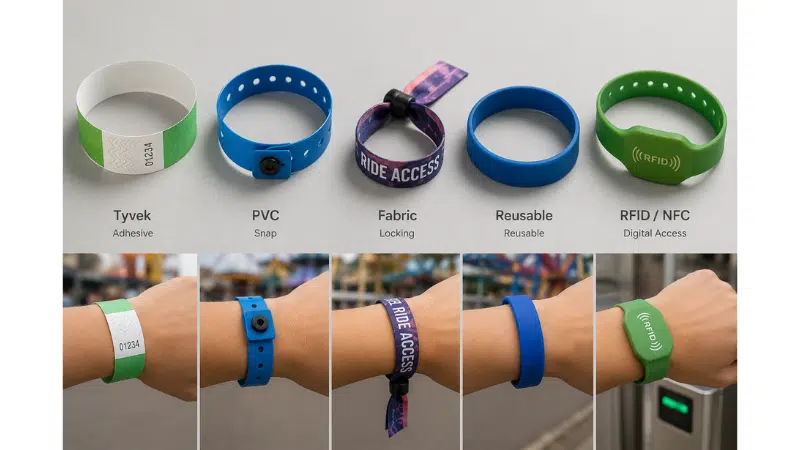
| Format | Practical starting use | Closure or construction question | What to verify on the finished sample |
|---|---|---|---|
| Tyvek-style disposable band | Short, controlled ride sessions or single-day events | Adhesive or other single-use closure | Fit, adhesive behavior, printing and expected moisture exposure |
| PVC/plastic-type band | More demanding outdoor or wet use | Snap or product-specific closure | Comfort, closure, print durability and water exposure |
| Fabric wristband | Multi-day or premium events | Locking or event-specific closure | Continuous comfort, transfer policy, branding and wear |
| Reusable silicone or removable format | Recurring venue programs | Reusable/removable construction | How sharing and account reassignment are controlled |
| RFID/NFC-enabled format | Electronic ride access or live-status applications | Physical closure plus electronic credential | Reader compatibility, on-wrist performance and platform workflow |
DuPont describes Tyvek as a synthetic material made from high-density spunbound polyethylene fibers and notes properties including low weight, durability and resistance to water and abrasion. Those base-material properties do not prove that every finished event band has identical performance; adhesive, perforation, printing and construction still matter. See the DuPont Tyvek material overview and Syntek's explanation of what Tyvek material is. :contentReference[oaicite:8]{index=8}
For more demanding constructions, compare relevant PVC RFID wristbands. Multi-day organizers can also review custom cloth wristbands for festivals and concerts. Recurring venues should evaluate the different control implications of reusable versus disposable wristbands.
Re-Entry Changes the Credential Risk
A wristband that is checked once and never used again carries a different operational risk from one that allows repeated return or several days of ride access.
| Re-entry model | Main question | Possible control direction |
|---|---|---|
| No re-entry | Does the band only need to show that admission and the ride package were issued? | Simple visual credential may be sufficient |
| Same-day re-entry | Must the original band still be attached, or is a scan required? | Clear intact-band policy or unique scan |
| Multi-day validity | How are the correct days and package status checked? | Date/session marking or digital status |
| Lost credential | Can the original be canceled before replacement? | Controlled support record or digital revocation |
| Damaged or removed credential | What evidence is required before a replacement is approved? | Written replacement rule |
When the organizer needs live status, cancellation or controlled zone permissions, relevant RFID access control wristbands can be evaluated only after the reader and platform requirements are known.
Control Issuance, Serial Ranges and Replacements
A well-designed wristband can still fail operationally when valuable credentials are handed out loosely or replacement decisions vary by staff member.
A practical issuance flow is:
- Validate the package. Confirm admission only, unlimited rides, fixed rides or another entitlement.
- Select the correct credential. Match the approved day, session and package rather than improvising a color substitution.
- Apply the band where required. If the closure is intended to discourage transfer, a controlled staff application is more meaningful than giving the band to the guest loose.
- Check fit and visibility. The credential should remain wearable and easy for ride staff to inspect.
- Explain the validity rule. The guest should know when it expires, whether re-entry is allowed and where problems are handled.
- Record exceptions. Misapplied, damaged and replacement credentials should follow the same process across shifts.
Serial control does not need to become complicated accounting. It does need enough traceability to explain where valuable stock went.

| Status | What it means | Useful record |
|---|---|---|
| Received | Stock accepted from production | Total quantity or serial range |
| Allocated | Stock issued to a gate, desk or shift | Station and range/quantity |
| Issued | Credential applied or assigned to a guest | Package or account reference where needed |
| Void | Misprinted, damaged, misapplied or canceled | Reason and serial where available |
| Replacement | New credential issued after an approved exception | Old and new credential references |
| Returned | Unused stock returned after the shift | Quantity or remaining range |
| Missing | Unexplained difference | Exception requiring review |
One practical principle is especially important for digital credentials: a legitimate replacement should not leave the support desk with both the old and new credential active unless the event deliberately allows that behavior.
How Many Carnival Ride Wristbands Should You Order?
Total attendance is not automatically the correct quantity for every ride credential.
Consider a hypothetical planning example:
- expected fair attendance: 10,000;
- admission-only guests: 5,500;
- unlimited-ride packages: 3,500;
- staff, vendors and other credentials: planned separately.
The appropriate planning base for unlimited ride wristbands is the 3,500 expected ride packages, not all 10,000 visitors.
Then add the categories the event genuinely needs to cover:
Planned ride-band quantity = forecast ride packages + day/session variants + approved role or size variants + expected application errors + authorized replacements + controlled contingency stock.
There is no defensible universal spare percentage for every carnival. A documented contingency calculation is more useful than repeating an arbitrary industry number.
When Does RFID Add Enough Value?
RFID is most useful when the ride credential needs a live system status rather than only a visible meaning.
| Operational need | Potential RFID/NFC value | Lower-complexity alternative |
|---|---|---|
| Simple one-session unlimited rides | Often limited | Well-designed visual wristband |
| Repeated electronic ride validation | Rapid credential lookup where the system supports it | QR/barcode if scanning workflow is acceptable |
| Package upgrades during the event | Backend permissions can potentially change without replacing the physical band | Issue a new visual credential |
| Lost credential cancellation | Old credential can potentially be disabled in the connected system | Manual replacement log where risk is lower |
| Several controlled zones | Central permission rules | Different staffed visual credentials |
| Cashless or stored-value account | Credential can interact with a compatible transaction platform | Card, mobile or separate payment method |
The word potentially matters. These functions come from the complete implementation rather than from an RFID chip by itself.
NIST's RFID guidance treats RFID security and operation as a system-level problem involving implementation and operational controls, not merely the presence of a tag. That is a useful model for carnival projects as well: the wristband, reader, application, database, network and staff procedure have to support the intended workflow together. See NIST SP 800-98. :contentReference[oaicite:9]{index=9}
If RFID is justified, use the actual project requirements to select the credential rather than choosing by appearance. Syntek's guide to choosing the right RFID wristband provides a broader selection framework. Projects carrying access rights or account-linked information should also consider RFID data security.
Test the Ride Credential Before Opening Day
Artwork approval is not operational approval. A production-equivalent sample should be tested through the same journey a guest and staff member will follow.
| Area | What to test |
|---|---|
| Visual recognition | Can ride staff distinguish package, day and session quickly while the band is worn? |
| Fit and closure | Does the intended wrist size and closure behave correctly during normal movement? |
| Outdoor exposure | Does the finished credential remain usable under expected rain, sweat or water-attraction exposure? |
| Tabs | Do they detach as intended without damaging the remaining credential? |
| Serials/QR | Are unique values readable, correctly printed and mapped to the intended record? |
| RFID/NFC | Does the production-equivalent band work with the actual reader, software and permissions? |
| Wrong package | Does the staff or system reject a credential that should not enter the ride or zone? |
| Re-entry | Does the second presentation follow the written rule? |
| Replacement | Can the old credential be handled correctly and the new credential receive the intended rights? |
| Failure mode | What do staff do if the scanner, reader, network or terminal is unavailable? |
More complex electronic deployments should use a documented acceptance process. Syntek's guide to RFID system testing covers that system-level approach, while quality inspection equipment is relevant when discussing production and batch verification.
What Affects Cost and Production Time?
A useful procurement article should not publish a made-up universal MOQ, unit price or lead time. Those values depend on the final specification and current supplier conditions.
The project becomes more complex when it requires more of the following:
| Specification driver | Why it matters |
|---|---|
| Material and closure | Different constructions involve different production and assembly processes |
| Multiple day/session colors | More artwork versions and controlled packing are required |
| Custom printing | Artwork method and print area affect preparation |
| Sequential numbers | Variable data must be generated and checked |
| QR/barcodes | Unique data generation, print quality and mapping need control |
| RFID/NFC chip and encoding | Chip selection, data preparation and compatibility testing are added |
| Production-equivalent sample | Approval adds a project step but can expose errors before mass production |
| Controlled packaging | Sorting by date, package, station or serial range adds traceability work |
| Late ticket-rule or artwork changes | Previously approved files or production steps may need revision |
Custom printing, encoding, variable data and controlled packaging requirements can be discussed through Syntek's OEM and ODM production service.
Pre-Production Checklist for Carnival Ride Wristbands
Before the order is released, the organizer and supplier should be able to answer the following:
- What exactly does each ride credential authorize?
- Is it valid for one day, one session, multiple days or selected attractions?
- Which guests receive admission only and which receive ride access?
- What material and closure are being ordered?
- What wrist sizes or age groups must be accommodated?
- Which colors, dates and package names appear on each version?
- Are sequential numbers, QR codes or other variable data required?
- If RFID/NFC is used, what exact reader and platform will verify it?
- How will re-entry work?
- What makes a damaged or lost wristband eligible for replacement?
- How will unused, voided and replacement stock be reconciled?
- What production-equivalent sample must pass before mass production?
- How should separate days, sessions or serial ranges be packed?
- What is the approved delivery date based on the final specification?
Common Carnival Ride Wristband Mistakes
Making Admission and Unlimited Rides Look Too Similar
If ride operators repeatedly have to read tiny text to decide whether a guest has ride access, the credential design is creating unnecessary work.
Finalizing Colors Before Ticket Packages
Colors should represent approved ticket rules, not become the rules themselves.
Calling Every Disposable Closure "Tamper-Proof"
Physical closure behavior varies. Claims such as tamper-evident, single-use or transfer-resistant should match the actual finished construction and issuance process.
Giving Valuable Credentials Out Loose
If the band is meant to link a ride entitlement to the wearer, uncontrolled distribution weakens that purpose.
Using RFID Because It Sounds More Advanced
A one-day unlimited-ride program may be easier to operate with a strong visual system. RFID is justified by the workflow it enables, not by the word RFID on the specification.
Replacing a Credential Without Controlling the Old One
A replacement process should consider whether the original can still be presented successfully and how that risk is controlled.
FAQ
Q: Is PM980 fiber only for 980 nm?
A: No. It depends on the specific fiber. Coherent currently specifies PM980-XP for 970–1550 nm, although several optical parameters are specified at 980 nm because that is its principal design region. :contentReference[oaicite:18]{index=18}
Q: Can PM980 fiber be used at 1064 nm?
A: It can when the selected fiber and finished assembly are qualified at 1064 nm. The operating range, MFD, PER requirement, splice target, power, connector, and other components still need to be checked.
Q: Is 1060 nm PM fiber the same as 1064 nm PM fiber?
A: Not automatically. They are often covered by the same 1 µm fiber family, but the actual operating range must include the laser wavelength and bandwidth. Fibercore's current standard PM range includes an HB1000 family intended for the 1 µm region. :contentReference[oaicite:19]{index=19}
Q: Can a PM1550 fiber be used at 980 nm?
A: It should not be assumed. A fiber optimized for the 1550 nm region can be below its intended cutoff regime at 980 nm. Check the manufacturer's cutoff and operating range first.
Q: Can I calculate 1550 nm beat length directly from a 633 nm datasheet value?
A: Only as a rough conceptual estimate under simplifying assumptions. Because birefringence itself can vary with wavelength, a simple wavelength ratio should not be presented as the guaranteed beat length at another wavelength. :contentReference[oaicite:20]{index=20}
Q: Can one PM cable carry both 980 nm and 1550 nm?
A: Potentially, if the bare fiber and the complete cable assembly are qualified for both wavelengths. The connected WDM, coupler, isolator, coating, connectors and polarization requirements must also be checked independently.
Q: What Is An Unlimited Ride Wristband?
A: It is a credential showing that the wearer has a defined unlimited-ride entitlement, such as one session or one day, according to the carnival's ticket rules.
Q: Are Ride Wristbands Better Than Individual Carnival Tickets?
A: They are particularly useful for simple unlimited-ride packages because staff can perform repeated checks without collecting a ticket every time. Tickets or digital credits may be more flexible when the number or value of rides changes.
Q: Can One Wristband Cover Both Admission And Rides?
A: Yes, when the event deliberately sells a combined package. The combined credential should remain clearly distinguishable from admission-only tickets or wristbands.
Q: Should Fair Ride Wristbands Use A Different Color Each Day?
A: They can. Different day or session colors can speed up visual checks, but the color meaning should remain consistent and important validity information should not depend on color alone.
Q: What Happens If An Unlimited Ride Wristband Breaks?
A: The answer should come from a pre-approved replacement policy. Depending on the credential value and system, staff may need proof of purchase, the damaged band, a serial/account lookup or electronic cancellation of the old credential.
Q: Are Carnival Ride Wristbands Waterproof?
A: There is no safe blanket answer for every product. Material, printing, closure and construction all affect finished performance. Test the actual product against the expected rain, sweat or water-attraction exposure.
Q: When Should A Carnival Use RFID Ride Wristbands?
A: RFID becomes worth evaluating when repeated electronic validation, changing permissions, controlled replacement, several zones or account-linked functions justify the extra readers, software and operating procedures.
Q: Can QR Codes And RFID Be Used On The Same Wristband?
A: They can be combined in some product and system designs, but whether doing so adds value depends on the intended fallback, support and verification workflow. Both identifiers must be mapped and tested correctly rather than assumed to represent the same value automatically.
Q: How Many Carnival Ride Wristbands Should Be Ordered?
A: Base the order on expected ride-package sales rather than total event attendance, then account separately for days, sessions, approved variants, application errors, replacements and controlled contingency stock.
Q: Should Ride Wristbands Have Sequential Numbers?
A: Numbering can improve stock traceability and support handling when the event records which numbers were received, allocated, issued, voided, replaced and returned. Printing numbers without a corresponding control process provides much less value.
Final Recommendation
The best carnival ride wristband is determined by the ride-sales model, not by the most advanced material or technology available.
Start with the ride package → define the entitlement → choose how staff or systems will verify it → define validity and re-entry → define replacement → choose the physical credential → test the real workflow.
A simple visual wristband can be the right choice for a one-day unlimited-ride package. Tickets or tabs can be better for fixed redemptions. QR can suit scanned digital validation. RFID or NFC becomes more valuable when the event needs live permissions, cancellation, controlled replacement, several access zones or account-linked transactions.
The credential succeeds when guests understand what they bought, ride staff can enforce it quickly, and the organizer can account for what was produced, issued, voided and replaced.
Buyers with a defined event date, package structure, quantity, material, artwork, variable-data and electronic requirements can request a sample or quotation before mass production.
Send Inquiry