


What Is an RFID Smart Card?
May 21, 2026
Leave a message

Core Components and How RFID Smart Cards Work
An RFID smart card is a credit-card-sized device that stores data on an embedded microchip and transmits it wirelessly to a reader through radio frequency energy. Unlike magnetic stripe cards that need physical swiping, or contact IC cards that must be inserted into a slot, an RFID smart card communicates the moment it enters a reader's electromagnetic field, with no alignment, no friction, and no moving parts.
Three components make this possible. The integrated circuit (IC) chip handles data storage, encryption, and processing logic. A flat copper or aluminum antenna coil receives the radio signal from the reader and harvests enough energy to power the chip. And the card body, typically injection-laminated PVC, though PET-G and wood composites are entering the market, protects both from mechanical stress and environmental exposure.
A properly laminated contactless card completes an ISO/IEC 14443-compliant transaction in under 200 milliseconds and survives years of daily pocket carry without read-range degradation.
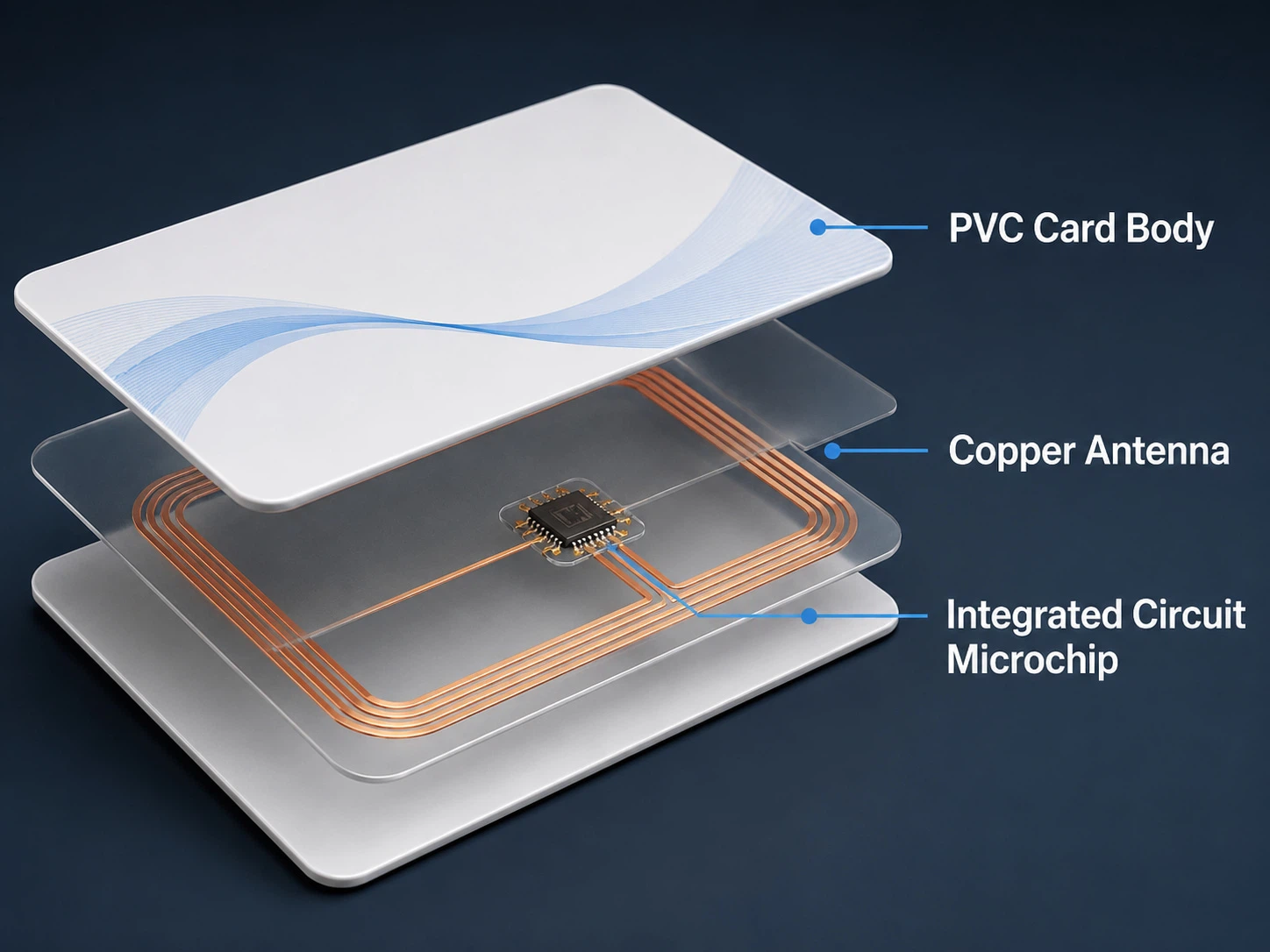
How an RFID Smart Card Communicates with a Reader
Understanding how an RFID smart card works matters because it directly determines which card type fits a given project.
When you bring a card within range of a compatible reader, the reader's antenna emits a modulated radio signal at a specific frequency. That signal serves two purposes simultaneously: it provides operating power to the card's chip (since passive RFID smart cards have no internal battery), and it initiates a data exchange protocol defined by standards like ISO/IEC 14443 or ISO/IEC 15693 (ISO).
The chip responds by modulating the reader's field, a process called load modulation, encoding its stored data into the return signal. The reader decodes this response, verifies it against its access control or payment system, and completes the transaction. The entire cycle happens without the user needing to position the card precisely, which is why contactless cards have largely displaced barcode and magnetic stripe credentials in high-throughput environments like metro stations and corporate lobbies.
RFID Smart Card Types: A Frequency-First Classification
Not all RFID smart cards are interchangeable. The single most important technical variable is operating frequency, because it determines read range, data speed, security capability, and, critically, which readers the card will work with.
| Dimension | Low Frequency (LF) 125 kHz | High Frequency (HF) 13.56 MHz | Ultra-High Frequency (UHF) 860–960 MHz |
|---|---|---|---|
| Typical read range | 3–10 cm | 1–10 cm (cards); up to 1 m (tags) | 1–12 m |
| Common chip families | EM4100, HID Prox, T5577 | MIFARE Classic, MIFARE DESFire, NTAG | Impinj Monza, NXP UCODE |
| Encryption capability | None (static ID only) | Crypto-1, 3DES, AES (chip-dependent) | Varies; limited on passive cards |
| Primary B2B use cases | Legacy access control, animal ID | Access control, transit, hotel key cards, payment | Warehouse logistics, asset tracking, supply chain |
| Card cost range (bulk, 500+ units) | $0.08–$0.25 | $0.15–$2.50 (Classic to DESFire) | $0.30–$1.50 |
Price ranges reflect Syntek production-run pricing as of Q1 2026. Market rates vary by chip availability, order volume, and customization requirements.
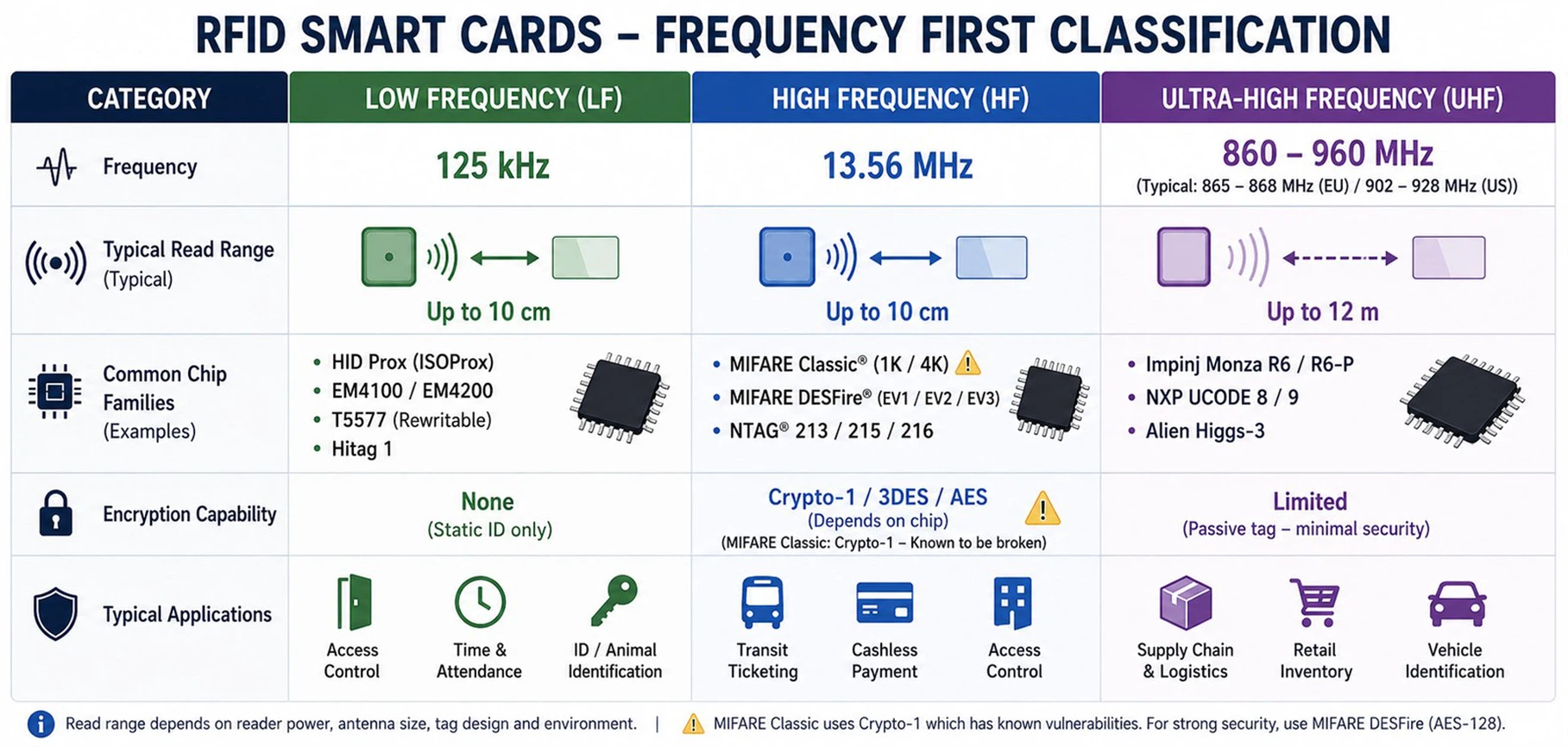
Beyond frequency, RFID smart card chip types fall into three security tiers. Memory-only cards (like EM4100) store a fixed ID number with zero encryption, readable by any compatible device. Logical encryption cards (like MIFARE Classic 1K) add password-protected sectors, though the underlying Crypto-1 algorithm has been publicly compromised since 2008. CPU cards (like MIFARE DESFire EV2/EV3) run a full microprocessor with AES-128 encryption, mutual authentication, and support for multiple isolated applications on a single card.
Our position on this is clear: for any new access control or identity project in 2026, specifying anything below DESFire-level encryption is accepting a known, documented security risk. The cost difference between a Classic and a DESFire card at volume is roughly $0.80–$1.50 per unit (based on Syntek bulk order data), a negligible premium compared to the cost of a single security breach.
RFID Smart Card vs NFC Card: A Distinction That Causes Real Procurement Failures
This is where most buyer confusion, and most expensive mistakes, originate.
NFC (Near Field Communication) is a communication protocol built on top of HF RFID at 13.56 MHz. Every NFC card is technically an RFID smart card, but not every HF RFID smart card is NFC-compatible. The difference matters most when a project requires smartphone interaction.
MIFARE Classic cards, despite operating at 13.56 MHz, use a proprietary communication frame that iPhones cannot reliably read. If a system integrator specifies Classic chips for a project that later needs mobile credential support, the entire card inventory may need replacement. MIFARE DESFire EV2 and NTAG series chips, by contrast, comply with the NFC Forum Type 4 Tag specification and work across both Android and iOS devices.
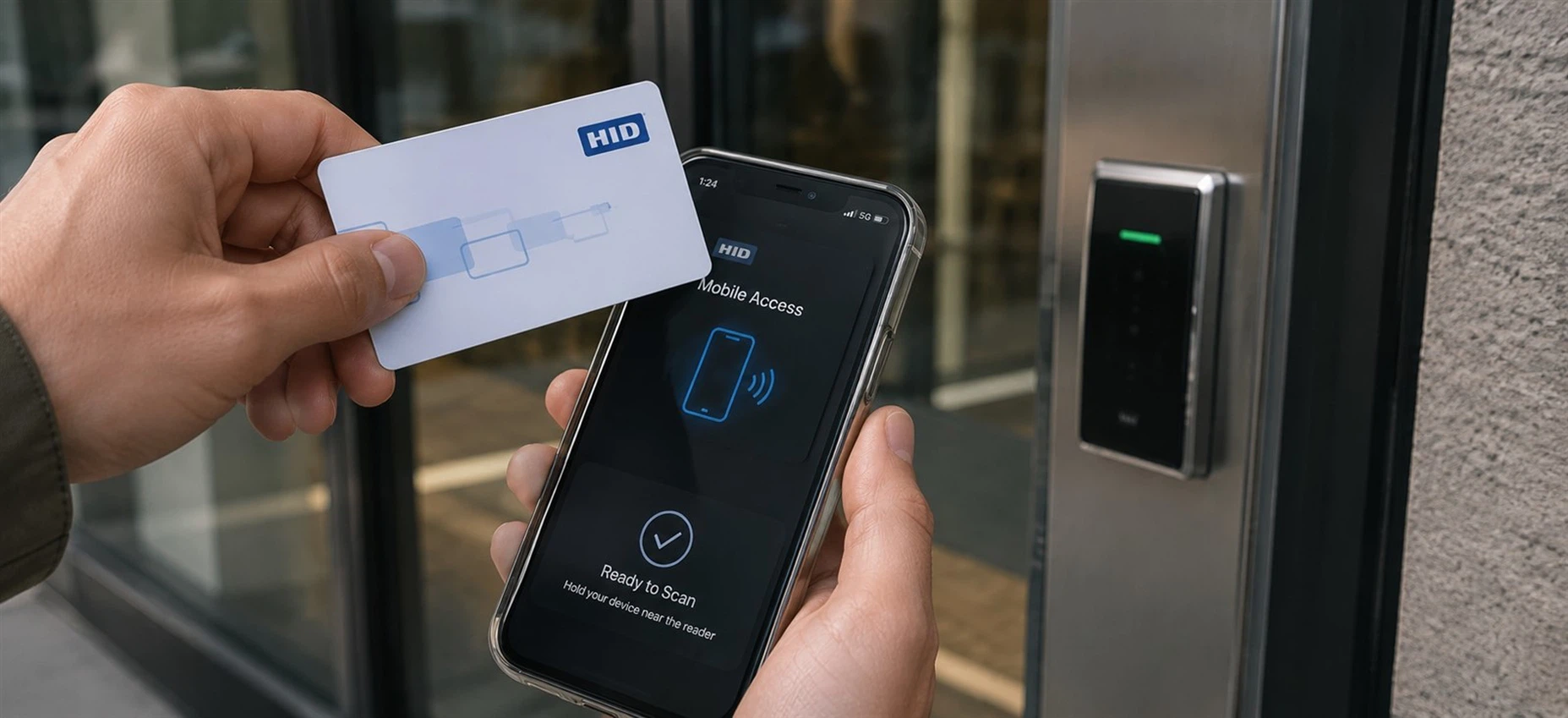
We've seen this play out with a logistics-sector client who ordered 10,000 MIFARE Classic cards for office access control. Six months in, the company rolled out a new visitor management app that required NFC phone-tap authentication at lobby turnstiles. Every Classic card in the system had to be replaced, and the re-carding cost roughly doubled the original card procurement budget, not counting the project delay. Confirming NFC Forum compliance before bulk procurement eliminates this risk entirely.
Where RFID Smart Cards Are Deployed at Scale
The global RFID market reached approximately $16.7 billion in 2025 and is projected to grow at an 11.5% CAGR through 2031 (Research and Markets). That growth is concentrated in several B2B verticals where the RFID smart card has become operational infrastructure rather than a convenience feature.
In hospitality, HF RFID smart card applications in hotels now span room access, elevator authorization, pool/spa gating, and minibar billing, all encoded on a single guest key card that's reprogrammed at each check-in.Public transit systems across Asia and Europe run on MIFARE-based fare collection, with cumulative deployments exceeding 10 billion chips worldwide (Cardzgroup). In manufacturing, companies like Bishop Cabinets have replaced error-prone barcode scanning with passive UHF RFID tags linked to ERP systems. UHF was the right frequency choice here because its 1–3 meter read range allows workers to scan large cabinet parts on shelving without physically handling each piece, something HF's 10 cm near-field limit cannot support.
For a deeper look at how RFID technology applies across industries, our breakdown of nine major RFID application scenarios covers use cases from retail anti-theft to livestock management.
RFID Smart Card Security: The Risks Most Guides Leave Out
This is the section that competing guides consistently skip, and it's arguably the most important for any buyer evaluating RFID smart card security in 2026.
The MIFARE Classic problem is not theoretical. In 2008, researchers at Radboud University publicly broke the Crypto-1 encryption used in MIFARE Classic chips, demonstrating successful card cloning via eavesdropped communication (NCBI/PMC). In 2024, Quarkslab researcher Philippe Teuwen discovered a hardware backdoor in MIFARE Classic-compatible chips manufactured by Shanghai Fudan Microelectronics (FM11RF08S), allowing instantaneous cloning of cards used in hotels across the US, Europe, China, and India (SecurityWeek).
Separately, the Unsaflok vulnerability exposed Dormakaba's Saflok RFID lock system, deployed on 3 million doors in 13,000 properties across 131 countries, to a key-forging attack that required only one expired guest keycard and a $300 read-write device (RFID Journal).
And 125 kHz proximity cards? They transmit a static, unencrypted ID number. Tools like Flipper Zero and Proxmark3 clone them in seconds. Yet millions of these cards remain in active use across corporate and residential access systems worldwide.
The mitigation path is straightforward but requires deliberate specification: deploy DESFire EV2 or EV3 chips with AES mutual authentication, implement rolling session keys, and, where budget allows, layer card-based access with a second factor such as PIN or biometric. For organizations already using vulnerable cards, our guide to RFID signal shielding provides an interim protective measure while migration planning is underway.
How to Choose the Right RFID Smart Card for Your Project
Selecting the correct card comes down to five decision variables, and three mistakes that reliably derail bulk RFID smart card procurement.
Match frequency to your reader infrastructure first. A 13.56 MHz DESFire card will not communicate with a 125 kHz proximity reader. Before specifying cards, audit every reader in the deployment scope.
Specify chip model, not just frequency. "13.56 MHz card" is not a specification. It's a frequency band that encompasses dozens of incompatible chip families. The purchase order should name the exact IC (e.g., "NXP MIFARE DESFire EV2 4K"), not a generic frequency descriptor.
Verify chip sourcing with your supplier, and insist on documentation. This is the risk most B2B buyers overlook, and in practice it's more involved than simply asking. Some manufacturers substitute lower-cost compatible chips, such as Fudan FM11RF08S, for original NXP silicon without disclosing the change. The cards look identical and pass basic read/write tests, but may carry undocumented security vulnerabilities. At Syntek, every bulk shipment includes a chip batch certificate traceable to the original IC manufacturer (NXP, Infineon, or equivalent), and we provide third-party CE/FCC test reports on request. If your current supplier cannot produce these documents, that gap alone should be a selection criterion.
The three most common procurement mistakes: ordering Classic chips for projects that will later need NFC mobile compatibility, specifying LF proximity cards for new installations where encryption is required, and accepting "equivalent chip" substitutions without verifying security certification parity. In practice, when we spec RFID smart cards for access control across an office campus, the chip choice alone can shift the total project cost by 15–40% once reader upgrades and re-carding risk are factored in.
For teams building a new system from scratch, the following default recommendations reflect what our production and application engineering teams specify most often:
| Deployment Scenario | Recommended Chip | Why This One |
|---|---|---|
| Hotel guest room cards | MIFARE DESFire EV2 (2K or 4K) | AES encryption + NFC Forum compliant for future mobile key integration |
| Corporate office access control | MIFARE DESFire EV3 (4K or 8K) | EAL5+ certified, supports multi-application (access + cafeteria + parking on one card) |
| Temporary visitor passes / parking | NTAG215 or MIFARE Classic 1K | Lower security acceptable for short-lifespan, low-risk credentials |
| Government / financial identity | DESFire EV3 + SAM module | Highest security tier with secure access module for key management |
Reader compatibility and existing infrastructure always take priority over these defaults. Lead times, customization options, and minimum order quantities for each chip type are detailed on our RFID smart card product pages.
Where the RFID Smart Card Market Is Heading
Transaction latency in newer reader-chip architectures has dropped by approximately 30%, making contactless RFID smart cards viable for high-speed throughput environments that previously required dedicated hardware (Technavio). The global smart card market, valued at approximately $65.2 billion in 2025, is projected to reach $122.8 billion by 2035, driven primarily by contactless payment expansion and government digital identity programs (Global Market Insights).
Sustainable card materials, including 100% recycled PET-G, are increasingly available from card manufacturers, meeting ESG procurement requirements without sacrificing mechanical durability. And cloud-based access management platforms allow remote credential updates, eliminating the need to physically re-encode cards when access permissions change, a meaningful operational savings for enterprise teams managing multi-site deployments.
Getting Started
The right RFID smart card isn't the cheapest one; it's the one that matches your reader system, meets your security threshold, and comes from a supplier who will tell you exactly what chip is inside it.
Syntek has manufactured RFID cards since 2006, with ISO 9001 and CE certified production, full chip traceability from IC sourcing through final lamination, and export coverage across North America, Europe, the Middle East, and Asia-Pacific. Whether you need blank DESFire cards for a system integrator project or custom-printed HF access cards for a hotel chain rollout, we provide free samples and technical consultation before you commit to a bulk order.
Explore Syntek's full RFID smart card product line →
Frequently Asked Questions
Q: What is the difference between an RFID card and a smart card?
A: An RFID card is a subset of smart cards, specifically the contactless type that uses radio frequency for wireless data exchange, as opposed to contact smart cards that require physical insertion into a reader.
Q: Can RFID smart cards be cloned?
A: Cards using unencrypted protocols (125 kHz proximity) or compromised encryption (MIFARE Classic Crypto-1) can be cloned with inexpensive tools. Cards using AES encryption (DESFire EV2/EV3) offer strong resistance to known cloning methods.
Q: What is the difference between RFID and NFC?
A: NFC is a communication protocol built on HF RFID at 13.56 MHz. All NFC cards are RFID cards, but not all RFID cards support NFC, a distinction that affects smartphone compatibility.
Q: How do I choose the right RFID card for my project?
A: Match frequency to your existing readers, specify the exact chip model (not just frequency), confirm NFC compatibility if mobile access is planned, and verify your supplier's chip sourcing transparency. For most new installations in 2026, MIFARE DESFire EV2 is a practical default that covers NFC compliance, AES encryption, and multi-application support without over-specifying.
Q: How long does an RFID smart card last?
A: PVC-based cards typically survive 5–10 years of daily use. The chip itself has no practical read/write cycle limit for passive cards. Lifespan depends primarily on physical wear and environmental exposure.
Send Inquiry